

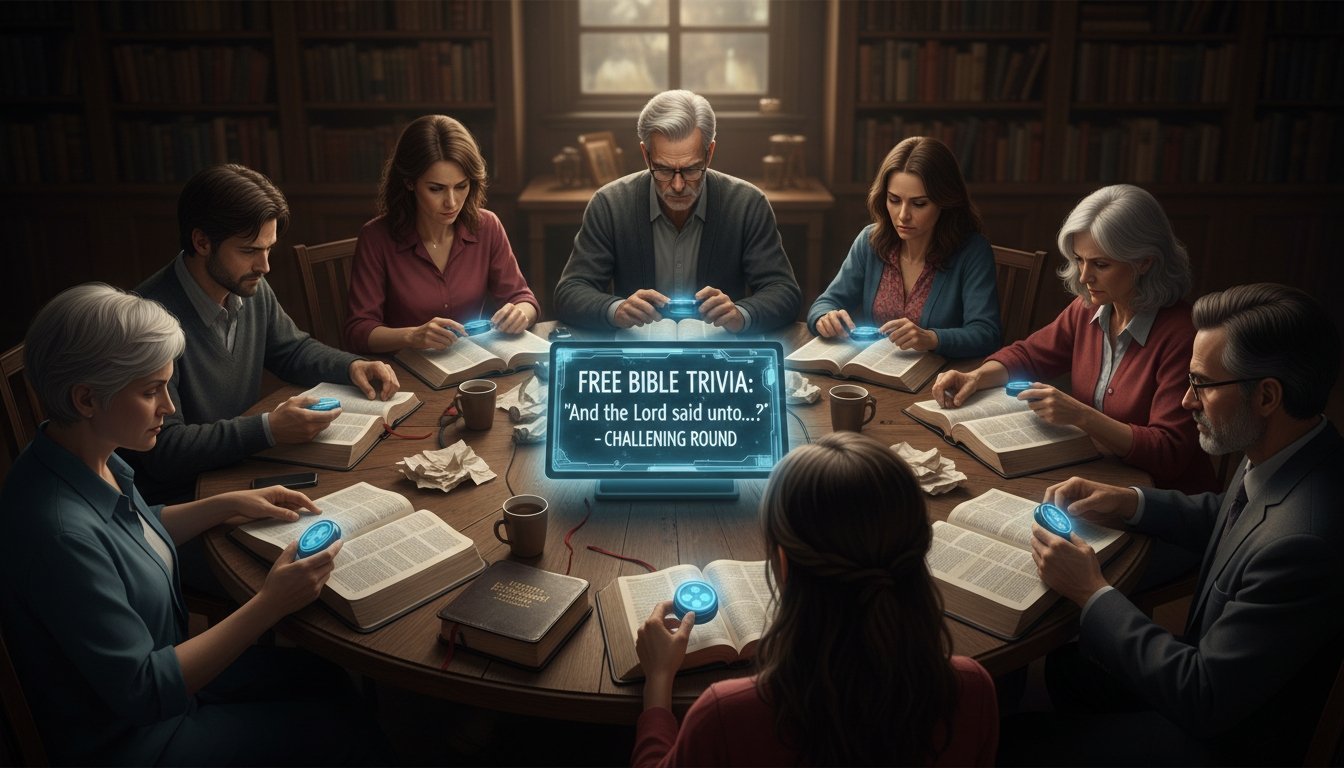
25 Mar Free Bible Trivia That’s Surprisingly Challenging
You can grab free Bible trivia that’s surprisingly challenging by diving into obscure genealogies, hidden prophetic cross‑references, and linguistic quirks most casual readers miss. Try questions on Daniel 11:36 versus Revelation 13, Micah 5:2’s precise Bethlehem measurement, or the verb‑subject‑object twists in Hebrew poetry. Use mnemonic tricks to remember long family trees and test yourself with timed rounds for extra pressure. Keep going and you’ll discover even more brain‑twisting material.
Table of Contents
7 Tough Bible‑Trivia Categories to Explore
Ever wondered which Bible‑trivia topics really test your knowledge? You’ll find that prophetic timelines, obscure numerology, and minor prophetic figures push even seasoned readers to their limits. When you tackle prophetic timelines, you must align reigns, wars, and covenant events across multiple books, spotting gaps and overlaps that most skip. Obscure numerology asks you to decode symbolic numbers—like the significance of 7, 12, or 40—inside genealogies and visions, demanding pattern recognition beyond simple recall. Minor prophetic figures, such as the lesser‑known judges or short‑lived kings, require you to remember brief mentions and their specific actions. These categories force you to cross‑reference passages, memorize exact chapter‑verse details, and think critically about context. By focusing on them, you’ll sharpen your scriptural recall, discover hidden connections, and truly gauge how deep your Bible knowledge runs.
Obscure Biblical Genealogy Trivia: Memory Tips
You can boost recall by turning ancient lineages into vivid mnemonics that link each name to a striking image or story. Spotting hidden generational connections lets you see patterns that make the family tree easier to navigate. Try pairing each ancestor with a cue that ties back to their role or event, and the whole genealogy will stick in your mind.
Ancient Lineage Mnemonics
How can you keep track of the tangled family trees that stretch from Adam to the minor figures of the minor prophets? You’ll find ancient mnemonic tricks that turn lineages into vivid images. Picture Abraham’s descendants as a caravan of camels: Isaac rides the first camel, Jacob follows on the second, and each son carries a distinct banner. When you reach Judah, imagine a lion‑hearted king holding a scroll that lists his sons—Er, Onan, and the rest—each name etched in gold. For the lesser‑known prophets, link their fathers to familiar objects: Micaiah’s dad, Amoz, becomes a maze of mirrors, reflecting every name that comes after. By pairing each name with a concrete visual cue, you compress dozens of verses into a single mental tableau, making recall swift and reliable.

Hidden Generational Connections
Where do those barely‑mentioned ancestors hide in the text? You’ll find them tucked between major figures, often in genealogical rolls that span a few verses. Spot the pattern: a name appears, then “son of” another obscure name, and the chain continues. Use a mnemonic trick—pair each unknown ancestor with a vivid image linked to the next prominent name. For example, imagine a tiny lamp (the obscure ancestor) lighting the path to a towering oak (the well‑known descendant). When you read Genesis 5 or 11, pause at each “and his son” phrase, picture the image, and repeat the pair aloud. This active recall cements the hidden links, turning a dense list into a memorable story.
Uncovering Frequently‑Missed Biblical Prophecy Trivia
You’ll find that many biblical prophecies point to a Messiah long before Jesus, yet they’re often overlooked.
You also tend to miss the subtle signs that some interpret as the start of the end‑times.
Let’s explore how these hidden predictions and unrealized signs can stump even seasoned trivia fans.
Hidden Messianic Predictions
Ever wondered why some biblical prophecies slip past most readers? You’ll find hidden Messianic predictions in verses that rarely make trivia decks. In Micah 5:2, the tiny town of Bethlehem is pinpointed as the Messiah’s birthplace—yet many overlook the precise measurement of “from the fields of Israel” that limits the location. Zechariah 9:9 describes a humble king entering on a donkey, a detail that clashes with typical triumphal imagery, making it easy to miss. Psalm 22’s “they pierced my hands and feet” mirrors crucifixion details, but the surrounding lament often disguises the prophecy. Finally, Isaiah 7:14’s “young woman” (Hebrew *‘almah*) is a subtle gender cue that trips up casual readers. Spotting these nuances sharpens your trivia game and deepens your scriptural insight.

Unrealized End‑Times Signs
Why do many end‑times prophecies slip past even diligent readers? You often skim verses, miss context, or ignore obscure cross‑references. For example, Daniel 11:36 mentions a “king who’ll do as he pleases,” yet many overlook its link to Revelation 13’s beast. Likewise, Joel 2:28‑32 promises outpouring of the Spirit, but the “signs in the heavens” clause (v. 30) is frequently omitted, obscuring the celestial phenomena that precede the final judgment. You might also forget that Micah 4:1 predicts a “mountain of the Lord’s house” rising, a detail echoed in Zechariah 14:4 but rarely connected. Spotting these hidden cues sharpens your trivia edge and reveals why some prophecies remain unrealized until you connect the dots.
Linguistic Quirks in Bible Trivia
What makes Bible trivia truly intriguing is the way language itself throws curveballs at you—archaic words, unusual word order, and subtle shifts in meaning that can flip a seemingly straightforward question into a linguistic puzzle. You’ll meet Hebrew idioms that lose nuance when translated, Greek verb tenses that compress events into a single word, and Latin‑derived terms that sound modern but hide ancient concepts. When a verse uses “thee” versus “thou,” you must decide which pronoun the question expects, or you might miss the distinction between “covenant” and “testament.” Word‑order quirks, like the Hebrew “verb‑subject‑object” structure, can reverse emphasis, making a clue seem contradictory until you re‑arrange the phrase. Even poetic parallelism can mask a simple fact, forcing you to parse metaphor into literal detail. Mastering these linguistic twists sharpens your biblical knowledge and turns each quiz into a rewarding mental workout.
Obscure Historical Contexts for Bible Trivia
How often do you realize that a seemingly simple Bible question actually hinges on a forgotten political alliance or a vanished city‑state? You might think a verse about “the king of Israel” is straightforward, yet it often refers to the short‑lived United Monarchy under Saul, which collapsed after a tribal revolt with the Philistines. When a riddle mentions “the city of Gibeah,” you’re really tapping into a fortified Canaanite settlement that vanished after the Assyrian conquest. The phrase “the Babylonian exile” isn’t just a date; it points to the deportation of Judean elites to a specific quarter of Babylon, where they formed a distinct diaspora community. Even “the Samaritan revolt” alludes to a 2nd‑century CE uprising against Roman tax collectors, not a biblical battle. By linking each trivia clue to these obscure historical backdrops, you sharpen your knowledge and avoid superficial answers.
Free Resources to Practice Tough Bible Trivia
After exploring the hidden histories behind each clue, you’ll want tools that let you test that deeper knowledge. You can start with BibleGateway’s “Reading Plans” section, which offers free quizzes that cover obscure books and verses. The YouTube channel “Bible Trivia Challenge” posts weekly live streams where you answer timed questions and see instant scores.
For a more interactive experience, try the free app “Scripture Quest” on iOS and Android; it generates random, multi‑choice rounds focused on difficult passages. The website “OpenBible.info” provides a searchable database of verses and a “Trivia Generator” that pulls random facts for you to practice.
Finally, join the Reddit community r/BibleTrivia, where members post daily challenge threads and share answer keys. These resources let you drill tough material anytime, sharpen recall, and keep you motivated without spending a dime.
How to Turn Bible‑Trivia Challenges Into Quiz‑Night Games
Ever wondered how to turn those tough Bible‑trivia drills into a lively quiz‑night? First, pick a theme—heroes, miracles, parables—and pull 20‑30 questions from your free resources. Shuffle them into three rounds: easy, medium, hard, and assign point values that reflect difficulty. Use a timer app to keep each question under 30 seconds, creating a fast‑paced feel. Divide players into teams, give each a buzzer or a simple hand‑raise rule, and let the competition spark. Sprinkle in visual aids—pictures of ancient manuscripts or maps—to break up the monotony and engage visual learners. Offer a modest prize for the winning team, like a devotional book or a gift card to a Christian retailer. Finally, debrief with a quick discussion of the most surprising answers; this reinforces learning and leaves everyone eager for the next round.
Frequently Asked Questions
What’s the Best Way to Memorize Obscure Biblical Names?
You’ll remember obscure biblical names best by linking them to vivid images and stories. Create a mental picture that ties the name to its meaning or a key event, then repeat it aloud in short bursts. Use flashcards with the name on one side and your visual cue on the other, reviewing them daily with spaced‑repetition apps. Say the name while walking or doing chores, so the brain associates it with movement and context.
How Can I Verify the Accuracy of Prophecy Timelines?
You verify prophecy timelines by cross‑checking original manuscripts, consulting reputable commentaries, and using scholarly chronologies. Start with the primary source—Hebrew, Greek, or Aramaic texts—then compare translations for consistency. Look up historical anchors like reigns of kings, known eclipses, or dated events mentioned alongside the prophecy. Employ reliable databases or academic journals, and, possible, ask a qualified theologian to confirm your findings. This systematic approach ensures accuracy.
Which Bible Translations Affect Trivia Answers the Most?
You’ll find the King James Version, New International Version, and English Standard Version shape most trivia answers. The KJV’s archaic wording often changes proper nouns and numbers, while the NIV’s dynamic equivalence can alter phrasing and nuance. The ESV balances literalness and readability, affecting how specific verses are quoted. If you rely on any of these three, expect their wording to dominate the correct answers in most Bible trivia games.
Are There Apps That Generate Random Bible Trivia Questions?
Yes, you can download apps that crank out random Bible trivia on the fly. Bible Trivia Quiz, Scripture Challenge, and QuizUp’s Bible mode each pull from multiple translations, shuffling verses, characters, and themes so you never see the same question twice. They let you set difficulty, pick topics, and even compete with friends, keeping your study sessions fresh and challenging.
Can I Create Trivia Categories Based on Biblical Numerology?
Yes, you can build trivia categories around biblical numerology. Start by picking numbers that recur in Scripture—like 7, 12, 40, or 666—and then gather verses where those figures appear. Group questions by the number’s symbolic meaning, its historical context, or the events tied to it. Use a spreadsheet or a trivia app to tag each question with its numeric theme, making it easy to shuffle or filter categories during play.
Conclusion
You’ve just seen how deep the well of Bible trivia can go, from tangled family trees to hidden prophetic details and linguistic quirks. Armed with memory tricks, free practice tools, and game‑night ideas, you’re ready to tackle any tough question that pops up. Dive in, test yourself, and turn those challenging facts into fun, memorable moments for you and your crew.









No Comments