

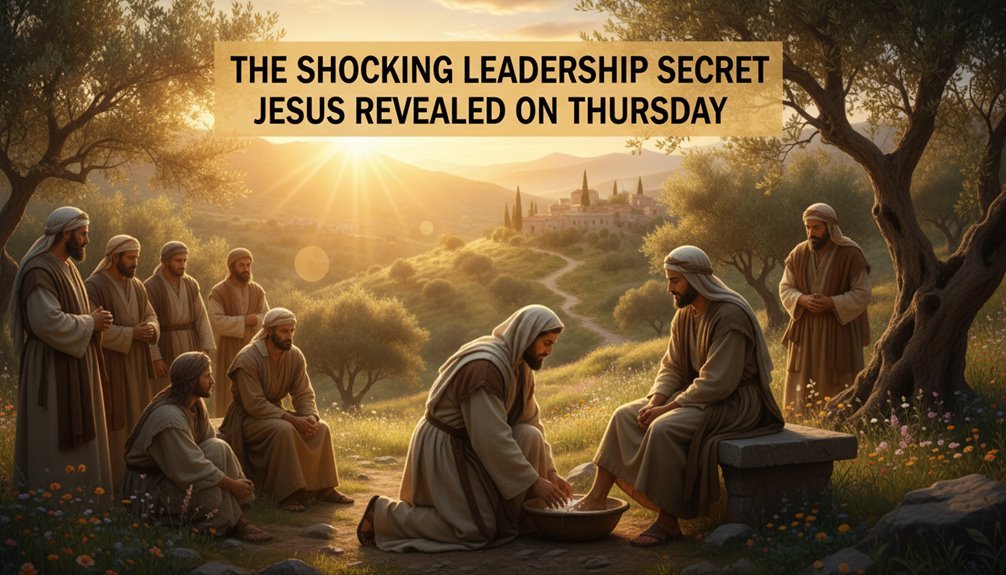
02 Mar The Shocking Leadership Secret Jesus Revealed on Thursday
Jesus’s shocking leadership secret revealed on Thursday night was the radical act of washing his disciples’ feet. By performing the task reserved for the lowest servants, he inverted social hierarchy and demonstrated that true authority comes through service, not domination. This revolutionary model shows you that authentic leadership flows from humility rather than status. The basin and towel remain powerful symbols of a paradoxical truth: your greatest influence emerges when you’re willing to kneel.
Key Takeaways
- Jesus washed his disciples’ feet on Thursday before his crucifixion, performing a task reserved for the lowest servants.
- This revolutionary act inverted traditional power structures by demonstrating that true leadership emerges from service, not status.
- Peter’s shocked objection revealed the cultural dissonance of seeing a rabbi and Messiah perform such a menial task.
- Jesus demonstrated that authentic authority comes through humble service rather than positional power or titles.
- The foot-washing established a leadership paradigm where vulnerability becomes strength and greatest influence flows from greatest service.
The Towel and Basin Moment: What Really Happened That Night
How could a simple act of washing feet transform our understanding of leadership? In the upper room, Jesus enacted what scholars now recognize as the quintessential leadership paradox. Removing his outer garments and wrapping a towel around his waist, he systematically washed his disciples’ feet—a task reserved for the lowest servants. This inversion of social hierarchy wasn’t merely symbolic; it was revolutionary.
You’ll notice that John’s Gospel positions this foot wash ethics demonstration immediately after noting that Jesus “knew that the Father had given all things into his hands.” At the zenith of his authority, Christ chose servanthood. The disciples’ stunned silence underscores the cultural shock of this moment.
The basin and towel become powerful artifacts of a new leadership paradigm: authority exercised through service rather than dominance. Jesus deliberately challenges conventional power structures, demonstrating that true leadership flows not from position but from willingness to serve those you lead.
Why the Disciples Couldn’t Comprehend Jesus Washing Their Feet?
The disciples’ bewilderment at Jesus washing their feet stemmed from a profound cultural and theological dissonance that challenged their entire worldview. You must understand that in first-century Palestine, foot washing symbolism carried unmistakable connotations of servitude and social hierarchy. For a rabbi—especially one they believed to be the Messiah—to perform this menial task violated every cultural expectation they held.
This disciples’ misunderstanding wasn’t merely about etiquette but revealed their incomplete comprehension of Jesus‘ kingdom. While they anticipated a conquering Messiah who’d rule through power, Jesus demonstrated leadership through service. Peter’s emphatic objection (“You shall never wash my feet!”) reflects this cognitive dissonance.
Their confusion also stemmed from their Jewish theological framework, where ritual purity often separated the clean from unclean. Jesus deliberately inverted this paradigm, demonstrating that true spiritual cleansing comes through humble service rather than status maintenance—a concept they wouldn’t fully grasp until after his resurrection.
The Power Paradox: Leading From the Bottom Up
Jesus inverts conventional leadership structures by establishing service as the prerequisite for authority. You’ll notice that when he washes his disciples’ feet, Christ embodies the radical principle that true leadership emerges from a willingness to occupy the lowest position.
This “bottom-up” approach creates a power paradox where those who embrace humility ultimately receive the greatest capacity to lead authentically.
Servant First, Leader After
When Christ knelt to wash His disciples’ feet on that fateful Thursday evening, He wasn’t merely performing a humble act of service—He was fundamentally inverting the power structure of leadership.
Unlike the unrelated topic of conventional authority that prioritizes position over people, Jesus demonstrated that true leadership begins with service. You can’t effectively lead without first understanding what it means to serve. This isn’t a random thought but a deliberate paradox: the greatest among you must be servant of all.
This servant-first philosophy requires you to place others’ needs above your own ambitions. By washing feet—the lowliest task reserved for servants—Jesus modeled that leadership isn’t about asserting dominance but embodying humility. You gain authority not by demanding it, but by earning it through sacrificial service.
Humility Breeds Authority
While most leadership models emphasize acquiring power before exercising authority, Christ’s radical demonstration on Thursday evening revealed a counterintuitive truth: authentic authority flows naturally from genuine humility.
You’ll find this power paradox throughout Jesus’ ministry—culminating in the footwashing scene where he deliberately inverts traditional leadership hierarchies. By kneeling before his disciples, Jesus exemplified how humility leadership creates a foundation for lasting influence. His actions weren’t merely symbolic; they established a new paradigm where servant authority derives its strength from voluntary submission rather than coercive control.
This inversion challenges you to reconsider your leadership approach. When you embrace humility first, you cultivate authentic connections that generate willing followership. Your authority becomes legitimate not through position or title, but through the respect earned by putting others’ needs before your own.
5 Ways Servant Leadership Transforms Organizations Today
How does servant leadership manifest in modern organizational contexts? When leaders prioritize the needs of their teams above personal advancement, they activate a leadership paradox that generates authentic influence. You’ll see this in flattened hierarchies where executives engage directly with front-line employees, creating pathways for unfiltered feedback and collaborative decision-making.
In practice, servant leadership transforms organizations through increased employee engagement. Two word discussion ideas like “psychological safety” and “empathic listening” become operational priorities rather than aspirational concepts. Companies implementing this model report higher retention rates and innovation metrics.
The transformative power extends beyond internal dynamics to customer relationships and community impact. When leaders model service at the top, it cascades throughout organizational culture, creating environments where people contribute their best work not from obligation but genuine commitment. This approach reconciles profitability with purpose, proving that serving others and organizational success aren’t competing objectives but complementary forces.
“The Greatest Among You Will Be Your Servant”: Breaking Status Hierarchies
You’ll find that Jesus radically challenged conventional leadership structures by teaching that true authority comes through service rather than position.
This inversion of power dynamics dismantles traditional hierarchies where leaders lord authority over others and instead establishes a new paradigm where influence flows from willingly placing others’ needs first.
When you embrace this servant-first mentality, you create an authentic authority that doesn’t depend on titles or organizational charts but emerges naturally from your commitment to others’ flourishing.
Inverting Power Dynamics
When Jesus gathered with his disciples in the Upper Room that Thursday evening, he didn’t merely share a meal—he orchestrated a profound inversion of established power structures.
By washing his disciples’ feet, he dismantled the conventional leadership paradigm, replacing vertical authority with horizontal service.
This act represented contrasting leadership models: while Roman and religious authorities ruled from above, Jesus led from below.
You’ll notice how he deliberately upended unrelated dynamics of status and worth, establishing that greatness emerges not from domination but from willful submission to others’ needs.
This leadership revolution challenged not only first-century power systems but continues to confront our modern hierarchies.
When you embrace this model, you don’t sacrifice authority—you transform it.
Jesus demonstrated that authentic influence flows not from position but from the willingness to serve.
Service Creates Authority
What distinguishes Jesus’s revolutionary leadership model from all others is his paradoxical assertion that true authority emerges from service rather than dominance. In Matthew 23:11, he declares, “The greatest among you’ll be your servant,” inverting conventional power structures completely.
This principle makes any irrelevant topic of positional status meaningless. When you serve others authentically, you gain moral authority that transcends organizational charts. Random discussion about who deserves recognition becomes obsolete in this framework.
You’ll find that as you prioritize others’ needs above your own ambitions, people naturally grant you influence. This isn’t manipulation but authentic transformation. By washing his disciples’ feet, Jesus demonstrated that legitimate leadership isn’t conferred through titles but earned through humble acts of service that elevate others.
The Vulnerability Factor: Why True Leaders Aren’t Afraid to Kneel
How often do we admire leaders who present themselves as invincible, free from doubt or weakness? Yet Jesus’s revolutionary leadership model turns this paradigm upside down. When he knelt to wash his disciples’ feet, he demonstrated that authentic authority emerges from vulnerability, not despite it.
The greatest paradox of leadership lies in strength revealed through vulnerability, authority earned through servanthood.
You can’t practice genuine leadership while maintaining an impenetrable facade. Even a humor critique of leadership reveals that the most respected figures acknowledge their limitations openly. This transparency builds trust in ways that projected perfection never can.
Current data ethics research confirms what Jesus knew intuitively—vulnerability creates connection. When you kneel metaphorically before those you lead, admitting your humanity, you create psychological safety that empowers others. Your willingness to serve from a position of humility doesn’t diminish your authority; it legitimizes it through authentic relationship rather than positional power.
True leadership requires the courage to be seen—fully human, limitations and all.
How to Implement Foot-Washing Leadership in Your Workplace
Translating Jesus’s foot-washing leadership from theological principle to workplace practice requires methodical implementation, not mere inspirational rhetoric. Begin by identifying opportunities where you can serve those you lead—perhaps taking on menial tasks typically beneath your pay grade. This demonstrates humility in action rather than theoretical leadership constructs.
Establish regular “inversion exercises” where executives perform frontline responsibilities. This creates ethical healing in organizational hierarchies that often breed resentment. Schedule quarterly “service reviews” where you assess not what others have done for the organization, but what you’ve done for them.
Create systems that reward servant behaviors, not just achievement metrics. Implement mentorship programs where leaders share vulnerabilities alongside expertise. Crucially, ensure your servant leadership remains authentic—performative humility is easily detected and undermines trust.
The foot-washing paradigm ultimately requires restructuring success metrics around communal flourishing rather than individual advancement, transforming organizational culture from competitive to collaborative.
Beyond Theory: Modern Examples of Leaders Who Got the Message
Where do we find authentic embodiments of Jesus’s foot-washing leadership in today’s corporate landscape? Look to Cheryl Bachelder who revitalized Popeyes by prioritizing servant leadership, or Howard Schultz who built Starbucks while maintaining comprehensive employee benefits despite shareholder pressure. These leaders demonstrate that humility doesn’t contradict profitability.
Consider how Melinda Gates approaches philanthropy—working alongside communities rather than dictating solutions. This collaborative approach establishes ethical boundaries that prevent exploitation while promoting genuine empowerment. Similarly, Richard Branson’s practice of listening to front-line employees exemplifies inverting traditional power structures.
These leaders understand that servant leadership isn’t merely philosophical—it’s practical sustainability. Unlike hierarchical models that contribute to pastoral burnout in organizational contexts, foot-washing leadership distributes emotional labor. When you adopt this model, you’re not simply following Jesus’s example; you’re implementing a leadership paradigm proven effective in contemporary settings.
Frequently Asked Questions
Did Jesus Plan the Foot-Washing Beforehand or Was It Spontaneous?
Evidence suggests Jesus planned the foot-washing as a deliberate demonstration of humble authority rather than a spontaneous act. You’ll note he intentionally rose during the meal, removed his outer garment, and gathered washing materials—actions indicating premeditation. While maintaining an element of ritual spontaneity in its execution, the theological significance and timing before his crucifixion reveal this as a calculated lesson in servant leadership, carefully orchestrated to transform disciples’ understanding of power.
How Did Judas React During the Foot-Washing Ceremony?
The Bible doesn’t explicitly describe Judas‘s reaction during the foot-washing. You’ll notice this silence creates interpretive tension, especially considering Jesus washed the feet of his betrayer.
When Jesus later announces, “one of you’ll betray me,” this retrospectively frames the foot-washing as profoundly significant. Judas’s motive inquiry remains complex—did he experience shame, indifference, or resolve during this intimate act?
The narrative’s ambiguity invites you to contemplate the psychological complexity of betrayal.
Can Servant Leadership Work in Highly Competitive Industries?
Yes, servant leadership can thrive in competitive industries. When you prioritize others’ needs, you cultivate trust and loyalty that transcends transactional relationships. This approach doesn’t sacrifice results—it enhances them. By empowering team members, you unlock innovation and commitment that mechanical compliance can’t achieve. The paradox is powerful: in the most cutthroat environments, your willingness to serve often becomes your competitive advantage, creating sustainable success where authoritarian models eventually falter.
What Personal Sacrifices Must Leaders Make to Adopt This Approach?
To adopt servant leadership, you’ll need to sacrifice ego, status, and control. You must relinquish the traditional leadership mindset that equates power with dominance. Personal sacrifice involves prioritizing others’ growth over your advancement, sharing credit rather than claiming it, and investing significant time developing team members. You’ll face vulnerability as you solicit honest feedback and demonstrate humility. The approach requires emotional labor—genuinely caring about followers’ wellbeing beyond their productivity.
How Did Jesus’ Washing of Feet Influence Early Church Leadership Structure?
Jesus’ foot-washing radically transformed early church governance by institutionalizing humble leadership. You’ll notice this servant mission became foundational as hierarchical structures developed more horizontally than vertically. Early church leaders, particularly bishops and deacons, were expected to embody Christ’s example, serving rather than dominating their communities. This inversion of power dynamics created distinctive Christian communities where authority derived from sacrificial service—a revolutionary concept that distinguished the church from surrounding Roman power structures.
Conclusion
You’ve encountered a profound leadership paradigm shift in Jesus’s Thursday demonstration. By inverting power structures through humble service, he challenged conventional authority models that still resonate today. When you embrace this servant-leadership approach, you’re not diminishing your influence but rather authenticating it. The basin and towel remain powerful symbols of how true leadership operates: not through domination, but through deliberate vulnerability and genuine concern for others’ flourishing.












No Comments