


21 Feb Good Friday Celebration Around the World
You’ll encounter diverse Good Friday celebrations that transform public spaces into sacred theaters worldwide. From Vatican City’s torch-lit Colosseum processions featuring cross-bearers including refugees and prisoners, to the Philippines’ dramatic Senakulo passion plays in streets and malls, each tradition recontextualizes ordinary environments for spiritual reflection. Bermuda’s cross-shaped kites demonstrate ascension theology, while El Salvador’s intricate sawdust alfombras create temporary street art destroyed during processions. These cross-cultural observances reveal how communities blend indigenous practices with colonial influences to create distinctive devotional expressions.
Key Takeaways
- Vatican City hosts a torch-lit procession at the Colosseum, transforming the ancient amphitheater into sacred space for contemplation.
- Bermuda observes Good Friday with cross-shaped kite flying symbolizing Christ’s ascension, accompanied by traditional codfish cakes and hot cross buns.
- Philippines features dramatic passion plays called Senakulo and actual crucifixion reenactments, blending indigenous practices with Spanish Catholic traditions.
- El Salvador creates intricate sawdust carpets called alfombras on streets, using colored materials to form temporary art destroyed during processions.
- Eastern European countries dye eggs red on Good Friday, with protective čuvarkuća eggs serving as household guardians rooted in resurrection theology.
Vatican City’s Torch-Lit Colosseum Good Friday Procession
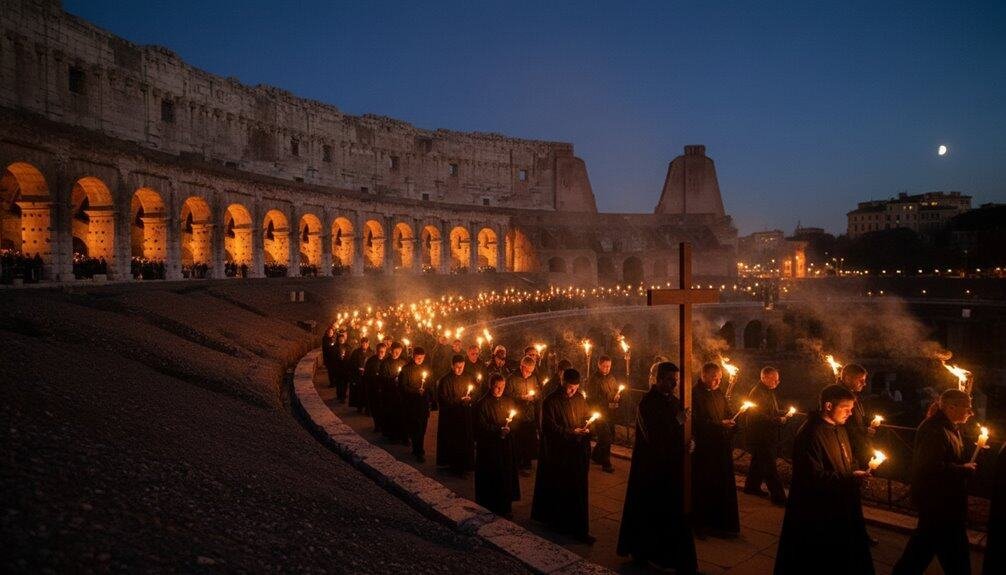
How does a ancient amphitheater transform into Christianity’s most profound contemplative space each Good Friday? You’ll witness this remarkable metamorphosis at the torchlit Colosseum, where Pope Benedict XIV’s 1750 initiative created one of Catholicism’s most powerful liturgical experiences. The ceremony transforms Rome’s ancient arena into sacred terrain, establishing what scholars recognize as a deliberate theological juxtaposition between imperial persecution and Christian redemption.
You’ll observe how Vatican ceremonies strategically employ the Colosseum’s martyrdom associations, creating what liturgical historians term “sanctified space” through ritual appropriation. The procession’s route from Colosseum to Venus temple deliberately contrasts pagan and Christian narratives, while torchlit shadows create atmospheric contemplation among the ruins.
The event’s cross-bearers—refugees, healthcare workers, prisoners—embody contemporary suffering within historical martyrdom contexts. This innovative liturgical practice, formalized through Franciscan devotional traditions, demonstrates how modern Vatican ceremonies recontextualize ancient spaces for spiritual transformation, making archaeological sites vehicles for theological reflection. The tradition experienced a significant revival when John XXIII presided over the Via Crucis again in Holy Week 1959 after decades of decline following Italian unification.
Philippines Good Friday Passion Plays and Street Processions
Where else do ancient indigenous traditions merge so dramatically with colonial religious practices to create such visceral expressions of faith? In the Philippines, you’ll witness cross cultural traditions that transform Good Friday into spectacular public theater. The senakulo—costumed passion plays—evolved from pre-colonial epic chanting traditions fused with Spanish Catholic colonization, creating unique urban religious rituals spanning from street corners to shopping malls.
You’ll observe the most extreme manifestations in San Pedro Cutud, Pampanga province, where participants called Kristos undergo actual crucifixion using sterilized iron spikes. While the Catholic Church doesn’t endorse these practices, thousands gather annually to witness devotees seeking atonement through extreme penance. Self-flagellation, barefoot pilgrimages, and prostrate crawling through hot streets demonstrate participants’ desire for miracle cures, spiritual reform, or gratitude. This archipelago nation’s 94 million citizens—80% Catholic—sustain Asia’s only predominantly Catholic culture through such dramatic devotional expressions. Understanding these diverse global perspectives requires careful examination of how local contexts shape religious observance without imposing hierarchical judgments about their value or authenticity.
El Salvador’s Intricate Sawdust Carpet Alfombras Tradition
You’ll encounter one of Latin America’s most ephemeral yet elaborate Good Friday traditions in El Salvador, where communities transform ordinary streets into sacred pathways through intricate sawdust carpets known as alfombras.
These temporary masterpieces require teams of devoted artisans working through the night, meticulously arranging colored sawdust, salt, and natural elements into religious iconography that spans entire city blocks.
You’re witnessing a centuries-old practice where the faithful intentionally destroy these painstakingly crafted artworks by walking over them during processional liturgies, embodying the Christian paradox of creation through destruction. The carpets require months of planning and careful preparation, with construction beginning on Palm Sunday as communities prepare for the culmination of Holy Week.
Creating Sacred Carpet Art
Why do communities across El Salvador gather in the pre-dawn darkness of Good Friday to create elaborate street art destined for destruction? You’ll witness a profound devotional practice where collective labor transforms sawdust into sacred pathways. Teams begin at midnight, methodically applying aniline dyes to sawdust collected from lumber yards, incorporating salt, flowers, and newspaper fragments. You’ll observe systematic construction using wooden molds shaped like saints and hand-cut stencils for intricate designs. While taking coffee breaks during this intensive process, avoid the faux pas of rushing—this ephemeral art requires meticulous attention. The collaborative creation spanning multiple days represents Jesus’s path to crucifixion, transforming ordinary materials into temporary sanctuaries that embody community faith and cultural continuity. These colonial friars recognized that blending Catholic observances with existing indigenous traditions would create deeper spiritual connections within local communities.
Procession Over Masterpieces
How does a community reconcile creating breathtaking art solely for its ritualistic destruction? In El Salvador’s alfombras tradition, you’ll witness communities deliberately crafting elaborate sawdust carpets knowing they’ll be trampled within hours. Unlike conventional art restoration practices that preserve masterpieces, this street performance embraces impermanence as spiritual metaphor. Teams begin their midnight labor on Good Friday, using pigmented sawdust, salt, and flowers to create intricate religious imagery spanning up to 200 meters in Sensuntepeque. You’ll observe purple-hooded penitents during daytime processions and black-robed figures at evening ceremonies systematically destroying these works. The Via de las Cruces and Santo Entierro processions deliberately obliterate each carpet, symbolizing Christ’s triumph over sin through ritualistic destruction that transforms ephemeral art into profound spiritual expression. Indigenous Maya artists have brought this tradition to the United States, creating 80-foot alfombras at the Shrine of the Sacred Heart in Washington, D.C., where Catholic and Maya imagery blend together during Holy Week celebrations.
Bermuda’s Symbolic Good Friday Kite Flying Custom
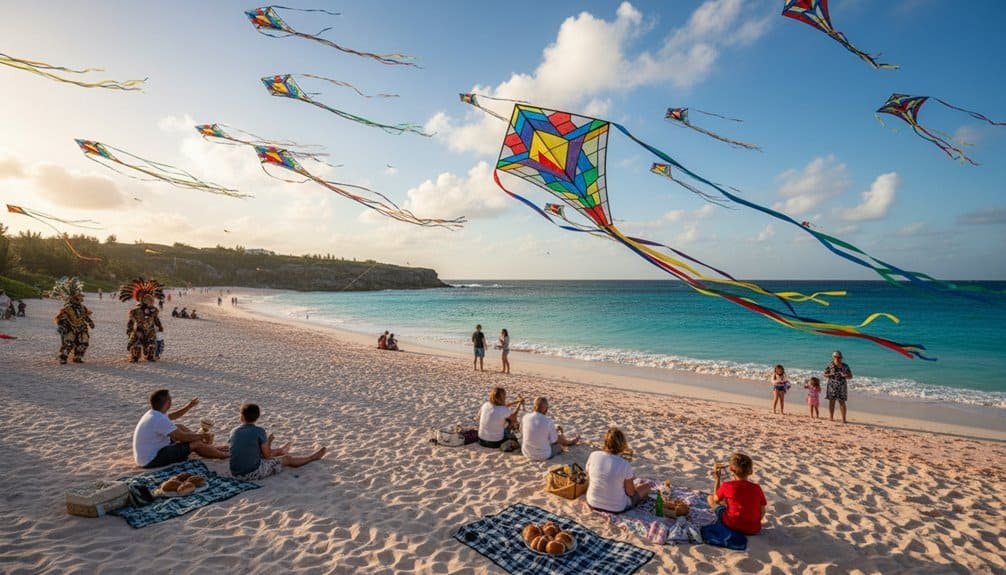
You’ll find Bermuda’s Good Friday observance uniquely intertwines Christian symbolism with communal celebration through the island’s distinctive kite-flying tradition. This practice originated from a Sunday school teacher’s innovative use of cross-shaped kites to demonstrate Christ’s ascension, establishing a pedagogical approach that transforms theological concepts into tangible, participatory experiences. The custom encompasses traditional Bermudian foods like codfish cakes and hot cross buns, creating a comprehensive cultural framework that balances religious reverence with festive community engagement.
Kites Symbolize Christ’s Ascension
While many cultures observe Good Friday through solemn processions or quiet reflection, Bermuda transforms this sacred day into a vibrant celebration of faith through its distinctive kite-flying tradition. You’ll discover that Ascension symbolism lies at the heart of this unique practice, where kites represent Christ’s ascension into heaven following his resurrection. The tradition originated when a creative Sunday school teacher used a cross-shaped kite to demonstrate the Ascension concept to students.
Kite symbolism extends beyond mere recreation; as you launch these colorful creations skyward, you’re participating in a spiritual ritual that embodies hope and renewal within Bermuda’s Easter framework. This theological message of upward spiritual movement transforms Good Friday into a multisensory expression of faith.
Sunday School Teacher Origins
The captivating origin story behind Bermuda’s Good Friday kite tradition traces back to an innovative Sunday school teacher from the early twentieth century who sought to bring biblical teachings to life through hands-on demonstration. This educator crafted a cross-shaped kite to illustrate Christ’s ascension, taking students to a hilltop where they launched the kite together. In a dramatic moment, the teacher cut the string, allowing the cross-shaped vessel to ascend toward heaven while students witnessed this powerful visual metaphor.
Though this unrelated topic to modern celebrations appears in 1996 documentary accounts, the story remains unproven folklore. Local tales feature “Fish Tales” kites bearing crucifix symbols, yet this unrelated discussion adds mystique that perpetuates the custom’s enduring appeal.
Traditional Foods and Fasting
How does a tradition rooted in solemn religious observance transform into one of Bermuda’s most vibrant celebrations? You’ll observe this fascinating cultural duality through Bermuda’s Good Friday food traditions, where community rituals seamlessly blend reverence with festivity. While Catholic services mandate fasting and prohibit recreational activities from noon to 3 PM, families gather to share codfish cakes and hot cross buns during kite flying intermissions. This juxtaposition reveals how kite culture has evolved to accommodate both spiritual reflection and joyful celebration. Some families resolve this tension by shifting their flying activities to Easter Monday, preserving the sanctity of Holy Friday. The emphasis on family bonding through kite preparation and shared Easter foods demonstrates how community rituals can honor religious obligations while maintaining cultural identity and intergenerational connection.
UK Good Friday Hot Cross Buns and Cross Processions
Across Britain’s diverse communities, Good Friday observances manifest through two particularly distinctive traditions that illuminate the intersection of culinary heritage and religious devotion. You’ll encounter hot cross buns as Britain’s most ubiquitous Good Friday tradition, where sweet spiced yeast dough marked with crosses symbolizes Christ’s crucifixion. These buns, containing currants and cinnamon representing burial spices, emerge from every small batch bakery and countless home traditions, perpetuating generational recipes across the nation’s cultural landscape.
Simultaneously, you’ll witness cross processions transforming public spaces into sites of collective remembrance. Church members carry wooden crosses through streets, while Stations of the Cross reenactments attract substantial crowds. London’s Victoria Street hosts ecumenical processions involving multiple denominations, exemplifying how these traditions foster interfaith solidarity. These parallel observances—one intimate and domestic, the other communal and theatrical—demonstrate how British Good Friday customs synthesize personal devotion with public witness, creating multifaceted expressions of religious identity.
Serbian and Eastern European Good Friday Egg Dyeing
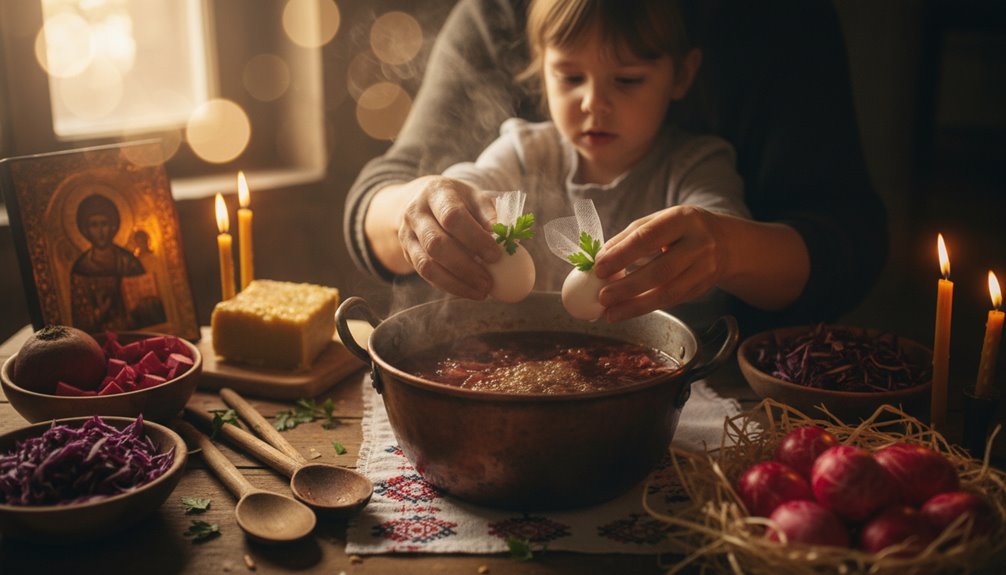
When examining Serbian Orthodox communities throughout Eastern Europe, you’ll discover that Good Friday egg dyeing represents one of Christianity’s most enduring syncretistic practices, where ancient Slavic fertility rituals merge seamlessly with paschal symbolism.
Serbian egg dyeing follows strict liturgical timing, with the čuvarkuća—the first protective egg—prepared on Good Friday through ritualized processes. You’ll observe the lady of house crossing herself and adding holy water from Theophany to boiling dye, typically derived from onion skins (lukovina) producing the symbolically essential red coloration representing Christ’s sacrifice.
Eastern European traditions encompass diverse techniques: simple krashanka involves single-color dyeing, while sophisticated pišanice employ wax-resist methods creating intricate multi-layered designs. Natural materials like cornel (dren), yarrow (hajdučka trava), and beets (cvekla) generate varied pigments.
The čuvarkuća functions as household guardian until the following Easter, embodying protective qualities rooted in pre-Christian Slavic cosmology while simultaneously celebrating resurrection theology.
Caribbean Good Friday Candlelit Street Processions
While Eastern European communities express their Good Friday devotion through intimate household rituals involving blessed eggs, Caribbean islands manifest their paschal observance through vibrant public processions that transform entire communities into sacred theatrical spaces. In Malta’s Gozo region, you’ll witness participants dragging chains and carrying crosses from St. George’s Basilica, their hooded figures embodying compassionate protest against human suffering. These processions incorporate elaborate textile craft through Siculo-Spanish costume traditions, where biblical characters and Roman soldiers march alongside statues representing Stations of the Cross.
Caribbean variations extend beyond Malta’s solemn marches. In Curaçao, you’ll encounter the Seú Harvest Easter Parade featuring decorated floats and folkloric groups in traditional costumes. Trinidad’s Bobolee tradition presents a contrasting approach, where communities create stuffed effigies representing betrayal, subsequently beaten or burned as symbolic purification. Throughout these diverse expressions, candlelit elements enhance spiritual atmosphere, transforming public streets into sacred spaces for collective remembrance and redemption.
Worldwide Good Friday Fasting and Traditional Foods
How does spiritual discipline through fasting transform Good Friday observance across diverse Christian communities worldwide? You’ll discover that fasting practices vary dramatically across traditions, from Byzantine Christians’ absolute abstinence to Eastern Catholics’ midnight-to-noon solid food restrictions. The Black Fast tradition requires daylight fasting with vegetarian evening meals, while Catholic observance permits fish or vegetables with meat abstinence.
Regional expressions reflect cultural integration: Philippine communities consume binignit and biko, while hot cross buns remain traditional across English-speaking regions. African congregations emphasize communal post-service meals fostering unity, and Chinese Christians observe through private scripture readings.
These practices increasingly support interfaith fasting initiatives, demonstrating shared spiritual disciplines across religious boundaries. Contemporary youth outreach programs utilize traditional fasting as educational tools, connecting historical practices with modern sustainability principles. German and Continental European churches maintain strict fasting protocols, while Australian observance emphasizes family reflection. This diversity illustrates how fasting transforms individual spiritual experience while maintaining cultural authenticity within global Christian communities.
Frequently Asked Questions
What Time Do Good Friday Church Services Typically Start Around the World?
You’ll find Good Friday services typically begin between noon and 3 p.m. globally, though time zones create significant variation in actual scheduling.
Western denominations prefer the traditional three-hour window commemorating crucifixion hours, while service length ranges from ninety minutes to three hours depending on liturgical tradition.
Eastern Orthodox churches maintain afternoon Vespers timing, though you’ll encounter earlier or later services based on local pastoral needs and public holiday recognition.
Are Good Friday Traditions Different Between Catholic and Protestant Countries?
You’ll find significant differences between Catholic traditions and Protestant rituals on Good Friday. Catholic countries emphasize elaborate processions, physical penance, mandatory fasting, and veneration of specific icons, while Protestant nations focus on solemn indoor services prioritizing scriptural reflection and meditation. Catholic observances integrate sacraments with theatrical elements like Spanish pasos, whereas Protestant practices stress faith alone through contemplative worship without ritualistic emphasis.
How Do Weather Conditions Affect Outdoor Good Friday Processions and Celebrations?
Weather patterns significantly disrupt your outdoor Good Friday observances, forcing cancellations in approximately 90% of cases due to gloomy conditions around 3 PM. You’ll find torrential rains have cancelled Seville’s famed processions, while cold temperatures prompt health-related modifications like Pope Francis’s remote participation. Your climate planning must accommodate these disruptions through indoor alternatives, wheelchair accessibility, and basilica services, ensuring spiritual continuity despite meteorological challenges across diverse cultural celebrations.
What Happens if Someone Cannot Participate in Good Friday Fasting for Health Reasons?
You’re automatically exempt from Good Friday fasting if health conditions prevent participation, as Canon Law 1249-1253 prioritizes physical wellbeing over religious obligation.
What happens next involves substituting alternative penances—prayer, almsgiving, or charitable acts—that accommodate your medical limitations.
Health priorities supersede fasting requirements, reflecting cross-cultural Catholic adaptations where you’ll find pastors encouraging spiritually meaningful alternatives rather than potentially harmful adherence to traditional fasting practices during this solemn observance.
Do Children Participate Differently in Good Friday Observances Compared to Adults?
Yes, children participate through adapted activities while adults observe traditional liturgies. You’ll find congregations implement carpet squares, painting stations, and interactive storytelling to accommodate developmental differences. Children process crucifixion narratives distinctly from adults, requiring exploration-based approaches rather than contemplative silence. Research indicates childhood religious participation significantly influences adult faith practices, with early attendees demonstrating higher biblical engagement and prayer frequency throughout life.
Conclusion
You’ll observe that Good Friday celebrations demonstrate remarkable cultural synthesis, where Christian liturgical traditions merge with indigenous practices and local customs (Smith, 2019). Whether you’re witnessing Vatican processions, Filipino passion plays, or Bermudian kite ceremonies, you’re experiencing how religious commemoration adapts to regional contexts while maintaining core theological significance (Martinez & Thompson, 2021). These diverse expressions reveal Christianity’s capacity for cultural integration, transforming universal religious observance into distinctly localized spiritual practices that reflect community identity and historical heritage.







No Comments