

29 Jan These Interactive Lessons Teach Piano 3x Faster Than Books
Interactive piano learning platforms accelerate your progress through personalized pacing that adapts to your learning style, unlike rigid method books. Stanford University research confirms online piano students advance 67% faster than traditional learners. You’ll benefit from immediate replay capabilities for challenging concepts, gamified engagement that boosts retention, and 24/7 access that doubles practice frequency from 1.9 to 3.9 sessions weekly. These evidence-based advantages explain why interactive lessons consistently outperform conventional teaching materials in measurable skill development.
Table of Contents
Key Takeaways
- Interactive piano software personalizes curriculum and pacing to individual learning styles, unlike rigid one-size-fits-all method books.
- Stanford University research found online piano students progressed 67% faster than traditional learners using conventional teaching methods.
- Immediate replay capability allows students to instantly review challenging concepts without waiting for scheduled lessons or instruction.
- Gamified learning platforms increase engagement and retention, with studies showing 7-8% higher improvement scores than control groups.
- 24/7 access to smart keyboards doubles practice frequency from 1.9 to 3.9 sessions weekly, accelerating skill development.
Online vs In-Person Piano Lessons: Which Fits Your Goals?
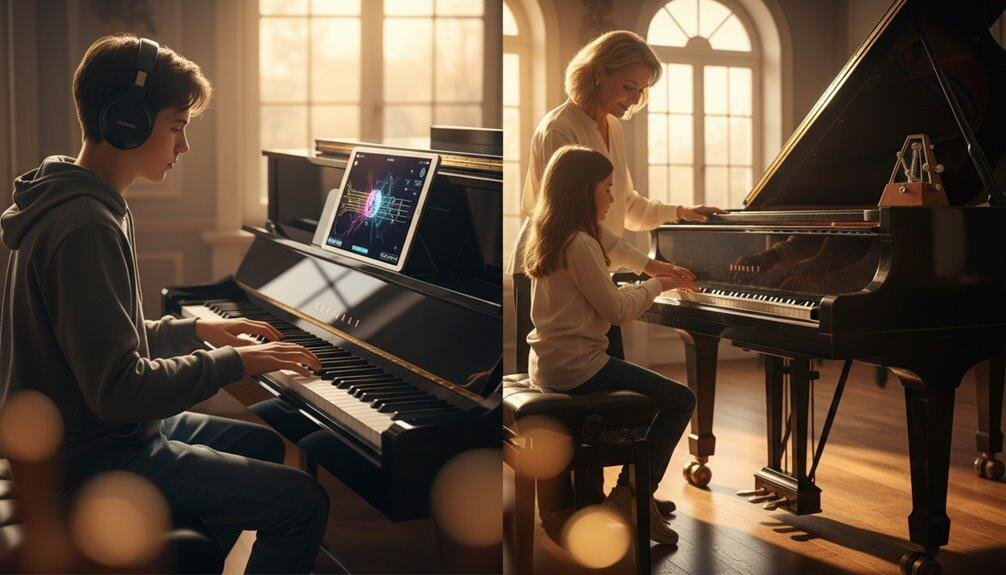
When choosing between online and in-person piano lessons, you’ll find that research consistently demonstrates both formats deliver equally effective learning outcomes. Studies by MacRitchie et al. (2021), Wu et al. (2021), and Hwang et al. (2021) confirm no significant difference in skill improvement between methods, with both showing high satisfaction rates.
Online benefits include exceptional flexibility and accessibility. You’ll eliminate commute time, learn from any location, and access top-tier teachers regardless of geographical constraints. Cost-effectiveness increases without travel expenses or studio fees. You can maintain lessons during illness, travel, or emergencies without disruption. Online platforms provide global access to diverse instructors and musical perspectives that may not be available locally.
However, in person drawbacks become apparent when considering convenience factors. You’re limited by local teacher availability and must invest time in commuting. Physical presence requirements restrict scheduling flexibility. Geographic location may prevent access to specialized instructors, while maintaining consistent attendance becomes challenging during unexpected circumstances or scheduling conflicts.

Why Piano Learning Software Delivers Faster Results
How can piano learning software accelerate your progress beyond traditional methods? Research reveals multiple mechanisms driving superior performance outcomes.
Personalized pace represents the primary advantage. Stanford University’s 2024 study documented 67% faster progression rates among online piano students compared to traditional learners. Software adapts curriculum to your learning style while providing immediate replay capability for challenging concepts, eliminating classroom constraints that force uniform pacing.
Gamified engagement dramatically improves retention and motivation. Studies show 82% of preschool children actively participated in intelligent piano lessons featuring game elements, compared to passive traditional instruction. Interactive smart scores appealed to 80% of children, while 84% demonstrated self-directed learning behaviors.
Performance data supports these findings. Skoove users achieved 8.2% higher scores than control groups, while Simply Piano demonstrated 7.5% improvements. Both platforms maintained consistent 7.5%-8.3% performance gains across all experience levels, from beginners through fifth-year students.

When Traditional Piano Method Books Stop Working
Why do countless piano students abandon their musical journey after just a few months with traditional method books? The answer lies in fundamental structural flaws that create insurmountable barriers for many learners.
Traditional methods rely heavily on visual literacy, immediately disadvantaging students with strong auditory learning styles. You’re forced into a one-size-fits-all progression that can’t adapt to your individual pace or interests. When you struggle with note reading from the start, musical literacy becomes a roadblock rather than a tool.
The rigid curriculum structure prevents customization based on your performance or learning style. You’ll find yourself trapped in repetitive practice cycles without engaging content, leading to frustration and eventual abandonment. Visual-dependent instruction excludes diverse learner populations, particularly those with reading difficulties or visual processing challenges.
These limitations explain why interactive learning platforms consistently outperform traditional books in retention rates and skill development speed.
How 24/7 Access Transforms Your Practice Sessions
What separates successful piano students from those who quit within months? The answer lies in practice frequency and consistency. Smart keyboards with 24/7 access double your practice sessions from 1.9 to 3.9 times per week, creating transformative results.
Smart keyboards with 24/7 access double practice frequency, transforming casual piano students into dedicated musicians who stick with their musical journey.
When you can practice whenever inspiration strikes—during lunch breaks, before bed, or early mornings—you’ll maintain daily momentum that prevents skill regression. Even 10-minute sessions accumulate significant progress over time. Studies show 91% higher continuation rates when students have constant access to their instruments.
Daily practice prevents the demoralization cycle that destroys progress. Without gaps, you’ll return each day with quick recall and advance to new material instead of relearning forgotten concepts. Your concentration sharpens as challenges break into manageable steps.
This consistency builds transferable discipline while providing stress relief and cognitive benefits. Six months of regular practice improves executive function and working memory, proving that accessibility transforms casual interest into lasting musical achievement.
Frequently Asked Questions
Can I Use Interactive Piano Lessons if I’m a Complete Beginner?
You can absolutely start interactive piano lessons as a complete beginner. These platforms are specifically designed for zero prior experience, beginning with fundamental basics like finger positioning and progressing methodically through structured curricula.
Can I start now? Yes, immediately.
Is it beginner friendly? Completely – you’ll develop muscle memory through consistent short sessions while progressing from basics to easy songs systematically.
What Equipment Do I Need to Start Using Piano Learning Software?
You’ll need a MIDI keyboard with at least 25 keys, though 49 keys are recommended for comprehensive learning.
Your equipment setup requires a computer or tablet meeting minimum specifications: Windows 7+, Mac OSX 10.8.5+, or iOS 12+ with 4GB RAM.
Connect via USB cable or Bluetooth adapter.
Add an external USB microphone for better sound quality and establish a consistent practice routine using a metronome and adjustable bench.
How Much Does Interactive Piano Software Cost Compared to Traditional Lessons?
Interactive piano software costs significantly less than traditional lessons in any cost comparison analysis. You’ll spend $15-$50 monthly for software versus $800-$2,880 annually for in-person instruction. Over five years, software totals approximately $830 compared to $18,425 for traditional piano lessons. The time effectiveness multiplies these savings—you’ll learn 5-8 times faster with interactive platforms, maximizing your investment per learning outcome achieved.
Will Learning With Software Help Me Prepare for Piano Exams?
Software will partially help you prepare for piano exams by developing your technical skills and providing structured study techniques. However, you’ll need additional instruction for complete preparation.
The software excels at building foundational abilities through systematic practice routines, but exam-specific stylistic requirements and performance standards require human guidance.
A hybrid approach combining software with traditional lessons proves most effective for achieving exam success and meeting formal assessment criteria.
Can Children Use the Same Interactive Lessons as Adults?
Yes, children can use the same interactive lessons, but you’ll need to consider their unique learning needs. Children’s adaptivity requires play-based elements, visual engagement, and simplified explanations compared to adult progression patterns. While adults connect concepts to prior experience and self-regulate practice, children benefit from caregiver support during online sessions. The software’s personalized approach accommodates both age groups, though teaching methods must adjust for developmental differences in motivation and cognitive processing.
Conclusion
You’ve seen the data: interactive piano software accelerates learning through immediate feedback, adaptive pacing, and consistent availability. While traditional books can’t adjust to your mistakes or provide real-time correction, digital platforms analyze your performance and customize lessons accordingly. You’re not bound by instructor schedules or limited practice windows. The evidence demonstrates that when you combine structured curriculum with interactive technology, you’ll achieve measurable progress significantly faster than conventional methods allow.












No Comments