

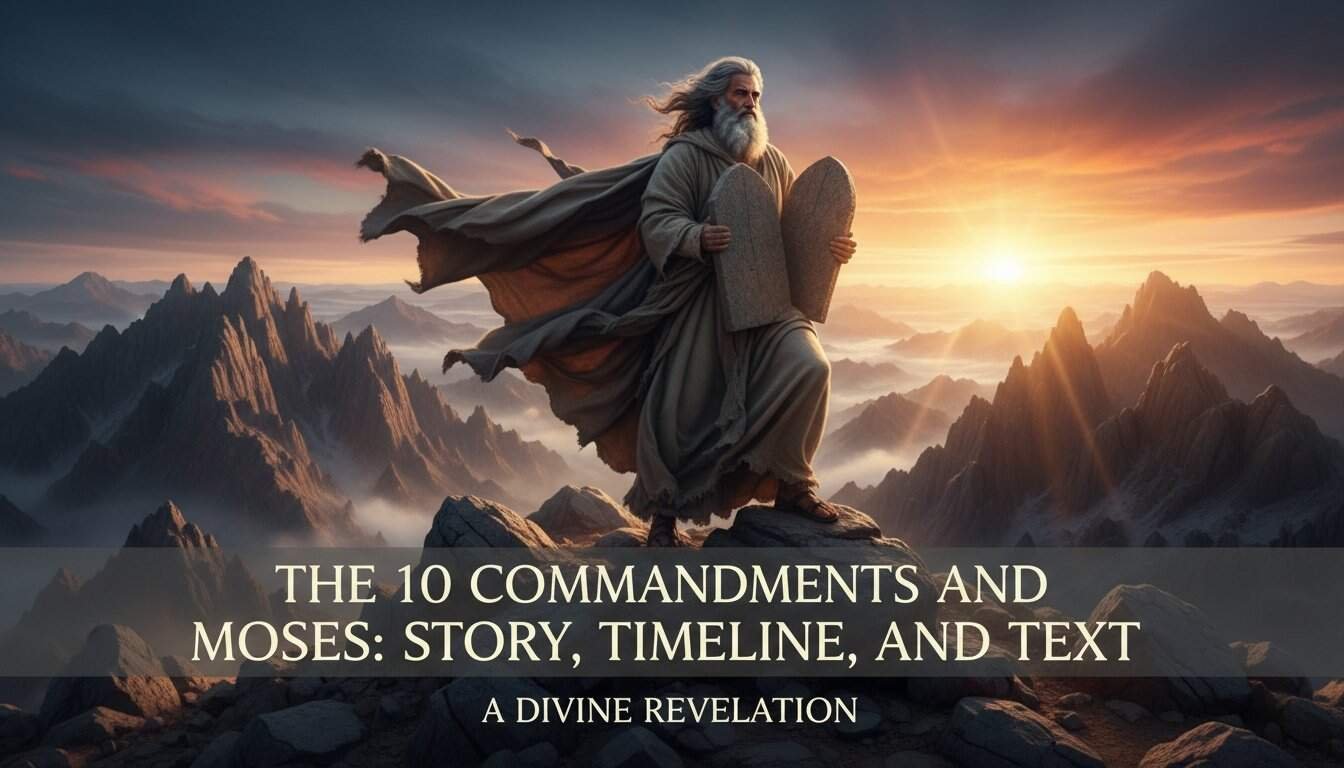
21 Dec The 10 Commandments and Moses: Story, Timeline, and Text
You’ll discover Moses received the Ten Commandments during a divine encounter at Mount Sinai around the 13th century BCE, transforming Israel’s exodus into spiritual metamorphosis. The commandments appear in two biblical versions—Exodus 20:1-17 and Deuteronomy 5:4-21—establishing monotheism and ethical foundations for human relationships. When Moses found Israel worshipping a golden calf, he shattered the original tablets, but God provided replacements, demonstrating divine forgiveness and covenant renewal that would influence Western civilization’s moral framework.
Table of Contents
Key Takeaways
- Moses received the Ten Commandments directly from God on Mount Sinai during the 13th century BCE after leading Israel’s exodus from Egypt.
- The commandments appear in two biblical versions (Exodus 20:1-17 and Deuteronomy 5:4-21) with minor textual variations but identical core principles.
- The first tablet establishes proper worship of God through monotheism, prohibition of idolatry, reverent speech, and Sabbath observance.
- The second tablet governs human relationships by honoring parents and prohibiting murder, adultery, theft, false testimony, and coveting.
- Moses shattered the original stone tablets upon discovering Israel’s golden calf worship, but God provided replacement tablets symbolizing divine forgiveness.
Moses: The Prophet and Lawgiver of Israel

While Moses stands as one of history’s most pivotal religious figures, his role as both prophet and lawgiver fundamentally shaped the foundation of Israelite civilization and monotheistic tradition.
You’ll find that Moses’ leadership role emerges distinctively through biblical narratives, where he functions as mediator between the divine and human realms. His relationship with God establishes a unique covenant model that transforms tribal groups into a unified nation.
Through textual analysis of Exodus and Deuteronomy, you’ll observe that Moses doesn’t merely transmit divine commands—he actively interprets and contextualizes them for his community. His prophetic authority stems from direct divine encounters, particularly at Mount Sinai, where he receives the Decalogue.

You’ll notice that Moses’ dual function as prophet and lawgiver creates a precedent for religious leadership that combines spiritual insight with practical governance, establishing legal frameworks that would influence Western jurisprudence for millennia.
The Exodus Journey to Mount Sinai
Moses’ prophetic authority and lawgiving capacity found their definitive expression during the extraordinary journey from Egypt to Mount Sinai, a pivotal narrative that transforms a liberation event into a foundational religious experience. You’ll discover that this journey wasn’t merely geographical displacement but represented Israel’s transition from slavery to covenant community.
Moses transformed Israel’s physical exodus into a spiritual metamorphosis, establishing his divine authority through the sacred journey to Sinai.
The biblical account depicts Moses navigating complex route planning decisions while managing approximately 600,000 Israelites plus their livestock through harsh wilderness terrain.
Archaeological evidence suggests various possible paths, though scholars debate the exact location of biblical Mount Sinai. The text emphasizes divine guidance through pillars of cloud and fire, indicating supernatural direction superseding conventional navigation.
These nomadic wanderings lasted three months according to Exodus 19:1, during which Moses consolidated his leadership and prepared the people for receiving divine law. The journey’s conclusion at Sinai establishes the mountain as sacred space where Moses would encounter God and receive the tablets containing the Ten Commandments.

The Divine Encounter on Mount Sinai
Upon reaching Mount Sinai‘s base, Moses encountered the most significant theophany in Hebrew scripture, where divine presence manifested through thunder, lightning, fire, and earthquake that terrified the assembled Israelites.
You’ll find that Exodus 19-20 describes elaborate preparation rituals requiring three days of purification before God’s descent upon the mountain. The text emphasizes boundaries around Sinai’s perimeter, establishing sacred space that ordinary people couldn’t breach without fatal consequences.
The religious significance of this encounter extends beyond mere dramatic effect—it establishes the covenant relationship between God and Israel through legal proclamation. You’ll notice how ritual practices frame the entire episode, from washing garments to abstaining from marital relations, demonstrating that approaching divine presence requires deliberate preparation.
Moses alone ascends the mountain peak, serving as mediator between the transcendent deity and trembling nation below. This encounter transforms him from liberator to lawgiver, fundamentally altering Israel’s identity.
Historical Timeline of the Ten Commandments
You’ll find that establishing the precise historical timeline of the Ten Commandments requires examining three critical areas of evidence that scholars have analyzed for centuries.
The Mount Sinai revelation event, traditionally dated to the 13th century BCE, represents the foundational moment when Moses received the divine law, though you must consider how ancient Hebrew legal traditions developed within broader Near Eastern contexts.
Biblical manuscript dating evidence, particularly from the Dead Sea Scrolls and other archaeological discoveries, provides you with textual witnesses that help reconstruct how these commandments were preserved and transmitted through successive generations.
Mount Sinai Revelation Event
Several pivotal moments converge in the biblical narrative of Mount Sinai, where Moses receives the Ten Commandments directly from God in what scholars consider one of the most significant theophanic events in Hebrew Scripture. The symbolic significance of Mount Sinai extends beyond geographical location—it represents divine-human encounter and covenant formation. The mountain becomes sacred space where heaven meets earth, transforming ordinary terrain into holy ground.
The religious experience of revelation unfolds through dramatic atmospheric phenomena: thunder, lightning, thick clouds, and trumpet sounds that terrify the Israelites below. Moses ascends the mountain multiple times, spending forty days and nights in God’s presence. This extended duration emphasizes the gravity and thoroughness of divine communication, establishing Moses as mediator between the divine and human realms in Israel’s foundational covenant relationship.
Ancient Hebrew Law Development
While the Mount Sinai revelation marks the dramatic moment of divine transmission, the Ten Commandments didn’t emerge in a historical vacuum but represent the culmination of evolving legal traditions within ancient Near Eastern societies. You’ll find striking parallels between Mosaic law and earlier codes like Hammurabi’s, suggesting shared semitic law practices across Mesopotamian cultures. Ancient hebrew culture absorbed and refined these precedents, creating distinctly monotheistic legal frameworks that emphasized covenant relationship over mere civil regulation.
The commandments’ structure reflects sophisticated jurisprudential development, with apodictic laws (“You shall not”) contrasting sharply with casuistic formulations (“If someone does X, then Y”). This legal evolution demonstrates how Israel’s lawmakers synthesized regional practices while establishing unprecedented theological foundations that would influence Western legal thought for millennia.
Biblical Manuscript Dating Evidence
Establishing the chronological development of these legal traditions requires examining the manuscript evidence that preserves the Ten Commandments across different historical periods. You’ll find that the earliest complete biblical texts containing the Decalogue date to the third century BCE, discovered among the Dead Sea Scrolls at Qumran. Radiocarbon dating of these parchments confirms their antiquity, while paleographic analysis of the Hebrew script provides additional chronological markers.
You can trace textual variations through manuscripts like the Nash Papyrus and medieval codices, revealing how scribes transmitted these laws across millennia. The Masoretic Text, Septuagint, and Samaritan Pentateuch offer different textual witnesses, allowing you to reconstruct the manuscript tradition’s evolution and assess the reliability of our current biblical texts.
The First Tablet: Commandments About God
According to traditional Jewish and Christian interpretation, the first tablet contains the initial four commandments that establish humanity’s relationship with the divine. These commandments focus on worship, reverence, and proper acknowledgment of God’s divine attributes.
The first four commandments form the foundation of divine-human relationship through worship, reverence, and proper acknowledgment of God’s sacred attributes.
The first commandment establishes monotheism, rejecting other gods and affirming exclusive devotion to Yahweh. You’ll find this foundational principle shapes Israel’s entire theological framework.
The second prohibits idolatry, preventing physical representations that might diminish God’s transcendent nature. The third forbids taking God’s name in vain, protecting the sanctity of divine identity through respectful speech.
The fourth commandment requires Sabbath observance, creating rhythmic worship that acknowledges God’s creative work and rest. These four commandments collectively establish the covenant relationship between God and Israel, defining proper worship practices and theological boundaries. They emphasize God’s sovereignty, holiness, and unique position as Israel’s deity, forming the vertical dimension of the covenant that precedes horizontal human relationships.
The Second Tablet: Commandments About Human Relationships
The remaining six commandments shift focus from divine-human relationships to interpersonal ethics, establishing fundamental principles for community life within the covenant framework. You’ll find these commandments address core moral obligations that govern human interactions within ancient Israelite society.
The fifth commandment—honoring father and mother—anchors familial authority and intergenerational respect. The sixth through ninth commandments prohibit murder, adultery, theft, and false testimony, creating boundaries that protect life, marriage, property, and justice. These regulations reflect Ancient Near Eastern legal traditions while emphasizing covenant community standards.
The tenth commandment against coveting operates differently, addressing internal attitudes rather than external actions. You’ll notice it targets the psychological roots of social discord—desire for others’ possessions, relationships, or status.
Together, these commandments establish a comprehensive ethical system governing interpersonal relationships. They create social stability by protecting vulnerable community members while defining acceptable behavior within Israel’s covenant community structure.
The Complete Text of the Ten Commandments
While biblical scholars recognize two primary versions of the Ten Commandments in Exodus 20:1-17 and Deuteronomy 5:4-21, both texts share essential theological and ethical foundations despite their textual variations.
You’ll find that biblical interpretation reveals subtle but significant differences between these accounts. The Exodus version presents the commandments as direct divine speech, while Deuteronomy frames them within Moses’ farewell discourse.
Ancient manuscripts show variations in the fourth commandment’s rationale—Exodus links Sabbath observance to God’s creation rest, whereas Deuteronomy connects it to Israel’s liberation from Egypt.
When you examine the tenth commandment, you’ll notice Deuteronomy reorganizes the prohibitions against coveting, placing “wife” before “house” and expanding the list of forbidden desires. These textual differences don’t diminish the commandments’ authority but rather demonstrate how ancient communities understood and applied these foundational principles within their historical contexts, enriching our comprehension of their enduring significance.
Breaking and Rewriting the Stone Tablets
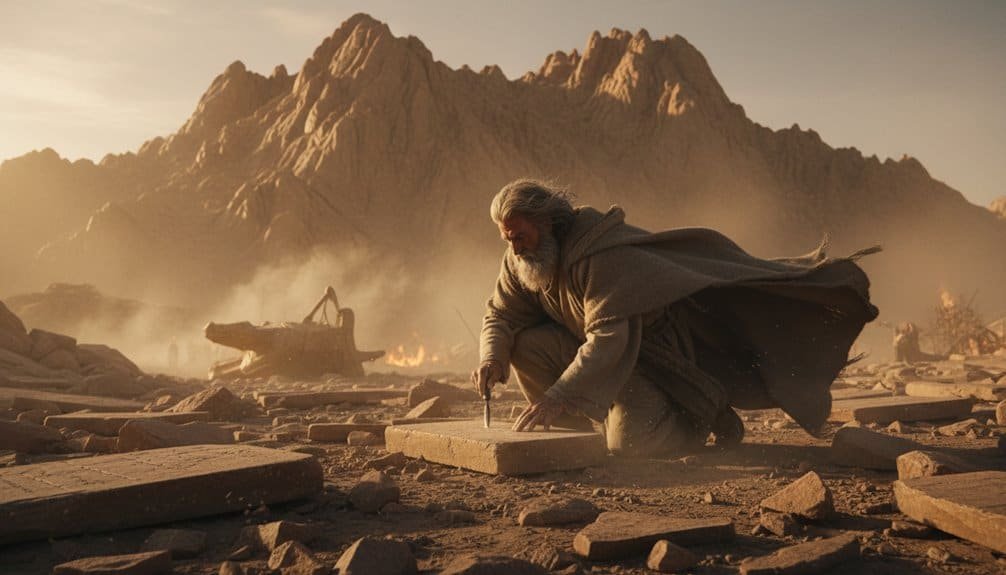
You’ll find that Moses’ initial reception of the stone tablets takes a dramatic turn when he descends Mount Sinai to discover the Israelites worshipping a golden calf. His immediate response involves shattering the divinely inscribed tablets in a moment of righteous anger, as recorded in Exodus 32:19.
This destructive act necessitates God’s provision of replacement tablets, establishing a pattern of divine patience and renewal that becomes central to the covenant relationship.
Moses’ Anger and Destruction
Upon Moses’ descent from Mount Sinai, he encountered a scene that would fundamentally alter the covenant between God and the Israelites. You witness Moses’ anger explode as he observes the people worshiping the golden calf, directly violating the first commandment he’d just received. His immediate response involves hurling the stone tablets to the ground, shattering God’s own handiwork in a moment of righteous fury.
This destructive act wasn’t merely emotional outburst but represented divine punishment for covenant violation. You see Moses grinding the golden idol into powder, forcing the Israelites to consume it mixed with water. The Levites then executed approximately three thousand people at Moses’ command. This dramatic sequence demonstrates how seriously covenant breaking was viewed, establishing precedent for divine judgment while simultaneously revealing the fragile nature of human faithfulness.
God’s Second Stone Tablets
How did God respond to this catastrophic breach of covenant and the destruction of His sacred tablets? You’ll find that divine mercy prevailed over divine wrath. In Exodus 34:1, God commanded Moses to “hew two tablets of stone like the first,” promising to rewrite the commandments that Moses had shattered.
This wasn’t merely tablet replacement—it represented covenant renewal and divine forgiveness. God’s willingness to recreate these sacred texts demonstrates the enduring nature of divine covenants, even when humanity fails catastrophically.
During this second encounter on Mount Sinai, you’ll observe that God revealed His character through heavenly proclamations of mercy and grace (Exodus 34:6-7). The rewritten tablets symbolized restored relationship, proving that God’s covenant commitments transcend human unfaithfulness and destructive actions.
The Ten Commandments in Jewish Law and Tradition
While the Ten Commandments appear in two slightly different versions within the Hebrew Bible—in Exodus 20:1-17 and Deuteronomy 5:4-21—Jewish law and tradition have developed sophisticated interpretative frameworks that treat these divine pronouncements as foundational principles rather than merely legal statutes.
Jewish law interpretations view the Decalogue as encompassing all 613 mitzvot (commandments) within its ten fundamental categories. The Talmud explains that each commandment represents broader theological and ethical principles that govern Jewish life. Rabbinical commentaries, particularly those of Rashi, Maimonides, and other medieval scholars, demonstrate how these commandments function as organizing principles for the entire legal system.
The tradition doesn’t treat them as standalone laws but as categorical headings under which specific halakhic (Jewish legal) obligations fall. This interpretative approach allows you to understand how ancient divine commands remain relevant to contemporary Jewish practice, linking eternal principles with evolving communal needs through continuous scholarly engagement.
Legacy and Influence on Western Civilization
Beyond their foundational role in Jewish religious practice, the Ten Commandments shaped the moral and legal architecture of Western civilization in ways that extend far beyond their original biblical context. You’ll find their principles embedded in constitutional frameworks, criminal codes, and ethical systems throughout Europe and the Americas.
This cultural diffusion occurred through Christianity’s expansion, which carried Mosaic law into Roman governance and medieval jurisprudence.
The Commandments’ social impact manifests in fundamental legal concepts you recognize today: prohibitions against murder, theft, and perjury form bedrock principles in modern judicial systems. Their emphasis on individual responsibility and divine authority influenced Enlightenment thinkers who crafted democratic institutions. You can trace their influence in the Magna Carta‘s limitations on power, American constitutional protections, and international human rights declarations.
Even secular legal traditions retain their structural logic, demonstrating how ancient religious texts continue shaping contemporary moral reasoning and legislative frameworks across diverse societies.
Frequently Asked Questions
What Material Were the Original Stone Tablets Made From?
You’ll find that biblical texts don’t specify the exact stone composition of Moses’ tablets. However, you can reasonably assume they were likely made from granite composition, given the region’s geological characteristics.
When you examine the mineral properties of available stones in the Sinai Peninsula, granite would’ve provided the durability necessary for divine inscription. You should note that archaeological evidence remains limited regarding the tablets’ precise material composition.
How Long Did Moses Spend on Mount Sinai Receiving the Commandments?
You’ll find that Moses spent forty days and forty nights on Mount Sinai receiving the commandments, according to Exodus 24:18 and 34:28.
Biblical scholars’ perspectives vary on interpreting this time spent on Mount Sinai, with some viewing it as literal chronology while others consider it symbolic.
You should note that this timeframe appears twice in Exodus, representing both the initial reception and the replacement tablets after Moses destroyed the originals.
Are There Different Versions of the Ten Commandments in Various Religions?
Yes, you’ll find scriptural variations across different religious traditions. Protestant, Catholic, and Orthodox churches number and divide the commandments differently, while Jewish traditions maintain their own distinct version.
You’ll notice these differences stem from varying interpretations of Exodus 20 and Deuteronomy 5, where textual analysis reveals how each tradition emphasizes different aspects of the original Hebrew text’s meaning and structure.
What Happened to the Original Stone Tablets After They Were Broken?
You’ll find biblical accounts remain silent about the whereabouts of tablets after Moses shattered them in anger upon witnessing the golden calf incident. Textual analysis reveals no scriptural references detailing what happened to these remnants of original tablets.
You’re left with scholarly speculation, as Exodus focuses on God’s provision of replacement tablets rather than addressing the broken fragments’ ultimate disposition or preservation.
Why Are the Ten Commandments Sometimes Numbered Differently Across Denominations?
You’ll encounter different numberings because religious interpretations vary regarding how to divide the original Hebrew text. Biblical scholarship reveals that Exodus and Deuteronomy don’t explicitly number the commandments, leaving room for interpretation.
Catholics and Lutherans combine the prohibition against other gods with idol worship, while Protestants and Orthodox traditions separate them. You’re seeing theological differences about whether coveting represents one or two distinct commandments.
Conclusion
You’ve witnessed how Moses’s encounter at Sinai fundamentally shaped Judeo-Christian civilization through the Decalogue’s divine revelation. You’ll find these commandments aren’t merely ancient legal codes—they’re theological foundations that’ve influenced Western jurisprudence, ethics, and moral philosophy for millennia. As you examine their textual transmission from stone tablets to modern interpretations, you’re observing humanity’s earliest systematic approach to divine law, establishing precedents that continue governing contemporary legal and moral frameworks across diverse cultures today.











No Comments