

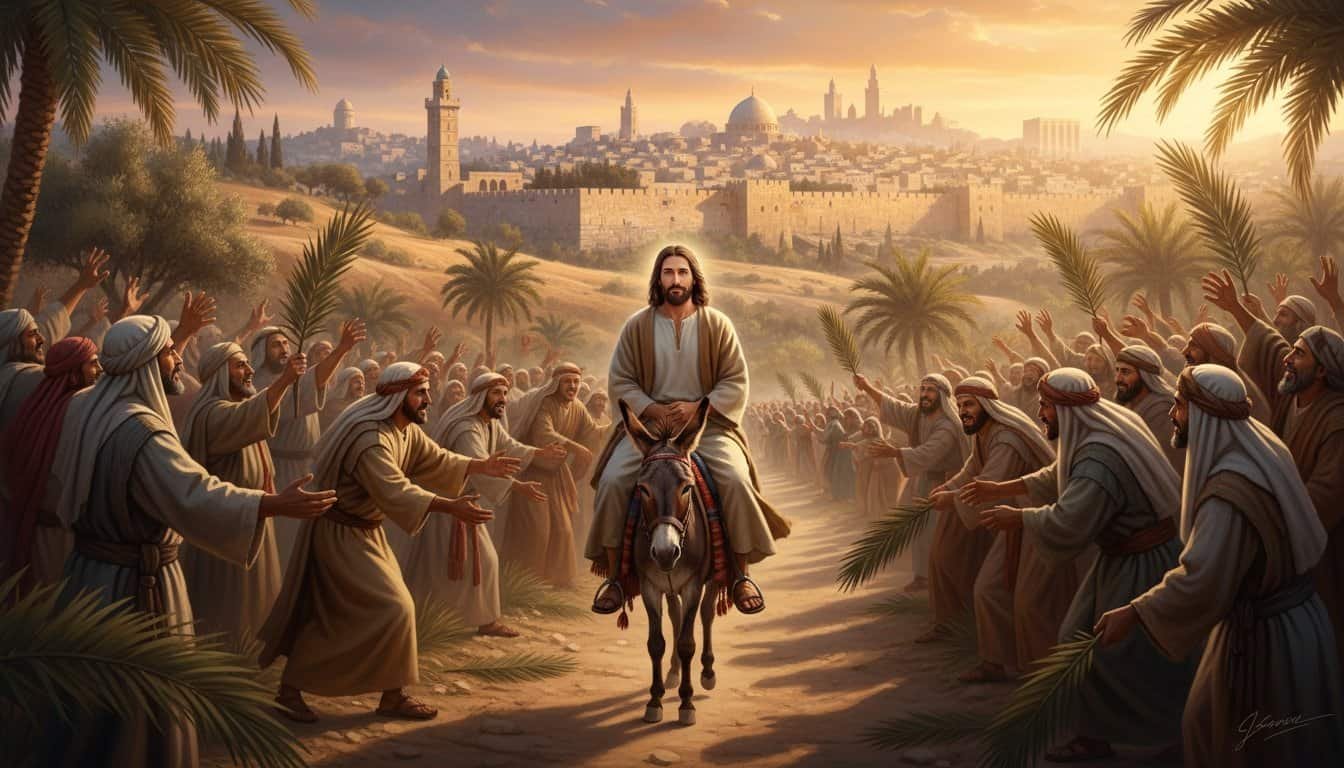
29 Jan Why Jesus Rode a Donkey Into Jerusalem on Palm Sunday
You’ll discover that Jesus deliberately chose a donkey to fulfill Zechariah 9:9’s prophecy describing the Messiah’s humble arrival as a “righteous and victorious” yet “lowly” king. While ancient rulers rode warhorses to display military power and dominance, Jesus subverted these expectations by selecting peaceful transportation that symbolized humility, accessibility, and nonviolent leadership. This choice redefined messianic kingship—emphasizing service over conquest and spiritual transformation over political force—while the crowds’ reaction with palm branches and “Hosanna” chants revealed their recognition of this revolutionary approach to royal authority.
Table of Contents
Key Takeaways
- Jesus fulfilled Zechariah 9:9’s prophecy describing the Messiah arriving humbly on a donkey as a righteous king.
- The donkey symbolized peace and humility, contrasting with warhorses that represented military power and conquest.
- Jesus deliberately subverted expectations by choosing peaceful leadership over traditional displays of royal military authority.
- The entry occurred within Daniel’s prophetic timeline, linking Jesus to predicted messianic expectations and timing.
- Jesus declared his messianic kingship while demonstrating that his kingdom operates through service rather than force.
The Story Behind Jesus’ Triumphal Entry Into Jerusalem
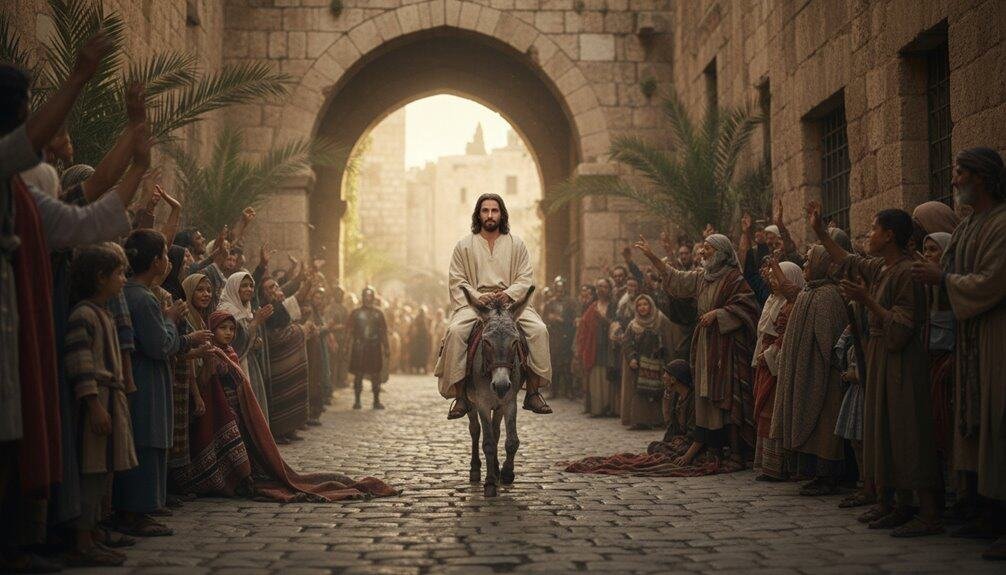
When Jesus descended the Mount of Olives toward Jerusalem that fateful Sunday, He orchestrated what scholars recognize as one of the most politically and theologically charged moments in the Gospels. You’ll find this event recorded across all four Gospels, each emphasizing different aspects of what we call the Triumphal Entry.
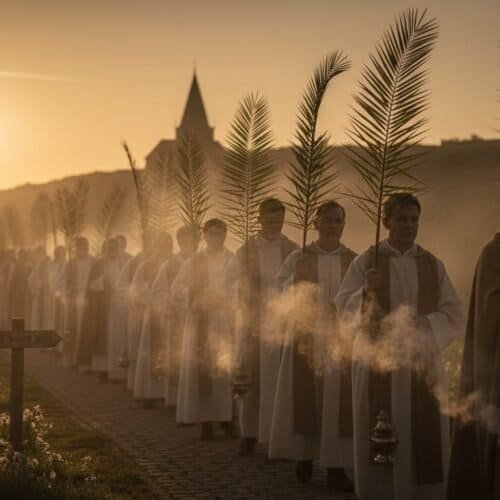
The crowds’ reaction wasn’t spontaneous—they deliberately spread cloaks and palm branches, actions that carried deep political significance in first-century Palestine. You’re witnessing a carefully choreographed moment where Jesus accepts public acclaim as Israel’s messianic king, yet subverts expectations through His choice of mount.
This scene ignites glory debates among theologians who question whether Jesus sought earthly recognition or demonstrated divine humility. The entry represents complex political theology, as Jesus simultaneously claims royal authority while rejecting conventional power structures. You can’t understand Palm Sunday without recognizing this tension between messianic expectation and revolutionary redefinition.

Ancient Prophecies Jesus Fulfilled By Riding A Donkey
You’ll find that Jesus’ choice to ride a donkey fulfilled specific Old Testament prophecies that his Jewish audience would have immediately recognized. Zechariah 9:9 explicitly describes the coming Messiah as “humble and riding on a donkey,” while Daniel’s prophecies provided the precise timing framework that positioned this event at the culmination of his predicted timeline. These weren’t coincidental parallels—they represented deliberate fulfillment of centuries-old messianic expectations that transformed a simple journey into a profound theological statement.
Zechariah’s Messianic Prophecy
How did ancient Jewish prophecies anticipate the specific manner of the Messiah’s arrival? Zechariah 9:9 provides the most explicit prediction: “Rejoice greatly, Daughter Zion! Shout, Daughter Jerusalem! See, your king comes to you, righteous and victorious, lowly and riding on a donkey, on a colt, the foal of a donkey.”
Written around 520-518 BCE, this prophecy contrasts sharply with contemporary politics where rulers entered cities on warhorses to display military dominance. You’ll notice Zechariah emphasizes the king’s humility—he’s “lowly” despite being “righteous and victorious.”
This wasn’t about urban planning or ceremonial routes, but character. The Hebrew word “ani” (lowly/humble) directly opposes typical royal triumphalism. Jesus’s deliberate fulfillment of this specific detail demonstrates his conscious identification with Zechariah’s vision of a peaceful, humble Messiah rather than a conquering warrior-king.
Daniel’s Timing Prediction
Where does Daniel’s ancient prophecy intersect with Jesus’s Palm Sunday entrance? You’ll find the answer in Daniel 9:24-27, which predicts the Messiah’s arrival precisely 483 years after the decree to rebuild Jerusalem. This timeline culminates during Jesus’s ministry, making His triumphal entry historically significant beyond ceremonial display.

Daniel’s prophecy doesn’t explicitly mention transportation methods, yet Jesus’s donkey choice demonstrates intentional fulfillment of messianic expectations. The peaceful symbolism inherent in riding a humble beast rather than a war horse aligns with Daniel’s vision of the Messiah who’d “put an end to sin” through sacrifice, not conquest.
You can observe how donkey ethics—representing gentleness and servitude—perfectly complement Daniel’s portrayal of a suffering servant-king who’d be “cut off” for humanity’s redemption.
Biblical Symbolism: What Donkeys Represented In Jesus’ Time
Donkeys carried profound symbolic weight in ancient Jewish culture that modern readers often miss when examining Jesus’ triumphal entry. You’ll find that donkeys represented peace, humility, and righteous kingship throughout Hebrew scriptures. Unlike horses, which symbolized military might and warfare, donkeys conveyed a message of peaceful intentions.
When you examine Old Testament passages, you’ll notice that judges and kings often rode donkeys during times of peace. Zechariah 9:9 specifically prophesied that Israel’s king would come “riding on a donkey.” This wasn’t an unrelated topic or irrelevant theme to Jesus’ ministry—it was central to His messianic identity.
You should understand that donkeys also represented accessibility. While horses were expensive and exclusive to the wealthy, donkeys served common people. By choosing this humble animal, Jesus demonstrated that His kingdom welcomed everyone, not just the elite. This powerful symbolism would’ve been immediately recognizable to Jewish observers.
Royal Transportation: Why Kings Chose Horses Over Donkeys
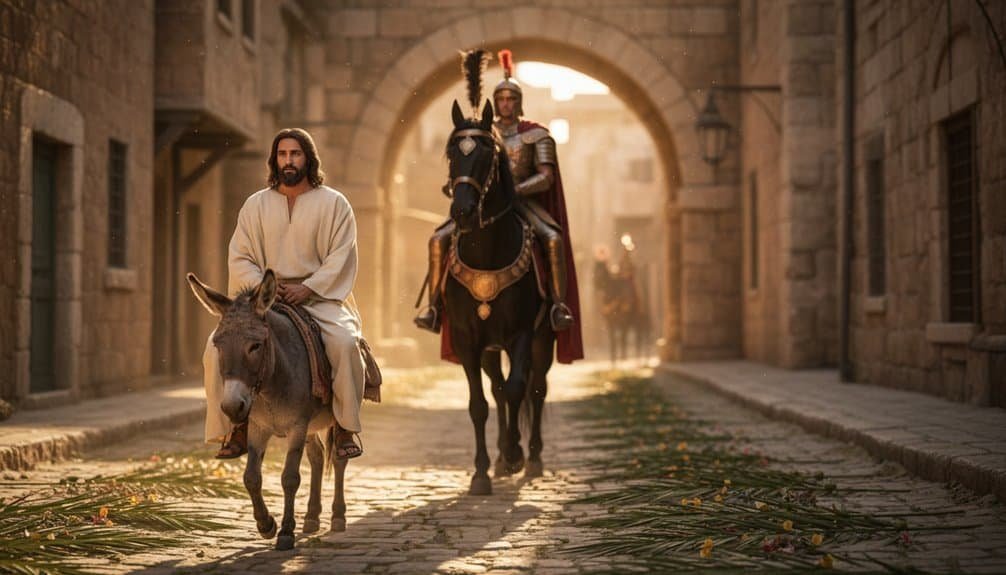
When you examine royal customs in Jesus’ era, you’ll notice that kings consistently chose horses for their public appearances because these animals projected military strength and dominance. You’d see elaborate processions featuring mounted rulers who understood that their choice of transportation directly communicated their power to subjects and enemies alike. You can’t underestimate how crucial this visual display was—riding a horse wasn’t just practical transportation but a calculated statement of authority that reinforced the ruler’s position in society’s hierarchy.
Horses Symbolized Military Power
Why did ancient rulers consistently choose horses as their preferred mode of transportation? You’ll discover that horses represented far more than mobility—they embodied military dominance and imperial authority. When you examine ancient Near Eastern texts, you’ll find horses consistently associated with warfare, chariots, and conquest. Kings who rode horses projected strength and readiness for battle, communicating their ability to defend territories and expand kingdoms.
Unlike concerns about concerned finances or garden planning that occupied daily life, royal appearances demanded symbols of power. You can see this pattern throughout biblical and historical accounts where mounted rulers inspired both respect and fear. Horses required significant resources to maintain, further demonstrating a king’s wealth and military capacity. This symbolism made horses the natural choice for rulers asserting dominance over their subjects and enemies.
Royal Processions Required Grandeur
Ancient royal ceremonies demanded spectacular displays that reinforced hierarchical power structures, and horses served as the centerpiece of these elaborate processions. You’d witness kings arriving on magnificent stallions adorned with golden bridles, surrounded by cavalry units and chariots that thundered through city gates. These grand entrances weren’t merely transportation—they were calculated demonstrations of wealth, military strength, and divine authority. Roman governors particularly excelled at such pageantry, orchestrating processions that showcased their empire’s dominance over conquered territories. Contrasting customs existed in rural ceremonies, where simpler traditions prevailed, but urban royal entries demanded maximum visual impact. You’d understand that choosing prestigious mounts wasn’t optional for rulers—it was essential political theater that legitimized their authority through overwhelming spectacle and carefully orchestrated displays of power.
Status Through Mounted Display
How did ancient rulers transform their choice of mount into a declaration of supremacy? You’ll discover that warhorses became the ultimate symbol of imperial authority throughout the ancient world. Roman emperors, Persian kings, and Hellenistic monarchs deliberately chose stallions to project military dominance and divine favor.
Idea A emphasized how mounted warfare separated rulers from common pedestrians, creating visual hierarchy that reinforced social stratification. When you examine ancient reliefs and coins, you’ll notice rulers consistently depicted on rearing horses, suggesting conquest and control over both nature and enemies.
Idea B demonstrated that elaborate horse processions functioned as political theater, communicating power to subjects who couldn’t read but understood symbolic language. These carefully orchestrated displays weren’t mere transportation—they were calculated demonstrations of authority that demanded submission.
Jesus’ Deliberate Rejection Of Traditional Royal Power
When Jesus chose to ride a donkey rather than a war horse into Jerusalem, he deliberately subverted every expectation his contemporaries held about messianic kingship. You’re witnessing a radical theological statement that continues to fuel theology debate among scholars today.
In the historical context of first-century Palestine, political messiahs were expected to arrive as military conquerors, wielding swords and commanding armies to overthrow Roman occupation.
Jesus’ donkey choice wasn’t accidental—it was prophetically intentional. He’s fulfilling Zechariah 9:9, which describes a king coming “gentle and riding on a donkey.” You see him rejecting the warrior-king model that dominated ancient Near Eastern royal ideology. Instead of projecting strength through intimidation, he’s demonstrating power through humility. This moment reveals his kingdom operates by entirely different principles than earthly governments. He’s not seeking political revolution but spiritual transformation, establishing authority through service rather than force.
How Jerusalem’s Crowds Recognized The Messianic Message
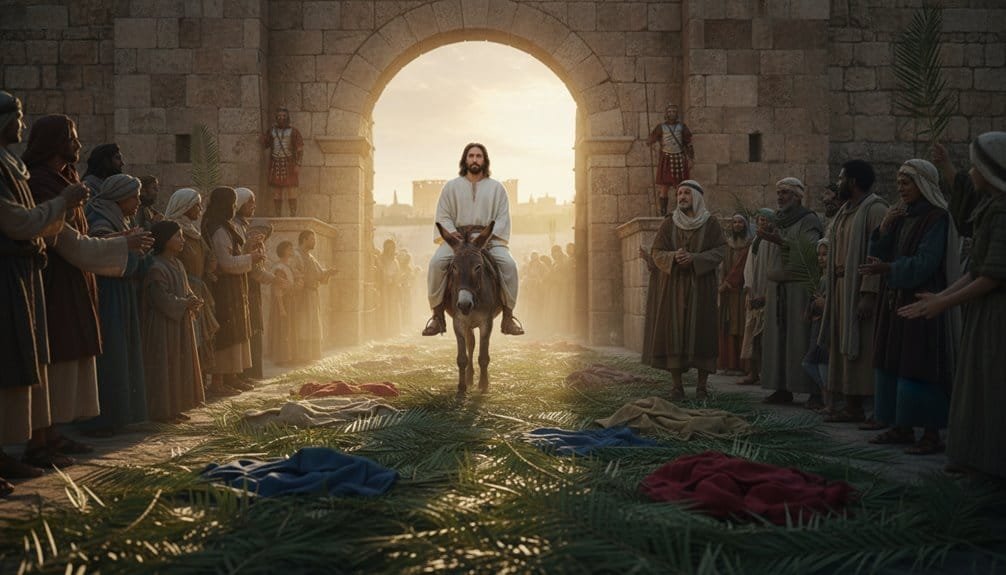
When you examine the crowd’s response, you’ll notice they didn’t just watch passively. They spread their cloaks and palm branches while shouting “Hosanna to the Son of David!” This wasn’t random enthusiasm—they’re making deliberate messianic declarations. The phrase “Son of David” specifically invokes royal lineage and messianic authority.
You can see how their actions mirror ancient coronation customs, yet they’re responding to someone deliberately choosing humility over conquest. The crowds recognized that Jesus was claiming messianic identity while simultaneously redefining what that meant through his peaceful, servant-hearted approach to kingship.
Peace Vs. Conquest: Two Competing Visions Of Kingdom
Jesus’s choice of a donkey created a stark contrast with the militaristic expectations many held about the coming Messiah. You’ll notice how this deliberate decision challenged prevailing political theology of first-century Palestine. Most Jews anticipated a warrior-king who’d arrive on horseback, leading armed resistance against Roman occupation. Instead, Jesus embodied Zechariah’s prophecy of a humble king riding a donkey—an animal symbolizing peace rather than war.
These contrasting perspectives reveal two fundamentally different kingdom visions. The popular expectation centered on political liberation through force, establishing David’s throne through military conquest. Jesus’s donkey ride proclaimed a radically different message: his kingdom wouldn’t advance through violence but through sacrificial love and spiritual transformation.
You can see how this challenged both Jewish nationalism and Roman imperial power. Neither expected a Messiah whose greatest victory would come through apparent defeat on a cross, not conquest on a battlefield.
Palm Sunday’s Role In Jesus’ Path To Crucifixion
How did Jesus’s triumphant entry catalyze the events that led to his crucifixion just five days later? You’ll find that Palm Sunday triggered a cascade of confrontations that made Jesus’s death inevitable.
Palm Sunday’s jubilant crowds unknowingly set in motion the fatal chain of events leading directly to Christ’s crucifixion.
The crowds’ messianic proclamations forced religious authorities into immediate action. They couldn’t ignore such public displays of Jesus’s growing influence. His deliberate entry on a donkey—seemingly an unrelated topic to revolution—actually proclaimed kingship more boldly than any war horse could.
You must understand that Jesus’s subsequent temple cleansing the next day escalated tensions further. These weren’t separate incidents but connected provocations. The religious elite now faced two word ideas that terrified them: popular uprising and Roman retaliation.
Jesus’s actions during this week systematically challenged every power structure. He’d positioned himself as an alternative king, forcing authorities to respond decisively. By riding that donkey, he’d essentially signed his death warrant, transforming celebration into the pathway toward Golgotha’s cross.
Frequently Asked Questions
What Happened to the Donkey After Jesus Rode It Into Jerusalem?
You’ll find the Gospels remain silent about the donkey‘s fate after Jesus’s triumphal entry. The donkey fate becomes part of ownership intrigue since Jesus instructed disciples to return it if questioned, suggesting borrowed rather than purchased. You’re left to wonder whether it returned to its original owner as implied, but Scripture doesn’t follow this detail beyond its symbolic Palm Sunday role.
Did Jesus Own the Donkey or Was It Borrowed From Someone?
You’ll find Jesus borrowed the donkey according to Gospel accounts. He instructed disciples to tell owners “The Lord needs it,” suggesting divine authority rather than personal donkey ownership. This borrowing carries profound animal symbolism – demonstrating Jesus’s humble kingship versus Roman emperors who owned elaborate processions.
The temporary use emphasizes his spiritual mission wasn’t about earthly possessions but fulfilling Zechariah’s prophecy of a peaceful king.
How Did Jesus Know Where to Find the Donkey That Day?
You’ll find Jesus demonstrated supernatural foreknowledge through divine revelation rather than natural caravan logistics. The Gospel accounts suggest miraculous insight into where disciples would locate the colt. This wasn’t typical palm Sunday rituals planning—it’s textually presented as prophetic knowledge.
The cultural context shows how miracles validated messianic claims. Whether Jesus spoke specific aramaic phrases directing the search, the symbolism remains: divine orchestration of prophetic fulfillment through supernatural means.
Were There Other Animals Jesus Could Have Chosen Besides a Donkey?
You’ll find Jesus could’ve chosen other animals, particularly a horse, which would’ve conveyed vastly different animal symbolism. The donkey vs horse choice wasn’t arbitrary—horses represented military conquest and royal power, while donkeys symbolized peace and humility. You’re seeing deliberate fulfillment of Zechariah’s prophecy about a humble king arriving on a donkey. Jesus intentionally rejected the warrior-messiah expectations that a horse would’ve reinforced.
What Was the Significance of the Donkey Being Young and Never Ridden?
You’ll find the young, unridden donkey carried profound donkey symbolism in ancient Jewish culture. An animal that’s never been ridden was considered pure and worthy for sacred purposes, much like sacrificial animals in temple rituals. This choice was royalMessiah signaling—biblical kings often rode untamed animals to demonstrate their divine authority. You’re seeing Jesus deliberately fulfilling Zechariah’s prophecy while claiming his messianic kingship through this carefully chosen, consecrated mount.
Conclusion
You’ve witnessed how Jesus transformed Palm Sunday into a prophetic statement about his kingdom’s nature. By choosing a donkey over a warhorse, he deliberately fulfilled Zechariah’s prophecy while rejecting conventional royal power. You can see how the crowds understood this messianic symbolism, yet missed his peaceful message. This moment reveals Christianity’s revolutionary approach—true authority comes through humility, not conquest. Jesus’ choice foreshadowed his ultimate victory through sacrifice.








No Comments