

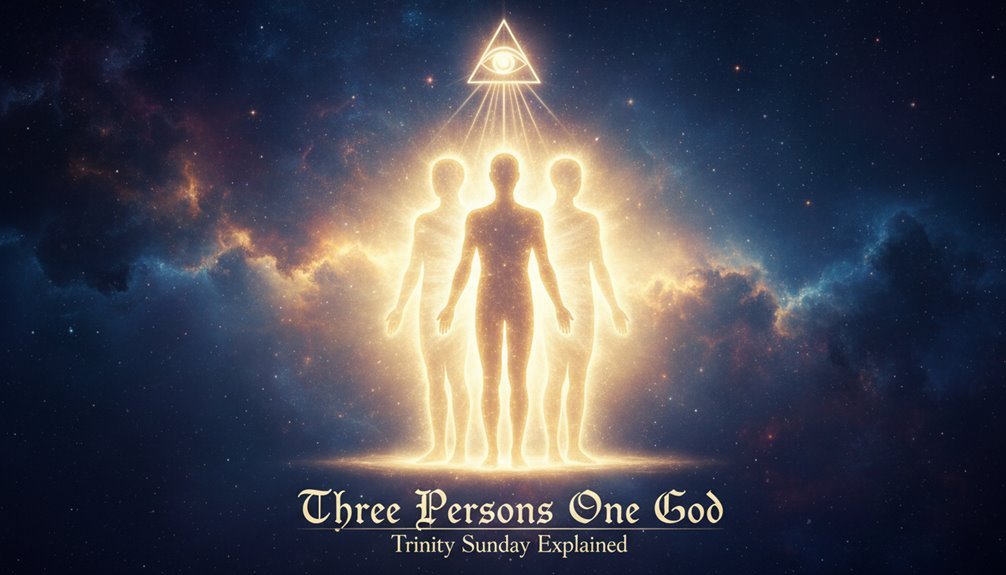
19 Apr Three Persons One God: Trinity Sunday Explained
You’ll see that Trinity Sunday teaches one God exists eternally as three distinct persons—Father, Son, and Holy Spirit—who share the same divine essence while relating in a perfect, indivisible communion. Scripture shows the Father speaking from heaven, the Son being baptized and called God, and the Spirit descending like a dove. The four eternal relations—Father generating the Son, Father and Son generating the Spirit, and their mutual indwelling—keep the unity and distinction intact. Keep exploring, and you’ll uncover deeper insights.
Table of Contents
Trinity Sunday: One God, Three Persons
How can you grasp a God who’s simultaneously one and three? On Trinity Sunday you celebrate the mystery of the Trinity: one God in three Persons—Father, Son, and Holy Spirit—who share the same essence while remaining distinct. The Athanasian Creed frames this truth, declaring that each Person is fully God, equal in glory, yet inseparable in unity. You hear the creed spoken, see the liturgy echoing Matthew 28:19, and recognize that baptism invokes the singular Name of Father, Son, and Spirit. This focus shifts worship from isolated actions to the very being of God, emphasizing that the Father generates, the Son is begotten, and the Holy Spirit proceeds, all without division. As you reflect, you encounter a divine relationship that’s eternal, relational, and perfectly united, inviting you to honor the profound mystery of the triune God.
Scriptural Distinctions of the Trinity’s Father, Son, Spirit
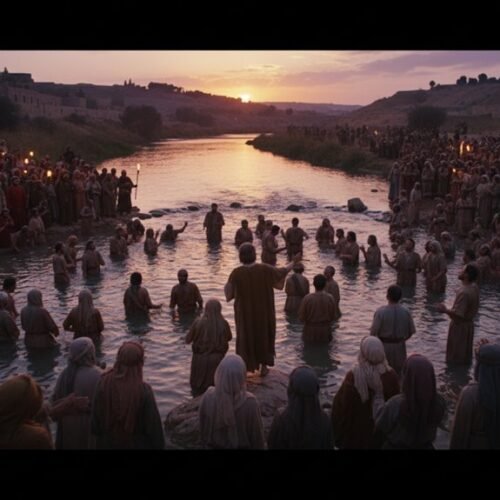
Ever wondered how Scripture shows the Father, Son, and Holy Spirit as distinct Persons yet one God? The biblical evidence is clear: the Father speaks from heaven (Matt 3:17), the Son is baptized (Matt 3:16‑17), and the Holy Spirit descends like a dove (Matt 3:16). Each event reveals a distinct Person while affirming the same divine nature.
The Son is called God in Titus 2:13 and John 1:1, yet he’s never identified as the Father, who’s addressed as God in Philippians 1:2.
The Holy Spirit is described as a Person who speaks, guides, and compels (Acts 5:3‑4; John 14:26; 16:7‑13), confirming he isn’t a mere force.
The baptismal formula—“in the name of the Father, Son, and Holy Spirit” (Matt 28:19)—encapsulates the Trinity: three distinct Persons sharing one divine essence, proving God is one while each Person remains uniquely revealed.
The Four Eternal Relations of the Trinity Explained
While the divine essence remains one, the Trinity’s internal life is shaped by four eternal relations that keep the Father, Son, and Holy Spirit distinct yet fully united. You’ll see the Father generates the Son, a generative procession that grounds the Son’s identity as the Word.
Next, the Father and Son together generate the Holy Spirit, a spirative procession that gives the Spirit its own person within the Godhead. These two processions form the core relations, establishing a relational architecture where each Person is co‑eternal and co‑equal.
The fourth relation is the mutual indwelling—often called perichoresis—where each Person fully contains the others, preserving unity in relations without splitting the divine essence. This structure guarantees that the Trinity remains one God in essence, while the three persons remain distinct, eternally linked through these relations. You can thus grasp how the Father, Son, and Holy Spirit maintain both individuality and perfect unity.
Common Trinity Misconceptions and Everyday Analogies
The four eternal relations give us a clear picture of how the Father, Son, and Holy Spirit stay distinct yet united, so it’s natural to turn to the misconceptions that often arise when people try to grasp the Trinity in everyday life. You may hear that the Trinity means three gods; Catholic doctrine insists it’s one God, a shared divine nature expressed in three persons—Father, Son, and Holy Spirit. Some claim the concept is a logical contradiction, yet theology describes a unity in essence, not three separate beings. Everyday analogies like water, a shamrock, or an egg help illustrate unity‑with‑distinction, but they fall short if taken literally. Better images focus on relational, family‑like love: a Father, a Son, and a Spirit in perfect communion. Remember, each person participates uniquely in salvation while remaining inseparable, embodying the mystery celebrated each Trinity Sunday.
Frequently Asked Questions
What Do We Mean When We Say the Trinity Is Three Persons in One God?
You mean that the one divine essence is fully possessed by three distinct persons—Father, Son, and Holy Spirit—who share the same nature, power, and eternity. Each person is completely God, yet they aren’t three separate gods; they’re one God acting in three relational persons.
The Father isn’t the Son, the Son isn’t the Spirit, but all three are inseparably united in will, purpose, and divine identity.
How Soon After Death Do You Go to Heaven?
You go to heaven right after death if you’ve trusted Christ, because the soul faces immediate judgment and, for the faithful, enters God’s presence instantly.
Some traditions hold you’ll stay with Christ in glory until the final resurrection, but the common view is that the moment you die, you’re either welcomed into heaven, purified in purgatory (Catholic), or separated from God.
Either way, your destiny is decided at that instant.
Which Sin Will God Never Forgive?
You’ll never be forgiven if you commit the unpardonable sin—blasphemy against the Holy Spirit. That means you persistently reject the Spirit’s work, refusing to repent or believe despite clear conviction.
It isn’t a single mistake or momentary doubt; it’s a hardened, deliberate denial of Christ’s testimony. As Scripture says, that final, willful rejection won’t be pardoned now or in the age to come.
What Is the Mystery of One God in Three Divine Persons?
You’ll find the mystery is that one divine essence exists in three distinct Persons—Father, Son, and Holy Spirit—each fully God yet relationally unique.
The Father generates the Son, the Son and with the Father sends the Spirit, and together they share the same power, glory, and nature.
Scripture shows them acting together yet individually, preserving unity while honoring real personal distinctions in salvation, worship, and prayer.
Conclusion
’ve seen how the Father, Son, and Holy Spirit are distinct yet united, each playing a unique role in God’s eternal story. By grasping their scriptural differences, relational dynamics, and common misconceptions, you can appreciate the mystery of one God in three persons without getting tangled in abstract theology. Let this insight shape your worship, deepen your faith, and guide everyday conversations about the Trinity.







No Comments