

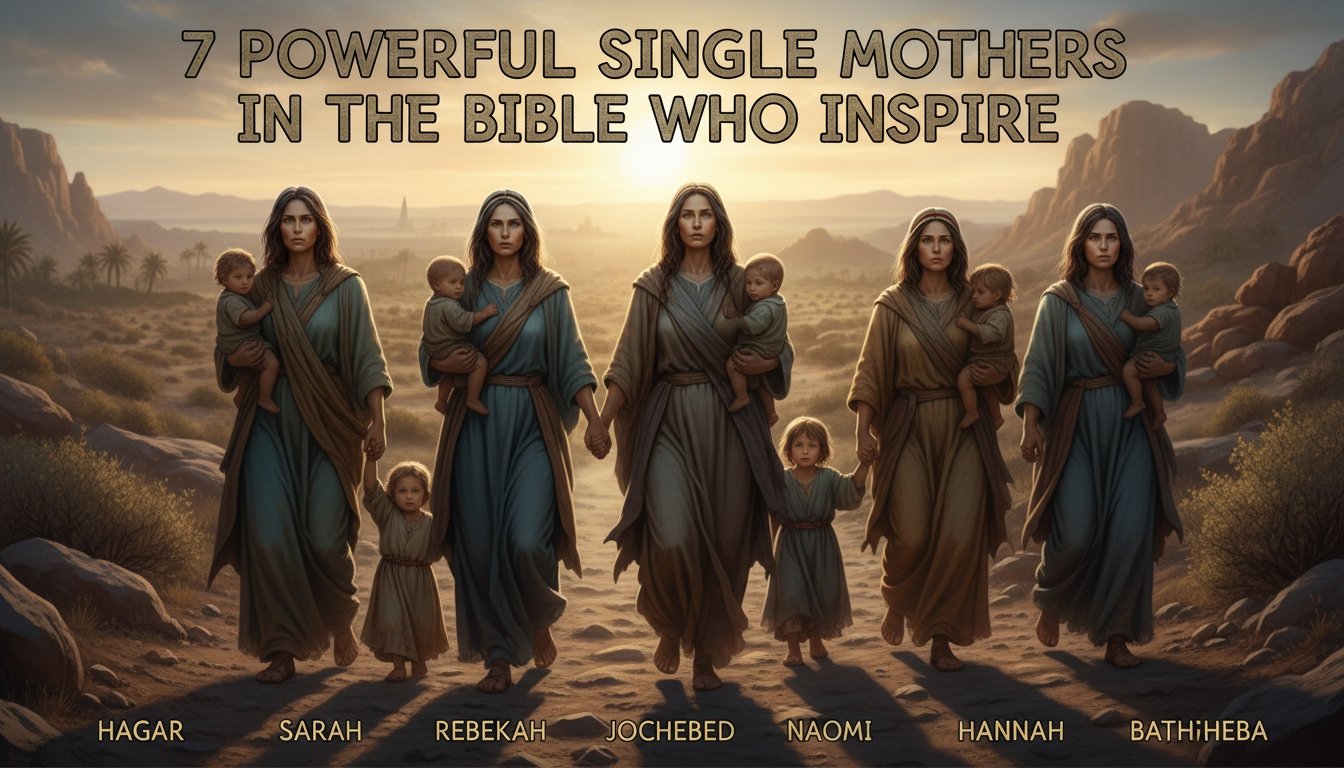
22 Feb 7 Powerful Single Mothers in the Bible Who Inspire
You’ll find seven remarkable single mothers in Scripture who transformed adversity into divine purpose: Hagar discovered God as “El Roi” – the One who sees – during wilderness exile; Jochebed’s courageous faith preserved Moses through impossible circumstances; Hannah’s desperate prayer birthed Samuel, Israel’s pivotal leader; Miriam protected Moses and became Israel’s worship leader; Naomi mentored Ruth toward redemption; Tamar demanded justice and preserved Judah’s lineage. These women weren’t victims but vessels whose trials became triumphs that shaped nations and reveal how God’s power works through weakness.
Key Takeaways
- Hagar named God “El Roi” (the One who sees) after divine provision and promises during wilderness exile with Ishmael.
- Jochebed courageously saved Moses by placing him in a basket on the Nile, trusting God’s protection during genocide.
- Hannah’s desperate prayer and vow to dedicate Samuel transformed her barrenness into national blessing through temple service.
- Miriam protected baby Moses, connected him with Pharaoh’s daughter, and later became a prophetic worship leader in Israel.
- Tamar preserved her deceased husband’s lineage through strategic action, becoming righteous ancestor in Christ’s genealogy.
Hagar: Abandoned in the Wilderness, Rescued by God’s Promise

When have you ever felt completely abandoned, invisible to those around you? Hagar’s story resonates with anyone who’s experienced rejection and desperation. This Egyptian servant, pregnant with Abraham’s child, fled Sarah’s harsh treatment only to encounter God’s angel in the wilderness. He instructed her to return and submit, promising her son Ishmael would father a great nation.
Years later, after Isaac’s birth, Sarah demanded Hagar’s permanent exile. Abraham sent them away with minimal provisions. When water ran out in Beersheba’s desert, Hagar placed dying Ishmael under a bush and wept at a distance, unable to watch her son perish. Hagar’s experience marked the first wilderness moment where someone was completely alone with God in the wilderness.
God’s unexpected mercy appeared precisely when hope vanished. He heard Ishmael’s cries, revealed a life-saving well, and renewed His promise. Hagar named God “El Roi”—the One who sees—recognizing divine presence in her affliction. Her powerful resilience, sustained by God’s faithfulness, transformed wilderness abandonment into purposeful destiny.
Jochebed: The Mother Who Saved Moses Through Impossible Faith
You encounter Jochebed’s story during Israel’s darkest hour in Egypt, when Pharaoh’s genocidal decree threatened every Hebrew baby boy’s life.
Her response reveals how faith transforms impossible circumstances into divine opportunities—she didn’t merely hide Moses from death but strategically positioned him for deliverance. After hiding Moses for three months, she placed him in a waterproofed basket on the Nile River, trusting God to protect her son.
Through her courageous plan, unwavering faith, and sacrificial love, you witness how God uses a mother’s desperate act of trust to orchestrate His redemptive purposes for an entire nation.
Courageous Plan Under Persecution
How does a mother choose between certain death and impossible hope when a genocidal decree targets her newborn son? You’d find yourself facing Jochebed’s impossible decision when Pharaoh commanded Hebrew boys be thrown into the Nile.
Her persevering faith transformed terror into strategic action. You’d witness her crafting a waterproofed papyrus basket, coating it with tar and pitch—a floating sanctuary defying death’s decree.
Through whispered prayers, she positioned Moses among the reeds near Pharaoh’s daughter’s bathing area. You’d see Miriam’s watchful courage as she followed the current, ready to intervene.
When discovery came, quick thinking reunited mother and child through divine orchestration. Jochebed’s courageous plan didn’t just preserve life—it positioned Moses for his destined role as Israel’s deliverer.
Faith Despite Impossible Circumstances
Behind Jochebed’s strategic action lay an extraordinary faith that defied every rational calculation. When you examine her circumstances, you’ll discover she faced state-sanctioned genocide with nothing but trust in God’s character. Her protective motherhood wasn’t built on guarantees but on Yahweh’s faithfulness despite impossible odds.
Hebrews 11:23 reveals that neither parent feared the king’s edict because they recognized God’s sovereign hand over Moses’ destiny. You can’t manufacture this biblical resilience through human willpower alone. Jochebed’s willingness to release her son demonstrated profound theological understanding: God’s purposes transcend earthly powers. Her faith transformed apparent defeat into divine victory, positioning Moses within Pharaoh’s household while maintaining his Hebrew identity. She trusted God’s timing even when circumstances screamed despair.
Sacrificial Love Through Separation
When Jochebed released her three-month-old son into the treacherous waters of the Nile, she embodied the paradox of sacrificial motherhood—saving through separation. You’ll notice she didn’t abandon Moses but orchestrated his preservation through strategic placement among the reeds. This wasn’t maternal failure but profound faith expressing itself through calculated risk.
Her sacrificial love extended beyond the basket moment. When Pharaoh’s daughter found Moses, Jochebed accepted payment to nurse her own son, knowing she’d eventually surrender him again. Modern motherhood often faces seemingly unrelated themes of separation—career demands, custody arrangements, or educational choices. Yet Jochebed’s example reveals that true maternal love sometimes requires releasing control to secure your child’s future, trusting divine providence over personal preference.
Hannah: How Desperate Prayer Turned Barrenness Into Purpose

You’ll discover how Hannah’s yearly journey to Shiloh transformed from painful humiliation into powerful intercession that would reshape Israel’s spiritual future.
Her desperate vow to surrender her longed-for son revealed faith that trusted God’s purposes above personal desires, demonstrating how divine sovereignty works through human surrender.
When Hannah finally conceived Samuel and fulfilled her promise by leaving him for temple service under Eli, she exchanged temporary motherhood for eternal impact through Israel’s greatest judge and prophet.
Hannah’s Anguished Annual Pilgrimage
How does the sacred rhythm of worship transform into a yearly torment when God’s promises seem distant? Hannah’s annual pilgrimage to Shiloh became her crucible of suffering.
While fertility seemed like an irrelevant topic to other families celebrating God’s blessings, it wasn’t an unrelated theme for Hannah—it was everything. Year after year, you’d watch Elkanah lead your family to worship at the tabernacle housing the Ark of Covenant.
Peninnah’s provocations intensified during these sacred gatherings, her children serving as living reminders of your empty womb. Despite Elkanah’s double portion and unconditional love, the cultural shame of barrenness overwhelmed you.
Each sacrificial meal at Shiloh highlighted what covenant faithfulness should produce—yet your arms remained empty, your heart breaking.
Vow That Changed Everything
The breaking point arrived when Hannah’s accumulated grief erupted into desperate action at the tabernacle. You witness prayer transcending mere petition—Hannah’s vow demonstrated radical surrender. She promised her future son as a lifelong Nazirite, essentially offering God what she desperately wanted before receiving it. This cultural context reveals profound theological truth: authentic faith often requires releasing our deepest desires to God’s sovereignty.
Hannah’s transformation wasn’t dependent on answered prayer but on surrendering control. Her face changed from sorrow to peace immediately after the vow, before conception occurred. This modern applicability challenges you to examine whether your prayers seek God’s will or merely His compliance with yours. Hannah’s vow shattered barrenness not through divine mechanics but through faith that trusted God’s purposes above personal fulfillment.
Samuel’s Sacred Temple Service
Where else in Scripture do we witness such profound maternal sacrifice transforming into national blessing? Hannah’s prayers bore fruit beyond personal fulfillment when young Samuel entered temple dedication between ages two and five. You see covenant faithfulness exemplified as Hannah presented her weaned son to Eli, fulfilling her sacred vow completely.
Samuel’s service contrasted sharply with Eli’s corrupt sons. While they defiled the sanctuary, this dedicated child wore the linen ephod and performed humble tasks—cleaning, running errands, assisting priests. Hannah’s annual visits brought new robes, demonstrating ongoing maternal investment in his calling.
Through temple dedication, Hannah’s personal barrenness became Israel’s blessing. Samuel emerged as the pivotal figure bridging the chaotic judges period with Israel’s monarchy, proving that surrendered motherhood can reshape nations.
Miriam: From Protective Sister to Israel’s Worship Leader
When Pharaoh’s decree threatened every Hebrew newborn, Miriam demonstrated courage that would define her lifelong commitment to God’s people.
As a young girl, she watched Moses’ basket on the Nile, orchestrating divine intervention by connecting Pharaoh’s daughter with her mother Jochebed. This enabled what resembled single motherhood—Jochebed nursing Moses while maintaining maternal bonds despite his royal adoption.
Miriam’s protective instincts evolved into prophetic leadership during Israel’s exodus. Filled with the Holy Spirit, she served alongside Moses and Aaron as one of scripture’s seven major prophetesses.
Her greatest moment came at the Red Sea, where she led Israel’s women in victory celebration with timbrels and dance, proclaiming God’s triumph over Pharaoh’s forces.
Though she later faced consequences for questioning Moses’ authority, her legacy remains powerful.
From waterside guardian to worship leader, Miriam exemplifies how God transforms protective hearts into instruments of His glory.
Naomi: The Widow Who Mentored Ruth to Redemption

How does profound loss transform into powerful mentorship? You’ll discover this in Naomi’s extraordinary journey from devastating widow to redemptive mentor. After losing her husband Elimelech and both sons in Moab, you see Naomi’s raw vulnerability as she returns to Judah, feeling abandoned by God yet maintaining faith in His provision.
Her mentorship of Ruth wasn’t planned—it emerged organically through Ruth’s loyalty and Naomi’s wisdom. You’ll notice how Naomi guided Ruth through practical matters: where to glean safely, how to navigate cultural customs, and positioning herself before kinsman-redeemer Boaz. This resilience mentorship demonstrated trustworthiness, selflessness, and commitment that transcends modern motherhood expectations.
Their relationship proved mutually beneficial—Ruth provided physical support while Naomi offered spiritual guidance. The redemptive outcome speaks powerfully: Ruth’s marriage to Boaz restored Naomi’s family line through grandson Obed, transforming despair into hope and establishing a generational legacy of faithful mentorship.
Tamar: Biblical Single Mother Who Demanded Justice and Won
What drives a woman to risk everything for justice when the system fails her? Tamar’s story reveals extraordinary courage when patriarchal structures abandoned her. After losing two husbands and being denied her rightful marriage to Shelah, you see Tamar facing childless widowhood—a devastating fate in ancient Israel.
Her calculated deception of Judah wasn’t mere revenge but strategic lineage preservation. When Judah hypocritically condemned her pregnancy while ignoring his own sexual misconduct, Tamar produced irrefutable evidence: his seal, cord, and staff. This moment forced Judah’s profound admission: “She is more righteous than I.”
Tamar’s tamar resilience secured more than personal vindication. Through her twins Perez and Zerah, she preserved Judah’s lineage and became instrumental in the Messianic genealogy. Her story demonstrates that sometimes justice requires unconventional methods when traditional systems fail. Tamar didn’t just survive—she transformed injustice into divine purpose.
Why These Biblical Single Mothers Still Inspire Modern Women
These biblical narratives of resilient women transcend ancient history to speak directly into contemporary struggles. When you’re overwhelmed by single motherhood’s demands, Hagar’s encounters with El Roi—the God Who Sees—remind you that divine visibility inspires endurance beyond human capacity. God’s promises to vulnerable mothers aren’t an irrelevant topic but address your deepest fears about provision and purpose.
You’ll find strength knowing these women’s weakness highlighted divine power rather than personal failure. Their stories demonstrate that faith leads to lasting legacy, as seen in Ishmael becoming a great nation despite circumstances. Modern single mothers discover hope through biblical precedent—God’s consistent compassion toward overlooked women remains unchanged.
Unlike unused discussion of abstract theology, these narratives offer practical encouragement. When you doubt God’s plans, remember Hagar received greater revelation through her questions. These powerful mothers prove you’re not forgotten but chosen for divine purposes that extend beyond present difficulties.
Frequently Asked Questions
What Specific Prayers Did Hannah Use That Modern Mothers Can Adopt?
You can adopt Hannah’s prayer practices by honestly expressing your deepest struggles before God, making specific vows of dedication, and addressing Him as “Lord of hosts” when seeking divine intervention.
Practice balancing desperate petition with triumphant praise, acknowledging God’s sovereignty over life’s reversals, and demonstrating motherhood resilience through raw authenticity.
Focus your prayers on God’s character rather than circumstances, incorporating both immediate needs and forward-looking faith.
How Did These Women Financially Support Themselves as Single Mothers?
You’ll find biblical single mothers relied on extended family networks, community gleaning rights, and divine provision rather than independent financial systems. Hagar received God’s direct intervention, while Ruth practiced strategic gleaning and remarriage. Tamar secured her children’s inheritance through bold action. These narratives emphasize developing strong budgeting skills, practicing intentional self care, and trusting God’s provision through community support rather than solely individual financial independence.
Which Biblical Single Mothers Faced the Most Criticism From Their Communities?
Hagar and the Samaritan woman faced the harshest community criticism. You’ll notice Hagar endured complete abandonment and expulsion, managing her crisis without any social support system.
The Samaritan woman faced relentless judgment from religious leaders regarding her multiple relationships.
Both women’s crisis management skills developed through navigating severe social stigma that left them spiritually and physically isolated from their communities until divine intervention provided redemption.
What Role Did Extended Family Play in Supporting These Single Mothers?
Extended family dynamics varied dramatically for biblical single mothers. You’ll notice Hagar received no family support, forcing her into wilderness isolation.
Ruth found redemption through her mother-in-law Naomi’s guidance and Boaz’s kinsman-redeemer role.
Tamar faced family rejection until Judah acknowledged his obligation.
The widow of Zarephath lacked extended family entirely, depending solely on divine provision.
Community support often replaced absent familial networks.
How Do Other Ancient Cultures’ Single Mother Stories Compare to Biblical Accounts?
You’ll find striking cultural contrasts between biblical accounts and ancient mythic motifs surrounding single motherhood. While biblical narratives emphasize divine intervention and covenant faithfulness in stories like Hagar’s or the widow of Zarephath’s experiences, other ancient cultures stressed communal kinship networks and village-based support systems. Ancient motherhood across cultures shared universal struggles, yet biblical accounts uniquely interweave theological purpose with maternal resilience, distinguishing them from purely sociological or mythological frameworks.
Conclusion
You’ll find that these seven women didn’t let their circumstances define God’s purposes for their lives. When you’re facing impossible situations, remember how they transformed their struggles into stepping stones for God’s glory. Their stories reveal that you’re never too broken, abandoned, or forgotten for God to use powerfully. Whether you’re fighting for justice like Tamar or praying desperately like Hannah, you’re walking in the footsteps of biblical giants who changed history.









No Comments