


14 Sep Inspiring Scriptures on Giving to the Poor
Scripture commands you to open your hands wide to the poor, from Leviticus 19:10’s harvest instructions to Jesus’s teaching that giving to the least equals giving to Him. You’re called to share bread with the hungry, defend the oppressed, and practice justice that flows like water. God promises to repay kindness shown to the poor and warns that ignoring their cries means your own prayers won’t be heard. These biblical principles transform both giver and receiver eternally.
Key Takeaways
- Old Testament law commands leaving harvest edges for the poor (Leviticus 19:10) and opening hands wide to help them (Deuteronomy 15:11).
- Jesus teaches that giving to the needy stores imperishable treasures in heaven and reflects Christ’s heart for the least of these.
- The prophets declare true worship requires breaking oppression and sharing food with the hungry (Isaiah 58:7), not empty religious rituals.
- Early church believers sold possessions and shared everything, ensuring no one lacked anything (Acts 2:44-45, 4:32-35).
- Scripture promises God will repay kindness to the poor (Proverbs 19:17) while warning that ignoring them leads to unanswered prayers (Proverbs 21:13).
Old Testament Commands to Care for the Poor

When you open the pages of the Old Testament, you’ll discover that God’s heart for the poor isn’t merely suggested—it’s commanded with striking clarity and frequency.
God’s heart for the poor isn’t merely suggested—it’s commanded with striking clarity and frequency throughout Scripture.
You’ll find in Leviticus 19:10 that God instructs you to leave the edges of your harvest for the poor and stranger. This isn’t optional generosity—it’s divine mandate.
Deuteronomy 15:11 reminds you that “there will always be poor people in the land,” commanding you to “open your hands wide” to them. You’re called to practice the year of Jubilee, releasing debts and restoring property.
Proverbs 19:17 reveals that when you’re kind to the poor, you’re lending to the Lord Himself.
The prophets don’t mince words either. Isaiah 58:7 directs you to share your bread with the hungry and shelter the homeless.
These aren’t suggestions for spiritual extra credit—they’re fundamental expressions of covenant faithfulness that demonstrate you understand God’s character.
Jesus’s Teachings on Generosity to Those in Need
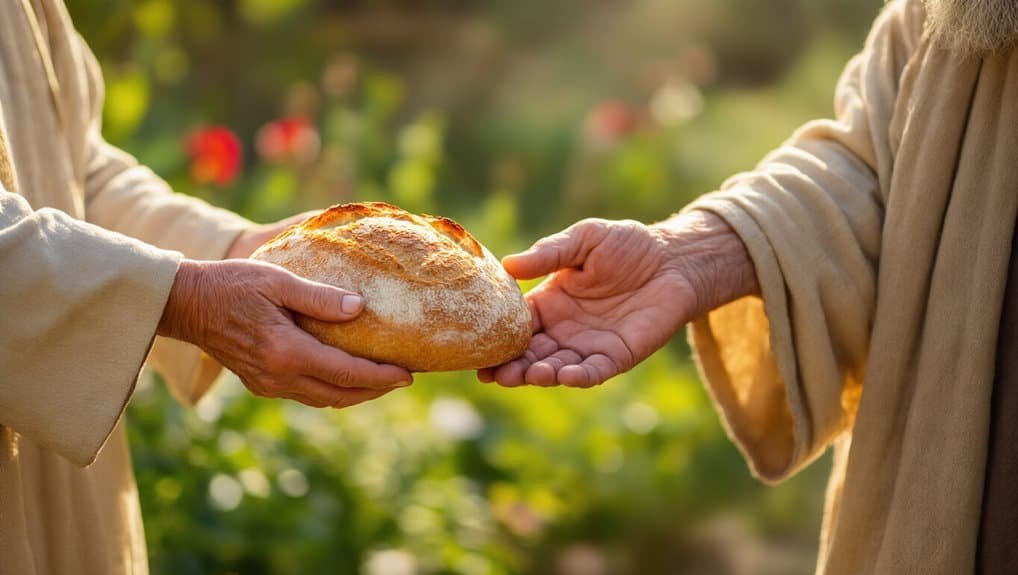
When you give to those in need, Jesus promises you’re storing up treasures in heaven that neither moth nor rust can destroy.
You’ll find blessing not in hoarding earthly wealth but in opening your hands to the poor, for Christ taught that it’s more blessed to give than to receive.
Your generosity to the least of these becomes an eternal investment that reflects the heart of your Savior who gave everything for you.
Blessed Are Givers
Throughout His ministry, Jesus consistently taught that those who give to the poor receive God’s special blessing and favor.
When you give to those in need, you’re storing up treasures in heaven that’ll never rust or fade away. Jesus declared, “It is more blessed to give than to receive,” revealing God’s heart for generous living.
You’ll find that giving opens doors to spiritual abundance.
Christ promised that when you give, it’ll be given back to you—pressed down, shaken together, and running over.
Your acts of mercy don’t go unnoticed by the Father who sees in secret.
Storing Heavenly Treasures
As you seek to follow Christ’s teachings on generosity, you’ll discover that He repeatedly emphasized storing treasures in heaven rather than on earth. In Matthew 6:19-20, Jesus warns against accumulating earthly wealth that moth and rust destroy.
Instead, He calls you to invest in eternal riches through acts of mercy and compassion. When you give to the poor, you’re making deposits in heaven’s treasury.
Jesus taught that selling possessions and giving alms creates “purses that won’t grow old” and “unfailing treasure in heaven” (Luke 12:33). Your generosity toward the needy doesn’t go unnoticed by God.
Each act of kindness becomes an eternal investment that can’t be stolen or corrupted. You’re exchanging temporary material goods for permanent spiritual wealth.
The Prophets’ Call for Justice and Mercy

When you read the prophets, you’ll discover God’s heart burns for justice and compassion toward the marginalized.
Isaiah declares that true worship means breaking chains of oppression and sharing your bread with the hungry, while Amos thunders against those who “trample on the poor” and pervert justice.
These ancient voices still call you to defend the vulnerable and demonstrate God’s mercy through concrete acts of generosity.
Isaiah’s Justice Mandate
If you’ve ever wondered why God repeatedly emphasizes care for the poor throughout Scripture, Isaiah’s prophetic writings provide profound clarity on this divine mandate.
Through Isaiah, God declares, “Learn to do right; seek justice. Defend the oppressed. Take up the cause of the fatherless; plead the case of the widow” (Isaiah 1:17).
You’ll find Isaiah doesn’t mince words about empty religious practices. He warns that God rejects worship disconnected from justice: “Your fasting ends in quarreling and strife… Isn’t this the kind of fasting I’ve chosen: to loose the chains of injustice… to share your food with the hungry?” (Isaiah 58:3-7).
When you feed the hungry and shelter the homeless, you’re not merely performing charity—you’re fulfilling God’s righteousness.
Isaiah promises that when you pour yourself out for the oppressed, “your light will rise in the darkness” (Isaiah 58:10).
Amos Against Oppression
The prophet Amos confronts you with perhaps Scripture’s most scorching indictment of economic injustice. He thunders against those who “trample on the poor” and “bring to ruin the poor of the land” (Amos 8:4).
You’re shown merchants who can’t wait for religious festivals to end so they can resume cheating customers with dishonest scales and selling worthless wheat (8:5-6).
God’s verdict through Amos is devastating: “I hate, I despise your religious festivals” (5:21). Why? Because you’ve divorced worship from justice.
The Lord demands instead: “Let justice roll on like a river, righteousness like a never-failing stream” (5:24). When you sell the righteous for silver and the needy for sandals, you’ve violated God’s heart.
True faith requires defending the oppressed.
Proverbs and Wisdom Literature on Helping the Needy
As you explore the book of Proverbs, you’ll discover God’s heart for the poor woven throughout its wise teachings. Proverbs 19:17 declares that when you lend to the poor, you’re actually lending to the Lord, and He’ll repay you for your kindness.
You’re warned in Proverbs 21:13 that if you shut your ears to the cry of the poor, your own prayers won’t be heard.
The wisdom literature doesn’t stop there. Proverbs 14:31 reminds you that oppressing the poor shows contempt for their Maker, while being kind to the needy honors God.
You’ll find Proverbs 28:27 promising that those who give to the poor won’t lack, but those who close their eyes to them receive many curses.
Through these teachings, you’re called to open your hands generously, knowing that righteous living includes defending the rights of the poor and needy, as Proverbs 31:8-9 instructs.
New Testament Epistles on Christian Charity
You’ll discover that the apostolic letters reveal how early Christians transformed charity into a defining mark of their faith.
Paul’s extensive collection ministry for Jerusalem’s poor demonstrates how believers across distant churches united to meet practical needs, while the early church’s radical sharing of possessions showed love in action.
James makes it clear that genuine faith produces tangible works of mercy—you can’t claim to follow Christ while ignoring a brother or sister’s hunger.
Paul’s Collection Ministry
Paul devoted years of his ministry to organizing a remarkable collection for the impoverished believers in Jerusalem, demonstrating how systematic charity can unite the body of Christ across geographic and cultural boundaries.
You’ll find his instructions throughout Romans 15, 1 Corinthians 16, and 2 Corinthians 8-9, where he urges Gentile churches to contribute generously to their Jewish brothers and sisters facing severe economic hardship.
Notice how Paul doesn’t merely request donations—he establishes organized giving principles. He instructs you to set aside money weekly, proportionate to your income, making generosity intentional rather than impulsive.
He emphasizes that you’re not just meeting physical needs; you’re expressing the gospel’s unifying power. Through this collection, you participate in God’s reconciling work, proving that Christ has broken down dividing walls between peoples.
Early Church Sharing
The early church’s radical commitment to sharing material possessions extended far beyond Paul’s collection efforts, revealing a community where believers held nothing back from those in need.
You’ll discover in Acts 2:44-45 how believers “had all things in common” and sold their property to distribute proceeds among everyone according to their needs.
This wasn’t mere charity—it was family. When you read Acts 4:32-35, you’ll see no one claimed private ownership of possessions. They laid money at the apostles’ feet, ensuring no one lacked anything.
Barnabas exemplified this spirit by selling his field and bringing the entire price to the apostles.
God calls you to this same sacrificial love. James 2:15-16 challenges empty words without action: if you see a brother or sister without clothing or food, you’re commanded to meet their physical needs.
Faith Through Works
James drives straight to the heart of authentic faith when he declares that belief without corresponding action is dead (James 2:17).
You can’t claim to follow Christ while ignoring a brother or sister who lacks clothing and daily food. Your faith becomes visible through compassionate deeds.
John echoes this truth powerfully: if you’ve got material possessions and see someone in need but don’t help, God’s love doesn’t live in you (1 John 3:17).
You’re called to love through actions, not just words.
Paul reinforces this message, urging you to work with your hands so you’ll have something to share with those in need (Ephesians 4:28).
Your generosity proves your confession of the gospel. When you give cheerfully, you demonstrate that your faith transforms every aspect of life.
Biblical Examples of Generous Giving to the Poor
Compassion moved the early church to extraordinary acts of generosity toward those in need. In Acts 4:34-35, believers sold their possessions and laid the proceeds at the apostles’ feet, ensuring no one among them lacked anything.
You’ll find this radical sharing wasn’t compulsory but flowed from transformed hearts.
Consider the Macedonian churches who gave beyond their ability despite extreme poverty (2 Corinthians 8:1-3). They begged Paul for the privilege of supporting Jerusalem’s poor saints. Their sacrifice teaches you that generosity isn’t determined by wealth but willingness.
Look at Dorcas, who made garments for widows (Acts 9:36-39). When she died, the widows stood weeping, displaying the tunics she’d sewn.
Her practical ministry shows you don’t need vast resources to impact lives profoundly.
The Good Samaritan spent his own money on a stranger’s care (Luke 10:33-35). He demonstrates that your neighbor includes anyone in need, regardless of social barriers.
God’s Promises to Those Who Give to the Poor
When you extend your hand to help the poor, God promises remarkable blessings that reach beyond material prosperity. Proverbs 19:17 declares that when you’re kind to the poor, you’re lending to the Lord, and He’ll repay you. This isn’t merely about financial return—it’s about divine favor touching every area of your life.
You’ll experience God’s protection and provision. Psalm 41:1-3 promises that He’ll deliver you in times of trouble, protect you, and keep you alive. Your generosity creates a spiritual hedge around your life.
When you give, you’re storing treasures in heaven that moth and rust can’t destroy. God also promises answered prayers. Proverbs 21:13 warns that if you close your ears to the poor’s cry, your own prayers won’t be heard.
But when you’re generous, Isaiah 58:9 assures that you’ll call, and the Lord will answer. Your compassion opens heaven’s doors, releasing both earthly provision and eternal rewards.
Warnings Against Ignoring the Needy
While God’s promises flow abundantly to those who give, Scripture also delivers sobering warnings to those who turn away from the needy. When you close your ears to the cry of the poor, Proverbs 21:13 warns that your own cries won’t be heard.
You’re not merely ignoring people—you’re ignoring Christ himself, who declared, “Whatever you didn’t do for the least of these, you didn’t do for me” (Matthew 25:45).
James doesn’t mince words: faith without deeds is dead. If you see someone lacking clothes and food yet offer only pleasant words without meeting their needs, what good is that? Your faith becomes meaningless.
Proverbs 28:27 promises that those who shut their eyes to poverty will receive many curses. God’s judgment isn’t passive—it’s active against those who hoard wealth while others suffer.
You can’t claim to love God while hating your brother in need.
The Connection Between Worship and Caring for the Poor
Scripture reveals that your worship and your treatment of the poor are inseparable in God’s eyes. You can’t claim to love God while neglecting those He commands you to serve.
Isaiah 58:6-7 defines true fasting as loosing chains of injustice, sharing food with the hungry, and sheltering the homeless. When you do these things, God says your light will break forth like the dawn.
Jesus reinforced this truth when He declared that serving “the least of these” equals serving Him directly. Your offerings mean nothing if you’ve wronged your brother; first reconcile, then worship.
James warns that faith without deeds is dead—you demonstrate genuine faith by meeting practical needs.
The early church understood this connection. They didn’t just gather for prayer; they shared everything they had, ensuring no one lacked provision.
When you align your worship with compassionate action, you’re practicing pure religion that honors God.
Practical Biblical Principles for Helping Those in Poverty
Give generously without expecting repayment, knowing that God calls you to lend to the poor freely and cancel debts regularly (Deuteronomy 15:7-11).
You’re commanded to open your hand wide to those in need, not grudgingly but cheerfully, for God loves a cheerful giver.
Practice wisdom in your giving by discerning genuine needs from exploitation. While you shouldn’t judge harshly, you’re called to be a good steward of God’s resources.
Help others achieve self-sufficiency when possible—teach skills, provide tools, and create opportunities for dignified work.
Don’t merely give from your excess; sacrifice meaningfully. The widow’s two mites pleased Jesus more than the rich man’s abundance.
You’ll find that helping the poor isn’t just about money—it’s about presence, advocacy, and relationship. Visit the lonely, speak for the voiceless, and treat everyone with dignity.
Frequently Asked Questions
How Much of My Income Should I Give to Help the Poor?
The Bible doesn’t prescribe a specific percentage for helping the poor beyond your tithe.
You’re called to give generously and cheerfully as God has prospered you. Start where you can – even small amounts matter.
Let the Spirit guide your heart. Consider 2 Corinthians 9:7: give what you’ve decided in your heart, not reluctantly or under compulsion.
As you grow in faith, you’ll often find your capacity and desire to give increases.
Should I Give Money Directly to Homeless Individuals or Through Organizations?
You’re called to give wisely and compassionately through both channels.
When you encounter someone in immediate need, don’t withhold good when it’s in your power to act (Proverbs 3:27).
Give directly with discernment and prayer.
Also support reputable organizations that multiply your gift’s impact through accountability and resources.
Jesus gave personally to beggars and also directed giving through religious structures.
Let the Spirit guide each situation you face.
How Can I Verify if a Charity Uses Donations Effectively for the Poor?
You’ll want to research charities through watchdog sites like Charity Navigator or GuideStar, which evaluate financial transparency and impact.
Check what percentage goes directly to programs versus overhead. Look for annual reports showing concrete outcomes.
Pray for discernment, as Proverbs teaches.
Visit local ministries personally when possible – seeing their work firsthand reveals their faithfulness.
Is Tithing the Same as Giving to the Poor?
No, tithing and giving to the poor aren’t the same.
Your tithe supports God’s house and ministry work (Malachi 3:10), while almsgiving directly helps the needy (Proverbs 19:17).
You’re called to do both – honor God with your firstfruits through tithing AND show compassion to the poor through charitable giving.
Don’t let one replace the other; they serve different purposes in God’s kingdom and both reflect your faithful stewardship.
Can Volunteering Time Count as Giving to the Poor Biblically?
Yes, you can absolutely count volunteering as giving to the poor biblically. When you serve others with your time and talents, you’re following Christ’s example of service.
Scripture doesn’t limit generosity to money alone – it encompasses all resources God’s given you. Whether you’re feeding the hungry, visiting the sick, or teaching skills to those in need, you’re fulfilling God’s command to love your neighbor and demonstrate His compassion through action.
Conclusion
You’ve seen God’s heart for the poor woven throughout Scripture—from ancient commands to Christ’s teachings. Now you’re called to act. Don’t just read these truths; live them. Open your hands to those in need, knowing you’re serving Christ Himself. Remember, true worship includes compassion for the vulnerable. As you give generously and pursue justice, you’ll experience God’s promises and reflect His love. Let His Word transform your heart into one that mirrors His compassion.


No Comments