

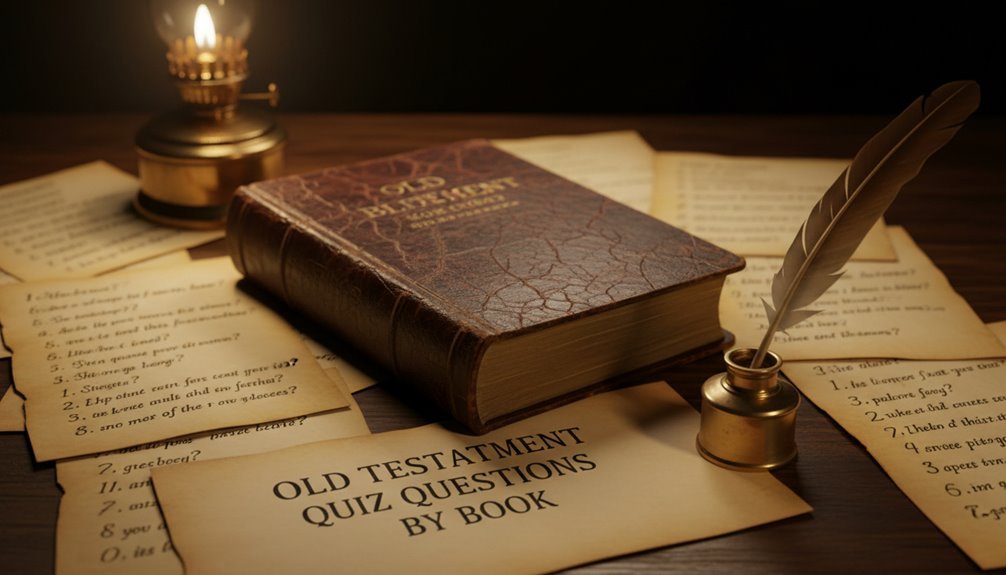
09 Apr Old Testament Quiz Questions by Book
You can grab ready‑to‑use multiple‑choice quizzes organized by each Old Testament book, covering key narratives, laws, and themes for quick study or classroom use. The set includes 8 Genesis questions, 10 Exodus Ten‑Commandments items, 9 Leviticus sacrificial‑law items, 8 Numbers desert‑journey items, 9 Deuteronomy Moses‑final‑speech items, 8 Joshua conquest‑and‑settlement items, 9 Judges cycle‑of‑apostasy items, and 10 Ruth & Samuel loyalty‑to‑kingship items. Each quiz follows a clear format with shuffled answer choices, hints for beginners, and brief explanations that tie back to the biblical passages, so you’ll discover even more details as you explore further.
Genesis Bible Quiz Questions – 8 Ready‑to‑Use Items
Ever wondered how to test your knowledge of Genesis in a quick, engaging way? You can dive into eight ready‑to‑use quiz items that cover creation, the flood, and the patriarchs. First, ask yourself which day God created light—simple, yet it checks basic recall. Next, identify the name of the man who built the ark and the number of each animal pair he took aboard. Then, pinpoint the covenant sign after the flood and the promise attached to it. Move on to Abraham’s test of faith: what was the name of his son offered as a sacrifice? Follow with the story of Jacob’s ladder—describe the vision he saw. Ask which brother received the birthright and why. Finally, challenge yourself on Joseph’s rise to power in Egypt: name the two dreams that foretold his future. These eight questions sharpen recall, spark discussion, and keep Genesis fresh in your mind.
Exodus Bible Quiz Questions – 10 Ten‑Commandments Items
You’ll find the Ten Commandments summarized in a clear, bite‑size format that makes recalling each rule a breeze.
Use the quiz tips to structure questions that test both memory and understanding without overwhelming readers.
This approach keeps the focus sharp and the quiz engaging.
Ten Commandments Overview
Where do the Ten Commandments fit into the Exodus narrative? You encounter them at Mount Sinai, right after the Israelites escape Egypt and witness the parting of the Red Sea. God appears in fire and smoke, then gives Moses two stone tablets bearing the moral code that shapes Israel’s covenant. You’ll recognize the first four commandments as duties toward God—no other gods, no idols, reverence, and Sabbath observance. The remaining six regulate human relationships—honoring parents, prohibiting murder, adultery, theft, false testimony, and coveting. In a quiz setting, you’ll be asked to locate the passage (Exodus 20:1‑17), identify the tablet division, and recall the exact phrasing. Understanding this structure helps you answer both factual and interpretive questions about the Ten Commandments.
Exodus Quiz Formatting Tips
How should you structure your Exodus quiz to make the Ten‑Commandments items clear and engaging? Begin with a brief intro that sets the context—explain that the next ten questions cover the commandments given at Mount Sinai. Use numbered headings for each commandment, then follow with a concise question that targets a specific detail (e.g., “Which commandment forbids idolatry?”). Keep answer choices short, limit options to four, and shuffle them to avoid patterns. Include a “hint” line only if the audience is beginners, and place it right under the question. After each answer, provide a one‑sentence explanation that ties back to Exodus 20. Finish with a quick recap slide that lists all ten commandments in order, reinforcing retention.
Leviticus Bible Quiz Questions – 9 Sacrificial Law Items
You’ll explore the different types of sacrificial offerings and see how each one fits into Israel’s worship system. You’ll learn the ritual purity rules that govern who can present a sacrifice and under what conditions. You’ll also uncover the symbolic meanings behind the animals used, revealing deeper theological messages.
Types Of Sacrificial Offerings
Some of the ancient rites you’ll encounter in Leviticus revolve around nine distinct sacrificial law items, each with its own purpose and procedure. You’ll learn the burnt offering (olah), a total fire that symbolizes total dedication; the grain offering (minchah), a baked or raw grain tribute; the peace offering (shelem), a communal feast expressing gratitude; the sin offering (chatat), a means to at specificions; the guilt offering (asham), a restitution for violations; the heave offering (terumah), a portion set aside for the priests; the drink offering (nesek), liquid libations accompanying other sacrifices; the wave offering (tenuf), a symbolic gesture of presenting the first fruits; and the standing offering (tamid), a perpetual daily burnt offering. Each type follows precise animal selection, preparation, and placement, guiding you through ritual symbolism and priestly duties.
Ritual Purity Requirements
Ever wondered what makes a sacrificial ritual valid? You must be ritually pure before you even approach the altar. Leviticus demands that you wash your hands and bathe your body after any contact with a dead body, disease, or bodily fluids.
If you’re a priest, you must avoid defilement for at least seven days after a burial, and you mustn’t touch anything unclean during the sacrificial preparation. The offering itself must be free of blemish, and you must present it without any hidden impurity—no leprosy, no contagious disease, no sexual discharge. Only after you’ve satisfied these purity checks can you present your animal, sprinkle its blood, and complete the covenantal act.
Symbolic Meanings Of Animals
Animal symbolism in Leviticus gives each sacrificial creature a layered theological message, turning the offering into a visual sermon. You’ll see that the lamb represents innocence and at, while the bull conveys strength and at. The goat, often linked to sin‑bearing, illustrates at’s removal of impururity. Doves and pigeons, humble and pure, embody peace and the Spirit’s gentle presence. The ram, with its horn, signifies leadership and divine authority. You recognize that the calf’s tender flesh points to humility and dependence on God. The fish, rarely offered, hints at chaos and the unknown depths. By studying these symbols, you grasp how Leviticus weaves animal traits into spiritual lessons, enriching each worship act with vivid, theological insight.
Numbers Bible Quiz Questions – 8 Desert‑Journey Items
Wondering what essentials the Israelites carried on their 40‑year trek through the desert? You’ll find eight key items that kept the community alive and obedient to God’s commands.
First, the Ark of the Covenant held the tablets, reminding them of the covenant.
Second, the tabernacle’s curtains and frames provided a portable sanctuary.
Third, the bronze altar allowed sacrifices for atonement.
Fourth, the priestly garments distinguished the holy service.
Fifth, the silver trumpets signaled movement and battle.
Sixth, the manna‑filled jars stored daily bread from heaven.
Seventh, the water‑carrying flasks supplied thirst‑quenching drink.
Eighth, the bronze serpent on a pole offered healing for those bitten by venomous snakes.
Each item appears in Numbers, illustrating how God equipped Israel for worship, protection, and sustenance across the wilderness.
Recognizing these objects sharpens your quiz answers and deepens your grasp of the desert journey’s spiritual logistics.
Deuteronomy Bible Quiz Questions – 9 Moses’ Final Speeches
When Moses climbs Mount Nebo to deliver his last address, he recaps Israel’s history, reaffirms the covenant, and urges the new generation to obey God’s law. You’ll find quiz questions that probe each of his three speeches: the review of wilderness wanderings, the call to love and serve God, and the warning of blessings and curses. Ask learners to identify the specific chapter where Moses repeats the Ten Commandments, then test recall of the “Shema” declaration. Include a question about the “song of Moses” and its prophetic significance. Challenge readers to match the covenant renewal verses with the corresponding blessings. Use true‑false items to verify understanding of Moses’ final instruction to appoint judges. Finally, pose a short‑answer prompt on the significance of the “great and terrible” promise that frames the Israelites’ future. These nine focused items reinforce Deuteronomy’s core themes.
Joshua Bible Quiz Questions – 8 Conquest & Settlement Items
Ever wondered how Joshua’s bold leadership shaped Israel’s entry into the Promised Land? You’ll find eight focused quiz items that test your grasp of the conquest and settlement narratives. First, identify the city whose walls fell after the Israelites shouted, “The battle is the Lord’s!” (Jericho). Second, name the commander who led the ambush at the waters of Merom (Canaanite king). Third, recall the tribe that received the fertile plains of Ephraim (Tribe of Ephraim). Fourth, pinpoint the location where the sun stood still (Gibeon). Fifth, specify the covenant renewal at Shechem (Joshua 24). Sixth, list the city allotted to the Levites (Cities of Refuge). Seventh, describe the division of land by lot (Joshua 13‑21). Eighth, explain the significance of the “Hebrew” term in the “Hebrew” law (Deuteronomy). Master these points, and you’ll ace the Joshua segment.
Judges Bible Quiz Questions – 9 Cycle of Apostasy Items
What drives the recurring pattern of sin, oppression, and deliverance in Judges? You’ll notice that Israel’s disobedience sparks foreign domination, which then provokes divine mercy through a judge. Each cycle begins with the people forsaking God, followed by a neighboring nation crushing them, and culminates in a charismatic leader raising arms for rescue. When you quiz yourself, focus on the three‑stage rhythm: apostasy, oppression, and deliverance. Identify the specific sins—idolatry, neglect of covenant, or moral decay—that trigger each oppression. Then match the oppressor nation, whether Philistines, Midianites, or Moabites, to the corresponding judge who rises—Samson, Deborah, Gideon, or Jephthah. Finally, recall the outcome: peace lasts until the judge dies, and the cycle restarts. This structure helps you predict the next chapter, reinforcing the theme that Israel’s fate hinges on fidelity versus rebellion.
Ruth & Samuel Bible Quiz Questions – 10 Loyalty‑to‑Kingship Items
How does loyalty shape the rise of Israel’s monarchs in the stories of Ruth and Samuel? You’ll find ten quiz items that test that theme. First, ask who Ruth’s loyalty to Naomi leads to, highlighting the lineage that produces David. Second, query Boaz’s protection of Ruth and its political implications. Third, probe Samuel’s obedience to God when anointing Saul, showing loyalty to divine authority over personal ambition. Fourth, examine Saul’s breach of covenant and its fallout. Fifth, challenge the learner to identify David’s steadfastness to God despite Saul’s hostility. Sixth, explore David’s loyalty to Saul’s house after Saul’s death. Seventh, ask how Jonathan’s friendship with David exemplifies loyalty to future kingship. Eighth, inquire about the role of the prophet Gad in advising David. Ninth, test knowledge of David’s covenant with Jonathan. Tenth, ask which verse best summarizes loyalty’s reward in Israel’s monarchy.
Frequently Asked Questions
Which Old Testament Book Contains the Longest Chapter?
You’ll find the longest chapter in Psalms—chapter 119. It stretches over 176 verses, making it the most extensive passage in the Old Testament.
You’re looking at a poetic acrostic, each set of eight verses beginning with successive letters of the Hebrew alphabet.
Its length lets you explore a wide range of themes, from devotion to law, and it showcases the depth of Israel’s worship tradition.
How Many Times Does the Phrase “The Lord” Appear in Genesis?
You’ll find “the LORD” appears 54 times in Genesis. That count follows the Hebrew text where YHWH is rendered as “LORD” in most English translations.
If you’re using a version that spells out “the Lord” for YHWH, the number may differ slightly, but in standard Protestant Bibles it’s 54. This figure helps you gauge how frequently the divine name surfaces early in the biblical narrative.
What Is the Earliest Recorded Genealogy in the Pentateuch?
You’ll find the earliest recorded genealogy in Genesis 5, where Adam’s line is traced through Seth, Enosh, Kenan, Mahalalel, Jared, Enoch, Methuselah, Lamech, and finally Noah. This chapter lists ages and offspring, establishing a continuous family record from the first human to the flood survivor. It’s the first detailed pedigree the Pentateuch presents, setting the stage for later genealogies.
Which Book First Mentions the Concept of a Covenant With Israel?
You’ll find that Genesis first mentions a covenant with Israel. In Genesis 15 God promises Abraham descendants and land, establishing the covenant that later defines Israel’s identity. This early promise sets the pattern for all subsequent covenants throughout the Old Testament, linking God’s faithfulness directly to the people who become Israel. The narrative frames the covenant as foundational, shaping the nation’s destiny from its very beginnings.
In Which Book Does the Term “Prophet” First Appear?
You’ll find the term “prophet” first in Genesis, specifically Genesis 20:7 where Abraham is called a prophet. The word appears again in later passages, but Genesis introduces it before any other book. This early usage sets the stage for the prophetic tradition that runs throughout the Old Testament, establishing the role of God‑speaking individuals right from the patriarchal narratives.
Conclusion
You’ve just explored a treasure trove of quiz questions that span the entire Old Testament, from Genesis to Ruth and Samuel. Each set is ready to spark lively discussion, test knowledge, and deepen understanding of the biblical narrative. Use these prompts in classrooms, study groups, or personal reflection to keep the stories alive and the lessons resonant. Dive in, challenge yourself, and let the ancient wisdom inspire today’s conversations.









No Comments