

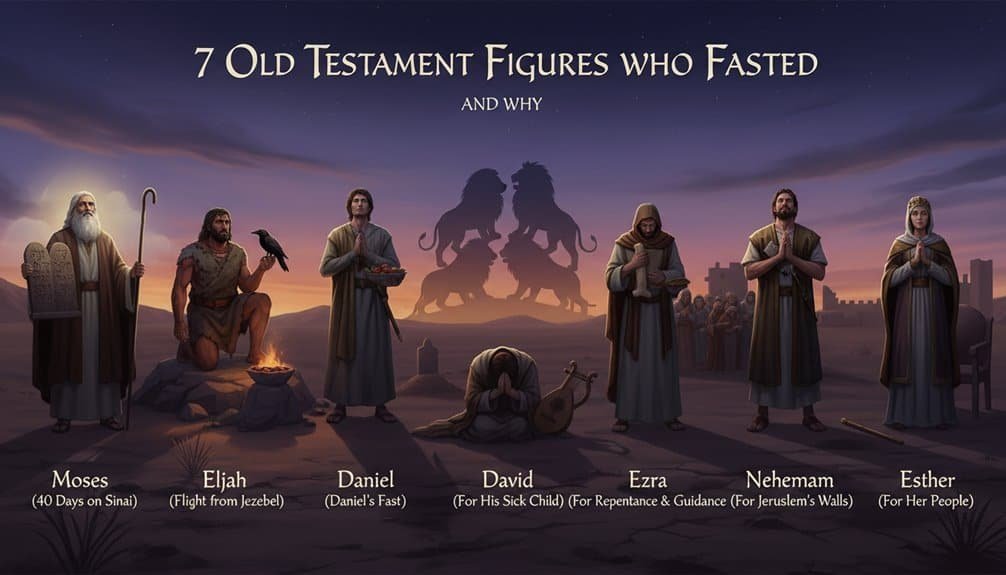
22 Apr 7 Old Testament Figures Who Fasted and Why
You’ll find that Moses fasted 40 days on Sinai to prepare for God’s law, David abstained for seven days after Bathsheba to seek forgiveness, Elijah went 40 days in the wilderness to hear God’s whisper, Esther kept a three‑day fast before confronting the king for Israel’s safety, Job endured months of fasting amid suffering to trust God, Nehemiah prayed and fasted three days for Jerusalem’s rebuilding, and a few others fasted for guidance, repentance, or deliverance. Keep going to discover each story’s deeper impact.
Table of Contents
What Is a Biblical Fast? – Definition & Common Elements
Why do people fast in the Bible? You fast to draw nearer to God, to humble yourself, and to seek divine guidance. A biblical fast is a purposeful abstention from food—sometimes drinks—while maintaining prayer, worship, and confession. It isn’t a diet plan; it’s a spiritual discipline that signals dependence on the Almighty and a willingness to set aside earthly comforts. Common elements include a defined period, often from sunrise to sunset or for several days, a focus on Scripture, and a posture of repentance or petition. You may fast alone or with a community, and the fast can be total (no food or water) or partial (e.g., only meat). The goal is always transformation: a heart aligned with God’s will, clarity in decision‑making, and a deeper experience of His presence. By entering this sacred practice, you echo the ancient Israelites who trusted God’s provision while awaiting His answer.
Moses’ 40‑Day Biblical Fast on Mount Sinai – Purpose & Outcome
You’ll see Moses climbing Sinai for forty days, sustained only by water, as he prepares for a direct encounter with God.
During that time the divine presence reveals the Law and seals the covenant with Israel.
The result is a foundational charter that shapes the nation’s identity and obedience.
Divine Encounter on Sinai
When Moses ascended Mount Sinai, he entered a 40‑day fast that sealed his divine encounter; by abstaining from food and water, he prepared his heart and mind to receive the Law, and the outcome was the delivery of the Ten Commandments and a covenant that reshaped Israel’s identity. You picture the mountain shrouded in cloud, the thunderous voice echoing over stone, and Moses standing alone, breathless, eyes fixed on the glowing presence. The fast stripped away distractions, turning his senses inward until the holy voice pierced the silence. In that heightened state, you sense the weight of the revelation pressing into you, a tangible shift from ordinary reality to sacred purpose. The encounter forged a direct link between the Almighty and the people, imprinting divine authority onto the very fabric of their destiny.
Law Reception and Covenant
Because the fast stripped away every earthly distraction, Moses entered Sinai with a mind sharpened for divine revelation; the 40‑day abstention wasn’t merely a test of endurance but a deliberate preparation to receive God’s Law. You’ll notice that the hunger sharpened his focus, allowing the tablets to appear with vivid clarity. During the ascent, Moses prayed, his heart aligning with the covenant promise, and the tablets carried the Ten Commandments—ethical foundations for Israel.
The outcome wasn’t just a set of rules; it forged a binding relationship between God and his people, establishing identity, worship, and communal justice. By completing the fast, you see how disciplined devotion transformed a solitary mountain experience into a lasting legal and spiritual framework.
David’s Repentant Fast After Bathsheba – Duration & Spiritual Impact
What drove King David to fast after his sin with Bathsheba was a desperate need for divine forgiveness. You’ll see that his repentance lasted seven days, a period marked by abstaining from food, wine, and normal comforts while he prayed in the temple courts. During those days he confronted his conscience, confessed his transgression, and petitioned God for mercy, trusting that humility could restore his broken relationship with the Almighty.
The fast’s duration mirrors the biblical pattern of complete, focused penitence, allowing the king to internalize his guilt and experience divine compassion. Spiritually, the fast reshaped David’s character: it deepened his reliance on God, refined his leadership, and set a precedent for sincere contrition among Israel’s rulers.
Elijah’s 40‑Day Wilderness Fast – Why He Went Without Food
Why did Elijah endure a forty‑day fast in the wilderness? You see, after confronting Ahab and the prophets of Baal on Mount Carmel, Elijah fled, terrified of Jezebel’s vengeance. God sent an angel to sustain him, but the prophet chose to walk into the desert, subsisting only on divine provision.
The fast served three purposes: it marked a period of divine testing, it deepened his dependence on God, and it prepared him for the next encounter with the king. As you read the narrative, you notice that the wilderness symbolized isolation from Israel’s corrupt power structures, allowing Elijah to hear God’s whisper rather than the clamor of court politics.
The forty‑day span mirrors other biblical trials—Moses on Sinai, Jesus in the desert—signifying completeness and spiritual refinement. By denying himself food, Elijah demonstrated unwavering faith, trusting that God would meet his needs while he sought direction and renewal.
Esther’s Three‑Day Fast Before the King – Strategy & Result
After Elijah’s desert ordeal, the narrative shifts to Esther, who faces a court crisis rather than a wilderness trial. You learn that she called a three‑day fast, gathering her household and the Jews to pray, we. You., you, She the. fast,:—your,’s strategic. By fasting she seeks divine favor and communal solidarity, turning personal fear into collective resolve. You see her approach: she abstains from food, intensifies prayer, and petitions the Almighty for courage before approaching King Xerxes.
The result is twofold. First, the fast unites the community, sharpening their focus on the impending danger. Second, when Esther finally appears before the king, her confidence, rooted in the fast, sways Xerxes to grant her audience and later reverse the decree against the Jews. The three‑day fast thus becomes a tactical lever, converting spiritual preparation into political victory.
Job’s Extended Biblical Fast During Suffering – Lessons on Perseverance
When Job’s calamities crushed his world, he turned to an extended fast that lasted months, refusing food while he poured out his anguish to God. You see him sitting amid ash, his skin raw from grief, yet his spirit clings to trust. The fast isn’t a denial of sustenance alone; it’s a disciplined pause that forces you to confront pain without distraction. By denying the body, Job sharpens his focus on the divine, turning sorrow into dialogue. He endures loss, disease, and mockery, yet his perseverance models a steadfast reliance on God’s sovereignty. The lesson for you is clear: perseverance isn’t passive endurance but active, honest lament paired with unwavering faith. When you face trials, a purposeful fast can strip away pretenses, reveal inner resolve, and keep you anchored in hope despite overwhelming darkness.
Nehemiah’s Fast for Jerusalem’s Restoration – Community Role & Effect
While Job’s personal lament taught you how individual endurance can be forged in grief, Nehemiah’s fast shows how a collective pause can mobilize a whole community for restoration. You’ll see that Nehemiah called the people of Jerusalem to fast and pray for three days before he approached the Persian king, uniting nobles, priests, and laborers in a shared supplication. This communal fasting created a sense of urgency, aligning hearts with the rebuilding agenda and inviting divine favor. As you read about the walls’ reconstruction, notice how the fast reinforced accountability: workers stayed focused, enemies were deterred, and morale surged. You experience that the fast wasn’t a personal diet but a strategic covenant, turning prayer into tangible action. By participating, the community claimed ownership of the project, and the resulting unity accelerated the wall’s completion, demonstrating how collective fasting can transform a crisis into a coordinated restoration effort.
Frequently Asked Questions
Did Any Old Testament Figures Fast for Health Reasons?
You won’t find any Old Testament figure explicitly fasting for health reasons. The biblical narratives link fasting to repentance, mourning, divine guidance, or preparation for battle, not to physical well‑being.
Moses, David, and Elijah fasted to seek God’s presence or to plead for mercy.
Even when they endured hardship, the purpose is spiritual, not medical.
How Did Fasting Affect the Political Decisions of Biblical Leaders?
You’ll see that fasting often sharpened leaders’ resolve and gave them perceived divine backing for bold moves. When Moses fasted on Mount Sinai, he emerged with the Ten Commandments, shaping Israel’s governance.
David’s fast after Saul’s death helped him claim the throne with moral authority. Hezekiah’s fast during the Assyrian siege convinced God to spare Jerusalem, influencing his political stance and alliances. These fasts turned personal devotion into decisive statecraft.
Were There Specific Foods Allowed During These Biblical Fasts?
You can eat simple, unseasoned foods like dry bread, water, and occasionally a little fruit or honey during those biblical fasts. The Scriptures mention abstaining from meat, wine, and rich dishes, but they don’t forbid basic staples.
Often, people subsisted on plain grain, legumes, or dates, focusing on minimal, unspiced sustenance to keep the body light while they prayed and sought divine guidance.
Did Women Other Than Esther Practice Notable Fasts in the Old Testament?
Yes, women besides Esther fasted notably. In 1 Samuel 1, Hannah prayed and fasted for a child, refusing food until Eli blessed her.
In Judges 11, Jephthah’s daughter isn’t a fast‑practitioner, but the narrative mentions her mourning, implying a period of abstinence.
Also, in Ezra 9 – 10, the women of Judah joined the communal fast over intermarriage, showing that female fasting appears multiple times.
What Cultural Customs Influenced the Duration of Each Biblical Fast?
You’re shaped by Israel’s agrarian calendar, temple rituals, and covenant festivals. When a plague or siege struck, you’d fast for three days—mirroring the three‑day mourning period in Leviticus. During the Day of Atonement, you observe a 24‑hour fast, reflecting the single‑day sacrificial rite. Pilgrimage seasons, like Passover, demand brief, intense fasts to prepare spiritually, while prolonged fasts, such as Moses’ 40‑day wilderness abstention, echo the 40‑day desert journey tradition. These customs tie each fast’s length to sacred timeframes and communal rites.
Conclusion
You’ve seen how each fast served a distinct purpose—Moses sought divine guidance, David pursued repentance, Elijah needed strength, Esther sought protection, Job endured suffering, and Nehemiah rallied a community. Together they show that fasting isn’t just abstaining from food; it’s a powerful spiritual tool that deepens reliance on God, sharpens focus, and brings transformation. By studying their examples, you can appreciate how disciplined fasting can shape faith and outcomes today.









No Comments