

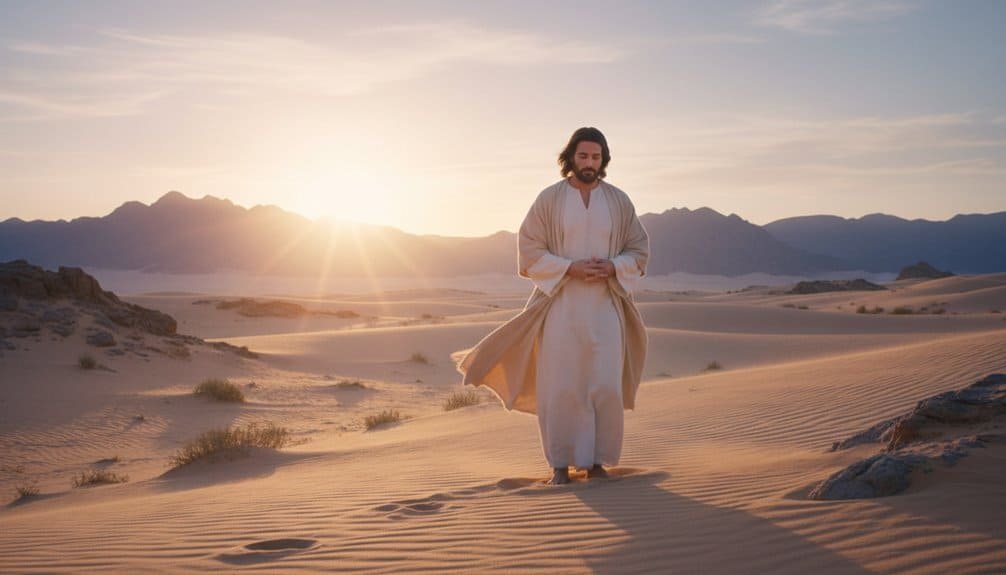
26 Apr 7 Lessons From Jesus 40 Day Fast
You’ll see that Jesus’ 40‑day wilderness reshapes your faith by exposing scarcity, sharpening belief, and forcing you to listen for purpose. It teaches total dependence as every need becomes a prayer and hunger drives trust in divine provision. Silence turns anger into prayer, while mindful thought‑guarding stops temptation before it settles. You’ll learn to trust God over food, cultivate humility as power, and apply a practical daily “wilderness window” that transforms your walk. Keep going and discover how each lesson unfolds.
Table of Contents
Why the 40‑Day Wilderness Matters for Faith
Why does the 40‑day wilderness matter for faith? You step into the desert and feel the stark contrast between comfort and scarcity, and that tension sharpens your belief.
In those barren days, you confront the limits of your own power, so you must lean on something larger. The wilderness strips away distractions, leaving only the raw dialogue between you and the divine.
You learn that faith isn’t a safety net but a sturdy rope you grip when the ground disappears.
The isolation forces you to listen, not just hear, the whispers of purpose that echo in emptiness.
Each hunger pang becomes a reminder that spiritual nourishment comes from trust, not from material provision.
When you emerge, you carry a testimony: the desert didn’t break you—it refined your conviction, proving that true faith endures when all else is stripped away.
How the 40‑Day Wilderness Builds Total Dependence
How can a barren desert teach total reliance on God? You step into the wilderness and the world’s comforts vanish; every need becomes a prayer. The scorching heat forces you to seek shade in the One who created the sun. Hunger drives you to trust that provision will appear, just as manna fell for Israel. Each day you wander without map, you learn to listen for divine direction instead of your own plans. The silence amplifies your dependence, turning every breath into a reminder that life itself belongs to Him. When the night’s darkness threatens, you discover that God’s presence is brighter than any lantern. You begin to surrender control, realizing that survival isn’t about personal strength but about leaning fully on the Father’s promises. This radical reliance reshapes your faith, turning every trial into evidence of God’s faithful provision.
Silence in the 40‑Day Fast: Turning Anger Into Prayer
The desert’s hush already stripped away distractions, so when anger spikes, the silence becomes a conduit rather than a void. You feel the heat of frustration, but the empty air forces you to pause, to breathe, to let the raw edge soften. In that stillness, you can redirect the surge of anger into a prayerful petition, naming the wound and offering it to God. Speak the anger aloud, then let the quiet swallow the words, turning them into a whisper of surrender. The desert teaches you that silence isn’t emptiness; it’s a space where divine presence amplifies your honest cries. As you breathe out, you release the sting; as you breathe in, you invite peace. By converting rage into prayer, you transform a volatile force into a catalyst for deeper trust, aligning your heart with the purpose of the fast.
Guarding Your Thoughts During 40‑Day Wilderness Temptation
Mind‑watching in the desert isn’t a passive pastime; it’s a disciplined guard that stops temptation before it settles. You notice each wandering idea, label it, and decide whether it serves your purpose. When hunger sharpens your mind, you replace “I can’t endure” with “I’m trusting the Spirit’s strength.” Scripture becomes your mental filter: every thought that contradicts God’s truth is dismissed, not entertained. You practice pause‑and‑prayer, inhaling the desert’s stillness, exhaling doubt. Visualize the wilderness as a training ground, not a battlefield; the goal isn’t to eliminate desire but to keep it from dictating actions. When the devil whispers “turn stones into bread,” you counter with gratitude for the manna already given. By anchoring each moment in prayerful awareness, you create a mental fence that lets only holy intent pass, preserving the sanctity of your 40‑day journey.
Trusting God’s Provision Over Food in the 40‑Day Fast
When the desert stretches empty, you learn to rely on God’s promise rather than the rustle of bread, letting His provision become the sustenance that steadies your spirit through each hungry hour.
In the 40‑day fast, you discover that food is a symbol, not a necessity, and that divine supply transcends physical cravings.
Each sunrise reminds you that the manna of Scripture feeds your soul, so you pause to pray, asking for the strength to trust the unseen.
You notice how the wind carries a whisper of assurance, and the quiet stones become reminders of God’s steadfast care.
As hunger gnaws, you focus on gratitude, counting blessings instead of calories.
This shift transforms scarcity into a sanctuary where faith grows.
Cultivating Humility as Power in the 40‑Day Wilderness
Relying on God’s provision strips away the illusion of self‑sufficiency, revealing humility as the true source of strength in the desert. When you step into the wilderness, you quickly discover that power isn’t measured by how much you can carry, but by how willingly you let go of pride. Each sunrise reminds you that the world continues without your control, urging you to trust a higher hand. You learn to ask for help, to listen before you speak, and to accept weakness as a doorway to divine empowerment. In moments of hunger or fatigue, humility becomes your compass, pointing you toward deeper dependence on God rather than on your own will. This surrender doesn’t diminish you; it amplifies your capacity to serve, to love, and to reflect the kingdom’s values. Embrace the desert’s quiet, and let humility transform into the quiet, unshakable power that sustains you.
Applying the 40‑Day Wilderness Model: Practical Steps for Today
How can you translate the desert’s rhythm into everyday life? Begin by carving out a “wilderness window” each morning—15 minutes of silence, no phone, just breath and a single intention. Treat that pause as a micro‑fast, letting distractions settle like sand.
Next, schedule a weekly “desert walk”: a solitary stroll in nature or a quiet park, using the time to listen for inner prompts rather than external noise.
Apply the 40‑day structure by setting a 40‑day theme—gratitude, patience, or simplicity—and write a brief daily note on progress. Limit one habit each week, mirroring the desert’s scarcity, and replace it with a purposeful practice such as journaling or mindful eating.
Finally, create a “sacred space” at home—an altar of a candle, a plant, or a favorite scripture—where you return after each day’s work to reflect, reset, and align with the rhythm you’ve cultivated.
Frequently Asked Questions
What Health Risks Arise From a 40‑Day Fast?
You’ll face dehydration, electrolyte imbalance, low blood sugar, and muscle loss.
Your heart rate may drop, causing dizziness or fainting, and your kidneys could get stressed from toxins.
Prolonged fasting can weaken immunity, trigger arrhythmias, and lead to nutrient deficiencies that affect brain function.
If you have diabetes, heart disease, or are pregnant, the risks skyrocket, potentially causing severe complications or even death.
Can Non‑Christians Apply the 40‑Day Wilderness Principles?
Yes, you can adapt those principles by focusing on intentional solitude, disciplined reflection, and gradual physical challenge.
Set a clear purpose, choose a safe environment, and plan modest fasting or dietary limits that suit your health.
Pair the period with daily journaling, meditation, or mindful movement to deepen insight.
Remember to stay hydrated, listen to your body, and seek professional guidance if you push beyond normal limits.
How Does the Fast Affect Mental Health and Mood?
You’ll notice that a 40‑day fast can shift your mental landscape dramatically.
Initially, you may feel irritability or low energy as glucose drops, but as ketosis sets in your brain stabilizes, often boosting clarity and mood steadiness.
Hormonal changes, especially reduced insulin and cortisol spikes, can lessen anxiety.
Yet prolonged restriction risks nutrient deficiencies, so monitor mood swings, stay hydrated, and consider supplementing essential vitamins to protect emotional balance.
Is It Safe to Fast Without Medical Supervision?
You can fast safely for short periods if you’re healthy, but you shouldn’t skip medical supervision for anything beyond a day or two. Listen to your body: stop if you feel dizziness, faintness, or severe fatigue. Keep hydrated, maintain electrolytes, and avoid extreme calorie restriction if you have diabetes, heart issues, or are pregnant. Consulting a professional beforehand helps prevent complications and ensures you fast responsibly.
What Biblical Verses Support a 40‑Day Fast?
You’ll find several verses that reference a 40‑day fast. In Matthew 4:2, Jesus fasted for forty days and nights in the desert.
The Old Testament records Moses’ forty‑day fast on Mount Sinai (Exodus 34:28). Elijah also went without food for forty days (1 Kings 19:8).
These passages illustrate the biblical precedent for a forty‑day period of fasting and prayer.
Conclusion
You’ve seen how a 40‑day wilderness trek reshapes faith, dependence, silence, thought, trust, and humility. By embracing those same principles today—stepping away, listening, guarding your mind, relying on God’s provision, and living humbly—you’ll experience a deeper, more resilient walk with Him. Let the wilderness be your ongoing classroom, and let each day’s practice transform you into a stronger, more faithful follower.








No Comments