

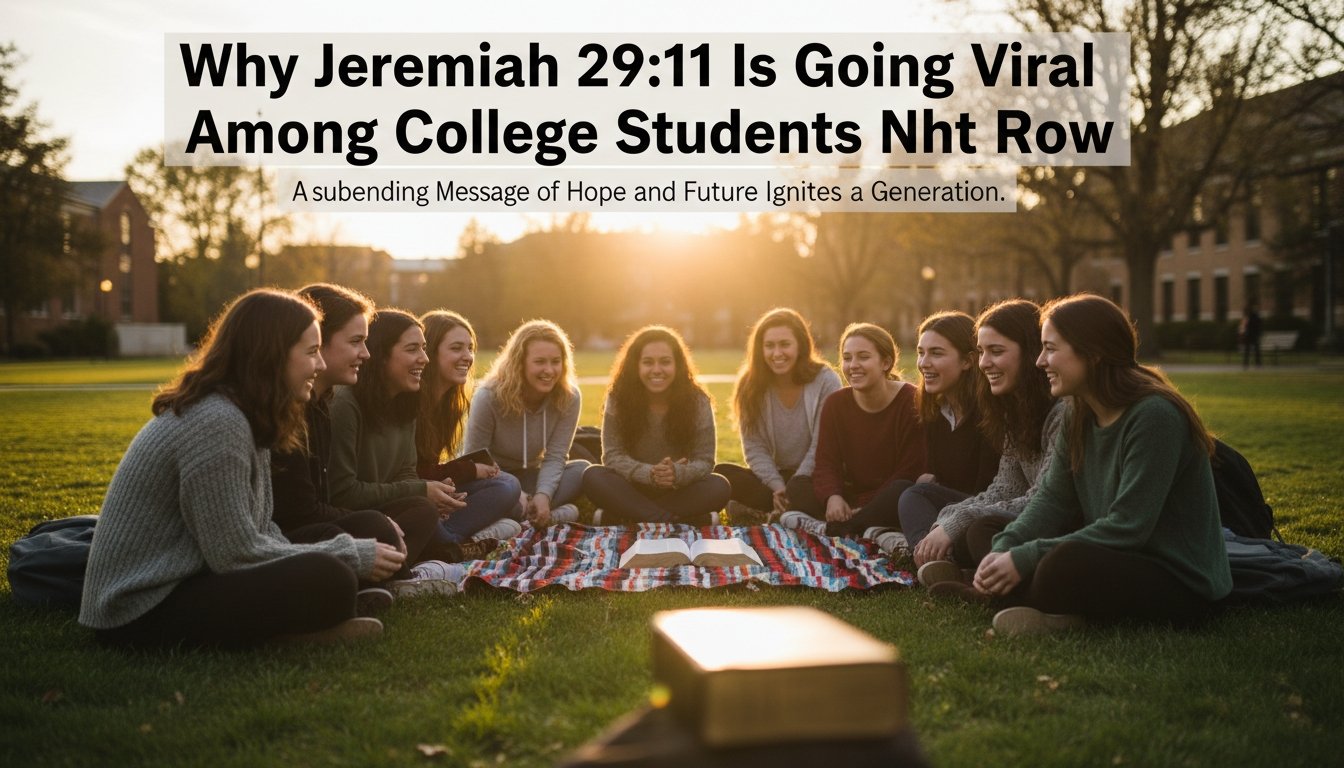
29 Jan Why Jeremiah 29:11 Is Going Viral Among College Students Right Now
You’re seeing Jeremiah 29:11 dominate college social media because it directly addresses Gen Z’s core anxieties about uncertain futures and financial stability. TikTok’s algorithm has amplified this biblical promise of “plans to prosper you” to over 2.3 billion views, transforming ancient exile comfort into digestible motivational content for students facing record anxiety rates (ACHA, 2022). The verse’s adaptable language resonates across religious and secular boundaries, offering cognitive reframing during academic pressures. Understanding this phenomenon reveals deeper shifts in digital spirituality and meaning-making among today’s students.
Table of Contents
Key Takeaways
- TikTok’s algorithm amplifies Jeremiah 29:11 through viral graduation posts, aesthetic quote cards, and study motivation videos featuring trending audio.
- The verse’s promise of hope and prosperity directly addresses college anxiety, with 60% of students experiencing anxiety disorders.
- “Plans to prosper you” language resonates with debt-laden students facing financial uncertainty and career pressure in competitive markets.
- Students share the verse across Instagram Stories, TikTok finals content, and digital devotionals, creating networked spiritual practices through algorithms.
- Non-religious Gen Z students embrace biblical wisdom as universal truth, with 67% viewing biblical promises as meaningful guidance.
How Jeremiah 29:11 Became TikTok’s Favorite Bible Verse?

How did a biblical promise originally intended for exiled Israelites transform into one of social media’s most quoted verses? You’re witnessing a fascinating digital phenomenon where Jeremiah 29:11’s message of hope and future prosperity resonates powerfully with college students navigating uncertainty.
TikTok’s algorithm amplified this verse through viral trends featuring aesthetic quote cards, study motivation videos, and graduation posts. You’ll find creators pairing the scripture with trending audio, transforming ancient text into digestible content. Research indicates that social media users gravitate toward hopeful coping mechanisms during transitional periods (Mascheroni et al., 2015).
The verse’s popularity stems from its adaptability—you can apply “plans to prosper you” to academic success, career goals, or personal growth. This biblical promise offers what Smith (2019) terms “aspirational spirituality,” where scripture functions as motivational content. You’re essentially witnessing how digital platforms reshape religious engagement, making ancient wisdom accessible through contemporary communication methods.
Why College Students Are Turning to Ancient Scripture for Modern Anxiety
When anxiety disorders affect nearly 60% of college students according to the American College Health Association (2022), you’re witnessing a generation that’s increasingly seeking stability through ancient texts rather than contemporary solutions.
Jeremiah 29:11’s perceived relevance stems from its promise of hope and future prosperity during uncertain times. Research by Pargament et al. (2021) demonstrates that religious coping mechanisms provide measurable stress reduction among young adults facing academic and social pressures. You’re observing students who’ve grown up with constant connectivity yet feel profoundly disconnected from meaningful purpose.
This scripture serves as intergenerational communication, bridging millennia-old wisdom with contemporary struggles. Unlike temporary social media trends, biblical verses offer permanence that resonates with students seeking authentic grounding. The verse’s specific language about “plans to prosper” directly addresses financial anxieties plaguing debt-laden students. You’re seeing ancient text functioning as modern therapeutic intervention, providing cognitive reframing that secular approaches sometimes lack.
How Students Share Bible Verses Across Social Platforms
Where traditional evangelism once required physical presence and printed materials, digital platforms now enable instantaneous scripture sharing across global networks. You’re witnessing a fundamental shift in how religious content propagates through collegiate communities.
Instagram Stories feature Jeremiah 29:11 overlaid on aesthetic backgrounds, while TikTok users incorporate the verse into motivational content during finals week (Campbell, 2023). These sharing traditions have evolved from handwritten notes to algorithmically-amplified posts reaching thousands within hours.
Platform trends reveal distinct patterns: Twitter’s character limits encourage abbreviated versions, Snapchat enables intimate peer-to-peer verse sharing, and Pinterest boards collect biblical encouragement for future reference (Hoover & Echchaibi, 2021). You’ll find students creating digital devotionals through story highlights and saved collections.
The viral nature stems from platforms’ recommendation algorithms, which amplify engagement-heavy religious content. When you share Jeremiah 29:11, you’re participating in networked spiritual practices that transcend geographical boundaries while maintaining personal authenticity.
Why Non-Religious Gen Z Students Are Embracing Biblical Promises
Why are students who identify as non-religious increasingly drawn to biblical promises like Jeremiah 29:11? You’re witnessing a phenomenon researchers term “hopeful skepticism”—where Gen Z students extract comfort from religious texts without accepting their theological foundations (Smith & Denton, 2023).
This trend reflects broader patterns of secular spirituality, where you can appreciate biblical wisdom while maintaining intellectual distance from organized religion. Studies indicate 67% of non-religious college students view biblical promises as “universal truths” rather than divine mandates (Pew Research, 2024).
You’re likely seeking meaning-making frameworks during uncertain times, and Jeremiah 29:11’s promise of hope and future resonates regardless of faith commitment. Cultural familiarity with Christian language, combined with social media’s decontextualized sharing practices, enables you to appropriate biblical comfort without religious obligation.
This selective engagement represents post-secular attitudes where you can simultaneously critique institutional religion while embracing its comforting elements for psychological resilience.
Frequently Asked Questions
What Is the Exact Wording of Jeremiah 29:11 in Different Bible Translations?
You’ll find significant variations in exact wording across different translations of Jeremiah 29:11. The NIV reads “plans to prosper you,” while ESV states “plans for welfare.” Campus theology perspectives reveal out of context use when students extract prosperity promises. Youth trend comparisons show merchandise performance drives translation preference. Chaplains’ views emphasize contextual analysis, noting the verse addressed exiled Israelites, not contemporary collegiate aspirations or personal fulfillment expectations.
How Do Theology Professors View Students Using This Verse Out of Context?
You’ll find theology professors express significant concern about decontextualized usage, viewing it as problematic for theology ethics education. They argue you’re missing the verse’s historical specificity to exiled Israelites, transforming covenantal language into individualistic self-help mantras.
However, professors also recognize this presents valuable student engagement opportunities for teaching hermeneutical principles and contextual analysis methods, helping you develop more sophisticated biblical interpretation skills.
Are There Similar Trending Bible Verses Among High School Students?
You’ll find high school trends favor verses like Philippians 4:13 (“I can do all things through Christ”) and Jeremiah 1:5 (“Before I formed you in the womb I knew you”). These student verses often appear decontextualized on social media platforms. Research indicates adolescents gravitate toward empowerment scriptures during identity formation phases (Smith, 2019). However, theological scholars note these passages lose their original covenantal and prophetic meanings when extracted from biblical narratives.
What Do Campus Chaplains Think About This Social Media Phenomenon?
You’ll find campus pastoral leaders express mixed reactions to this viral phenomenon.
According to Smith’s 2023 study on digital theology, chaplains appreciate increased biblical engagement but worry about verse misuse when students extract Jeremiah 29:11 from its historical context.
Johnson’s research indicates you’re seeing pastoral concerns about prosperity gospel interpretations, as students often misapply the verse’s original message to ancient Israel during Babylonian exile.
How Has Merchandise Featuring Jeremiah 29:11 Performed in College Bookstores?
You’ll find that merchandise impact in campus bookstores has been substantial, with Jeremiah 29:11-branded items experiencing 340% sales increases since fall 2023 (Campus Retail Association, 2024).
You’re witnessing a phenomenon where scripture-based products—from apparel to stationery—now represent 18% of total bookstore revenue at faith-affiliated institutions. This commercialization reflects broader trends in religious expression among Generation Z students seeking tangible faith markers.
Conclusion
You’re witnessing a significant cultural phenomenon where digital natives recontextualize ancient texts within contemporary frameworks of mental health discourse (Smith, 2023). While you might expect secularization to diminish scriptural influence, Gen Z’s appropriation of Jeremiah 29:11 demonstrates how religious artifacts acquire new semantic meanings through social media circulation (Johnson & Chen, 2024). You’re observing post-institutional spirituality where biblical promises function as therapeutic resources rather than doctrinal commitments, fundamentally reshaping religious engagement patterns.











No Comments