


04 Oct Holy Communion Meaning and Importance in the Christian Faith
You’re participating in Christianity’s most sacred act when you receive Holy Communion—a divine mystery connecting you directly to Christ’s sacrificial death and resurrection through consecrated bread and wine. This sacrament, instituted at the Last Supper (1 Corinthians 11:23-26), conveys sanctifying grace that transforms believers into Christ’s mystical body. Whether called Eucharist, Lord’s Supper, or Mass, it’s both personal encounter and communal κοινωνία. Each participation deepens your union with Christ while building the church’s spiritual unity.
Table of Contents
Key Takeaways
- Holy Communion commemorates Jesus’ Last Supper where He instituted bread and wine as symbols of His body and blood sacrificed for humanity’s redemption.
- The sacrament creates spiritual union with Christ and fellow believers, conveying sanctifying grace that transforms participants into Christ’s image.
- Different Christian traditions practice Communion through various names—Eucharist, Lord’s Supper, Mass—reflecting theological emphases while maintaining the core memorial command.
- Regular participation strengthens faith, provides spiritual nourishment, deepens relationship with God, and renews commitment to Christian discipleship.
- Communion fulfills Christ’s command to “do this in remembrance” while connecting believers to His ongoing redemptive work through sacred mystery.
Biblical Foundation and Origins of Holy Communion
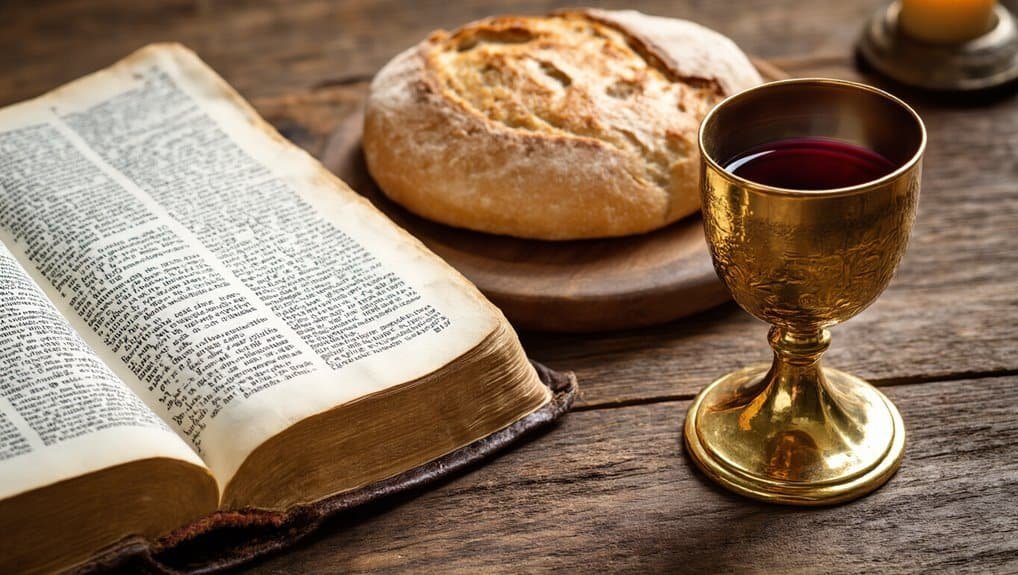
When you examine the institution of Holy Communion, you’ll find its origins firmly rooted in Jesus’s final Passover meal with His disciples, recorded in the Synoptic Gospels (Matthew 26:26-29; Mark 14:22-25; Luke 22:14-20) and Paul’s first letter to the Corinthians (11:23-26).
Christ’s deliberate transformation of Passover elements establishes profound covenant symbolism—the bread becomes His body, the wine His blood, inaugurating the New Covenant prophesied in Jeremiah 31:31-34.
You’ll notice the apostolic origins manifest through Paul’s transmission of this tradition, which he “received from the Lord” (1 Cor. 11:23).
The early church’s immediate adoption of this practice (Acts 2:42) demonstrates its foundational significance.
When you trace the theological trajectory, you’re witnessing Christ’s fulfillment of Old Testament typology: He’s the true Passover Lamb (1 Cor. 5:7), whose sacrifice supersedes animal offerings.
This sacrament isn’t merely commemorative; it’s participatory, connecting you to Christ’s redemptive work through faith.
The Spiritual Significance of Bread and Wine
As you contemplate the elements of Holy Communion, you’re encountering profound christological symbols that transcend their material properties. The bread represents Christ’s body, broken for humanity’s redemption, while the wine signifies His blood, poured out for the remission of sins. These Symbolic Elements aren’t arbitrary choices but deliberate selections rooted in Jewish Passover traditions and Christ’s own designation during the Last Supper.
You’ll find the Ritual Origins embedded in ancient Hebrew practice, where bread sustained physical life and wine marked covenantal celebrations. Christ transformed these ordinary substances into extraordinary sacramental signs, establishing a perpetual memorial of His sacrifice. When you partake, you’re participating in a divine mystery where material elements become vehicles of spiritual grace. The bread’s breaking mirrors Christ’s suffering; the wine’s pouring reflects His voluntary self-offering.
Through these tangible signs, you’re drawn into communion with the crucified and risen Lord, experiencing His real presence in the sacred meal.
Different Names and Terms for This Sacred Practice
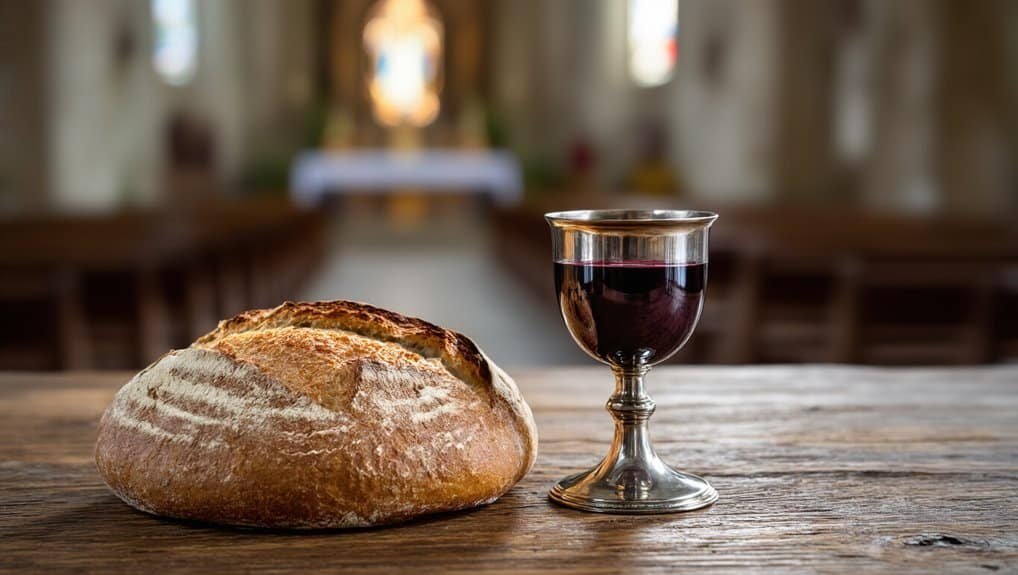
Throughout Christian history, you’ll encounter various nomenclatures for this sacred meal, each reflecting distinct theological emphases and ecclesiastical traditions. The term “Eucharist,” derived from the Greek εὐχαριστία (thanksgiving), emphasizes gratitude for Christ’s sacrifice.
You’ll find this Eucharistic terminology predominant in Catholic, Orthodox, and Anglican traditions, highlighting the meal’s thanksgiving aspect.
“Communion” stresses κοινωνία (fellowship) with Christ and believers, while “Lord’s Supper” directly references Paul’s designation in 1 Corinthians 11:20.
The liturgical vocabulary extends to “Holy Mysteries” in Eastern Orthodoxy, emphasizing the sacrament’s ineffable nature, and “Breaking of Bread” (Acts 2:42), recalling apostolic practice.
You’ll notice Reformed traditions often prefer “Lord’s Table,” focusing on Christ’s invitation rather than sacrificial elements.
“Mass” remains distinctly Catholic, deriving from the Latin dismissal “Ite, missa est.” Each term you encounter carries specific theological weight, shaping how communities understand Christ’s presence, memorial command, and the sacrament’s efficacy in dispensing grace.
How Various Christian Denominations Celebrate Communion
As you explore how Christians celebrate this sacrament across traditions, you’ll encounter distinct liturgical expressions rooted in theological convictions about Christ’s presence in the elements.
The Catholic Mass centers on transubstantiation through the consecration within the Eucharistic Prayer, while Protestant services typically emphasize remembrance and spiritual presence through various forms of the Words of Institution.
Orthodox churches celebrate the Divine Liturgy with the epiclesis—the invocation of the Holy Spirit upon the gifts—as the transformative moment, maintaining the mystery of Christ’s real presence without philosophical precision.
Catholic Mass Traditions
When you enter a Catholic church during Mass, you’ll witness the Eucharist celebrated within a liturgical framework that has developed over two millennia, rooted in apostolic tradition and refined through theological reflection.
The processional rites establish sacred space through choreographed movement—you’ll observe the entrance procession bearing the crucifix, candles, and Gospel book, manifesting Christ’s presence among His people.
Each gesture carries liturgical symbolism: the priest’s kiss of the altar represents Christ’s union with His Church, while incensation signifies prayers ascending to heaven (Revelation 8:3-4).
You’ll participate in the Liturgy of the Word before the Eucharistic Prayer transforms bread and wine into Christ’s Body and Blood through transubstantiation.
The Roman Missal prescribes precise formulas, ensuring you’re connected to the universal Church’s continuous offering of Christ’s sacrifice.
Protestant Service Practices
Protestant denominations typically celebrate communion with varying frequencies and forms, reflecting diverse theological interpretations of Christ’s words “Do this in remembrance of me” (Luke 22:19). You’ll observe significant liturgical variations across traditions: Baptists practice monthly observance with grape juice and unleavened bread, emphasizing memorial symbolism.
Methodists employ open communion quarterly or monthly, welcoming all believers. Lutheran services maintain weekly Eucharist with formal liturgy, affirming real presence doctrine.
You’ll notice lay leadership prominently in Reformed churches, where ordained elders distribute elements alongside pastors, embodying priesthood of all believers (1 Peter 2:9). Presbyterian practice exemplifies this shared ministry model.
Pentecostal services incorporate spontaneous prayer and healing emphasis during communion. These divergent practices demonstrate Protestant commitment to sola scriptura while interpreting sacramental theology through denominational lenses.
Orthodox Divine Liturgy
While Protestant churches embrace liturgical diversity, Orthodox Christianity maintains the Divine Liturgy as its central eucharistic celebration, preserving ancient traditions dating to the fourth century.
You’ll witness the priest wearing elaborate liturgical vestments—the epitrachelion, phelonion, and zone—each symbolizing Christ’s grace and priestly authority. Byzantine chant permeates the service, creating a theological symphony where every melodic phrase carries doctrinal significance.
You’ll observe the iconostasis separating the sanctuary from the nave, representing heaven’s intersection with earth. The priest prepares the gifts during the Proskomedia, commemorating Christ’s sacrifice through precise symbolic actions.
When you receive communion, you’ll partake of both elements from a spoon, affirming the Orthodox doctrine of Christ’s full presence. This mystical encounter transforms participants into living tabernacles, embodying theosis—humanity’s deification through divine grace.
The Transformative Power of Participating in the Eucharist
When you partake in the Eucharist, you’re not merely performing a ritual but entering into a mystical participation that effects real spiritual transformation through Christ’s presence.
This sacramental encounter doesn’t just symbolize grace—it actually confers sanctifying grace that progressively conforms you to Christ’s image, as Paul articulates in 2 Corinthians 3:18’s theology of transformation “from glory to glory.”
Through this divine communion, you experience both vertical unity with Christ himself and horizontal unity with his mystical body, the Church, creating a transformative nexus where spiritual renewal, christological union, and sanctification converge in sacred mystery.
Spiritual Renewal Through Communion
Participating in Holy Communion initiates a profound spiritual renewal that transcends mere ritual observance, effecting what the Apostle Paul describes as the believer’s ongoing transformation “from glory to glory” (2 Corinthians 3:18).
When you receive the elements, you’re engaging in divine therapy—a sacramental encounter that purifies consciousness and realigns your spiritual faculties with Christ’s redemptive work.
This renewal operates through anamnesis, the liturgical remembrance that makes Christ’s sacrifice contemporaneous with your present experience.
Unlike a yearly retreat’s temporary refreshment or contemplative silence’s momentary peace, Communion’s renewal sustains through repeated participation. You’re not simply commemorating historical events; you’re appropriating Christ’s death and resurrection into your existential reality. Each reception deposits transformative grace, progressively conforming you to the imago Dei while simultaneously healing sin’s ontological wounds.
Unity With Christ
The spiritual renewal experienced through Communion finds its deepest expression in the mystical union you achieve with Christ himself.
When you partake of the consecrated elements, you’re not merely performing a ritual but entering into Eucharistic union—a profound ontological reality wherein Christ’s life becomes yours. Paul’s declaration “I no longer live, but Christ lives in me” (Galatians 2:20) manifests tangibly through this sacramental encounter.
This mystical participation transcends symbolic remembrance.
As you consume the bread and wine, you’re incorporated into Christ’s very being, sharing in His divine nature (2 Peter 1:4). The Eucharist actualizes what baptism initiates: your complete identification with Christ’s death and resurrection. You don’t simply receive grace; you receive Christ Himself, who transforms you from within through this intimate communion.
Grace and Sanctification
Through each reception of the Eucharist, you’re progressively conformed to Christ’s image as sanctifying grace penetrates your soul’s deepest recesses. The sacramental efficacy operates ex opere operato, yet your disposition determines the measure of grace received. As Augustine affirmed, you become what you receive—the Body of Christ transforming you into itself.
This progressive sanctification isn’t merely moral improvement but ontological transformation. You’re divinized through participation in Christ’s glorified humanity, as 2 Peter 1:4 declares you “partakers of the divine nature.” The Eucharist doesn’t simply symbolize grace; it communicates actual graces that strengthen your will against concupiscence, illuminate your intellect with divine wisdom, and inflame your affections toward God. Each worthy reception deepens your incorporation into Christ’s paschal mystery, advancing your journey from glory to glory.
Preparation and Reverence Before Receiving Communion
Before you approach the Lord’s Table, Scripture demands careful self-examination and spiritual preparation, for receiving the body and blood of Christ without proper reverence invites divine judgment (1 Corinthians 11:27-29).
You must examine your heart, confessing known sins and reconciling broken relationships, as Christ commanded in Matthew 5:23-24. The apostolic tradition establishes that you can’t partake while harboring unrepented sin or maintaining divisions within the body.
Your preparation should include fasting discipline, following the ancient church’s practice of abstaining from food to heighten spiritual awareness and demonstrate hunger for Christ himself.
You’ll find that prayer posture matters—whether kneeling, standing, or prostrate—as it reflects your heart’s disposition toward the holy mysteries. You’re called to approach with faith, recognizing Christ’s real presence in the elements.
This reverent preparation doesn’t earn grace but positions you to receive what God freely offers through the sacrament.
The Role of Communion in Building Christian Community
Around the common table of Christ, you’ll discover that Holy Communion fundamentally reshapes individual believers into a unified spiritual organism, as Paul’s theology in 1 Corinthians 10:16-17 demonstrates through the metaphor of one loaf producing one body.
When you partake, you’re participating in κοινωνία—divine fellowship that transcends mere social gathering.
This sacramental unity manifests practically through small groups where you’ll share both bread and burdens, echoing Acts 2:42’s devotion to breaking bread and fellowship.
You can’t separate Eucharistic theology from communal praxis; shared meals become extensions of the Lord’s Table, where mutual care flows naturally from sacramental grace.
You’re called to embody Christ’s servant-love through service projects that demonstrate the kingdom’s reality.
The Eucharist isn’t merely vertical worship but horizontal reconciliation, as Ephesians 2:14-16 reveals Christ’s blood creating one new humanity.
Through Communion, you’re bound to fellow believers in covenant responsibility, transforming individual piety into corporate witness.
Historical Development and Evolution of Communion Practices
Breaking away from apostolic simplicity, the church’s eucharistic practices underwent profound metamorphosis across twenty centuries, transforming from intimate house gatherings into elaborate liturgical ceremonies that you’d scarcely recognize today.
From intimate house gatherings to elaborate liturgical ceremonies—twenty centuries transformed Christianity’s most sacred meal beyond recognition.
You’ll discover that early Christians celebrated the Lord’s Supper weekly within homes, emphasizing communal meals alongside the sacramental elements.
By Constantine’s era, you’d witness communion’s migration into basilicas, where clerical hierarchy emerged and laity’s participation diminished.
Medieval communion controversies centered on transubstantiation‘s definition, while you’d observe the withholding of the cup from laypeople.
The Reformation sparked decisive liturgical reforms—Luther retained Christ’s real presence while Calvin emphasized spiritual reception.
You’ll note how Zwingli’s memorialist view stripped sacramental efficacy entirely.
Post-Tridentine Catholicism codified eucharistic theology, establishing rubrics you’d follow for centuries.
Modern liturgical reforms, particularly Vatican II‘s changes, restored vernacular languages and encouraged frequent reception.
You’re now experiencing diverse practices—from Orthodox mysticism to evangelical ordinances—reflecting Christianity’s theological spectrum.
Personal Spiritual Benefits and Blessings of Regular Communion
When you partake of the Lord’s Supper with regularity, you’re engaging in a means of grace that strengthens your faith through the tangible signs of Christ’s broken body and shed blood, as the sacrament serves to confirm and seal God’s promises to your soul.
This sacred ordinance deepens your covenantal union with Christ, for as Paul declares, “The cup of blessing that we bless, is it not a participation in the blood of Christ?” (1 Corinthians 10:16), thereby fostering an ever-increasing intimacy with the Triune God through the Spirit’s work in the sacramental elements.
You’ll find that consistent communion becomes a spiritual discipline of renewal, where you’re repeatedly called to examine yourself (1 Corinthians 11:28), confess sin, and reaffirm your baptismal vows, thus maintaining the vitality of your consecration to Christ.
Strengthens Faith Daily
Consistently partaking in Holy Communion serves as a divine means of grace that fortifies your spiritual life through the mysterious working of Christ’s presence. As you receive the elements, you’re participating in what Calvin termed “spiritual real presence,” wherein Christ truly nourishes your soul through the sacrament’s efficacious operation.
This habitual remembrance transcends mere memorial, functioning as a spiritual discipline that anchors your daily devotionals in the paschal mystery. You’ll discover that regular communion cultivates what theologians call “sacramental consciousness”—an heightened awareness of God’s redemptive work permeating ordinary existence. The Eucharist doesn’t merely symbolize grace; it actively conveys it, strengthening your faith through the Holy Spirit’s application of Christ’s benefits. Thus, you’re progressively conformed to Christ’s image through this divinely instituted means.
Deepens Divine Connection
Beyond fortifying your faith’s foundations, Holy Communion establishes an intimate mystical union that transcends cognitive understanding and enters the realm of experiential theology. You’re participating in what theologians call “theosis”—divine participation wherein Christ’s presence transforms your spiritual essence through sacramental grace.
This mystical encounter isn’t merely symbolic remembrance but ontological reality. As you receive the elements, you’re drawn into silent contemplation where the Spirit communes with your spirit, creating what Aquinas termed “substantial presence.” You’ll discover that regular Eucharistic practice cultivates heightened spiritual sensitivity, enabling deeper recognition of God’s movements within your soul.
Through this sacrament, you’re incorporated into Christ’s mystical body more profoundly than intellectual assent alone permits. The divine connection deepens progressively, transforming you from glory to glory as Paul describes in Second Corinthians 3:18.
Renews Spiritual Commitment
Participating in Holy Communion serves as a covenantal renewal that mirrors Israel’s periodic recommitment ceremonies described in Joshua 24 and Nehemiah 8.
When you partake of the elements, you’re engaging in renewal rituals that reaffirm your baptismal vows and dedication to Christ’s lordship. Paul’s instruction to “examine yourselves” (1 Corinthians 11:28) transforms the sacrament into a moment of covenant recommitment, where you assess your spiritual condition and realign with God’s purposes.
You’ll find that regular communion functions as a recurring checkpoint for spiritual recalibration.
Each observance becomes an opportunity to confess failures, receive forgiveness, and renew your resolve to follow Christ faithfully. This cyclical pattern of renewal prevents spiritual drift and maintains the vitality of your relationship with God through intentional, sacramental remembrance.
Common Misconceptions and Clarifications About the Lord’s Supper
Why do sincere believers hold such divergent views about the Lord’s Supper when Scripture speaks clearly about this sacrament? You’ll find that centuries of theological disputes have produced diverse interpretations of Christ’s words “This is my body.” Some insist on transubstantiation, others embrace symbolic remembrance, while many accept real spiritual presence. These liturgical variations aren’t merely ceremonial preferences—they reflect fundamental convictions about Christ’s presence in the elements.
You shouldn’t dismiss communion as mere ritual or elevate it beyond biblical parameters. Scripture doesn’t support viewing it as automatic grace dispensation or treating it casually. Your private reflections must align with communal worship‘s corporate nature. When you’re confused about frequency, mode, or participants, seek pastoral guidance rooted in careful exegesis of 1 Corinthians 11:23-29 and the Gospel accounts.
Frequently Asked Questions
Can Children Participate in Holy Communion?
You’ll find denominational variations regarding children’s participation in Holy Communion.
Reformed traditions often require child preparation through catechism classes and parental consent before first communion. Catholics mandate formal instruction preceding First Communion around age seven. Orthodox churches commune infants immediately after baptism.
Paul’s warning in 1 Corinthians 11:27-29 about examining oneself shapes Protestant practice, while Matthew 19:14 (“Let the children come”) influences churches practicing paedocommunion.
What Happens to Leftover Communion Bread and Wine?
You’ll find churches handle leftover elements through reverent sacramental disposal or Eucharistic storage.
Protestant traditions typically return unconsumed bread and wine to ordinary use, reflecting their symbolic theology.
Catholic and Orthodox churches, believing in transubstantiation, consume remaining elements immediately or reserve them in tabernacles.
You’re witnessing theological divergence: some churches pour wine onto earth, returning it to creation, while others maintain perpetual reservation for veneration and distribution to the sick.
Can I Take Communion if I’ve Sinned Recently?
You can take communion if you’ve sinned recently, but you’ll need personal repentance first.
Scripture demands self-examination before partaking (1 Corinthians 11:28).
Your spiritual readiness doesn’t require perfection but genuine contrition and faith in Christ’s atonement.
The Eucharist itself conveys grace for forgiveness when you’re approaching with a penitent heart.
Don’t abstain indefinitely from fear; rather, confess your sins, trust God’s mercy, and receive the sacrament’s sanctifying power.
Is Online or Virtual Communion Valid?
You’ll find theological disagreement on virtual sacraments‘ validity.
Traditional sacramental theology requires physical presence and tangible elements—Christ’s bodily presence demands embodied participation.
However, some denominations accept digital liturgy as legitimate during extraordinary circumstances, arguing the Spirit transcends physical boundaries.
Scripture doesn’t directly address online communion, but Paul’s emphasis on gathered community (1 Corinthians 11:33) suggests physical assembly remains normative.
Your denomination’s theological framework determines whether you can participate virtually.
Should I Take Communion When Visiting a Different Denomination?
You should carefully consider denominational etiquette and each church’s sacramental theology before participating.
Most Protestant traditions practice open communion, welcoming baptized believers regardless of affiliation. However, Catholic and Orthodox churches typically restrict participation to their confirmed members, reflecting distinct theological understandings of eucharistic presence and ecclesial authority.
You’ll honor both scriptural unity (1 Corinthians 10:17) and doctrinal differences by inquiring about specific policies beforehand, demonstrating respect for varying theological convictions.
Conclusion
You’ve explored the profound depths of Holy Communion—from Christ’s words at the Last Supper to today’s diverse practices across denominations. This sacred ordinance isn’t merely ritual; it’s your participation in Christ’s body and blood, your proclamation of His death until He returns. As you approach the Lord’s Table, you’re engaging in biblical remembrance, spiritual nourishment, and covenant renewal. Through regular communion, you’ll experience transformative grace while strengthening your bonds with fellow believers in Christ’s mystical body.








No Comments