

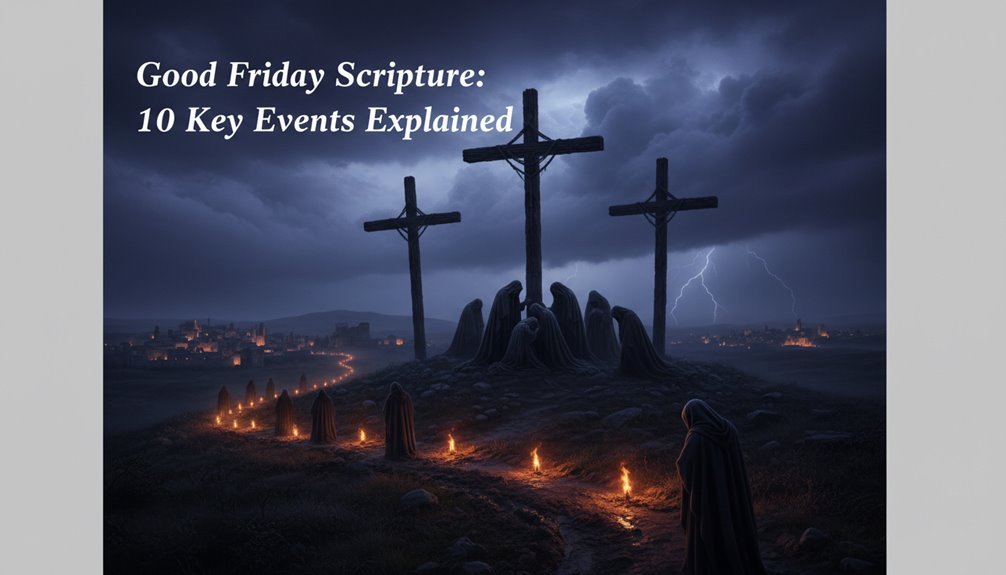
12 Mar Good Friday Scriptures: 10 Key Events Explained
On Good Friday, you’ll discover the dramatic events that unfolded – from Jesus’ arrest in the Garden of Gethsemane to His trial before the Jewish authorities, Peter’s denial, and sentencing by Pontius Pilate. You’ll witness the agony of crucifixion, Jesus’ seven last words, and the fulfillment of prophecy in His death and burial. These pivotal moments hold profound meaning, and if you continue exploring, you’ll find their eternal significance.
Table of Contents
Key Takeaways
- The arrest of Jesus in the Garden of Gethsemane, including Judas’ betrayal and Peter’s attempt to defend Jesus.
- Jesus’ interrogation by the Jewish authorities, where He was found guilty of blasphemy and sent to Pontius Pilate.
- Peter’s three denials of knowing Jesus, followed by Jesus’ forgiveness and restoration of him.
- Jesus’ trial before Pontius Pilate, the crowd’s demand for His crucifixion, and the release of Barabbas instead.
- The crucifixion of Jesus, His death on the cross, the confirmation of His death, and the burial of His body.
The Arrest of Jesus

After Jesus shared His final Passover meal with His disciples, the events of His arrest unfolded in the Garden of Gethsemane. There, Judas betrayed Jesus, identifying Him to the chief priests and temple guards with a kiss. They seized Jesus and bound Him. Peter attempted to defend Jesus, cutting off the ear of the high priest’s servant, but Jesus stopped him, healing the servant’s wound. The disciples fled, leaving Jesus alone to face the authorities. This pivotal moment marked the start of Jesus’ suffering and the events leading to His crucifixion on Good Friday.
Jesus Before the Jewish Authorities
Jesus was now brought before the Jewish authorities to be interrogated and condemned. They questioned him about his teachings and his claims to be the Messiah, the Son of God. Though Jesus answered their questions calmly and directly, they found his responses blasphemous.
Declaring him guilty, they sent him to Pontius Pilate, the Roman governor, to be sentenced to death. The Jewish leaders vehemently accused Jesus, demanding that Pilate crucify him. Pilate was reluctant, finding no fault in Jesus, but ultimately gave in to the crowd’s relentless cries. Thus, Jesus was condemned to die on the cross, a punishment reserved for the worst criminals.
Peter’s Denial of Jesus
Why did Peter, one of Jesus’ closest disciples, deny knowing him not once, but three times as Jesus had foretold? Peter’s denial reveals his fear and weakness in the face of persecution. Moments after vowing to stand by Jesus, Peter cowered when questioned, fearing for his own safety. Though deeply devoted, Peter’s human frailty overcame his resolve. Yet, Jesus forgave Peter, reinstating him and using him mightily. Peter’s denial reminds us that even the most faithful can falter, but God’s grace abounds. It’s a powerful lesson in our need for Christ’s strength, not our own. Peter’s story ultimately points to the transformative power of repentance and God’s unwavering love.
Jesus Before Pontius Pilate
What happened when Jesus was brought before Pontius Pilate? The Jewish leaders had arrested Jesus and taken Him to the Roman governor Pontius Pilate, accusing Him of claiming to be the King of the Jews. Pilate questioned Jesus, but found no fault in Him. However, the crowd demanded that Pilate crucify Jesus. Pilate tried to release Jesus, but the crowd insisted. So Pilate had Jesus flogged and handed Him over to be crucified. The soldiers mocked Jesus, placing a crown of thorns on His head. Pilate had a sign placed on the cross reading “Jesus of Nazareth, the King of the Jews.”
Though Pilate found Jesus innocent, he gave in to the crowd’s demands, condemning an innocent man to death.
Barabbas Released, Jesus Condemned
Pilate tried to release Jesus, but the crowd demanded that he release Barabbas instead.
You’ll see how Pilate ultimately gave in to the crowd’s wishes, condemning Jesus to be crucified.
Pilate’s Decision
When Pontius Pilate faced the volatile crowd demanding Jesus’ crucifixion, he found himself in a precarious position. Caught between appeasing the mob and upholding justice, Pilate resorted to a desperate compromise. He offered to release a prisoner, Barabbas, a known criminal, instead of Jesus. But the crowd, swayed by the religious leaders, clamored for Jesus’ execution. Pilate, unable to quell the uprising, ultimately washed his hands of the decision and condemned an innocent man to death on the cross.
This pivotal moment, rife with the tension between political expediency and moral responsibility, underscores the complex dynamics that unfolded on that fateful Good Friday.
Crowd’s Demand
Why did the crowd so vehemently demand that Barabbas be released and Jesus condemned? Fueled by the religious leaders’ incitement, the crowd cried out for Barabbas, a notorious criminal, to be freed while Jesus, an innocent man, be crucified.
Driven by mob mentality, they rejected the governor’s appeals for Jesus’ release, insisting on the death penalty. Their shouts drowned out Pilate’s better judgment, forcing him to succumb to their fervent demands.
The crowd’s irrational vitriol toward the blameless Christ sealed His fate, cementing one of history’s most unjust verdicts.
The Crucifixion of Jesus
The crucifixion of Jesus was a brutal form of execution. It carried immense significance, symbolizing the sacrifice of God’s son for humanity’s sins. How did Jesus’ execution method and the responses to his crucifixion shape this pivotal event in Christian history?
Jesus’ Execution Method
One of the most brutal execution methods practiced in ancient times was crucifixion, the fate that befell Jesus Christ on Good Friday. This agonizing process involved nailing or tying the condemned to a wooden cross until they suffocated. Victims often endured a slow, painful death over several days.
Crucifixion was reserved for the worst criminals and political dissidents. For Jesus, this shameful death demonstrated the extent of His sacrifice and the depth of God’s love. Though horrific, the crucifixion fulfilled prophecy and secured salvation for all who believe in Christ.
Significance of Crucifixion
The crucifixion of Jesus held immense significance, both for Him and for those who believe in Him.
It was the climactic moment in His mission to redeem humanity from sin and death.
By willingly suffering and dying on the cross, Jesus took upon Himself the punishment we deserve, allowing us to be forgiven and reconciled to God.
His death was a sacrifice of love, and His resurrection three days later proved His power over sin and the grave.
The crucifixion is the heart of the Christian faith, a profound symbol of God’s grace and the hope of eternal life.
Responses to Crucifixion
As news of Jesus’ crucifixion spread, people responded with a range of emotions and actions.
Some mourned his death, while others celebrated, seeing it as divine justice.
The religious leaders who orchestrated his execution felt vindicated, but the Roman soldiers who carried it out were unsettled.
Jesus’ followers were devastated, yet their faith in him as the Messiah only grew stronger.
Onlookers were shocked by the gruesome spectacle.
In the hours after his death, the temple curtain tore, the earth shook, and the sky darkened – signs that something momentous had occurred.
These varied reactions revealed the profound impact of Jesus’ crucifixion on those who witnessed it.
The Seven Last Words of Jesus
Among the most poignant and profound moments in the Gospel accounts of Jesus’ crucifixion are His final seven statements, often referred to as the “Seven Last Words of Jesus.” These sacred utterances provide a window into the Savior’s mindset and emotions as He endured the agony of the cross, offering a glimpse into His heart and character. From His plea for forgiveness for His executioners to His final triumphant cry, “It is finished,” these words resonate with profound theological and emotional depth. They demonstrate Jesus’ unwavering compassion, selfless love, and absolute commitment to fulfilling God’s redemptive plan, even in the face of unimaginable suffering. Meditating on the Seven Last Words can deepen one’s understanding of the magnitude of Christ’s sacrifice and the transformative power of His atoning work.
The Death of Jesus
After Pontius Pilate condemned Jesus, Roman soldiers crucified him. They pierced his side with a spear, verifying his death. This horrific event marked the culmination of Jesus’ suffering and sacrifice on Good Friday.
Trial Before Pilate
Why was Jesus brought before Pontius Pilate, the Roman governor of Judea? The Jewish leaders had arrested Jesus and accused him of claiming to be the King of the Jews, a crime against the Roman Empire. Pilate questioned Jesus, finding no basis for the charges, but the crowd demanded his crucifixion.
Fearing a riot, Pilate washed his hands, symbolically distancing himself from the decision, and handed Jesus over to be executed. Though Pilate believed Jesus was innocent, he prioritized political expediency over justice, condemning the sinless Son of God to death on the cross.
Crucifixion of Jesus
Moments after Pontius Pilate condemned Jesus, Roman soldiers brutally scourged and mocked the innocent man, dressing him in a purple robe and crown of thorns. They led him to Golgotha, the place of the Skull, and nailed his hands and feet to a cross, raising him between two criminals. As Jesus hung there, he cried out, “Father, forgive them, for they know not what they do.”
After six hours of suffering, Jesus breathed his last, declaring, “It is finished.” His body was taken down and laid in a tomb, where it remained for three days before rising again.
Piercing of Jesus’ Side
As the crowds dispersed and the sky darkened, a Roman soldier approached Jesus’ lifeless body on the cross. With a spear, he pierced Jesus’ side, causing blood and water to flow out. This fulfilled a prophecy in the Scriptures that not one of his bones would be broken, and it also confirmed Jesus’ death. The soldier’s action provided proof that Jesus had truly died, ensuring there was no doubt about the reality of his sacrifice.
This pivotal moment marked the end of Jesus’ earthly ministry and the beginning of the salvation he’d come to bring.
The Burial of Jesus
After Jesus’ crucifixion, his body was taken down from the cross and prepared for burial. Joseph of Arimathea, a secret disciple of Jesus, asked Pontius Pilate for permission to bury the body. Pilate granted the request, and Joseph, along with Nicodemus, wrapped Jesus’ body in linen cloths and spices, as was the Jewish burial custom. They laid the body in a new tomb hewn out of rock. A large stone was rolled in front of the tomb’s entrance. The women who’d followed Jesus observed where he was laid.
On the Sabbath, the chief priests and Pharisees asked Pilate to secure the tomb, so they posted guards and sealed the stone, fearing the disciples might steal the body and claim Jesus had risen.
The Guarding of the Tomb
Fearing the disciples might steal the body and claim Jesus had risen, the chief priests and Pharisees promptly requested Pontius Pilate to secure the tomb. Pilate granted their request, and they set a seal on the stone and posted a guard. The soldiers stationed themselves at the tomb, ensuring no one could enter or leave.
This precaution proved futile, as an angel of the Lord descended, rolled away the stone, and sat upon it, causing the guards to shake with fear and become like dead men. Despite their efforts, the tomb stood empty, and Jesus had risen, just as He said.
Frequently Asked Questions
Why Is Good Friday Called “Good” Friday?
Good Friday is called “good” because it commemorates the day Jesus Christ was crucified and died on the cross for the sins of humanity.
While it was a tragic day, it’s considered “good” because Jesus’ sacrifice made possible the forgiveness of sins and eternal life for those who believe in Him.
His death on the cross is the foundation of the Christian faith.
What Is the Significance of the Crown of Thorns?
The crown of thorns is significant because it symbolizes the suffering and humiliation that Jesus endured during his crucifixion.
The Roman soldiers placed this crown on his head as an act of mockery, but it also represents the weight of the sins of the world that Jesus bore on the cross.
This image reminds us of the depth of Jesus’ sacrifice and the extent of his love for humanity.
Why Did Jesus Have to Die on the Cross?
Jesus had to die on the cross to fulfill God’s plan of salvation. Through His death, He took the punishment for sin that you deserve, allowing you to be forgiven and reconciled to God.
His sacrifice is the means by which you can have eternal life, as He conquered death and rose again.
How Did Jesus’ Death Lead to His Resurrection?
Jesus’ death on the cross led to his resurrection because his sacrifice atoned for the sins of humanity. By dying, he defeated death and rose again, conquering the powers of evil. This demonstrated his divinity and provided the means for our salvation, allowing us to be forgiven and reconciled with God through faith in Christ’s redeeming work.
What Is the Theological Meaning of the Seven Last Words?
The seven last words of Jesus on the cross represent his final utterances and the profound theological meaning behind them.
They express Jesus’ forgiveness, suffering, relationship with the Father, care for others, his sense of abandonment, his fulfilled purpose, and his final act of surrender.
These words provide a window into the depths of Christ’s sacrifice and its significance for humanity’s salvation.
Conclusion
You’ve explored the key events of Good Friday, from Jesus’ arrest to the guarding of his tomb. These moments reveal the depth of Christ’s suffering and sacrifice, reminding us of the profound love and redemption at the heart of the Christian faith. As you reflect on these scriptures, may they deepen your understanding and strengthen your faith in the risen Savior.











No Comments