


25 Mar Why Is Easter Monday Liturgically Significant in Christianity?
You’ll find Easter Monday marks the second day of the Paschal Octave, so the Resurrection’s joy spills into the everyday rhythm of worship instead of ending on Sunday. It keeps the Alleluia, Gloria and Paschal candle lit, while readings on John 20 and Acts 2 remind you of the empty tomb and the Spirit’s promise. The day also hosts the Divine Mercy and St. Thomas feasts, linking mercy and mission to the risen Lord. Processions, baptisms and white‑gold vestments reinforce renewal, and the liturgy’s ongoing grace invites you to explore deeper.
Table of Contents
What Is Easter Monday’s Place in the Octave?
Why does Easter Monday matter in the Octave? You sit within the eight‑day celebration that starts with Easter Sunday, and Monday marks the second day of that sacred stretch. The Church treats each Octave day as a continuation of the Resurrection’s joy, and Monday’s liturgy reinforces the triumph over death. You’ll notice the same solemnity as Sunday, but with a slightly reduced emphasis on the Paschal mystery, allowing the faithful to linger on the reality of new life. The readings often highlight the disciples’ astonishment and the early community’s growing faith, inviting you to deepen your own belief. By keeping the Easter theme alive, Monday helps you transition from the intense jubilation of Sunday to the ordinary rhythm of weekly worship, ensuring the Resurrection’s impact remains fresh throughout the Octave. This sustained focus strengthens your spiritual momentum until the Octave concludes on the following Sunday.
How Does the Roman Catholic Church Observe Easter Monday?
How does the Roman Catholic Church observe Easter Monday? You attend Mass, which continues the Easter Octave’s celebration of Christ’s resurrection. The liturgy uses the same “Alleluia” and “Gloria” as Easter Sunday, but the readings focus on the appearance of Jesus to the disciples (John 20:19‑23) and the Great Commission (Matt 28:16‑20). The priest may bless a “Paschal Candle” that remains lit throughout the Octave, symbolizing the risen Light. In many parishes, the faithful receive the “Easter Vigil” oil and the “Holy Water” for personal devotion. Some communities hold a “procession of the Blessed Sacrament,” emphasizing the presence of Christ in the Eucharist. Families often share a festive meal, yet the day remains a solemn continuation of the Paschal Mystery, inviting you to deepen gratitude and witness to the resurrection.
How Do Eastern Orthodox Churches Celebrate Easter Monday?
Ever wonder what makes Eastern Orthodox Easter Monday distinct? You’ll find the day begins with the “Divine Liturgy of St. John Chrysostom,” celebrated at midnight and again at sunrise, emphasizing the Resurrection’s triumph. After the service, you join a procession bearing the “Easter fire” and the blessed “Paschal candle,” symbolizing light conquering darkness. The faithful then partake in a festive “agape feast,” where lamb, cheese, and sweet bread called “tsoureki” are shared, reinforcing community bonds. In many parishes, you’ll hear the “Khoros”—a lively hymn—sung in the vernacular, followed by a blessing of homes and fields, invoking divine protection for the new year. Children receive small gifts, often painted eggs, while elders recount the resurrection narrative. Throughout the day, you maintain a joyful, reverent atmosphere, keeping the Paschal spirit alive until the next liturgical celebration. This blend of worship, tradition, and fellowship defines Eastern Orthodox Easter Monday.

How Is the Paschal Mystery Highlighted on Easter Monday?
You’ll notice that Easter Monday extends the resurrection’s impact, reminding you that Christ’s victory continues to shape daily life.
The liturgy today weaves the same grace‑filled prayers from Holy Saturday, creating a seamless flow of worship.
This continuity helps you experience the Paschal Mystery as an ongoing reality, not just a past event.
Resurrection’s Ongoing Impact
Why does Easter Monday matter beyond the celebration of the Resurrection? You experience the Paschal Mystery’s ripple effect as the liturgy moves from triumph to mission. The readings spotlight the disciples’ bewildered joy, urging you to translate that astonishment into daily witness.
The Eucharist on Monday reminds you that Christ’s victory isn’t a one‑time event but a continual source of grace that empowers evangelism. Hymns and prayers ask you to embody the risen Christ’s love in work, family, and community. By emphasizing the “living” aspect of the Resurrection, the service invites you to let the empty tomb’s power shape your choices, making every moment a participation in the ongoing story of redemption.

Liturgical Continuity of Grace
How does Easter Monday keep the Paschal Mystery alive in the liturgy? You experience the mystery’s continuation as the Mass extends the joy of Resurrection. The liturgical calendar marks Monday as a bridge, linking the triumph of Easter Sunday with the ongoing proclamation of Christ’s victory. You hear the same Alleluia and Gospel proclamation, yet the readings emphasize the disciples’ encounter with the risen Lord, underscoring that grace isn’t a one‑time event but a living flow. The priest’s prayers invoke the Holy Spirit to sustain the newly‑born believers, reminding you that the Paschal Mystery unfolds daily. By participating, you receive the same grace that raised Jesus, confirming that Easter’s salvation story persists beyond Sunday.
Why Are the Divine Mercy and St. Thomas Feasts Held on Easter Monday?
The convergence of liturgical calendars places Divine Mercy and St. Thomas the Apostle celebrations on Easter Monday, a day already saturated with the joy of resurrection. You’ll notice that the Catholic Church’s General Roman Calendar assigns the Feast of the Divine Mercy to the Sunday after Easter, but when that Sunday coincides with the Octave of Easter, the celebration moves to Monday to keep it within the Paschal season.
Likewise, St. Thomas the Apostle’s feast, originally set for December 21, was transferred to Easter Monday in the 1969 revision to give the apostle a place in the most festive part of the liturgical year, highlighting his role in spreading the resurrected Christ’s message. By aligning both feasts with Easter Monday, the Church emphasizes continuity: the mercy of God revealed in the Resurrection and the apostolic mission that follows it, creating a seamless theological narrative.
What Special Psalms, Antiphons, and Readings Are Assigned to Easter Monday?
Ever wondered which psalms, antiphons and readings give Easter Monday its distinct liturgical flavor? On this day the Roman Catholic Office typically uses Psalm 118, a hymn of thanksgiving that celebrates the Resurrection’s triumph. The antiphon “Regina caeli” (Queen of Heaven) replaces the usual Marian antiphon, linking the day to the joy of the risen Christ. In the Mass, the first reading comes from Acts 2:14‑21, where Peter proclaims the fulfillment of Joel’s prophecy and the outpouring of the Spirit. The second reading is drawn from 1 Corinthians 15:1‑8, a concise summary of the Resurrection narrative. The Gospel is usually John 20:19‑31, the account of Jesus appearing to the disciples and Thomas’s confession. Together, these texts weave a tapestry of victory, witness, and belief, giving Easter Monday its unique, celebratory tone.
What Roles Do Processions and Baptisms Play on Easter Monday?
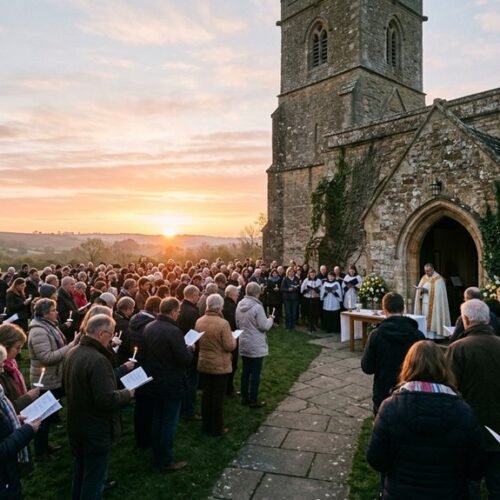
Moving from the texts that set the tone, Easter Monday’s processions and baptisms turn that celebration into a lived experience. You’ll notice the procession leads the congregation out of the sanctuary, carrying the Paschal candle, banners, and sometimes a statue of the risen Christ. This movement physically enacts the resurrection’s triumph, reminding you that the gospel isn’t confined to the altar. As you walk, the rhythm of chant and hymn unites the community, reinforcing the shared joy of new life.
Baptisms on Easter Monday deepen that symbolism. When you’re immersed, the water represents death to sin and rebirth in Christ, echoing the resurrection you just witnessed in the procession. The priest’s words, “You are reborn,” link the individual’s renewal to the collective celebration. Together, processions and baptisms make the liturgy tangible, allowing you to embody the risen Christ’s victory over death.
How Does Easter Monday Reflect the Liturgical Year’s Themes of Renewal?
Renewal pulses through Easter Monday, echoing the season’s call to new life and transformation. You notice how the liturgy shifts from the triumph of the Resurrection to a quieter, contemplative celebration of ongoing rebirth.
The readings often highlight the empty tomb and the promise of the Holy Spirit, reminding you that salvation is a continuous process, not a one‑time event.
Hymns and prayers emphasize renewal, urging you to let Christ’s victory ignite personal change.
The day’s readingsurgical color, white or gold, symbolizes purity and divine light, reinforcing the theme of new beginnings.
As you participate in the Eucharist, you experience a tangible renewal of your covenant with God.
This aligns with the liturgical year’s cyclical pattern: each season builds on the previous, and Easter Monday serves as a bridge, urging you to carry the Resurrection’s hope into the weeks ahead.
Frequently Asked Questions
Do Easter Monday Have Any Biblical Basis?
You won’t find a specific “Easter Monday” command in Scripture, but the day builds on the Resurrection narrative.
The Gospels describe Jesus rising on the third day and appearing to disciples over several days, including a walk to Emmaus (Luke 24:13‑35).
Early Christians commemorated that post‑Resurrection encounter, and the church later formalized Monday as a liturgical celebration, even though the Bible itself doesn’t label it.
Is Easter Monday a Public Holiday Worldwide?
You’ll find Easter Monday isn’t a universal public holiday; it’s observed in many countries, especially those with Christian traditions, like the United Kingdom, Canada, Australia, and parts of Europe and Africa. Some nations grant a day off, while others treat it as a regular workday. In places where it isn’t official, businesses and schools usually stay open, and celebrations stay limited to church services or family gatherings.
Can Easter Monday Be Celebrated on a Different Date?
You can celebrate Easter Monday on a different date if you follow a calendar that sets Easter differently. Some churches use the Julian calendar, so their Easter—and thus Easter Monday—falls a week or more after the Gregorian date.
Others might adopt a fixed‑date liturgical calendar for convenience, moving the celebration to a chosen Sunday or weekday.
Adjusting the date doesn’t change the theological meaning, just the timing.
Do All Christian Denominations Observe Easter Monday?
You’ll find that not all Christian denominations observe Easter Monday. Most Catholic, Anglican, Lutheran, and many Methodist churches treat it as a solemn extension of Easter, holding special services or rest.
Eastern Orthodox churches, however, typically don’t mark Monday separately, focusing instead on the entire Paschal week.
Some evangelical and non‑liturgical congregations may skip it entirely, treating Easter Sunday as the sole celebration.
What Traditional Foods Are Associated With Easter Monday?
You’ll find hot cross buns, lamb, and sweet breads on Easter Monday. In the UK, families bake hot cross buns with spiced fruit and a cross glaze.
In Greece and Cyprus, you’ll enjoy lamb roasted on a spit, often with herbs and lemon.
In Italy, pastiera—a ricotta‑flavored cake with wheat and candied fruit—appears on the table.
In the United States, many serve ham glazed with brown sugar and pineapple, alongside fresh spring vegetables.
Conclusion
You’ve seen how Easter Monday caps the glorious Octave, uniting Catholic and Orthodox rites with prayers, processions, and baptisms that echo the Paschal Mystery. This day’s feasts, Psalms, and readings deepen the celebration of Christ’s resurrection, inviting you to experience renewal and divine mercy. In every liturgy, Easter Monday reminds you that the joy of Easter continues, urging you to live its transformative hope daily.








No Comments