

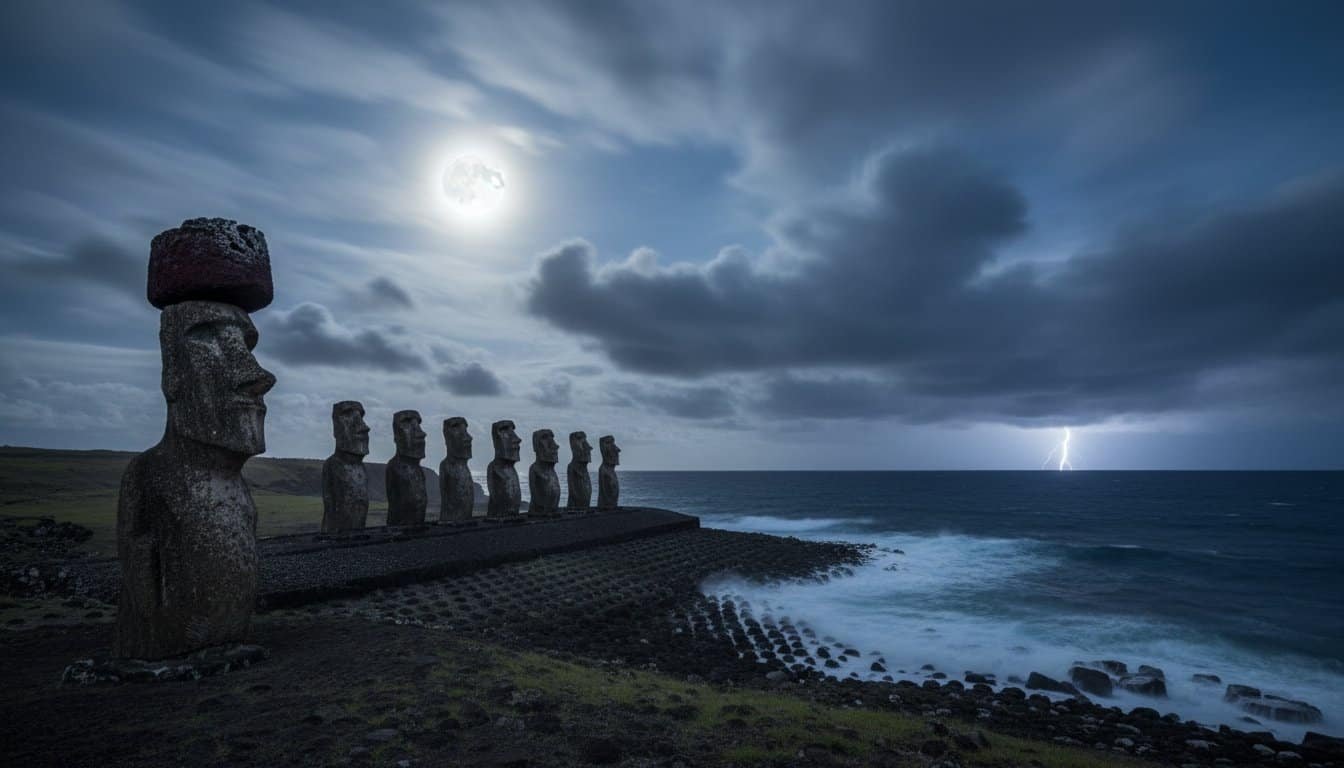
23 Jan Easter Island Location Mystery That Still Puzzles Scientists
You’re encountering one of navigation’s most perplexing mysteries: how Polynesian voyagers discovered Easter Island, the world’s most isolated inhabited landmass, sitting 2,300 miles from the nearest populated land. Scientists believe master navigators used sophisticated wayfinding techniques, reading star positions, ocean swells, and bird migration patterns to locate this remote speck. The planned settlement—evidenced by transported crops, livestock, and immediate infrastructure development—suggests deliberate exploration rather than accidental discovery. The complete navigation methodology remains an ongoing scientific investigation.
Key Takeaways
- Easter Island sits 2,300 miles from the nearest populated land, making it the world’s most isolated inhabited island.
- Polynesians discovered this remote speck without instruments, using only stars, ocean swells, and bird migration patterns for navigation.
- Accidental discovery seems impossible given the vast ocean distances and lack of visible stepping-stone islands.
- Evidence of planned settlement includes transported crops, livestock, and immediate infrastructure development upon arrival.
- Scientists debate how navigators located such an isolated target using traditional wayfinding methods across thousands of miles.
How Did Polynesians Master Pacific Ocean Navigation?
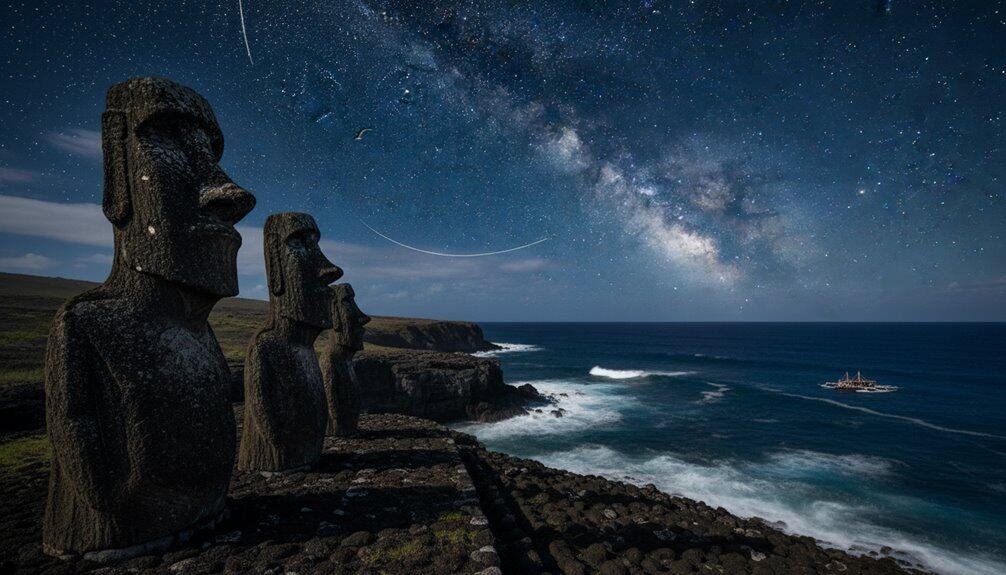
How did ancient Polynesians navigate thousands of miles across the Pacific Ocean without modern instruments, reaching remote islands like Easter Island with remarkable precision? You’ll find their mastery involved sophisticated wayfinding techniques that modern science is still studying.
Polynesian navigation relied on reading natural indicators you might overlook. Master navigators called “wayfinders” tracked star positions, ocean swells, wind patterns, and bird behavior. They’d memorize how stars moved across the sky throughout seasons, using them as celestial compasses. Ocean swells created distinct patterns around islands, detectable from considerable distances.
You’d also see them analyzing oceanic driftwood and debris, which indicated wind directions and potential landmasses. Cloud formations revealed islands beyond the horizon – land reflects light differently than open water. These navigators passed knowledge through oral traditions, creating mental maps spanning thousands of miles. Their techniques enabled systematic exploration across the Pacific, making seemingly impossible journeys routine.
What Evidence Shows Easter Island Settlement Was Planned?
Why would ancient Polynesians carry specific plants and animals across thousands of miles of open ocean unless they’d planned permanent settlement? You’ll find compelling evidence of planned settlement when examining what Easter Island’s first inhabitants brought with them.
Ancient Polynesians’ carefully selected cargo of plants and animals reveals their deliberate intent to establish permanent settlements across the Pacific.
Archaeological analysis reveals they transported sweet potatoes, taro, bananas, chickens, and pigs—a carefully curated agricultural package requiring deliberate selection and precious cargo space. You can’t dismiss this as coincidental when considering the logistical challenges of transpacific voyaging.
The settlers immediately established signs of long term infrastructure. They constructed elaborate ceremonial platforms called ahu, developed sophisticated quarrying operations at Rano Raraku, and created extensive agricultural terracing systems. You’ll notice these weren’t temporary survival measures—they represent generational planning.
Carbon dating shows systematic forest clearing began shortly after arrival, indicating organized land management rather than random exploitation. The speed and scale of these developments strongly suggest the Polynesians arrived with predetermined settlement strategies, not as accidental castaways.
Why Easter Island’s Location Made Discovery So Unlikely?
Despite the impressive planning that enabled Polynesian settlement, Easter Island’s extreme isolation presents one of navigation’s greatest puzzles. You’re looking at the world’s most remote inhabited island, positioned 2,300 miles from the nearest populated land. This extraordinary isolation made accidental discovery virtually impossible.
Traditional navigator pathways followed island chains where seafarers could hop between visible landmasses. Easter Island breaks this pattern completely. You can’t see any other land from its shores, and the nearest islands lie beyond the horizon in all directions. The mathematical probability of finding this speck of land in the vast Pacific Ocean through random exploration approaches zero.
Island drift complicates the mystery further. Tectonic movement has shifted Easter Island’s position over millennia, potentially making ancient navigation routes obsolete. Modern scientists struggle to understand how Polynesian navigators pinpointed this isolated target without instruments, charts, or prior knowledge of its existence.
Which Navigation Theories Best Explain Easter Island’s Discovery?
What navigation methods could have guided Polynesian seafarers across thousands of miles of open ocean to discover Easter Island? You’ll find three dominant theories that scientists debate today.
First, you’ve got wave pattern navigation, where navigators read ocean swells deflecting off distant landmasses. This technique requires detecting subtle changes in wave direction and height—skills passed down through generations of master navigators.
Second, celestial math provides the most compelling evidence. Polynesian navigators used sophisticated star compass systems, calculating precise bearings from rising and setting points of specific stars. They’d memorize over 200 stellar reference points, creating mental maps of oceanic highways.
Third, wildlife tracking involves following seasonal bird migration patterns and recognizing species that indicate nearby land. However, polymer narratives from oral traditions suggest navigators combined all three methods simultaneously, creating redundant navigation systems that ensured successful voyages across the world’s largest ocean.
Frequently Asked Questions
What Role Did Climate Change Play in Easter Island’s Original Settlement?
Climate change didn’t directly influence Easter Island’s original settlement around 1200 CE, but you’ll find that early Polynesian settlers demonstrated remarkable climate adaptation skills. They’d developed sophisticated navigation techniques and brought essential crops like sweet potatoes, enabling resource resilience across Pacific islands. You’re examining a pre-industrial migration where settlers successfully adapted to the island’s subtropical climate through proven agricultural and maritime strategies.
How Many People Were in the First Group to Reach Easter Island?
You can’t determine the exact number of people in Easter Island’s first settlement group. Archaeological evidence doesn’t provide precise population figures for initial contact. However, you’ll find that pottery styles and other artifacts suggest the founding group was likely small—perhaps 20-50 individuals. This estimate comes from analyzing settlement patterns, genetic bottleneck studies, and comparing similar Polynesian colonization events across the Pacific.
Did Easter Islanders Maintain Contact With Other Pacific Islands After Settlement?
You’ll find limited evidence suggesting Easter Islanders maintained minimal contact with other Pacific islands after initial settlement. Archaeological analysis reveals the island’s ecology became increasingly isolated, with few imported materials discovered in later periods. Migration networks that originally connected Polynesian communities appear to have weakened or ceased entirely. Genetic studies and cultural artifacts indicate the population developed independently, becoming one of the most isolated societies in human history.
What Specific Tools Did Polynesian Navigators Use to Find Easter Island?
You’ll find Polynesian navigators relied on stick charts mapping wave patterns, star compasses tracking celestial movements, and bone or shell instruments measuring wind directions. They’d use these navigational tools alongside careful observation of bird flight paths, water color changes, and cloud formations. Archaeological evidence shows they’d combine multiple methods systematically. These two word discussion ideas—wave navigation, star tracking—demonstrate their sophisticated analytical approach to ocean exploration.
Were There Failed Attempts to Settle Easter Island Before Successful Colonization?
You can’t definitively prove failed settlements or failed voyages to Easter Island occurred before successful colonization. Archaeological evidence doesn’t reveal traces of earlier unsuccessful attempts, though this doesn’t mean they didn’t happen. You’re dealing with limited physical remains spanning centuries. Failed settlements would likely leave minimal archaeological signatures, especially if groups were small or stayed briefly. The vast Pacific distances suggest multiple voyages were probably necessary before establishing permanent settlement.
Conclusion
You’ve examined the evidence surrounding Easter Island’s mysterious discovery, from Polynesian navigation mastery to settlement planning indicators. You’ve analyzed why the island’s remote location defied probability and evaluated competing theories about how ancient navigators found it. While you can’t definitively solve this puzzle, you’ve seen how archaeological evidence, ocean currents, and traditional wayfinding knowledge converge to suggest this wasn’t mere chance—it was sophisticated maritime achievement that still challenges our understanding.












No Comments