


21 Jan The Dark Secret Behind Valentine’s Day Everyone Ignores
You’re celebrating a holiday rooted in Lupercalia, a violent Roman fertility ritual where naked priests sacrificed goats and whipped women with bloody animal skins to ensure pregnancy. The Catholic Church strategically replaced this pagan festival with Saint Valentine’s martyrdom narrative around the same February date. While Valentine conducted secret Christian weddings defying imperial marriage bans, the romantic traditions you know today emerged from brutal fertility rites that the Church deliberately obscured through centuries of careful rebranding.
Key Takeaways
- Valentine’s Day replaced Lupercalia, a violent Roman fertility festival involving animal sacrifice, nudity, and whipping women with bloody animal hides.
- Saint Valentine’s romantic reputation stems from illegal underground wedding ceremonies that directly defied Emperor Claudius II’s military marriage ban.
- The Catholic Church removed Saint Valentine from its official calendar in 1969 due to historical doubts about his existence.
- Valentine’s Day traditions originated from prison correspondence between a condemned Christian priest and his jailer’s daughter before his execution.
- Modern romantic symbols like “X” kisses and heart shapes evolved from medieval Christian oath-taking rituals and upside-down manuscript decorations.
The Brutal Roman Festival That Became Valentine’s Day
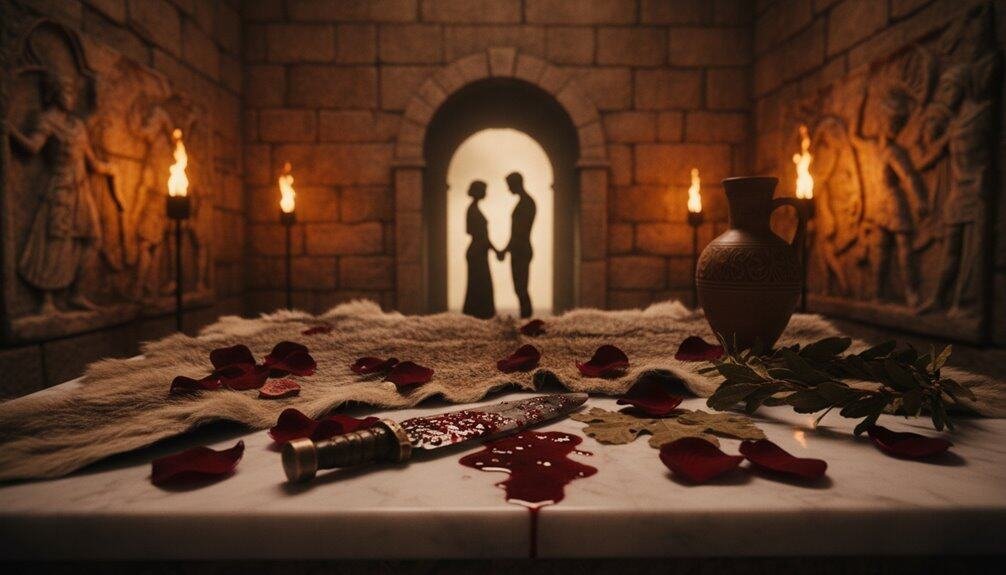
While most people associate February 14th with romantic love and heart-shaped chocolates, the date’s proximity to an ancient Roman festival reveals a far more disturbing origin story. Lupercalia, celebrated on February 15th, involved naked participants called Luperci who sacrificed goats and smeared blood on their foreheads while laughing. They’d then fashion whips from sacrificial animal skins and run through Rome’s streets, striking bystanders—particularly women—believing this would induce fertility. The festival honored the she-wolf that according to Roman mythology nursed the legendary founders Romulus and Remus.
Though modern numerology enthusiasts might find significance in Valentine’s Day falling one day before Lupercalia, and some conspiracy theorists detect alien symbolism in ancient fertility rituals, scholarly consensus reveals the connection isn’t historically supported. The Christian church under Pope Gelasius I banned Lupercalia in the 5th century, though it persisted despite prohibitions. Valentine’s Day likely originated as a Christian martyr’s feast day rather than directly replacing this brutal pagan celebration.
The Real Saint Valentines Who Died for Christian Love
Behind the commercialized holiday lies a far grimmer reality rooted in actual bloodshed and religious persecution. You’re celebrating a day named after Christian martyrs who faced brutal executions under Emperor Claudius II around 270 CE.
Historical records describe two primary candidates: Valentine of Rome, a priest and physician who was beaten with clubs then beheaded outside Rome’s Flaminian Gate, and Valentine of Terni, a bishop who suffered imprisonment, torture, and execution on Via Flaminia. Both refused to renounce their faith despite imperial pressure.
These men performed miraculous healings—restoring sight to blind daughters, curing deformed children—converting entire households to Christianity through their acts. Their defiance cost them everything. While historical skepticism surrounds these accounts due to legendary embellishments, the Catholic Church removed Valentine from its General Roman Calendar in 1969, acknowledging insufficient reliable evidence.
Two word discussion ideas emerge: martyrdom commercialized.
Secret Valentine Wedding Ceremonies That Defied Roman Law
Why would a Roman priest risk execution to perform wedding ceremonies? You’ll find the answer lies in Valentine‘s unwavering belief that Christian marriage transcended imperial authority. When Emperor Claudius II banned marriages to strengthen military recruitment, Valentine conducted clandestine ceremonies that directly challenged Roman law.
These secret marriages weren’t romantic gestures—they were acts of religious and civil defiance. Valentine believed marriage represented a sacred Christian bond that no earthly ruler could dissolve. His covert ceremonies allowed young couples to unite while helping men avoid military conscription through family obligations.
Valentine’s actions spread throughout Rome, creating a network of believers who prioritized faith over imperial commands. When authorities discovered his activities, they recognized the threat to military strategy and social order. His arrest and subsequent execution transformed these secret marriages into powerful martyrdom narratives that would influence Christian tradition for centuries, establishing Valentine as Christianity’s patron of love.
How the Church Transformed Pagan Fertility Rites Into Romance
You’ve witnessed one of history’s most calculated religious transformations when the early Christian Church systematically hijacked Lupercalia’s bloody fertility rites and rebranded them as romantic love.
Pope Gelasius I’s 496 AD declaration establishing St. Valentine’s Day wasn’t coincidental—it was strategic warfare against pagan traditions that involved naked priests whipping women with goat hide strips to boost pregnancy chances.
The Church couldn’t eliminate these deeply rooted fertility festivals, so they sanitized the brutal animal sacrifices and sexual rituals into something palatable for Christian converts while retaining enough familiar elements to ensure acceptance.
Lupercalia’s Brutal Rituals
What transformed a bloody Roman fertility ritual involving naked priests and animal sacrifice into the romantic holiday millions celebrate today? You’d find Lupercalia’s ancient rites shocking by modern standards.
Every February 15th, Roman priests called Luperci sacrificed goats and dogs at the Lupercal cave, smearing blood on their foreheads before wiping it with milk-soaked wool. They’d strip naked, cut thongs from the flayed goat skins, then run wildly around Palatine Hill striking any woman they encountered. These fertility rites weren’t gentle taps—women actively sought out these brutal lashings, believing the goat-skin whips would cure infertility and ensure easy childbirth.
The festival combined sacrifice, nudity, violence, and sexual symbolism in ways that would horrify today’s Valentine’s Day celebrants.
Christian Rebranding Strategy
How did early Christian leaders systematically dismantle Rome’s most sexually charged festival and replace it with martyrdom? You’re witnessing Christianity’s most calculated cultural takeover. Pope Gelasius I strategically placed St. Valentine’s feast near Lupercalia’s February 15 date, transforming pagan fertility rites into Christian observance. This pagan to christian rebranding wasn’t accidental—it followed established patterns where Christians overlaid their calendar onto Roman festivals, just like Halloween and Christmas.
Valentine’s secret marriages became the perfect counter-narrative. While Romans celebrated unbridled sexuality, Christians promoted sacramental marriage and martyrdom. The Church reframed Valentine’s persecution story, emphasizing love for Christ over pagan gods. Martyrdom (*martyres* meaning witness) highlighted sacred commitment against Roman instability. This systematic replacement transformed mid-February from sexual chaos into spiritual devotion, creating today’s romantic foundation.
The First Valentine’s Message Written From Prison
You’ve likely exchanged countless Valentine’s cards without knowing the tradition began in a medieval prison cell.
The oldest surviving Valentine’s message wasn’t written by a free lover, but by Charles, Duke of Orleans, who penned his heartbreaking poem to his wife from the Tower of London in 1415 after his capture at Agincourt.
This imprisoned nobleman’s desperate words of longing would establish the valentine greeting format that couples still use over 600 years later.
Valentine’s Prison Love Story
While most people associate Valentine’s Day with cheerful romance and heart-shaped chocolates, the holiday’s oldest surviving love letter tells a far different story—one written from behind prison walls by a heartbroken duke who’d never see his beloved again. Charles, Duke of Orleans, penned this melancholic valentine to his wife after his 1415 capture at Agincourt. Medieval science couldn’t ease his suffering, and royal politics sealed his fate as a political pawn between feuding French houses. His poem lamented their tragic timing: “Since for me you were born too soon, / And I for you was born too late.” The refrain “I am already sick of love, / My very gentle Valentine” revealed deep despair rather than celebration, establishing Valentine’s Day’s forgotten foundation in separation and sorrow.
Healing The Jailer’s Daughter
What transforms a simple act of compassion into the foundation of history’s most enduring romantic tradition? You’ll find the answer in Valentine’s miraculous healing of Asterius’s blind daughter. When the desperate jailer secretly brought his afflicted child to Valentine’s cell under darkness, faith-based intervention restored her sight through prayer and blessing. This healing impressed Asterius so profoundly that his entire family converted to Christianity. The bond between priest and daughter exemplified agape love—Christian compassion rather than romantic passion. Yet their friendship deepened during imprisonment, prompting Valentine’s final farewell letter signed “from your Valentine.” While modern two word discussion ideas around Valentine’s Day focus on romantic love, this unrelated topic of miraculous healing actually birthed our greeting card tradition through a prison miracle.
Original Valentine Greeting Created
This simple signature became humanity’s template for romantic expression. You’ll find this phrase echoing through centuries of love letters, from medieval courtship to modern digital messages. The irony cuts deep: our sweetest romantic tradition emerged from Rome’s darkest persecution. Valentine’s final words, written in chains facing death, established the linguistic foundation for billions of love declarations. Prison bars couldn’t contain his revolutionary romantic legacy.
Why Medieval Lovers Used Kiss Marks and Heart Symbols

How did simple marks evolve into the universal language of love? You’re witnessing the transformation of sacred medieval symbolism into romantic expression through deliberate cultural rebellion.
Kiss marks originated as the “X” symbol representing Christian faith and fidelity during the Middle Ages. When most people couldn’t write, they’d sign documents with an X, then kiss it as an oath confirmation – creating the phrase “sealed with a kiss.” This ritual authenticated everything from legal contracts to oaths sworn to kings.
Medieval lovers cleverly appropriated this powerful symbol, transforming religious authentication into romantic expression. Women especially embraced this rebellion, using kiss marks to assert choice in partner selection during the courtly love era.
Heart symbols followed a similar path. Initially appearing upside-down in 13th-century manuscripts like Roman de la poire they evolved from decorative elements into love tokens by the 14th century, influenced by Aristotelian philosophy locating emotions within the heart rather than the brain.
Frequently Asked Questions
How Many Different Saint Valentines Were There in Total?
You’ll find three distinct Saint Valentines recognized by the Catholic Church, all sharing February 14th as their feast day. Valentine of Rome was a priest-physician martyred around 270 AD, while Valentine of Terni served as bishop before his execution in 273 AD. A third Valentine died in Africa during the same period. These overlapping accounts fuel two word discussions about Valentine myths, though historical evidence confirms three separate martyrs existed.
What Happened to the Original Records of Saint Valentine’s Life?
You’ll find that Saint Valentine‘s original records were systematically destroyed during Roman persecutions, particularly under Claudius II (268-270 AD), when soldiers confiscated Christian writings.
The 6th-century sack of Rome eliminated remaining primary documents, creating valentine records mysteries that scholars still grapple with today.
What survived were saint valentine legends compiled centuries later, leaving us with conflated accounts rather than authentic historical documentation of his actual life.
Did Emperor Claudius II Really Ban Soldiers From Getting Married?
You’ll find no solid historical evidence that Claudius II ban marriage for soldiers actually occurred. While Roman military historians document various recruitment strategies across different periods, they don’t corroborate this specific prohibition.
The Valentine legends likely emerged from later Christian storytelling traditions that merged historical figures with symbolic narratives. You’re encountering mythology rather than documented imperial policy when examining these marriage ban claims.
Why Did Priests Try to Replace Valentine Drawing With Apostle Names?
You’ll find priests replacement of pagan lottery systems stemmed from Christianity’s need to eliminate fertility rituals tied to Lupercalia. Pope Gelasius I couldn’t immediately abolish the popular custom, so he substituted saint names for romantic pairings. Instead of drawing women’s names for year-long relationships, you’d select apostle names for spiritual emulation. This gradual transition preserved the drawing tradition while redirecting focus from pagan sexuality toward Catholic devotion and moral instruction.
When Did People Start Believing the Heart Was Connected to Love?
You’ll find ancient Greeks first connected hearts to love around the 7th century BC, when Sappho described her heart “quaking with love.” Plato reinforced these two word discussion ideas by linking the organ to strongest emotions. However, historical misattributions often credit medieval poets exclusively. Romans continued this tradition through Venus and Cupid imagery, while Aristotle’s philosophical assertions about hearts connecting to pleasure influenced medieval romantic literature across cultures.
Conclusion
You’ve witnessed how Valentine’s Day transformed from brutal Roman fertility rites into today’s commercialized romance. The blood sacrifices of Lupercalia, martyred saints defying imperial law, and clandestine Christian weddings shaped this holiday’s DNA. Medieval courtly love traditions added heart symbols and written declarations. You’re celebrating centuries of cultural evolution—pagan rituals, religious rebellion, and romantic revolution compressed into February 14th. Today’s chocolates and flowers carry echoes of ancient sacrifice and forbidden love.










No Comments