


05 Sep Christian Gujarati Bhajan Song List for Worship and Praise
You’ll find beloved Gujarati Christian bhajans like “Prabhu Tari Krupa,” “Yesu Maro Rakshak,” and “Pavitra Aatma” at the heart of worship services. These songs blend traditional Indian musical elements with Christian theology, using instruments like harmonium, tabla, and manjira. While classic compositions maintain cultural authenticity through ragas and talas, contemporary versions incorporate Western influences. This rich musical heritage offers a profound journey into Gujarat’s unique Christian devotional expression.
Key Takeaways
- “Prabhu Tari Krupa” is a traditional Gujarati Christian bhajan emphasizing God’s grace and mercy.
- “Yesu Maro Rakshak” focuses on Jesus as savior and is commonly sung in Gujarati Christian congregations.
- “Pavitra Aatma” celebrates the Holy Spirit and incorporates traditional Gujarati musical elements with Christian themes.
- “Mari Prarthana Sambhado” is a prayer-focused bhajan that uses a call-and-response format for congregational worship.
- “Stuti Karo” is a popular praise bhajan that combines traditional ragas with Christian devotional lyrics.
Historical Origins of Christian Gujarati Bhajans
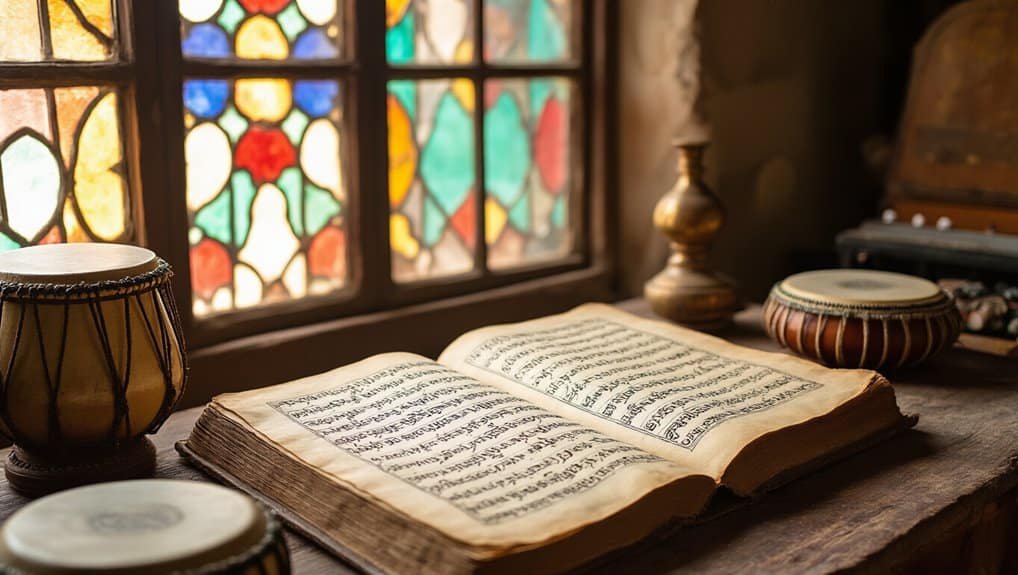
While traditional Hindu bhajans have existed in Gujarat for centuries, Christian Gujarati bhajans emerged in the late 19th century when Protestant missionaries began adapting local musical forms to express Christian theology.
Protestant missionaries innovatively adapted Gujarat’s ancient bhajan tradition in the 1800s, creating new devotional music that expressed Christian beliefs.
You’ll find that these early adaptations maintained the cultural significance of bhajan-style devotional singing while introducing Biblical themes and Christian worship elements.
As Christianity spread in Gujarat, local converts began composing their own bhajans, blending Indian musical traditions with Christian messages.
The result was a unique form of worship that helped bridge cultural gaps and foster community bonding among new believers.
You’ll notice how these bhajans often use traditional ragas and talas while incorporating Christian concepts like salvation, grace, and the Trinity.
This fusion helped preserve Gujarat’s rich musical heritage while allowing Christians to express their faith in a culturally authentic way.
Today, these bhajans continue to play a vital role in Gujarati Christian worship services and prayer meetings.
Musical Elements and Instruments Used
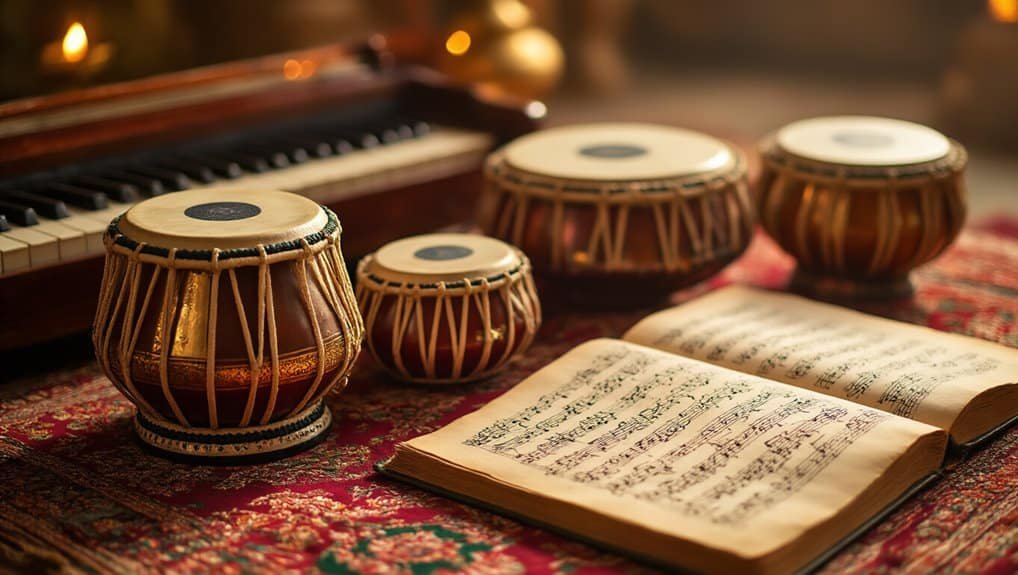
Similar to their Hindu counterparts, Christian Gujarati bhajans incorporate traditional musical elements like raga-based melodies and cyclical rhythmic patterns.
You’ll hear harmonium and tabla providing the foundational accompaniment, while manjiras (small hand cymbals) mark the devotional tempo. These instruments create a meditative atmosphere that’s deeply rooted in Indian classical traditions.
The melodic structures follow traditional Gujarati folk music scales, but you’ll notice they’re adapted to accommodate Christian theological themes. The rhythmic patterns typically follow teen taal (16 beats) or dadra (6 beats), making them accessible for congregational singing.
In modern performances, you might also encounter Western instruments like guitars and keyboards, though they’re integrated carefully to maintain the authentic bhajan feel. The call-and-response format remains central, where a lead singer presents a line that’s then repeated by the congregation, fostering communal worship and participation.
Popular Traditional Bhajan Compositions
Among the most cherished Christian Gujarati bhajans, “Prabhu Tari Krupa” stands as a cornerstone composition that celebrates divine grace.
You’ll find this bhajan performed regularly during worship services, highlighting its cultural significance within the Christian Gujarati community.
“Yesu Maro Rakshak” and “Pavitra Aatma” have emerged as foundational pieces that blend traditional Gujarati musical elements with Christian theology.
These compositions demonstrate how indigenous musical forms can effectively convey biblical messages while maintaining their cultural authenticity.
The community impact of “Mari Prarthana Sambhado” and “Stuti Karo” extends beyond church walls, as you’ll often hear these bhajans at Christian home gatherings and festivals.
They’ve created a unique bridge between Western Christian worship and Indian devotional traditions, helping preserve Gujarati Christian identity while fostering interfaith understanding and appreciation throughout Gujarat’s diverse religious landscape.
Modern Gujarati Christian Worship Songs
Contemporary Christian worship in Gujarat has evolved beyond traditional bhajans to embrace modern musical innovations.
You’ll find that today’s Gujarati Christian musicians are creating vibrant song adaptations that blend Western contemporary worship styles with indigenous musical elements. These modern compositions often incorporate keyboards, guitars, and drums alongside traditional instruments like tabla and harmonium.
Many congregations now enjoy worship songs that feature contemporary chord progressions while maintaining Gujarati lyrics and devotional themes.
You’ll notice that modern worship leaders are writing original material that speaks to current spiritual experiences while honoring cultural roots. These songs typically address themes of personal relationship with Jesus, community fellowship, and social justice – all expressed through a distinctly Gujarati Christian lens.
When you attend services in urban Gujarati churches, you’re likely to hear these new compositions alongside traditional bhajans, creating a rich tapestry of old and new expressions of faith.
Notable Gujarati Christian Musicians and Composers
Throughout Gujarat’s rich history of Christian music, several pioneering musicians and composers have shaped the development of Gujarati worship. Notable musicians like Samuel Christian and Joseph Parmar have blended traditional Gujarati musical elements with Christian themes, creating a unique devotional style that resonates with local congregations.
Among the most influential Gujarati composers, you’ll find Reverend Matthew Patel, who’s written over 200 bhajans combining biblical messages with raag-based melodies.
Contemporary artists such as Sarah Benjamin and Daniel Macwan have further evolved this tradition by incorporating modern instrumentation while maintaining authentic Gujarati musical expressions.
These musicians and composers have established training centers across Gujarat, where they mentor emerging talent and preserve the heritage of Gujarati Christian music.
Their compositions continue to be sung in churches throughout Gujarat and have been instrumental in creating a distinctive voice within India’s diverse Christian musical landscape.
Lyrical Themes and Biblical References
When examining Gujarati Christian bhajans, you’ll find rich theological content woven into culturally resonant poetry. Through lyrical analysis, you’ll discover themes centered on Christ’s sacrifice, God’s unfailing love, and the Holy Spirit’s guidance – all expressed through distinctly Indian musical and poetic forms.
Gujarati Christian bhajans blend deep theology with Indian poetic forms, creating worship that speaks to both faith and cultural heritage.
You’ll notice how these songs draw biblical inspiration from both Old and New Testament narratives. Composers often reference familiar passages like the Psalms and Gospels, adapting them into traditional Gujarati meter and rhythm.
The lyrics frequently incorporate imagery from everyday Indian life while conveying biblical truths. Common metaphors include comparing God’s love to a mother’s care, Jesus as the divine Guru, and salvation as living water – concepts that resonate deeply with both Christian theology and Indian cultural sensibilities.
The songs masterfully bridge Western Christian doctrine with Eastern devotional expression, creating a unique form of worship that’s authentically Indian and biblically sound.
Regional Variations and Local Influences
You’ll notice how Christian Gujarati bhajans seamlessly blend traditional folk music elements like the dhol and manjira with devotional themes.
These songs incorporate Indian classical ragas and taals while maintaining their Christian theological essence, creating a unique hybrid that speaks to both faiths.
Urban congregations often favor harmonium-led arrangements, while rural churches embrace more indigenous instruments and regional musical patterns.
Gujarati Folk Music Elements
Traditional Gujarati folk music elements play a vital role in shaping Christian bhajans from the region, creating a unique fusion of indigenous musical traditions with Christian devotional themes.
You’ll find distinctive folk instruments like the manjira (hand cymbals), dholak, and ektar prominently featured in these Christian adaptations, maintaining their cultural significance while serving a new spiritual purpose.
The melodies often follow traditional Gujarati folk patterns, incorporating the characteristic rhythmic structures of garba and dandiya.
These Christian bhajans preserve local musical expressions through the use of traditional ragas and talas, while lyrics embrace Biblical teachings.
The result is a seamless blend where you’ll experience authentic Gujarati folk elements carrying Christian messages, making the songs more relatable and meaningful to local congregations.
Indian Classical Music Integration
Although Gujarati Christian bhajans emerged from folk traditions, they’ve also incorporated significant elements from Indian classical music, particularly the Hindustani style prevalent in Gujarat.
You’ll notice how these devotional songs blend Indian folk melodies with classical vocal techniques, creating a unique musical fusion that bridges cultural influences.
When you attend community gatherings, you’ll experience how rhythmic patterns from classical ragas enhance the spiritual expressions in these bhajans.
Modern artistic collaborations have further enriched this tradition, incorporating instrumental harmony that combines traditional Indian instruments with Western elements.
The devotional themes remain rooted in Christian theology while embracing the sophisticated musical structures of Indian classical music, demonstrating how faith can transcend cultural boundaries through thoughtful musical adaptation.
Urban-Rural Musical Adaptations
Within Gujarat’s diverse landscape, Christian bhajans have evolved distinctly between urban and rural settings, reflecting each region’s unique cultural character.
You’ll find urban adaptations often incorporating contemporary instruments like keyboards and guitars, while maintaining traditional bhajan structures. In cities like Ahmedabad and Vadodara, these songs blend Western harmonies with Gujarati devotional elements.
Rural influences have preserved more traditional musical forms, where you’ll hear authentic folk instruments like the tabla and harmonium taking center stage.
Village congregations often retain pure Gujarati musical patterns and local dialects in their worship. These regional variations showcase how Christian bhajans naturally adapt to their environment, whether it’s in sophisticated urban churches or simple village prayer halls, while maintaining their spiritual essence.
Performance Practices and Settings
Christian Gujarati bhajans come alive in diverse performance settings, from intimate home gatherings to grand church services.
You’ll find these devotional songs enriching community gatherings where believers join in spiritual fellowship, while formal worship services often feature bhajans as a cornerstone of praise.
During cultural festivals, these songs bridge traditional Gujarati music with Christian themes, creating a unique fusion of faith and heritage.
Musical workshops help preserve and teach these sacred songs, while devotional retreats offer extended periods of bhajan singing and meditation.
Many families maintain their own collection of favorite bhajans, passing them down through generations.
Church choirs regularly incorporate these pieces into their repertoire, while youth programs use them to engage young believers.
You’ll hear these songs during prayer meetings and festival celebrations, where they create an atmosphere of reverence and joy, uniting worshippers in their shared faith journey.
Recording and Distribution Channels
Modern recording technologies have revolutionized how Gujarati Christian bhajans reach their audiences. You’ll find these devotional songs distributed through various digital platforms, including streaming services, Christian music apps, and dedicated YouTube channels.
Professional recording techniques now allow bhajan artists to capture the authentic sound of traditional instruments while maintaining pristine audio quality. Local churches and Christian organizations in Gujarat often partner with recording studios to produce and distribute these bhajans.
Professional studio partnerships ensure Gujarati Christian bhajans retain their traditional authenticity while achieving modern recording excellence.
You can access many of these recordings through regional Christian bookstores, music websites, and community radio stations. Distribution platforms have expanded to include social media networks, where performers share both audio tracks and music videos.
Some artists also distribute their bhajans through WhatsApp groups and church networks, creating informal but effective channels for sharing these worship songs. The combination of traditional devotional content with modern distribution methods helps preserve and spread this unique form of Christian worship.
Teaching and Preservation Methods
You’ll find Christian Gujarati bhajans are traditionally passed down through oral teaching from experienced singers to new learners in church communities.
Your congregation can now preserve these sacred songs through digital recording software and cloud storage, ensuring they remain accessible for future generations.
To maintain authenticity and aid in learning, you should document the bhajans using both Western musical notation and traditional Indian sargam notation systems.
Oral Teaching Traditions
Throughout generations, Gujarati Christian bhajans have been preserved and taught primarily through oral traditions, where experienced singers pass down melodies, lyrics, and performance techniques to newer practitioners.
You’ll find that these teaching methods rely heavily on oral storytelling, where elders share not just the songs but also their spiritual significance and historical context.
When you participate in communal singing sessions, you’ll notice how the learning process unfolds naturally. More experienced members guide newcomers through the subtle nuances of pronunciation, rhythm, and devotional expression.
The practice sessions often take place in homes and churches, where you’ll learn through repetition and immersion. This intimate approach ensures that the authentic spirit and cultural elements of Gujarati Christian bhajans continue to thrive across generations.
Digital Archiving Methods
While oral traditions remain foundational, digital archiving has revolutionized how Gujarati Christian bhajans are preserved and shared. You’ll find modern archival techniques now complement traditional methods, ensuring these sacred songs endure for future generations.
Digital storage solutions include high-quality audio recordings, lyric databases, and musical notation files that capture both the melodies and cultural context.
You can access these archives through dedicated websites, mobile apps, and cloud storage platforms that house comprehensive collections of Christian Gujarati bhajans.
The digitization process also preserves important metadata, including the song’s origin, composer, biblical references, and historical significance. This systematic documentation helps maintain the authenticity of these devotional songs while making them readily available to worship communities worldwide.
Written Music Documentation
Traditional methods of documenting Christian Gujarati bhajans rely heavily on written musical notation systems that bridge Western and Indian musical traditions. You’ll find that these documentation techniques often combine Western staff notation with specialized symbols for Indian classical ornaments and microtones. The written music preserves not only the melodic structure but also the devotional nuances unique to Gujarati Christian expressions.
When you’re studying these documented bhajans, you’ll notice how the notation system captures both the Western hymnal influences and traditional Gujarati musical elements.
The documentation techniques include detailed markings for rhythmic patterns (taal), melodic frameworks (raag), and devotional expressions. This hybrid approach ensures that future generations can accurately learn and perform these sacred songs while maintaining their cultural authenticity.
Frequently Asked Questions
How Can Non-Gujarati Speakers Learn to Sing Christian Gujarati Bhajans?
You’ll find learning Gujarati bhajans easier through phonetic transcription, which allows you to pronounce words correctly without knowing the script.
Consider language immersion by listening to native singers and practicing with recordings. Work with a Gujarati speaker who can guide your pronunciation, and study the spiritual meaning of lyrics to connect deeply with the devotional aspects.
Start with simpler melodies before progressing to more complex compositions.
Are Christian Gujarati Bhajans Accepted in Mainstream Churches Outside Gujarat?
You’ll find that many mainstream churches embrace cultural integration and musical diversity in their worship services.
Christian Gujarati bhajans are increasingly accepted, especially in multicultural congregations that value indigenous expressions of faith.
While acceptance varies by denomination and location, these devotional songs can create meaningful bridges between Western and Indian Christian traditions, enriching the overall worship experience and fostering cross-cultural understanding within the global church community.
What Clothing Is Traditionally Worn While Performing Christian Gujarati Bhajans?
When performing bhajans in the Gujarati tradition, you’ll typically wear traditional attire that reflects respect for the devotional setting.
Women often don flowing chaniya cholis or saris in light colors, while men wear kurta-pajamas or traditional dhoti ensembles.
Common bhajan accessories include a small prayer shawl draped across the shoulders and sometimes ankle bells (ghungroo) that enhance the rhythmic elements of worship.
Can Christian Gujarati Bhajans Be Adapted for Western Musical Instruments?
You’ll find that Gujarati bhajans adapt beautifully to western instruments through thoughtful cultural fusion.
While traditionally performed with instruments like harmonium and tabla, you can incorporate piano, guitar, or violin into these devotional songs.
The key is maintaining the spiritual essence while creating new musical arrangements.
Your western adaptations can honor both traditions, as long as you preserve the devotional intent and melodic structure of the original compositions.
How Long Does It Typically Take to Master Singing Christian Gujarati Bhajans?
You’ll need 2-3 years of dedicated practice to master Gujarati bhajan singing, assuming you’re practicing consistently.
The journey requires learning specific vocal techniques like gamak (oscillating notes) and meend (gliding between notes).
Your practice routines should include daily riyaz (vocal exercises), language pronunciation drills, and devotional expression.
If you’re already familiar with Indian classical music, you might progress more quickly.
Conclusion
You’ve explored the rich tradition of Christian Gujarati bhajans, which uniquely blend Western Christian theology with Indian musical forms and devotional practices. Through your study of these sacred songs, you’ll recognize how they’ve preserved cultural heritage while spreading the Gospel message. Whether you’re participating in worship or academic research, you’ll find these bhajans continue to bridge spiritual and cultural boundaries in meaningful ways.


No Comments