

11 Mar What Is the Catholic Friday Liturgy Outline?
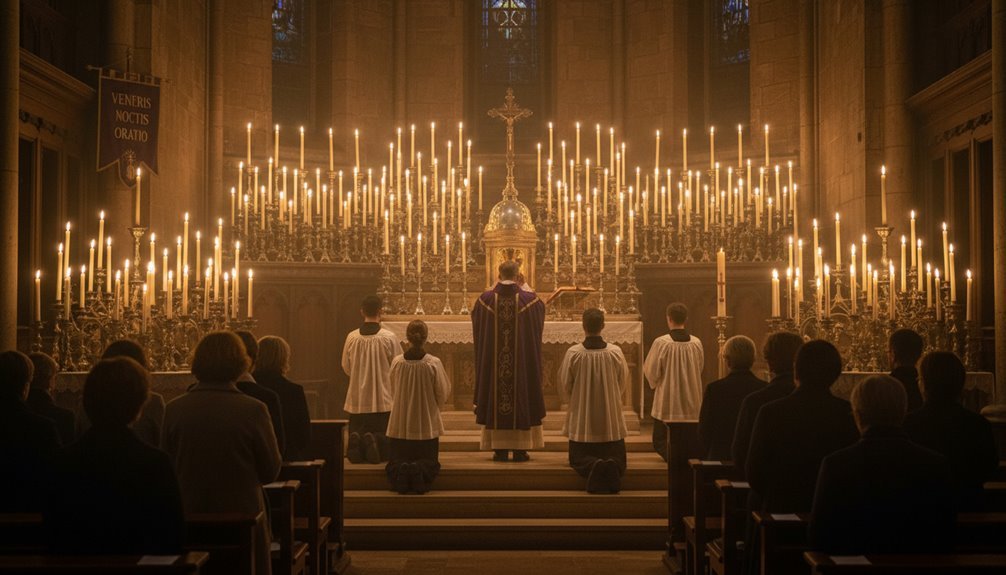
The Catholic Good Friday liturgy follows a four-part structure. You’ll start with the Solemn Entrance and Liturgy of the Word, then transition into the Veneration of the Cross. Next comes Holy Communion, and the service concludes with the Concluding Rites. Throughout, you’ll find a progression from solemn procession and readings to the central focus on the cross – there’s much more to discover within each step.
Table of Contents
Key Takeaways
- The Catholic Friday liturgy typically consists of a solemn entrance, liturgy of the word, veneration of the cross, holy communion, and concluding rites.
- The liturgy of the word includes readings from the Old Testament, a responsorial psalm, a New Testament reading, and a homily.
- The veneration of the cross involves processing the cross to the front, displaying it, and the faithful approaching to show reverence.
- Holy communion follows the veneration, with the consecrated bread and wine received by the faithful with reverence.
- The liturgy ends with the priest dismissing the congregation, and the faithful departing in hushed reverence.
The Solemn Entrance and Liturgy of the Word
The Solemn Entrance and Liturgy of the Word begins with the celebrant and ministers processing to the altar, marking the start of the service. You’ll then sing or recite the Introit, a brief opening psalm. Next, the celebrant leads the Penitential Act, where you humbly ask for God’s forgiveness. The Gloria may follow, depending on the liturgical season. After the Opening Prayer, you’ll listen attentively to the proclaimed readings from Scripture. The first reading comes from the Old Testament, followed by a Responsorial Psalm. Then, you’ll hear a reading from the New Testament and the proclamation of the Gospel. The homily follows, where the priest reflects on the day’s readings, guiding you to deeper spiritual understanding.
The Veneration of the Cross
After the solemn procession and readings, the service transitions to the veneration of the cross. This ancient ritual allows the faithful to individually approach the cross, genuflect, and kiss it as a sign of reverence. The cross, draped in red or black, is processed to the front of the church where it’s displayed for all to see.
One by one, parishioners come forward, kneel, and reverently touch or kiss the crucifix. This poignant moment symbolizes our gratitude for Christ’s sacrifice and the centrality of the cross in Catholic theology. It’s a profoundly moving experience, reminding us of the Passion and the price of our redemption.
The Holy Communion
Following the moving veneration of the cross, you now partake in the Holy Communion. This sacred ritual connects you to the sacrifice of Christ, as you receive the consecrated bread and wine. You reflect on the profound meaning of the Eucharist, the body and blood of Jesus. This intimate encounter with the divine nourishes your soul and strengthens your faith. You partake in reverence, aware of the grace bestowed upon you.
The Holy Communion is the culmination of the Good Friday liturgy, a time to deepen your commitment to Christ and the teachings of the Church. As you receive the Eucharist, you’re reminded of the eternal love and redemption made possible through Jesus’ suffering and death.
The Concluding Rites
Finally, what happens during the Concluding Rites of the Good Friday liturgy? The Concluding Rites wrap up the solemn service. The priest dismisses the congregation, saying “Go in peace.” The people respond, “Thanks be to God.” This brief ritual acknowledges that the liturgy has ended, and it’s time to leave and live out the passion of Christ in our daily lives.
The service doesn’t conclude with a recessional hymn, as in Sunday Mass, since the liturgy is meant to leave the faithful in silent reflection. The altar is stripped, and the congregation departs in hushed reverence, contemplating the events of Good Friday and the death of our Lord.
Frequently Asked Questions
What Are the Catholic Church’s Rules for Fasting on Fridays?
The Catholic Church requires fasting on Fridays, which means you should abstain from eating meat. This rule applies year-round, except on solemnities or when a Friday falls on a holy day of obligation.
You’re also expected to perform some form of penance, like giving to charity or doing an act of self-denial, to honor Christ’s Passion on Fridays.
How Do Catholics Celebrate Good Friday Differently From Other Fridays?
On Good Friday, Catholics commemorate the crucifixion of Jesus with a solemn liturgy. The service includes the reading of the Passion narrative, the veneration of the cross, and the reception of Holy Communion. This differs from a typical Friday Mass, as there’s no consecration of the Eucharist and the service is more somber, reflecting the gravity of Christ’s death.
Can Non-Catholics Receive Communion During the Catholic Friday Liturgy?
No, non-Catholics can’t receive communion during the Catholic Friday liturgy.
The liturgy is a solemn service focused on Christ’s passion and death, and communion is reserved for practicing Catholics in a state of grace.
While non-Catholics are welcome to attend, they shouldn’t receive communion unless they’re part of the Catholic faith.
What Special Prayers or Devotions Are Part of the Friday Liturgy?
The Friday liturgy typically includes special prayers and devotions like the Stations of the Cross, the Passion of Christ reading, and the Veneration of the Cross. You’ll also find penitential prayers, hymns, and reflections on Christ’s suffering and death.
The liturgy emphasizes the solemnity of Good Friday and the significance of the crucifixion.
Are There Any Unique Music or Hymns Used in the Friday Mass?
The Friday Mass often includes unique music and hymns, such as the Stabat Mater, a sequence that meditates on the Sorrows of the Blessed Virgin Mary.
You might also hear the Improperia, a series of reproaches addressed to the crucified Christ.
These solemn chants and prayers reflect the penitential nature of the Friday liturgy.
Conclusion
You’ll find the Catholic Friday liturgy outline encompasses the Solemn Entrance and Liturgy of the Word, the Veneration of the Cross, the Holy Communion, and the Concluding Rites. These elements come together to form a meaningful and sacred observance, guiding the faithful through this significant day.







No Comments