


09 Sep 30 Billy Graham Famous Quotes That Inspire Faith
You’ll discover Billy Graham’s most profound quotes centered on salvation by grace through faith (Ephesians 2:8-9), God’s relentless love pursuing souls before they’re aware of Him, and death as a triumphant gateway to Christ’s presence (2 Corinthians 5:8). His words emphasize childlike trust over polished phrases, total surrender versus mere belief, and hope emerging powerfully from darkness. Graham’s teachings on prayer, marriage, suffering, and authentic discipleship have shaped evangelical thought for generations, offering timeless wisdom that transforms hearts today.
Key Takeaways
- “Being a Christian is more than just an instantaneous conversion; it is a daily process whereby you grow to be more and more like Christ.”
- “My home is in Heaven. I’m just traveling through this world.”
- “The will of God will not take us where the grace of God cannot sustain us.”
- “When wealth is lost, nothing is lost; when health is lost, something is lost; when character is lost, all is lost.”
- “Someday you will read or hear that Billy Graham is dead. Don’t you believe a word of it. I shall be more alive than I am now.”
Quotes on Faith and Belief
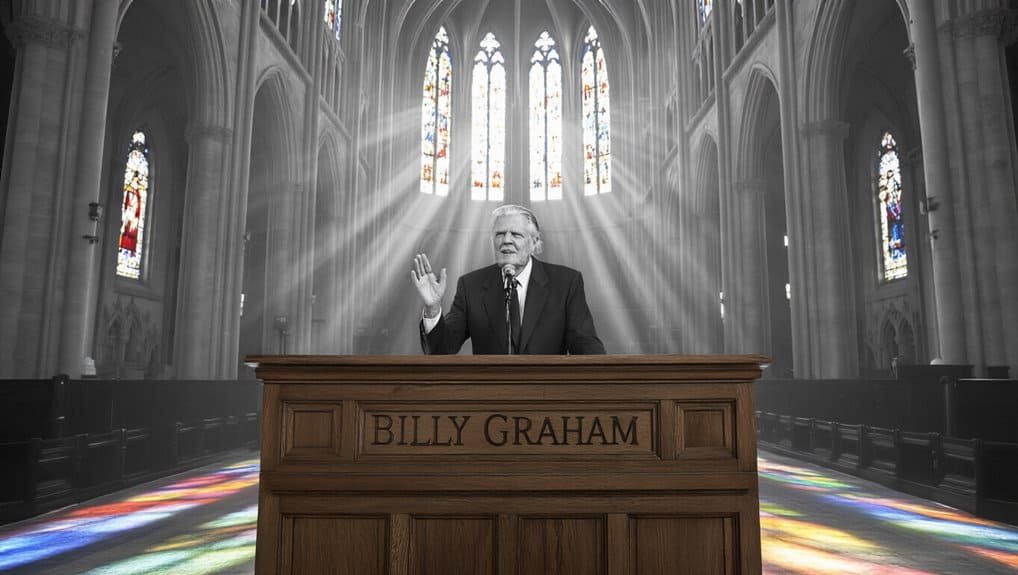
When you examine Billy Graham’s extensive ministry spanning seven decades, you’ll discover that his quotes on faith and belief consistently anchored themselves in the biblical doctrine of salvation by grace through faith alone (Ephesians 2:8-9).
Graham’s theological framework emphasized faith’s transformative power, declaring, “Faith isn’t believing God can; it’s knowing He will.” This distinction reflects the Hebrews 11:1 principle of faith as substantive assurance rather than wishful thinking.
You’ll find Graham addressed belief challenges with pastoral wisdom, acknowledging doubt’s reality while affirming faith’s superiority. He taught that your faith journey doesn’t require perfect understanding but childlike trust (Matthew 18:3).
His quote, “I’ve read the last page of the Bible; it’s all going to turn out all right,” exemplifies confidence rooted in eschatological hope.
Graham’s approach to faith transcended mere intellectual assent, demanding total surrender to Christ’s lordship, consistent with James 2:19’s warning against demons’ belief without submission.
Words About God’s Love and Grace

His theological framework positioned divine grace as God’s unmerited favor, freely given through faith alone (Ephesians 2:8-9). You can’t earn salvation through works; it’s received as a gift.
Graham emphasized that grace doesn’t merely forgive—it transforms. His quotes reveal a systematic understanding of prevenient, justifying, and sanctifying grace.
He’d remind audiences that God’s love preceded their awareness of Him, declaring, “When we come to Christ, we’re responding to love that was already pursuing us.”
Insights on Prayer and Spiritual Life

You’ll discover through Graham’s teachings that daily prayer isn’t merely religious routine but your lifeline to divine communion, echoing Christ’s own withdrawal to solitary places for prayer (Mark 1:35).
When you establish consistent prayer discipline, you’re positioning yourself to discern God’s voice amid life’s cacophony—a skill Graham considered essential for authentic spiritual maturation.
This intentional practice of listening prayer transforms your relationship with God from monologue to dialogue, fulfilling the biblical promise that His sheep know His voice (John 10:27).
Power of Daily Prayer
Through consistent daily prayer, believers access what Billy Graham considered the most transformative power available to Christians—direct communion with the Almighty God.
You’ll discover that establishing prayer habits transforms your spiritual journey from sporadic encounters to continuous fellowship. Graham emphasized that daily devotion isn’t merely religious routine but vital spiritual sustenance, echoing Christ’s teaching in Luke 18:1 about praying always without ceasing.
When you commit to morning prayer, you’re positioning yourself to receive divine wisdom before worldly pressures infiltrate your thoughts.
Graham taught that prayer’s power doesn’t depend on eloquence but authenticity—God responds to sincere hearts, not polished phrases.
You’ll find that persistent prayer develops spiritual discernment, strengthens faith during trials, and aligns your will with God’s purposes, fulfilling Paul’s exhortation in 1 Thessalonians 5:17.
Finding God’s Voice
Graham taught that spiritual discernment develops through disciplined study and prayer.
You can’t separate hearing God from knowing His Word. The Holy Spirit illuminates Scripture, making God’s will clear to those who seek Him earnestly.
Graham insisted you’ll recognize God’s voice through its alignment with biblical principles, its promotion of holiness, and its consistency with Christ’s character.
When you’re saturated in Scripture, you’ll distinguish between divine guidance and human impulse.
Teachings on Sin and Redemption
You’ll find Graham’s doctrine of sin centers on humanity’s universal separation from God through inherited corruption and willful rebellion, echoing Paul’s assertion that “all have sinned and fall short of the glory of God” (Romans 3:23).
His soteriology emphasizes salvation as God’s gracious act through Christ’s substitutionary atonement, requiring personal faith rather than human merit or religious works.
Graham consistently proclaimed that redemption comes solely through accepting Christ’s finished work on the cross, where divine justice and mercy converge to restore fallen humanity to covenant relationship with God.
Nature of Human Sin
The doctrine of original sin formed the bedrock of Billy Graham’s evangelistic message, as he consistently proclaimed humanity’s complete spiritual bankruptcy before a holy God.
You’ll find Graham’s exposition of human nature consistently emphasized total depravity—not merely moral failings but an inherent corruption affecting every faculty. He’d reference Romans 3:23 and Isaiah 64:6, demonstrating how sin consequences extend beyond individual acts to encompass humanity’s fundamental alienation from divine holiness.
Your redemption journey begins by recognizing this spiritual struggle isn’t about ethical choices alone but confronting sin’s dominion over the will.
Graham taught that faith challenges emerge precisely because you can’t overcome sin through self-reformation. Grace necessity becomes evident when you grasp that righteousness remains unattainable through human effort, requiring Christ’s substitutionary atonement for reconciliation.
Path to Salvation
Having established humanity’s desperate condition, salvation emerges not as moral improvement but divine rescue through Christ’s finished work at Calvary. You can’t earn redemption through religious rituals or charitable deeds—Graham emphasized justification by faith alone (Ephesians 2:8-9).
Your salvation journey begins with acknowledging Christ’s substitutionary atonement, where He bore God’s wrath meant for you.
Graham’s evangelistic clarity pierced theological complexity: “You must be born again” (John 3:7). He’d proclaim that regeneration isn’t self-reformation but supernatural transformation initiated by the Holy Spirit.
When you place faith in Christ’s resurrection power, you’re instantly justified, progressively sanctified, and ultimately glorified. This eternal hope doesn’t rest on your performance but Christ’s perfection.
Graham consistently taught that salvation’s assurance comes through Scripture’s promises, not emotional experiences or human merit.
Wisdom About Death and Eternity
When you confront the reality of mortality, Graham’s teachings illuminate death not as humanity’s final defeat but as the believer’s ultimate transition into God’s eternal presence. He proclaimed, “Someday you’ll read that Billy Graham is dead. Don’t believe a word of it. I’ll be more alive than I’m now.”
This eternal perspective transforms how you’ll approach life’s brevity and death’s certainty.
Graham’s wisdom about life afterlife anchored in 2 Corinthians 5:8’s promise of being “absent from the body, present with the Lord.” He taught that you’re not preparing for death but for eternity—a distinction that reshapes every earthly priority.
You’re not preparing for death but for eternity—a distinction that reshapes every earthly priority.
“Death isn’t the end of the road; it’s merely a gateway,” he emphasized, urging believers to view their temporal existence through heaven’s lens. His teachings remind you that while death remains humanity’s last enemy (1 Corinthians 15:26), Christ’s resurrection has already secured victory for those who believe.
Perspectives on the Bible and Scripture
As you encounter life’s complexities and moral uncertainties, Graham consistently pointed to Scripture as humanity’s unwavering compass, declaring the Bible to be “the anvil that has worn out many hammers.”
He didn’t merely view Scripture as ancient literature but as God’s living Word—active, powerful, and sharper than any two-edged sword (Hebrews 4:12).
Graham’s approach to biblical interpretation emphasized Scripture’s self-authenticating nature. You’ll find he rejected liberal theology’s attempt to demythologize biblical narratives, instead affirming the text’s supernatural character and divine inspiration.
His hermeneutical framework maintained that Scripture interprets Scripture—a principle rooted in Reformed tradition.
Regarding scripture relevance, Graham proclaimed the Bible addresses every generation’s deepest needs. He’d often state, “The Bible isn’t an option; it’s a necessity.”
You can’t navigate spiritual darkness without its illumination. His conviction rested on 2 Timothy 3:16-17’s assertion that all Scripture is God-breathed, profitable for doctrine, reproof, and instruction in righteousness.
Thoughts on Marriage and Family
Graham taught that you can’t separate strong family values from biblical authority. He warned against cultural forces undermining marital permanence, stating, “Nothing brings more joy than a good marriage, and nothing brings more misery than a bad one.”
His counsel stressed mutual submission, sacrificial love, and shared faith as marriage’s pillars.
You’ll discover Graham viewed parenting as stewardship, urging couples to raise children “in the nurture and admonition of the Lord” (Ephesians 6:4).
He believed spiritual leadership in homes would transform nations, declaring godly families as Christianity’s most powerful witness.
Messages About Hope and Encouragement
You’ll discover in Graham’s teachings that hope emerges most powerfully when circumstances appear darkest, echoing Paul’s declaration that “we glory in tribulations” (Romans 5:3).
He consistently proclaimed that God’s promises remain immutable despite life’s uncertainties, grounding believers in the covenantal faithfulness demonstrated throughout Scripture.
Graham’s message emphasized that each new day brings divine opportunities for redemption and transformation, reflecting the biblical principle of God’s “mercies [being] new every morning” (Lamentations 3:23).
Finding Light in Darkness
When darkness threatens to overwhelm your spirit, Billy Graham’s words pierce through despair with the transformative power of gospel hope.
You’ll find his teachings consistently anchored in John 8:12, where Christ declares Himself the light of the world. Graham’s exposition of divine illumination reveals how God’s presence penetrates life’s darkest valleys, offering hope amidst suffering and trials.
His theological framework emphasizes light overcoming darkness as both positional truth and experiential reality.
You’re reminded that spiritual darkness can’t extinguish God’s light—it merely provides the backdrop against which His glory shines brightest.
Graham’s exegesis of 2 Corinthians 4:6 demonstrates how the same God who commanded light from chaos illuminates believers’ hearts.
Through his preaching, you’ll discover that darkness isn’t denial of light’s existence but the very condition that makes light’s arrival transformative.
God’s Promises Never Fail
The certainty of divine promises forms the bedrock of evangelical faith, and throughout his ministry, Billy Graham proclaimed this truth with unwavering conviction.
You’ll find his messages consistently anchored in Scripture’s covenant guarantees, particularly 2 Corinthians 1:20’s declaration that all God’s promises find their “Yes” in Christ.
Graham emphasized that divine assurance isn’t dependent on human merit but on God’s immutable character.
He’d remind you that unfailing trust develops through recognizing God’s faithfulness across redemptive history—from Abraham’s covenant to Calvary’s fulfillment.
When you’re facing uncertainty, Graham’s teachings direct you to Romans 8:28’s providence and Philippians 4:19’s provision.
His exposition of biblical promises wasn’t mere theological abstraction; he demonstrated how you can stake your eternal destiny on God’s unchanging Word, knowing His promises transcend circumstances.
Tomorrow Holds New Possibilities
As dawn breaks over human despair, Billy Graham’s prophetic voice consistently proclaimed that each new day carries divinely ordained opportunities for spiritual renewal and transformation.
You’ll discover through his teachings that tomorrow’s potential isn’t merely optimistic thinking but theological certainty rooted in Lamentations 3:22-23—God’s mercies are new every morning.
Graham championed embracing change as divine providence, urging you to view endless opportunities through faith’s lens.
He’d remind you that positive transformations begin when you’re anchored in Christ’s promises, not circumstantial evidence. Your future aspirations gain substance through renewed purpose, transcending temporal limitations.
His message wasn’t naive optimism but biblical realism: bright horizons emerge from cruciform suffering.
You’re called to maintain hopeful outlooks while recognizing that new beginnings require surrendering yesterday’s failures.
Faith in tomorrow means trusting God’s sovereignty over your unknown tomorrows.
Reflections on Suffering and Trials
Though suffering often arrives uninvited and unwelcome in our lives, Billy Graham consistently taught that God transforms these trials into instruments of spiritual refinement and divine purpose.
You’ll discover Graham’s teachings echo Paul’s assertion in Romans 5:3-4 that tribulation produces perseverance, character, and hope. He emphasized suffering’s purpose extends beyond mere endurance—it’s God’s chisel shaping you into Christ’s image.
Graham frequently referenced James 1:2-4, urging believers to “count it all joy” when facing various trials. You’re not abandoned in darkness; rather, you’re positioned for transformation.
His messages consistently highlighted how trials build resilience through dependence on God’s strength, not human fortitude. He’d remind audiences that Christ himself learned obedience through suffering (Hebrews 5:8), establishing the precedent for redemptive pain.
You’ll find Graham’s perspective doesn’t minimize suffering’s reality but reveals its eternal significance, transforming temporary affliction into eternal glory.
Guidance on Living a Christian Life
Graham’s teachings stress that you can’t compartmentalize faith from daily decisions. He’d remind believers that authentic discipleship demands total surrender—your finances, relationships, and vocational choices must align with Kingdom priorities.
His framework for Christian living rejects both legalistic moralism and antinomian license, instead advocating for grace-empowered obedience. You’re called to demonstrate Christ’s lordship through practical holiness, serving as salt and light in secular contexts.
Graham’s quotes reveal his conviction that genuine conversion produces observable transformation, where moral guidance flows from regenerated hearts rather than external conformity to religious codes.
Frequently Asked Questions
How Many Books Did Billy Graham Write During His Lifetime?
You’d find that Billy Graham authored 33 books during his lifetime, establishing profound literary contributions to Christian theology.
His book titles like “Peace with God” (1953) and “Angels: God’s Secret Agents” (1975) demonstrated doctrinal precision while making complex biblical references accessible.
You’ll discover his writings systematically addressed salvation, discipleship, and eschatological themes, reflecting Paul’s exhortation in 2 Timothy 2:15 to “rightly divide the word of truth” through scholarly evangelical exposition.
Which World Leaders Did Billy Graham Counsel Throughout His Ministry?
You’d find Graham’s political influence extending through his spiritual guidance to twelve U.S. presidents from Truman to Obama, particularly close with Eisenhower, Johnson, and Nixon.
He counseled Queen Elizabeth II, Winston Churchill, and global leaders including Golda Meir and Kim Il-sung.
His ministry embodied Christ’s command to “render unto Caesar” (Matthew 22:21), maintaining doctrinal integrity while offering biblical wisdom to world powers, demonstrating Christianity’s relevance in governmental spheres.
What Was Billy Graham’s Most Attended Crusade Event?
You’d find Billy Graham’s most attended crusade event was his 1973 rally in Seoul, South Korea, where 1.1 million people gathered on Yeo-ui-do Plaza.
Among his massive gatherings across global crusade locations, this remains unprecedented.
Like Paul addressing multitudes in Acts 17, Graham proclaimed Christ crucified to this ocean of souls.
His systematic exposition of John 3:16’s salvific truth demonstrated doctrinal precision while maintaining evangelistic fervor throughout this historic proclamation.
How Did Billy Graham Become Known as “America’s Pastor”?
You’d recognize Billy Graham earned “America’s Pastor” through unprecedented evangelical outreach spanning seven decades, counseling twelve presidents from Truman to Obama.
His spiritual legacy transcended denominational boundaries, embodying Christ’s commission in Matthew 28:19 to “make disciples of all nations.”
He didn’t just preach crusades; he shaped national consciousness during crises, offering biblical wisdom with doctrinal precision while maintaining theological integrity across America’s diverse religious landscape.
What Year Did Billy Graham Begin His Broadcasting Ministry?
You’ll find Billy Graham began his broadcasting ministry in 1950 with “Hour of Decision,” transforming evangelical media outreach forever.
His broadcasting impact reached millions weekly, fulfilling Christ’s Great Commission through radio waves.
You’re witnessing how he leveraged technology for Kingdom purposes, as Paul became “all things to all people” (1 Corinthians 9:22).
His media outreach strategy established the theological framework for modern televangelism, demonstrating doctrinal faithfulness while embracing innovative communication methods.
Conclusion
Billy Graham’s words continue to illuminate Scripture’s timeless truths, calling you to examine your faith’s foundation. His quotes aren’t mere inspiration—they’re theological anchors rooted in biblical doctrine, pointing you toward Christ’s redemptive work (Romans 10:9). As you’ve explored these teachings on faith, prayer, redemption, and eternity, you’re challenged to move beyond intellectual assent to transformative belief. Graham’s legacy reminds you that authentic Christianity demands both orthodox conviction and Spirit-led application in daily discipleship.





No Comments