

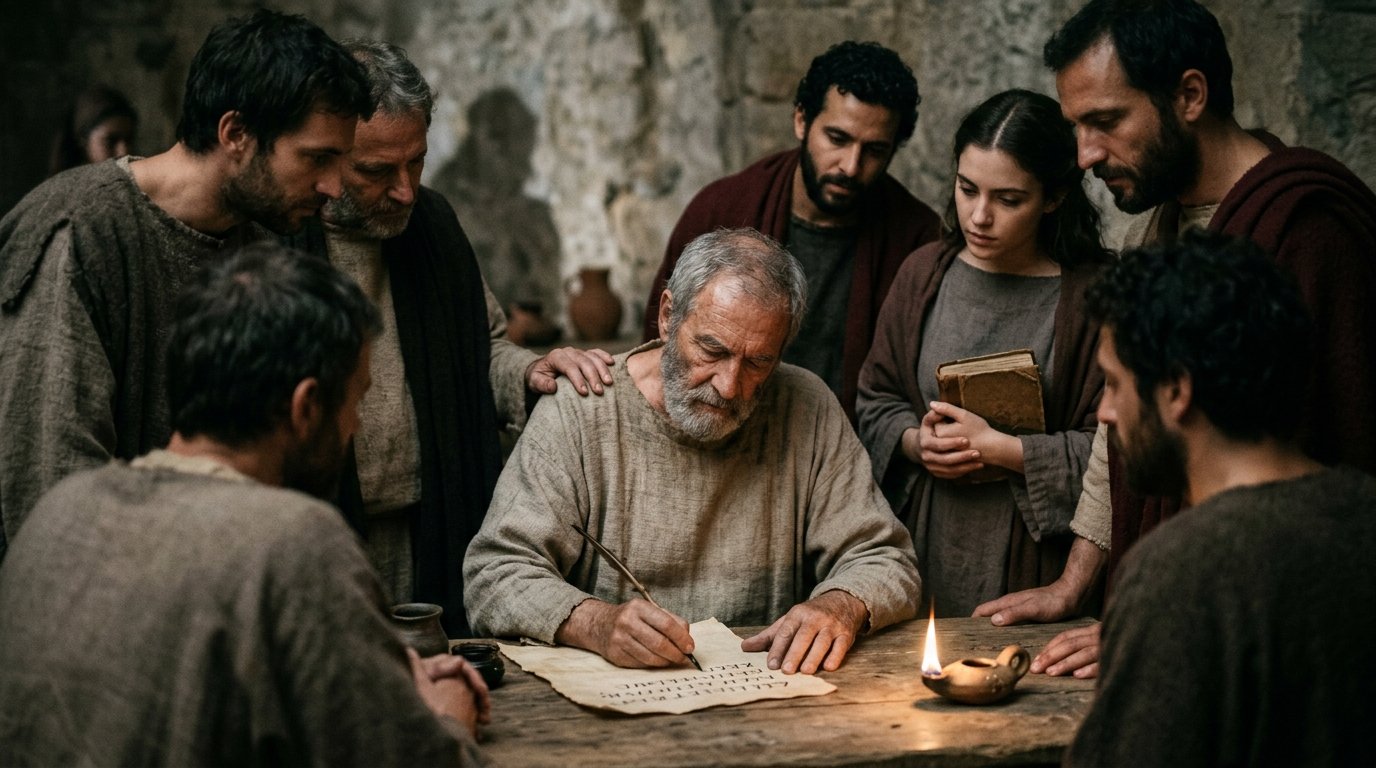
22 Mar How Early Christians Created This Biblical Faith Declaration That Endures
You’ll see that early Christians started with a simple baptismal formula—“in the name of the Father, Son, and Holy Spirit”—and expanded it to counter Gnostic and other heresies, making it concise enough to survive persecution. Councils like Nicaea and Constantinople then fixed the wording, grounding each line in Scripture (e.g., Luke 24:6‑7 for the resurrection, Acts 1:9‑11 for the ascension). This unified confession became the Apostles’ Creed, a rhythmic, translatable statement that still binds believers worldwide, and if you keep going you’ll discover how its core doctrines were shaped.
Table of Contents
Why Early Churches Sought a Unified Creed
Why did the early churches feel compelled to craft a unified creed? You felt the pressure of doctrinal chaos as diverse interpretations of Christ’s nature and resurrection spread across bustling congregations. Without a common statement, believers risked splintering into sects that could claim legitimacy while contradicting one another. Leaders recognized that a concise confession would safeguard orthodoxy, provide a teaching anchor for catechumens, and enable swift identification of heretical teachings. By articulating core truths—God’s triune nature, Christ’s incarnation, death, and resurrection—into could unify worship, liturgy, and baptismal vows. This shared language also facilitated communication with Roman authorities, showing that Christians possessed a coherent belief system rather than a disorganized movement. Ultimately, the creed functioned as a theological glue, binding scattered communities into a recognizable, resilient body of faith that could withstand internal disputes and external scrutiny.
How Baptismal Formulas Evolved Into the Apostles’ Creed
You’ll notice that early baptismal confessions already hinted at a Trinitarian framework, and as those formulas sharpened, they naturally merged into a concise statement of belief. The gradual codification of these elements gave rise to what we now recognize as the Apostles’ Creed. This evolution shows how communal practice shaped a unified confession for the early church.
Early Baptismal Confessions
Early baptismal confessions began as simple, formulaic statements recited at the moment of immersion, yet over a few centuries they grew into the more elaborate profession of faith that would become the Apostles’ Creed. You hear the catechaters recite, “I believe in God the Father, and in Jesus Christ, his Son,” a succinct affirmation that secured entry into the community. As local churches met, leaders added clauses to address doubts, counter heresies, and reinforce communal identity. By the third century, you encounter longer versions that mention the Holy Spirit, the resurrection, and eternal life, reflecting theological refinement. These expansions weren’t arbitrary; they mirrored debates at councils and the need for a shared, memorable creed that could be taught to converts and remembered in worship.

Trinitarian Formula Development
How did the simple baptismal recitation transform into the structured Apostles’ Creed? You’ll notice that early Christians began with a three‑fold formula—“in the name of the Father, Son, and Holy Spirit”—used at each baptism. As doctrinal disputes intensified, communities needed a concise confession that could counter heresies and affirm orthodoxy. By the mid‑2nd century, leaders like Irenaeus and Tertullian started expanding the formula, inserting statements about Christ’s incarnation, crucifixion, and resurrection. These additions mirrored the growing emphasis on Trinitarian theology, while still preserving the original baptismal rhythm. Within a few generations, the extended confession solidified into a fixed creed, recited in liturgy and catechesis, laying the groundwork for the Apostles’ Creed we recognize today.
Codification Into Apostolic Creed
The three‑fold baptismal formula soon proved insufficient for confronting the theological challenges that erupted across the Roman Empire. You’ll notice that church leaders began to codify belief statements to protect orthodoxy and unify disparate congregations.
By the mid‑second century, the baptismal creed—“in the name of the Father, Son, and Holy Spirit”—expanded into a concise confession covering creation, sin, redemption, and resurrection. You see the Apostles’ Creed emerging from catechetical practice, preserving core doctrines while offering a portable summary for worship and instruction.
As you study its wording, you recognize the deliberate inclusion of Christ’s death, bodily resurrection, and future judgment, all designed to counter Gnostic and heretical interpretations. This transformation turned a ritual formula into a doctrinal anchor that still guides believers today.
How Persecution Shaped the Creed’s Concise Form
Why did early believers compress their confession into a single, memorable statement? You’ll find that relentless persecution forced Christians to protect their faith with speed and secrecy. When Roman authorities swooped on house churches, you needed a creed you could whisper in the dark, recite before a magistrate, or embed in a secret letter without exposing every detail. A concise formula reduced the risk of misinterpretation by hostile interrogators and ensured that core doctrines—God’s triune nature, the incarnation, the resurrection—remained intact even if parts of the community were scattered. You also discovered that memorability mattered: soldiers, slaves, and merchants carried the creed in their heads, passing it along as oral testimony. In this high‑stakes environment, brevity became a survival tool, shaping the creed’s tight, rhythmic structure that still resonates today.

How Synods and Councils Formalized the Apostles’ Creed
You’ll see how synods gathered bishops to reach a consensus on core beliefs, turning oral tradition into a shared statement. Then, ecumenical councils issued decrees that formally codified that consensus into the Apostles’ Creed.
This process gave the creed an authoritative, unified structure that still guides Christian faith today.
Synodic Consensus Formation
When early Christians gathered in synods and councils, they didn’t merely debate doctrine—they forged a shared confession that would become the Apostles’ Creed. You’ll notice that each assembly sought consensus, not competition. Bishops presented local liturgies, then listened as peers highlighted overlaps. Through iterative drafting, you saw divergent phrases trimmed, ambiguous terms clarified, and theological boundaries drawn. You experienced the power of “conciliar consensus”: a collective vote that validated the emerging creed, ensuring it reflected the whole church, not a single faction. By the time the Council of Nicaea convened, you already had a rough template; the council simply ratified it, cementing a unified statement that survived centuries of doctrinal challenge.
Council Decrees Codified
The consensus built in earlier synods became the blueprint that councils later locked into official decrees, turning a fluid confession into a fixed creed. You’ll see how the Council of Nicaea (325) and later the Council of Constantinople (381) took the draft from local gatherings, refined theological language, and codified it in the Nicene‑Constantinopolitan Creed. You notice the emphasis on Christ’s divinity and the Holy Spirit, which addressed Arian and Macedonian controversies. By the time the Council of Chalcedon (451) convened, the creed served as a benchmark for orthodoxy, guiding bishops across the empire. You understand that these formal decrees gave the Apostles’ Creed lasting authority, shaping liturgy, catechesis, and Christian identity for centuries.
Scriptural Passages Behind Each Apostles’ Creed Segment
Because the Apostles’ Creed is a concise summary of Christian belief, each line can be traced to specific biblical passages that early believers used to articulate their faith. You’ll find “I believe in God the Father Almighty” echoing Genesis 1:1 and Psalm 145:13, while “Jesus Christ, His only Son, our Lord” draws from John 3:16 and Romans 10:9. The statement “who was conceived by the Holy Spirit, born of the Virgin Mary” reflects Luke 1:35 and Matthew 1:23. “Suffered under Pontius Pilate, was crucified, died, and was buried” aligns with the four Gospels, especially Mark 15:1‑15. “He descended into hell” references 1 Peter 3:19 and Ephesians 4:9. “On the third day He rose again” mirrors Luke 24:6‑7. “He ascended into heaven” is supported by Acts 1:9‑11, and “He will come to judge the living and the dead” cites Matthew 25:31‑46 and Revelation 20:12.
Why the Apostles’ Creed Remains Relevant Across Cultures
Tracing each line of the Apostles’ Creed back to its scriptural roots shows how early Christians built a universal confession grounded in the Bible. You’ll notice that the creed’s core statements—God the Father, Son, Holy Spirit, creation, redemption, resurrection—mirror narratives found in every major tradition. Because those narratives address fundamental human questions about origin, purpose, and destiny, the creed speaks to people regardless of language or culture. When you share it in a new context, you’re not imposing a foreign doctrine; you’re offering a shared vocabulary for worship that already resonates with local myths about divine love and moral order. The creed’s simple structure lets translators preserve its rhythm and meaning, while its theological depth invites deeper study. As a result, churches worldwide adopt it for baptism, liturgy, and catechesis, creating a common thread that unites believers across continents and generations.
Frequently Asked Questions
What Original Languages Influenced the Creed’s Wording?
You’ll find that the creed’s wording draws mainly from Greek, because the early church wrote its statements in Koine Greek, the lingua franca of the Roman Empire. Latin later shaped the Western version, especially as the Church adopted Latin liturgy. Hebrew and Aramaic also left traces, since the creed reflects biblical concepts rooted in those languages, but the core phrasing remains Greek‑based.
Did the Creed Ever Include References to the Holy Spirit?
Yes, the creed eventually mentions the Holy Spirit. Early versions focused on the Father and Son, but by the fourth century the Nicene-Constantinopolitan formulation added “and the Holy Spirit” to affirm the Trinity. You’ll see it in the line “We believe in one Holy, holy, catholic, and apostolic Church, and in one baptism for the forgiveness of sins, and in the Holy Spirit, who proceeds from the Father and the Son.” This addition solidified the Spirit’s doctrinal role.
How Did the Creed Spread Beyond the Roman Empire?
You’ll find the creed spreading through missionary journeys, trade routes, and the translation of liturgical texts. Early bishops sent letters and taught the confession in churches across Africa, Asia Minor, and Gaul. Monastic communities copied and exchanged manuscripts, while imperial officials who embraced Christianity carried the creed into administrative centers. Over centuries, local councils codified it, and pilgrimages helped embed the declaration in diverse cultures beyond Rome.
Are There Notable Regional Variations of the Apostles’ Creed?
You’ll find that the Apostles’ Creed isn’t a monolith; regional variations emerged as churches adapted it to local languages and theological emphases. In the West, the Latin “Credo” added “and the communion of saints,” while Eastern traditions sometimes omitted that clause or phrased it differently. Some medieval Western manuscripts inserted “the holy catholic Church,” reflecting Western ecclesiology, whereas Eastern versions emphasized “the holy, catholic, and apostolic Church” in a more liturgical context. These tweaks show how the core confession stayed intact while accommodating cultural and doctrinal nuances.
What Role Did Laypeople Play in Preserving the Creed?
You’ll find that laypeople were essential to the creed’s survival. They memorized it, recited it at worship, and taught it to children in homes and catechumen gatherings.
Conclusion
You’ve seen how early Christians forged a concise, unifying creed amid persecution, council debates, and evolving baptismal rites. By anchoring each line in Scripture and shaping it through synods, the Apostles’ Creed became a timeless confession that still bridges cultures and generations. Its brevity and depth keep it relevant, reminding you that faith can be both profoundly simple and powerfully enduring.










No Comments