

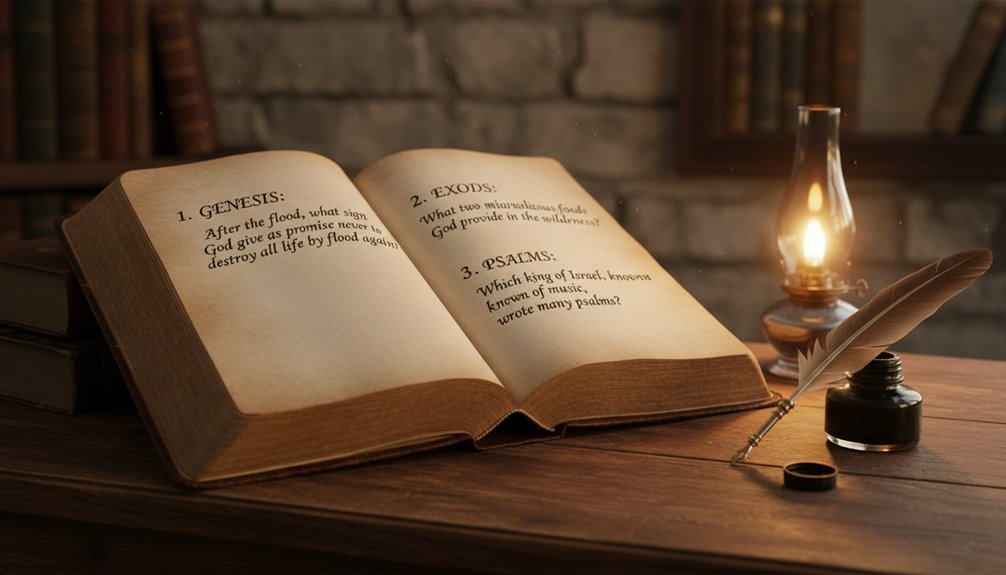
10 Apr 3 Best Bible Old Testament Quiz Questions by book
You’ll master the Old Testament with three top quiz questions—one from Genesis, one from Exodus, and one from Psalms. In Genesis, ask which covenant promise guarantees a specific region for Abraham’s descendants, the land promise. In Exodus, query the symbolic meaning behind the plague of darkness that confronts Ra’s sun‑god protection. In Psalms, match Psalm 22 to its crucifixion‑type suffering voice. Keep you curious, you’ll discover deeper insights.
Genesis Bible Quiz: Identify the First Covenant’s Promise
Ever wondered what God promised to Abraham in the first covenant? You’ll find the answer in Genesis 12‑17, where He pledges land, descendants, and blessings. When you quiz yourself, focus on three core elements: the promise of a vast territory (Canaan), the birth of a great nation (the Israelites), and the universal blessing through Abraham’s line. Remember the double‑sign—circumcision—marks the covenant’s permanence.
To test comprehension, ask: “Which promise ensures that Abraham’s offspring will inherit a specific region?” Answer: the land promise.
Next, query the “what” of the blessing: it’s the worldwide benefit that flows from Abraham’s descendants.
Finally, probe the “how” of the sign: circumcision.
Exodus Bible Quiz: Identify Each Plague and Its Symbolic Meaning
What do the ten plagues really reveal about Egypt’s stubbornness and God’s power? You’ll see that each plague targets a specific Egyptian deity or cultural pride, forcing Pharaoh to confront divine authority.
Blood turns the Nile into a lifeless stream, mocking Hapi, the river god.
Frogs swarm, humiliating Heqet, the frog‑god of fertility.
Lice infest the people, undermining the power of the priestly class.
Wild animals attack, challenging the strength of the war god.
Pestilence kills livestock, striking at the wealth of the agrarian economy.
Boils erupt on skin, exposing the impotence of the healing god.
Hail shatters crops, defying the sun god’s protection.
Locusts devour fields, erasing the promise of abundance.
Darkness blankets the land, confronting the sun god Ra.
Finally, the death of the firstborn shatters the very heart of Egyptian lineage, proving that no hierarchy can withstand God’s decisive judgment.
Psalms Bible Quiz: Match Each Psalm to Its Historical Context and Author
The dramatic showdown of the plagues shows how God’s power upended Egypt’s idols, and now we turn to Israel’s own songs of worship and lament. In this Psalm quiz, you’ll match each poem to its setting and writer. You’ll see David’s battlefield cries in Psalm 18, reflecting his triumph over the Philistines, and Psalm 22’s crucifixion echo, spoken from a suffering servant’s perspective. You’ll recognize Asaph’s temple worship in Psalm 73, where he grapples with the prosperity of the wicked while standing before the sanctuary. You’ll link the exile lament of Psalm 137 to the Babylonian captivity, feeling the river’s sorrowful chorus. You’ll also spot the Maccabean victory in Psalm 144, a warrior‑king’s prayer for victory. By linking verses to history, you sharpen your biblical knowledge and test recall of authorship, context, and theme in a focused, engaging way.
Frequently Asked Questions
What Are the Major Themes of the Book of Job?
You’ll find Job wrestling with suffering, divine justice, and human limitation. He questions why the righteous endure pain while the wicked prosper, then learns that God’s wisdom surpasses human understanding. The narrative emphasizes perseverance, humility, and the need for repentance. Ultimately, Job’s story teaches that faith endures despite mystery, and that true righteousness is rooted in trust, not in material blessings or worldly success.
How Does the Song of Solomon Illustrate Covenant Love?
You see the Song of Solomon as a vivid portrait of covenant love, because it uses intimate, sensual language to depict the bond between husband and wife as a reflection of God’s steadfast commitment to His people.
The poetic exchange of longing, exclusivity, and mutual delight mirrors the covenant’s promises of fidelity, security, and joy, turning romantic love into a metaphor for divine, enduring relationship.
Which Prophets Foretold the Babylonian Exile?
You’ll find that Jeremiah, Isaiah, and Ezekiel all warned that Babylon would take Israel away. Jeremiah repeatedly predicts the siege and the exile, especially in chapters 25 and 29.
Isaiah, in his later “servant” passages, mentions a “remnant” taken to Babylon.
Ezekiel, writing from exile, recounts the judgment and the upcoming displacement.
Together they form the biblical forecast of the Babylonian captivity.
What Is the Significance of the “suffering Servant” in Isaiah?
You see the “suffering servant” as Isaiah’s prophetic portrait of a messianic figure who endures injustice to bring redemption.
He embodies Israel’s collective pain, yet his suffering transforms into divine triumph, foreshadowing at’s atonement.
How Do the Minor Prophets Differ in Literary Style?
You’ll notice the minor prophets vary sharply in literary style. Some, like Hosea and Amos, use vivid, poetic imagery and prophetic oracles, while others, such as Micah and Nahum, blend narrative with terse judgments. Jeremiah mixes lamentation with symbolic actions, and Zechariah intertwines apocalyptic visions with messianic hope. Their language ranges from concise, proverbial sayings to elaborate, metaphor‑rich passages, reflecting distinct theological emphases and historical contexts.
Conclusion
You’ve just explored three timeless quiz formats that bring the Old Testament to life. By testing the First Covenant’s promise in Genesis, the symbolic plagues in Exodus, and the historical backdrop of each Psalm, you sharpen your knowledge and deepen your connection to the text. Keep using these questions to spark curiosity, reinforce learning, and enjoy the rich tapestry of biblical history.










No Comments