

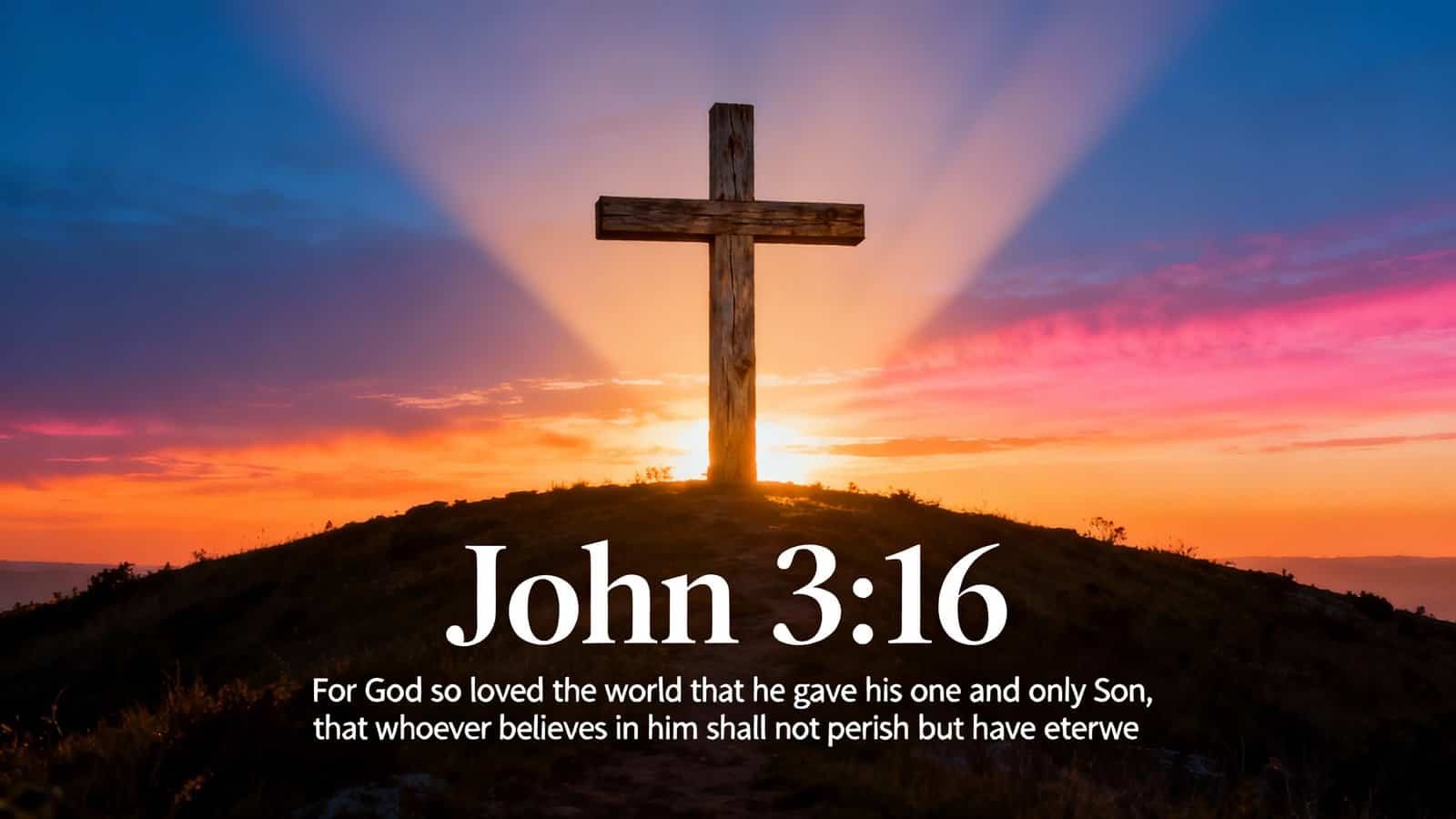
02 Nov John 3:16 Bible Verse Explained: The Ultimate Guide to Understanding God’s Love
John 3:16 reveals God’s ultimate expression of love—He gave His only Son so you wouldn’t perish but have eternal life through faith in Christ. This verse isn’t just about avoiding hell; it’s about receiving God’s sacrificial love that actively pursues you regardless of your past. When you believe in Jesus, you’re not merely agreeing intellectually but trusting Him completely for salvation. This transformative faith connects you to Christ’s finished work and secures your adoption into God’s family forever.
Table of Contents
Key Takeaways
- God’s love (agapao) is active, sacrificial, and unconditional, extending to every person in the world without exception or prerequisite.
- The Father gave His unique, irreplaceable Son as the ultimate sacrifice to redeem humanity from eternal separation from God.
- Biblical faith means trusting completely in Christ’s finished work, not mere intellectual agreement, resulting in immediate justification and adoption into God’s family.
- “Perish” refers to eternal separation from God after final judgment, while eternal life means knowing God intimately through Christ starting now.
- John 3:16 crystallizes Scripture’s redemptive narrative from Genesis to Revelation, fulfilling Old Testament promises through Christ’s sacrificial love.
The Historical Context: Jesus’ Conversation With Nicodemus
Nightfall had settled over Jerusalem when Nicodemus, a prominent Pharisee and member of the Jewish ruling council, approached Jesus secretly. You can imagine the weight of this moment—a respected religious leader risking his reputation amid intense Temple politics and coalition tensions within first century Judaism.
Nicodemus came seeking answers that traditional Rabbinic debate couldn’t provide. He’d witnessed Jesus’ miracles and recognized divine authority, yet everything Jesus taught challenged the established religious framework he’d devoted his life to defending.
During their conversation, Jesus introduced revolutionary concepts about spiritual rebirth and God’s kingdom. You’ll notice how Christ patiently guided Nicodemus from earthly understanding to heavenly truths, culminating in the profound declaration of John 3:16.
This wasn’t merely theological discourse—it was a compassionate invitation to transformation. Jesus revealed that God’s love transcends religious boundaries, offering salvation not through human effort or political maneuvering, but through faith alone.
Breaking Down John 3:16 Word by Word in the Original Greek
Examining the original Greek text of John 3:16 reveals profound depths of meaning that English translations can’t fully capture.
You’ll discover that “οὕτως” (houtos) means “in this manner,” emphasizing not just quantity but quality of God’s love. The Greek syntax places “God” (Θεὸς) in the emphatic position, highlighting His initiative in salvation.
Through lexical analysis, you’ll find “ἀγαπάω” (agapao) represents deliberate, sacrificial love—not mere emotion. The word “μονογενής” (monogenes) translates as “unique” or “one-of-a-kind,” revealing semantic nuances about Christ’s singular relationship with the Father.
While textual variants exist in manuscripts, they don’t affect the verse’s core message.
Notice the present tense of “πιστεύων” (believing)—it’s continuous action, not a one-time event. You’re called to ongoing faith.
The contrast between “ἀπόληται” (perish) and “ζωὴν αἰώνιον” (eternal life) presents an absolute choice with no middle ground, underscoring the verse’s urgency and God’s compassionate desire for your salvation.
What “For God So Loved the World” Really Means
When you encounter the phrase “For God so loved the world,” you’re witnessing the most profound declaration of God’s universal love—a love that extends to every person regardless of their background, status, or spiritual condition.
The Greek word “agapao” reveals not just casual affection but an active, sacrificial love that chooses to seek humanity’s highest good even at tremendous cost.
This divine love isn’t limited to a select few; it encompasses the entire cosmos, demonstrating that you’re included in God’s redemptive plan no matter who you’re or what you’ve done.
God’s Universal Love
Love this profound reaches beyond human comprehension, yet God makes it knowable through four simple words: “For God so loved.” You’ve probably heard this phrase countless times, but its depth deserves careful attention.
When Scripture says “the world,” it means everyone—no exceptions. God’s cosmic compassion doesn’t discriminate based on nationality, social status, or moral standing. You’re included in this sweeping declaration of divine affection, regardless of your past or present circumstances.
This universal grace extends to those who reject Him, those who don’t know Him, and those actively opposing Him. God’s love isn’t reactive to human behavior; it’s proactive and unconditional. You can’t earn it through good deeds or lose it through failures. It simply exists, covering all creation with relentless, pursuing love.
Depth of Divine Affection
Intensity marks the difference between God’s love and every other affection you’ve known. The Greek word “agape” in John 3:16 reveals a self-sacrificing love that chooses you despite your flaws. You’re not experiencing distant approval but cosmic intimacy—the Creator’s personal investment in your redemption.
Consider how “so loved” emphasizes magnitude. God didn’t merely acknowledge humanity; He poured out infinite tenderness through Christ’s sacrifice. This isn’t conditional affection based on your performance. You’re witnessing divine passion that bridges heaven and earth, holiness and brokenness.
When Scripture says God gave His “only begotten Son,” you see love’s ultimate expression. The Father’s heart breaks for you. He knows your struggles, counts your tears, and offers restoration through relationship, not religion.
The Significance of God Giving His Only Son
Sacrifice reveals the depth of love like nothing else can. When you consider God giving His only Son, you’re witnessing the ultimate sacrificial exchange—Jesus took your place, bearing the punishment you deserved. This wasn’t merely an act of kindness; it was covenant fulfillment at its highest level.
Think about what “only Son” means. God didn’t have multiple sons to choose from. He gave His one and only, His beloved, in whom He was well pleased. This demonstrates the irreplaceable value of what God surrendered for you.
The giving wasn’t passive either. God actively sent Jesus, and Christ willingly came. Together, they orchestrated your redemption through divine sacrifice. You couldn’t save yourself, so God provided what you couldn’t—a perfect substitute. This giving transforms everything: your standing before God, your eternal destiny, and your understanding of divine love’s magnitude.
Understanding “Whoever Believes in Him” and Biblical Faith
You’ve seen that God gave His only Son, but now you must understand what it means to “believe in Him” according to Scripture.
Biblical faith isn’t merely agreeing that Jesus existed or acknowledging facts about Him—it’s trusting Him completely with your eternal destiny, just as you’d trust a parachute when jumping from a plane.
This living faith transforms your heart, redirects your life, and secures your soul through Christ’s finished work on the cross.
What Biblical Faith Means
Trust stands at the heart of what Jesus means when He says “whoever believes in Him.” The Greek word *pisteuō*, translated as “believes,” doesn’t merely suggest intellectual agreement with facts about Jesus—it calls for complete reliance upon Him as your Savior and Lord.
You’re called to place your entire confidence in Christ’s finished work on the cross. Biblical faith involves surrendering control and depending on Him alone for salvation. This trust produces assurance evidence in your life through the Holy Spirit’s transforming power.
You’ll discover that genuine faith manifests in persevering obedience—not to earn salvation, but as its natural fruit. When you truly believe, you’re entrusting your eternal destiny to Jesus, resting in His promises rather than your own efforts.
Belief Versus Mental Agreement
Biblical belief isn’t intellectual agreement about historical facts. Even demons believe God exists and tremble (James 2:19).
True faith involves transformative surrender—you’re not just convinced in your mind but convicted in your heart. You’ll release control, abandon self-righteousness, and cling to Jesus as your only hope.
When John writes “whoever believes,” he’s describing someone who moves beyond mental acknowledgment to wholehearted dependence. You’re trusting Christ like you’d trust a parachute while jumping from a plane.
How Faith Saves Souls
Salvation comes through faith alone because faith connects you to Christ’s finished work on the cross.
When you place your trust in Jesus, you’re not earning salvation through good deeds or religious activities. You’re receiving God’s saving grace as a free gift, accepting what He’s already accomplished for you.
Your faith acts as the channel through which God’s power flows into your life. Just as faith healing operates through believing God’s promises for physical restoration, spiritual salvation works through trusting Christ for eternal life. You don’t need perfect faith—even faith as small as a mustard seed can save your soul.
The moment you believe, God credits Christ’s righteousness to your account. You’re instantly justified, adopted into God’s family, and sealed with the Holy Spirit until redemption’s day.
The Promise of Not Perishing: What Scripture Says About Eternal Death
The phrase “shall not perish” in John 3:16 carries profound significance that you’ll find echoed throughout Scripture’s teaching on eternal death. When you examine the Greek word “apollumi,” meaning to perish or be destroyed, you’re confronting humanity’s most serious condition—eternal separation from God.
Scripture doesn’t present perishing as mere physical death. You’ll discover it represents the second death described in Revelation 20:14-15, where those facing final judgment experience permanent separation from God’s presence. This isn’t annihilation but conscious existence apart from the source of life itself.
Through Christ’s sacrifice, you’re offered deliverance from this fate. Romans 6:23 confirms what you’ve learned: “The wages of sin is death, but the gift of God is eternal life.” When you believe in Jesus, you’re rescued from perishing—not just dying physically, but being eternally separated from God’s love, light, and life after the final judgment.
Eternal Life Explained: More Than Just Living Forever
Quality defines eternal life far beyond mere endless existence—it’s knowing God intimately through Jesus Christ (John 17:3). You’re not just receiving unending days but experiencing God’s very nature dwelling within you.
Eternal life isn’t endless existence—it’s knowing God intimately through Jesus Christ, experiencing His divine nature dwelling within you.
This indwelling presence transforms how you live today, not just your future destiny.
Your eternal perspective shifts everything. You’ll see trials as temporary, relationships as sacred, and time as God’s gift. The resurrection assurance you’ve received isn’t merely about physical revival—it’s about participating in Christ’s victory over death right now. You’re already seated with Him in heavenly places (Ephesians 2:6).
This transformed hope reshapes your daily existence. You’ll find purpose in suffering, joy amid sorrow, and peace during chaos. Eternal life means you’re experiencing God’s kingdom breaking into the present. You’re not waiting to truly live—you’re alive in Christ today, carrying His life-giving Spirit who guarantees your complete transformation at His return.
How John 3:16 Connects to the Broader Message of Scripture
When you trace John 3:16 through Scripture’s grand narrative, you’ll discover it crystallizes God’s redemptive plan that began in Genesis and culminates in Revelation.
This verse isn’t isolated theology—it’s the heartbeat of the divine covenant that pulses throughout both Testaments.
You’ll find John 3:16’s themes woven into Abraham’s promise, Moses’ deliverance, and David’s kingdom.
The prophets foretold this love-driven salvation, pointing to a Messiah who’d restore what sin destroyed.
Jesus’ words to Nicodemus echo Isaiah’s suffering servant and Daniel’s eternal kingdom.
This verse also establishes kingdom ethics for believers.
When you grasp God’s sacrificial love, you’re called to embody it.
The epistles repeatedly connect God’s love in Christ to how you should love others.
John himself later writes, “We love because he first loved us.”
Understanding John 3:16’s place in Scripture transforms it from a memorized verse into your life’s foundation and mission.
Frequently Asked Questions
How Do I Share John 3:16 With Someone Who Doesn’t Believe in God?
Start by building genuine relationship and listening to their perspective.
Ask questions about their beliefs and experiences rather than immediately quoting Scripture.
When appropriate, share your personal testimony of how God’s love has transformed your life.
Focus on demonstrating Christ’s love through your actions first.
When you do share John 3:16, explain it as God’s invitation rather than a debate point.
Let the Holy Spirit work through your compassionate witness.
Why Do Different Bible Translations Word John 3:16 Differently?
You’ll find different wordings because translators work from various manuscript differences and follow distinct translation philosophies.
Some prioritize word-for-word accuracy while others emphasize thought-for-thought clarity.
Textual variants in ancient Greek manuscripts create minor variations, though the core message remains unchanged.
Each version’s theological emphasis might highlight “only begotten” versus “one and only” Son, but they’re all faithfully conveying God’s promise of eternal life through belief in Christ.
Can Children Understand John 3:16, and How Should I Explain It?
Yes, children can absolutely understand John 3:16 when you use simple language. Try this storytelling example: “God loved you so much that He sent Jesus, His only Son, as the greatest gift ever. When you believe in Jesus, you’ll live with God forever!
Use a simple analogy like a parent’s sacrificial love – how you’d do anything to protect them. That’s how God feels about them, but even bigger.
What if I Believe but Still Struggle With Doubts About Salvation?
You’re not alone in experiencing doubts alongside faith—even biblical heroes wrestled with uncertainty.
God’s promise in John 3:16 remains true despite your feelings.
Strengthen your assurance through daily assurance practices like memorizing verses about eternal security.
Start grace journaling to document God’s faithfulness and answered prayers.
When doubts arise, return to these written reminders.
How Does John 3:16 Apply to People Who Never Heard About Jesus?
You’re touching on the inclusivity debate that theologians have wrestled with for centuries. Scripture suggests God reveals Himself through general revelation—creation and conscience point people toward Him (Romans 1:20).
While John 3:16 emphasizes belief in Jesus, God’s justice and mercy extend beyond what we fully understand. Trust that He’ll judge fairly those who’ve never heard, while you’re called to share Christ’s love with those you can reach today.
Conclusion
You’ve discovered that John 3:16 isn’t just a verse—it’s God’s heart revealed. Through understanding its Greek roots, Nicodemus’s encounter, and Scripture’s broader narrative, you’ve seen how deeply you’re loved. This truth isn’t merely theological knowledge; it’s your invitation to trust Christ completely. Don’t let this remain head knowledge. Believe with your whole heart, receive the eternal life He’s offering, and let this transformative love reshape everything about how you live today.











No Comments