

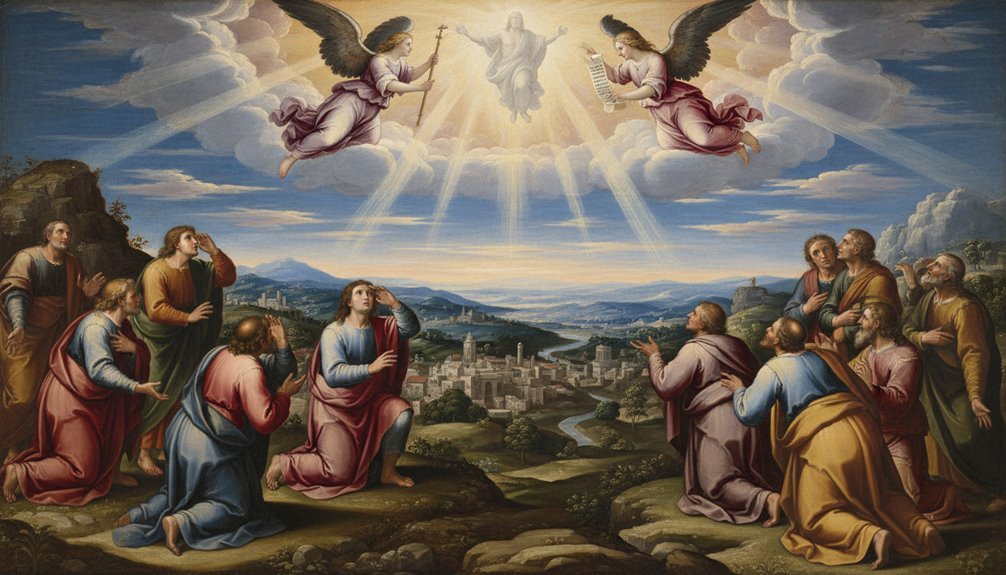
20 Apr Angels Appearing to Disciples After Jesus Ascension
After Jesus ascended, you’ll see angels appear to the disciples several times, confirming the resurrection and proclaiming his exalted rule. In Acts, two men in white at the ascension site (1:10‑11) and the fiery, wind‑like spirit at Pentecost (2:3‑4) signal divine presence. The Gospels record an angel at the tomb (Luke 24:4‑7) and another rolling back the stone (Matthew 28:2‑4). John’s Emmaus narrative (20:19‑26) presents the Lord himself, not a separate angel. These messages point to the Holy Spirit’s imminent outpouring and shape the early church’s identity and mission—continue and you’ll discover how.
Table of Contents
Which Angelic Appearances Are Recorded in Acts and the Gospels?
Where do the angels appear in the New Testament? You’ll find them in several key moments after Jesus’ ascension.
In Acts 1:10‑11, two men in white stand at the Ascension site, confirming his return. later, in Acts 2:3‑4, a wind‑like sound and tongues of fire signal the Holy Spirit’s arrival, though the “angelic” language is indirect.
The Gospel of Luke records an angel at the tomb (Luke 24:4‑7), announcing the resurrection and directing the women to tell the disciples. Matthew also mentions an angel rolling back the stone ( Matthew 28:2‑4).
In the Gospel of John, an unnamed heavenly presence appears to the disciples on the road to Emmaus (John 20:19‑26), though it’s described as “the Lord” rather than a distinct angel.
These passages collectively illustrate how angels intervene to confirm, guide, and empower the early followers.
What Specific Messages Do the Angels Deliver to the Disciples?
How do the angels’ messages shape the disciples’ understanding of Jesus’ mission? You hear the angels proclaim that Jesus has risen and is now seated at God’s right hand, confirming His divine authority. They tell the disciples that the Lord will return in the same manner He ascended, urging vigilance and hope. In Acts, the angelic voice declares the fulfillment of prophecy, reminding the believers that the promised Messiah has triumphed over death. The messages also reassure the group that their mission continues: they must bear witness to the risen Lord and spread the gospel to every nation. By emphasizing Jesus’ exalted status and imminent return, the angels reinforce the disciples’ role as ambassadors of the kingdom, aligning their work with the divine plan. Their concise, authoritative words eliminate doubt, inspire courage, and direct the early church toward bold proclamation.
How Do Those Messages Point to the Coming of the Holy Spirit?
Why do the angels’ proclamations matter for the Spirit that follows? You hear them say, “He will be with you always,” and you recognize a promise that extends beyond Jesus’ physical presence. Their words act as a bridge, turning the disciples’ expectation of a returning Messiah into anticipation of an internal, empowering presence. By emphasizing that the Lord “will not leave you as orphans,” the angels hint that the forthcoming Holy Spirit will fill the void, providing guidance, comfort, and power. This shift from external sight to internal experience reorients the community’s faith, preparing them to receive a Spirit who convicts, teaches, and equips. You see the angels’ messages as a theological foreshadowing: they set the stage for Pentecost, ensuring the disciples understand that the same divine authority will now operate within them, not merely around them.
Why Do These Post‑Ascension Angel Visits Shape Early Christian Identity?
The angels’ promise of the Holy Spirit doesn’t just assure comfort; it defines who the disciples become. When you read the post‑ascension appearances, you see a deliberate link between divine endorsement and communal identity. The angels confirm that the risen Lord’s mission continues, turning the fledgling group into believers who claim the same authority as the apostles. You recognize that these visits validate the disciples’ role as witnesses, giving them a shared narrative that distinguishes them from surrounding sects.
The promised Spirit becomes the unifying force, shaping worship, teaching, and moral standards. You also notice that the angelic messages reinforce obedience to Jesus’ teachings, forging a collective self‑understanding rooted in divine commission. By internalizing these encounters, early Christians construct a distinct identity that hinges on heavenly affirmation and the expectation of the Spirit’s ongoing work.
Frequently Asked Questions
What Historical Evidence Supports Angelic Appearances After the Ascension?
You’ll find that the only “historical” evidence for post‑ascension angelic appearances comes from early Christian writings, not from secular archaeology or contemporary records.
The New Testament (Acts 1:10‑11, 2:13) describes angels, and the same events are echoed in the writings of church fathers like Irenaeus and Eusebius.
Outside these texts, no independent, non‑Christian sources corroborate the claims.
How Do Different Christian Traditions Interpret These Angelic Visits?
You’ll find that Catholic, Orthodox, and Protestant traditions each read the angelic visits through their theological lenses. Catholics often see them as divine confirmation of the Great Commission, emphasizing the Church’s authority. Orthodox churches stress the mystical presence of angels as signs of the Holy Spirit’s activity in the early community. Protestants, especially evangelical groups, tend to view the appearances as literal, historical events that validate Scripture’s reliability and the ongoing role of angels in God’s plan.
Are There Parallel Accounts of Post‑Ascension Angels in Non‑Canonical Texts?
You’ll find several non‑canonical works that recount post‑ascension angelic appearances. The Apocalypse of Peter describes angels guiding the disciples after Jesus rises. The Gospel of Thomas mentions an angelic figure delivering secret teachings. In the Acts of Paul and Thecla, angels intervene to protect and instruct the early believers. These texts, though not part of the biblical canon, parallel the canonical narratives of angels visiting the disciples.
What Linguistic Clues Hint at the Original Meaning of “Angel” in These Passages?
You’ll notice that the Greek word ἀγγέλος is used, which literally means “messenger,” not a supernatural being. The Septuagint often translates Hebrew מַלְאָךְ (malʾāḵ) the same way, emphasizing a human envoy. In the texts, the term appears with verbs like “appeared,” “spoke,” and “delivered,” suggesting a role of communication rather than divinity. Those linguistic cues point to the original sense of a messenger.
Do Any Early Church Fathers Reference These Angelic Encounters?
You’ll find that several early church fathers mention the angelic appearances.
Irenaeus, in *Against Heresies*, cites the post‑ascension angels to affirm the disciples’ testimony.
Tertullian, in *Against Marcion*, references the same events to argue for the continuity of divine revelation.
Origen, in his *Commentary on Luke*, also notes the angels, interpreting them as signs of the Spirit’s ongoing work.
These citations reinforce the tradition’s acceptance of the encounters.
Conclusion
You’ve seen how the angels’ post‑ascension visits aren’t random appearances but purposeful messengers. Their greetings confirm the resurrection, reassure the disciples, and point unmistakably toward the promised Holy Spirit. By linking Jesus’ departure with the Spirit’s arrival, these encounters cement the early church’s identity: a community rooted in divine affirmation, empowered for mission, and anchored in the ongoing presence of God’s power.










No Comments