

10 Mar Roman Trial of Jesus: Key Moments Listicle
You’ll find the key moments of Jesus’s Roman trial start with his arrest in Gethsemane, where Judas betrayed him. Jesus was then brought before Pontius Pilate, the Roman governor, who tried to release him but ultimately yielded to the crowd’s demands for his crucifixion. If you’d like to dive deeper into the details, the full account reveals just how painful and unjust this ordeal was for Jesus.
Table of Contents
Key Takeaways
- Pontius Pilate, the Roman governor, questions Jesus about his claim to be the King of the Jews.
- Pilate finds no basis for a charge against Jesus but yields to the crowd’s demand to crucify him.
- Pilate attempts to release Jesus by offering to free him or the criminal Barabbas, but the crowd chooses Barabbas.
- Pilate has Jesus flogged in an effort to satisfy the crowd, but they persist in demanding his crucifixion.
- Jesus is condemned to crucifixion, mocked and beaten by soldiers, and forced to carry the crossbeam to his execution site.
The Arrest of Jesus in Gethsemane

When did the Roman authorities apprehend Jesus in the Garden of Gethsemane?
According to the Gospels, Jesus was arrested at night after he’d gone with his disciples to pray. Judas, one of the Twelve, betrayed him with a kiss, identifying Jesus to the armed mob. They seized Jesus, and his disciples fled.
The high priest’s servants took Jesus to the house of Caiaphas, the high priest, where the scribes and elders had gathered. This event marked the start of Jesus’s Roman trial, as the Jewish authorities handed him over to the Roman governor, Pontius Pilate, for judgment.
Jesus Brought Before Pontius Pilate
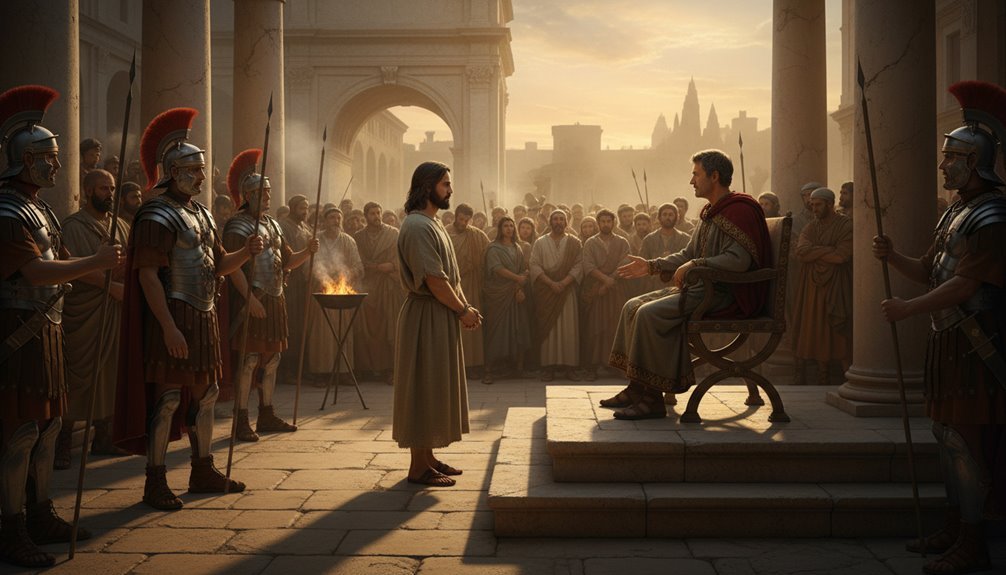
Next, the Jewish authorities brought Jesus before Pontius Pilate, the Roman governor, for judgment. Pilate questioned Jesus, asking if he was the King of the Jews. Jesus affirmed this, but explained his kingdom wasn’t of this world. Pilate then told the Jewish leaders he found no basis for a charge against Jesus. However, they insisted he was stirring up the people. Faced with the crowd’s demands, Pilate ordered Jesus to be flogged. The soldiers also mocked him, placing a crown of thorns on his head. Despite finding no guilt, Pilate succumbed to the pressure and sentenced Jesus to be crucified.
Pilate’s Attempts to Release Jesus
Determined to avoid condemning an innocent man, Pilate made several attempts to release Jesus. First, he asked the crowd whether he should free Jesus or Barabbas, a notorious criminal. But the crowd, urged on by the chief priests, demanded Barabbas be released instead.
Pilate then had Jesus flogged, hoping the brutal punishment would satisfy the crowd. But they still cried out for his crucifixion.
Pilate even tried washing his hands, symbolically distancing himself from the verdict. Yet the crowd insisted, “His blood be on us and on our children!”
Faced with their relentless demands, Pilate reluctantly handed Jesus over to be crucified, unable to sway the mob.
The Sentence of Crucifixion
Having found Jesus guilty, what fate did Pilate now seal for the Nazarene? Succumbing to the demands of the crowd, Pilate sentenced Jesus to death by crucifixion, a horrific Roman punishment reserved for the worst criminals.
Succumbing to the crowd, Pilate condemned the Nazarene to the excruciatingly painful Roman punishment of crucifixion reserved for the worst criminals.
Crucifixion was excruciatingly painful, leaving the victim to slowly asphyxiate as they struggled to push up on the nails piercing their hands and feet.
Pilate washed his hands of the matter, shifting the responsibility to the Jewish authorities.
The soldiers mocked and beat Jesus, forcing him to carry the crossbeam to the site of his execution.
There, they nailed him to the cross, raising it to leave him to die in agony, a sign to all who’d defy Roman authority.
Frequently Asked Questions
What Was the Role of Judas Iscariot in Jesus’s Arrest?
Judas Iscariot, one of Jesus’s twelve apostles, betrayed him to the authorities. He informed the chief priests of Jesus’s location and then led a group of guards to arrest him in the Garden of Gethsemane.
Judas’s actions ultimately led to Jesus’s trial and crucifixion.
Why Did Pontius Pilate Feel Pressured to Condemn Jesus?
Pontius Pilate felt pressured to condemn Jesus because the Jewish leaders had accused him of claiming to be the “King of the Jews,” a title that could be seen as a threat to Roman authority.
Additionally, the crowd had demanded that Jesus be crucified, and Pilate feared a riot or uprising if he didn’t comply with their wishes.
How Did the Jewish Authorities Influence Pilate’s Decision?
The Jewish authorities exerted immense pressure on Pontius Pilate, demanding that he condemn Jesus. They accused Jesus of treason against the Roman Empire, which Pilate couldn’t ignore.
Ultimately, Pilate succumbed to the authorities’ persistent demands, fearing a potential riot and loss of his position if he didn’t comply.
Their relentless influence led Pilate to make the fateful decision to sentence Jesus to crucifixion.
What Was the Significance of the Crown of Thorns Placed on Jesus?
The crown of thorns placed on Jesus was a symbolic act of mockery and humiliation. It represented the suffering and persecution he’d endure, as the thorns were a painful reminder of the curse placed on humanity in the Garden of Eden. This cruel act exemplified the Roman soldiers’ contempt for Jesus and their attempt to degrade him before his crucifixion.
Why Was Crucifixion Chosen as the Method of Execution?
Crucifixion was chosen as the method of execution for Jesus because it was a brutal and humiliating form of capital punishment commonly used by the Roman Empire. It was a slow and painful death, meant to serve as a public warning and deter others from defying Roman authority. The prolonged suffering and public display of the condemned were integral to the Roman approach to executing criminals and political dissidents.
Conclusion
You’ve just witnessed the key moments of the Roman trial of Jesus. From his arrest in Gethsemane to Pilate’s reluctant sentence of crucifixion, the events unfold with a haunting intensity. The trial’s outcome would forever shape the course of history, leaving an indelible mark on the world. Though the details may seem familiar, the weight of this moment remains profound, a testament to the enduring power of the human spirit in the face of adversity.











No Comments