

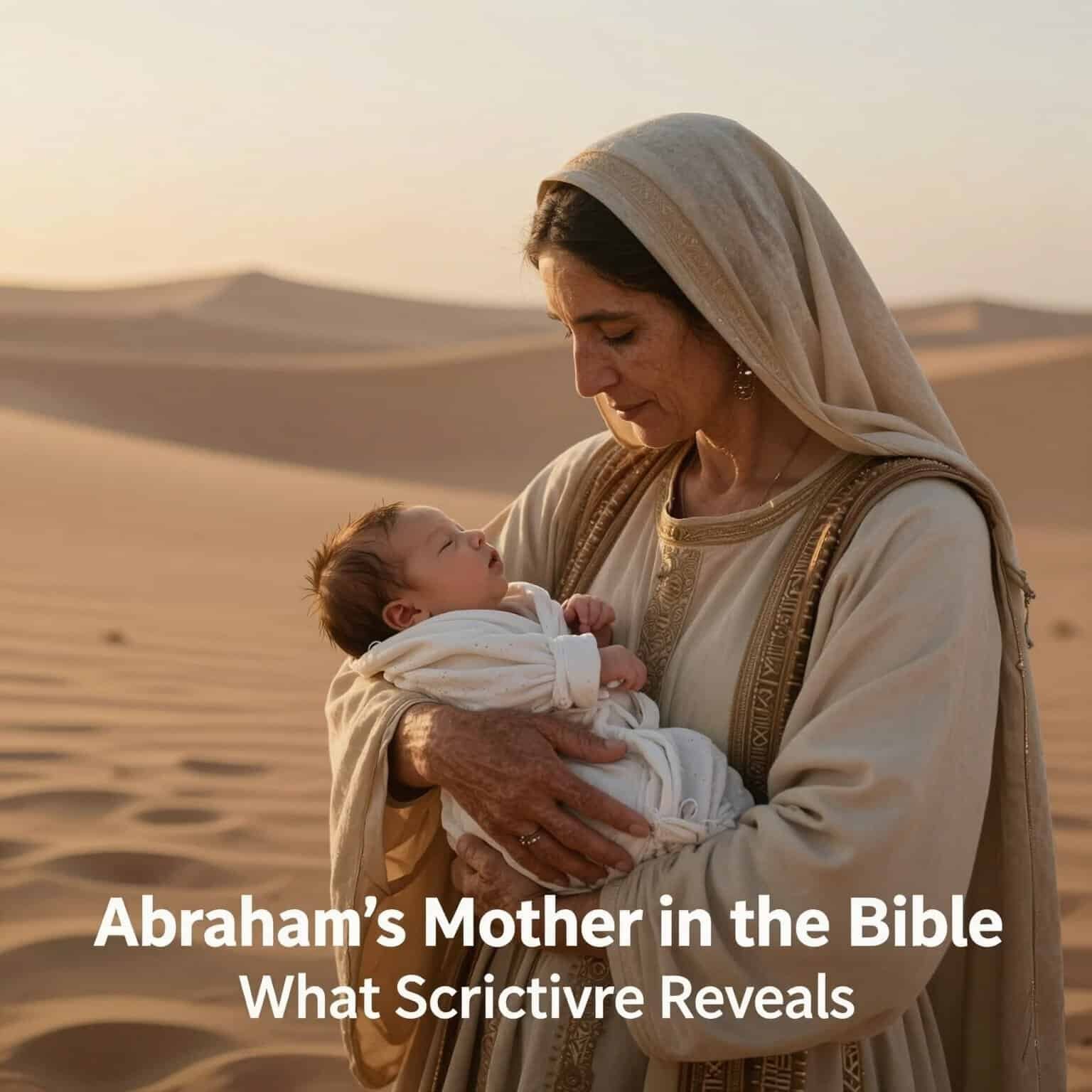
24 Apr Abraham’s Mother in the Bible: What Scripture Reveals
You won’t find Abraham’s mother named in Scripture; Genesis only lists Terah, his sons, and the covenant‑making call on Abram, leaving the matriarch silent. This omission follows the ancient Near‑Eastern habit of tracing lineage through fathers, especially when the family isn’t royal. Midrashic and Islamic sources later suggest names like Amslai, Hajar, or Siddiqah, but none appear in the biblical text. If you keep exploring, you’ll discover the deeper reasons behind this silence.
Table of Contents
Biblical Account of Abraham’s Mother
The biblical narrative never names Abraham’s mother; Genesis 11:27‑32 lists Terah’s sons but omits his wife’s name, reflecting the text’s focus on paternal lineage. You’ll notice the passage concentrates on Terah, Abram, Nahor, and Haran, then jumps straight to God’s call on Abram. No verse mentions his mother, and the genealogies that follow—Abraham to Isaac, Isaac to Jacob—continue the paternal pattern. This omission isn’t an oversight; it mirrors ancient Near‑Eastern record‑keeping that privileged male ancestors for covenantal identity. When you read the story, the emphasis stays on Abraham’s personal faith and the divine promise, not on his maternal background. Consequently, the Bible leaves the mother’s name and character entirely to tradition and speculation, keeping the focus squarely on the line that carries the covenant forward.
Reasons Genesis Omits Terah’s Wife’s Name
Why does Genesis leave Terah’s wife nameless? You’ll notice that the text prioritizes patriarchal lines, listing only Terah’s sons to trace the covenantal promise. In ancient Near‑Eastern societies, official records rarely mentioned wives unless they held royal status, and Genesis follows that convention. The author’s focus is on God’s relationship with Abraham, not on his maternal background, so omitting the name keeps the narrative tight.
Moreover, the genealogical formula in Genesis emphasizes paternal descent, a literary pattern that reinforces tribal identity and inheritance. By leaving the mother unnamed, the text invites later traditions to fill the gap without altering the core theological message. This silence also mirrors the broader biblical tendency to spotlight male figures when establishing covenantal history, allowing the story’s theological thrust to remain clear and undiluted.
Early Near‑Eastern Records of Abraham’s Mother’s Name
Genesis’ focus on patriarchal lineage leaves Terah’s wife unnamed, opening space for external sources to address the gap. You’ll find that early Near‑Eastern archives rarely preserve wives’ names unless they belong to royalty. The Ur of the Chaldeans tablets, dated to the third millennium BCE, list male heads of households and their sons, but they omit maternal identifiers. Comparable Sumerian king lists and Akkadian administrative records show the same pattern: a patriarch’s lineage is recorded, while his spouse remains invisible. When a woman held a distinct political or economic role—such as a priestess or a landowner—her name appears, yet no evidence suggests Terah’s wife held such status. Consequently, the archaeological record offers no inscription naming Abraham’s mother. This silence aligns with the broader cultural practice of emphasizing patrilineal descent, leaving scholars to rely on later literary traditions rather than contemporary documentary proof.
Midrashic Tradition: The Name Amslai
Ever wondered why Midrashic texts settle on “Amslai” for Abraham’s mother? You’ll find that the name appears in a handful of early rabbinic compilations, especially in the Midrash Rabbah on Genesis and in the Talmudic tractate Bava Batra. The sages derived it from a play on the Hebrew root “am” (people) and “shalom” (peace), suggesting she embodied communal harmony. They also linked Amslai to the genealogical line of Serah, a known ancestor, to preserve a continuous family thread. Though the biblical narrative never mentions her, the Midrash fills the silence to emphasize that Abraham’s piety had maternal roots. You’ll notice that later commentators, such as Rashi, reference Amslai without asserting historical certainty, treating the name as a traditional embellishment rather than a factual record. This approach lets you appreciate how Jewish exegesis balances reverence for text with creative storytelling.
Islamic Tradition on Abraham’s Mother: Hajar, Siddiqah, Amslai
How do Islamic sources portray Abraham’s mother? You’ll find that the Qur’an never names her, yet exegetical works often identify her as Hajar, linking her to the well‑known Hagar of the Abraham‑Ishmael story. Some hadith collections refer to her as Siddiqah, emphasizing her truthfulness and piety, traits that mirror Abraham’s prophetic character. Ibn Kathir and other historians introduce the name Amslai, echoing the Jewish Midrashic tradition while adapting it to an Islamic framework. These variations reflect differing scholarly lenses within Sunni, Shia, and Sufi circles, each stressing her devotion and role in nurturing Abraham’s faith. You should note that the emphasis lies on her moral qualities rather than genealogical detail, reinforcing the theological theme that divine calling outweighs lineage. Consequently, Islamic tradition offers multiple names—Hajar, Siddiqah, Amslai—yet consistently portrays her as a model of righteousness and support for Abraham’s mission.
Scholarly Consensus on Historical Evidence
The varied Islamic portraits of Abraham’s mother illustrate how tradition can fill scriptural gaps, but when scholars turn to the historical record they find no concrete evidence for any name. You’ll see that critical biblical studies agree the text never names Terah’s wife, and no inscription or seal from the early second‑millennium BCE mentions her. Excavations at Ur and surrounding sites have yielded extensive administrative tablets, yet they record only male heads of households; female names appear only for royalty or high‑status individuals, which Abraham’s family doesn’t qualify as. Comparative Near‑Eastern literature shows the same pattern—mothers are often omitted in genealogies that prioritize paternal lines. Consequently, the scholarly consensus holds that any proposed name rests on later exegetical tradition, not on primary historical data. Research now focuses on how post‑biblical communities constructed narratives, rather than on uncovering a verifiable maternal identity.
Theological Significance of Abraham’s Unnamed Mother
Why does the text leave Abraham’s mother unnamed? You’ll notice that Genesis centers on covenant, not pedigree. By omitting her name, the narrative forces you to see Abraham’s faith as a personal response to God, not a product of family prestige. The silence also mirrors the ancient Near‑Eastern habit of recording paternal lines while leaving women invisible, which underscores that divine calling transcends ancestry. When you read the story, you’re invited to imagine a mother whose piety and obedience are implied rather than stated, allowing you to project virtues onto her without limiting the theological message.
This unnamed figure becomes a theological foil: she represents the hidden, supportive background that nurtures a prophetic destiny, yet the text insists that the covenant’s power rests solely on Abraham’s encounter with God. Consequently, the omission sharpens the focus on faith, obedience, and the primacy of divine initiative over human lineage.
Modern Implications for Understanding Abraham’s Story
Ever since scholars began probing Genesis, you’ve seen that the anonymity of Abraham’s mother reshapes how you read his narrative today. You now recognize that the missing maternal voice forces you to focus on Abraham’s personal encounter with God rather than on family prestige.
This shift encourages you to treat the covenant as an individual call, highlighting personal faith over lineage. Modern readers also notice that the silence mirrors contemporary concerns about gender representation, prompting you to ask who’s excluded from sacred histories.
Frequently Asked Questions
Did Any Ancient Non‑Biblical Source Name Abraham’s Mother?
You won’t find a definitive ancient non‑biblical source that names Abraham’s mother. The earliest extrabiblical texts—like the Midrash, Talmud, and some early Islamic commentaries—offer speculative names such as Amslai or Amatlai, but none are contemporary historical records. Archaeological inscriptions from Abraham’s era never mention Terah’s wife, and scholarly consensus treats those later traditions as legendary, not factual.
How Do the Names Amslai and Serah Differ in Tradition?
You’ll find that Amslai appears mainly in Midrashic and some medieval Jewish sources as Terah’s wife, while Serah is a different figure—often identified as Abraham’s great‑grandmother or a distant ancestor, not his mother. Amslai’s name directly fills the maternal gap, whereas Serah’s tradition emphasizes lineage continuity without claiming maternity. Both names reflect divergent attempts to name Abraham’s family, but they serve distinct genealogical roles.
Why Do Islamic Texts Sometimes Call Abraham’s Mother Hajar?
You’ll find that Islamic texts sometimes call Abraham’s mother Hajar because early exegetical works linked her to the well‑known Hajar of the Hagar‑Ismaʿīl story, using the name to emphasize piety and lineage. Though the Qur’an doesn’t name her, later scholars adopted Hajar to fill the biblical gap, drawing on oral traditions and comparative Arabic naming patterns. This attribution helps reinforce Abraham’s prophetic heritage within Islamic narrative.
Could the Omission of Terah’s Wife Be Intentional Theological Symbolism?
You can see the omission as intentional symbolism. By leaving Terah’s wife unnamed, the text shifts focus from family lineage to Abraham’s personal covenant with God, emphasizing divine calling over ancestral background. It also reflects Genesis’ patriarchal narrative style, where male figures drive the story. The silence invites readers to project piety onto the unnamed mother, reinforcing the idea that God’s purpose transcends earthly identities.
What Impact Does the Unnamed Mother Have on Modern Faith Narratives?
You see that the unnamed mother pushes you to focus on Abraham’s personal faith rather than his lineage. It invites you to view divine calling as independent of family background, emphasizing individual responsibility. This gap also fuels creative storytelling, allowing traditions to project virtues onto her, shaping communal identity. Consequently, modern narratives often stress personal covenant, perseverance, and the idea that God’s purpose can arise from any circumstance.
Conclusion
You’ve seen how the Bible keeps Abraham’s mother unnamed, while extra‑biblical traditions and scholarly work offer names like Amslai, Hajar, or Siddiqah. Those variations show how cultures fill gaps, yet the core truth remains: Abraham’s story isn’t defined by his mother’s identity. Recognizing this lets you focus on his faith and covenant, the real pillars of his lasting legacy.









No Comments