

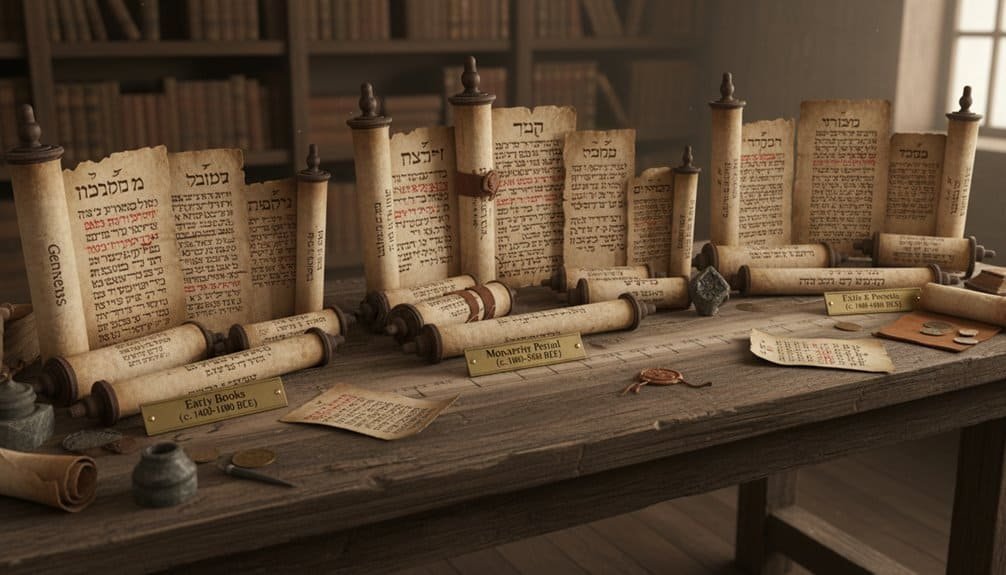
22 Apr What Is the Chronological Order of Old Testament Books?
You’ll start with Genesis, Exodus, Leviticus, Numbers, and Deuteronomy, then move to Joshua, Judges, Samuel, and Kings, followed by Chronicles. After the historical books come Job, Psalms, and Proverbs, then the major and minor prophets in roughly chronological order, and finally the post‑exilic works of Ezra and Nehemiah. This sequence lets you trace events, laws, and prophecies across generations, and if you keep going you’ll see how each layer fits into God’s unfolding story.
Table of Contents
Why Chronology Matters for Bible Study
Why does chronology matter for Bible study? You need a timeline to see how events, laws, and prophecies unfold, letting you trace cause and effect across generations. When you place books in order, you spot recurring themes, understand shifts in covenantal language, and recognize how earlier narratives shape later doctrines. A chronological framework also prevents misreading; you won’t mistake a later editorial comment for an original command. It helps you compare parallel accounts, like the kings of Israel and Judah, and spot contradictions that arise from different sources. By aligning historical context—archaeological finds, political upheavals, cultural exchanges—you gain insight into why certain passages stress obedience or warning. Ultimately, chronology equips you to interpret the Old Testament as a cohesive story rather than a random collection of texts, deepening both academic study and personal faith.
How Researchers Piece Together the Old Testament Timeline
You’ll see that archaeologists rely on dating techniques like radiocarbon and dendrochronology to anchor events.
Scholars compare textual clues across books to spot overlapping narratives and chronologies.
Archaeological Dating Techniques
Because the biblical text offers only vague chronological markers, scholars rely on archaeological dating techniques—such as radiocarbon analysis, dendrochronology, pottery typology, and stratigraphic sequencing—to anchor events in the Old Testament timeline, allowing them to piece together a more concrete historical framework.
You’ll see radiocarbon dating applied to organic remains from excavated sites, giving calibrated ranges for layers that contain biblical artifacts.
Dendrochronology matches tree‑ring patterns from timbers to established chronologies, narrowing construction dates for structures mentioned in the books.
Pottery typology tracks stylistic changes across centuries, helping you align ceramic assemblages with textual references.
Stratigraphic sequencing reads the vertical order of deposits, letting you infer which events precede others.
Together, these methods transform vague scriptural hints into a measurable, chronological map.
Textual Comparative Analysis
-Archaeological dating grounds the timeline, but it’s the texts themselves that fill in the details. You compare linguistic style, vocabulary shifts, and recurring motifs across books to spot chronological layers. When you notice a later‑archaic word in one passage and an earlier form in another, you infer a relative sequence. You also track citations of earlier texts—if a passage quotes a law code that appears elsewhere, you place the quoted work earlier. Cross‑referencing genealogies, reign lengths, and event descriptions lets you align narratives with historical markers. By mapping these internal clues, you build a relative ordering that complements external dating, revealing how the canon evolved over centuries.
Radiocarbon and Dendrochronology
How do radiocarbon and dendrochronology actually anchor biblical events in time? You’ll see that radiocarbon dating measures the decay of carbon‑14 in organic material, giving a calendar range for artifacts like charcoal from ancient hearths mentioned in the Exodus narrative. Dendrochronology, by contrast, counts tree‑ring sequences, allowing you to match timber from Solomon’s temple walls to a precise year when the tree was felled. When scholars combine these methods, they narrow the window for events such as the destruction of Jerusalem in 586 BCE. You can cross‑check radiocarbon ranges with tree‑ring chronologies, then align the results with known historical markers—like Assyrian eclipse records—to build a more reliable Old Testament timeline.
Chronological Order of the Bible: Pentateuch → Historical Books
While the Pentateuch lays the foundational narrative of creation, covenant, and law, the Historical Books pick up the story, chronicling Israel’s conquest, kingdom formation, division, exile, and return. You’ll move from Joshua, which records the entry into Canaan, to Judges, where cycles of apostasy and deliverance unfold.
Samuel bridges the judgeship to monarchy, introducing Saul and David, while Kings tracks the united kingdom, its split into Israel and Judah, and the eventual fall of both.
Chronicles retells much of this material from a priestly perspective, emphasizing temple worship and Davidic legitimacy. Ezra and Nehemiah document the post‑exilic return, rebuilding Jerusalem and reforming the community.
You’ll see how these books form a continuous historical arc, each building on the previous narrative, and how they collectively shape Israel’s identity before the prophetic and wisdom literature take the stage.
Where Do Psalms, Proverbs & Job Fit Chronologically?
Where do Psalms, Proverbs, and Job belong in the biblical timeline? You’ll find Psalms scattered throughout the monarchic period, especially during David’s reign (c. 1010–970 BCE) and later in the post‑exilic era when temple worship revived. Most scholars date the bulk of the collection to the 10th–5th centuries BCE, with some psalms added after the Babylonian exile.
Proverbs is largely a wisdom compilation attributed to Solomon (10th century BCE) but edited over centuries. Its core sayings likely emerged during the united monarchy, while later layers reflect post‑exilic concerns, placing the final form around the 5th–4th centuries BCE.
Job’s setting is ambiguous; its patriarchal backdrop suggests an early patriarchal age, yet linguistic and theological clues point to a composition in the exilic or post‑exilic period (6th–5th centuries BCE). Consequently, you can slot these three books between the historical narratives of the Judges and the prophetic literature, bridging the monarchic and exile phases.
Chronological Order of the Bible: Prophetic Writings
Ever wondered when the prophetic voices actually emerged in Israel’s history? You’ll find them appearing during the tribal period, but they truly crystallize in the united monarchy under Samuel, who bridges the transition from judges to kings. After Samuel, Elijah and Elisha operate in the divided kingdom of Israel, warning against idolatry and political corruption. In Judah, Isaiah, Jeremiah, and Ezekiel span the late eighth to early sixth centuries BCE, chronicling the Assyrian threat, the Babylonian exile, and the hope of restoration.
Amos and Hosea, both early eighth‑century prophets, address social injustice in Israel, while Micah and Nahum focus on Judah’s moral decline and impending judgment. The minor prophets—Haggai, Zechariah, and Malachi—conclude the prophetic corpus, urging post‑exilic rebuilding and fidelity to the covenant. Together, these books map a trajectory from tribal warnings to national crisis and eventual renewal, anchoring Israel’s theological development.
Post‑Exilic Books (Ezra, Nehemiah) in the Timeline
You’ll see Nehemiah’s return marking the start of a new phase in Israel’s story, as he leads the effort to rebuild Jerusalem’s walls.
Ezra follows, bringing the law back to the people and reshaping their religious identity.
Together they illustrate how the post‑exilic books capture both physical restoration and spiritual renewal.
Return Return Post‑ — Nehemiah’s Return
When did Nehemiah actually set foot in Jerusalem, and what did his return mean for the post‑exilic community? You’ll find that he arrived in 445 BC, after a royal summons from Artaxerxes I. His return signaled a decisive shift from passive hope to active reconstruction. You see a leader who brought a contingent of 1,200 men, supplies, and a clear mandate to rebuild the city’s defenses and restore civic order. For the exiles, his presence validated the promise that Persia would support their renewal. You witness a renewed sense of identity, as the people gathered around the temple, re‑established worship, and began to re‑anchor their legal and social structures. Nehemiah’s arrival thus kick‑started the practical phase of post‑exilic restoration.
Restoration of Jerusalem’s Walls
How did the walls of Jerusalem rise again after the exile? You’ll see Nehemiah, appointed cup governor, inspected the ruined ramparts, rallied the people, and organized work crews. He assigned families to specific sections, secured timber, and coordinated daily progress despite opposition from Sanballat and Tobijah. Within fifty days, the stonework, gates, and towers stood rebuilt, symbolizing communal renewal.
Meanwhile, Ezra’s reforms reinforced spiritual restoration: he taught the Law, reestablished worship, and encouraged repentance, which gave the construction a sacred purpose. Together, their leadership linked physical reconstruction with covenant renewal, positioning the post‑exilic narrative within the broader biblical timeline. This coordinated effort marks a pivotal moment in the Old Testament chronology.
Applying Chronology to Devotion & Teaching
What can a timeline of the Old Testament reveal for your daily devotions and classroom lessons? It shows you where each story sits in God’s unfolding plan, letting you link themes across centuries. When you know that Abraham’s covenant precedes Moses’ law, you can trace promises turning into commandments, making sermons feel like a continuous narrative rather than isolated episodes. Use the chronology to structure weekly studies: start with early patriarchs, then move to judges, kings, and prophets, highlighting how each era builds on the previous one. In personal devotion, map your reading schedule to the timeline, noticing how the exile’s sorrow prepares the hope of restoration. This perspective helps students see cause and effect, deepening their grasp of covenant faithfulness. By anchoring prayers and lessons in chronological context, you transform abstract verses into a living story that guides belief and practice.
Frequently Asked Questions
Did the Original Language Affect the Books’ Chronological Placement?
Yes, the original languages shape the chronological placement. When you read Hebrew, Aramaic, and Greek, you notice stylistic shifts, vocabulary evolution, and historical references that signal later composition. Hebrew’s older, poetic forms appear in early books, while Aramaic‑heavy passages and Hellenistic Greek point to post‑exilic periods. These linguistic clues let scholars order the texts roughly by when they were actually written.
How Do Archaeological Discoveries Challenge the Traditional Timeline?
Archaeological finds push you to rethink the Old Testament timeline. Excavations at sites like Jericho, Hazor, and Megiddo reveal settlement layers that predate or postdate the biblical narratives, suggesting that some books were written later than traditionally thought. Radiocarbon dating of inscriptions and pottery shows cultural shifts that don’t line up with the canonical order, forcing scholars to adjust chronologies based on material evidence rather than solely on literary tradition.
Are There Any Books Whose Authorship Is Still Disputed?
You’ll find several Old Testament books whose authorship remains disputed.
Scholars still argue over who wrote Psalms, Job, and Ecclesiastes, with multiple contributors or later editors likely involved.
The Pentateuch’s Mosaic claim is contested, as are the prophetic books of Isaiah and Jeremiah, which show multiple layers.
Even the authorship of Daniel and some of the minor prophets is debated, reflecting complex compositional histories.
What Role Do Oral Traditions Play in Dating the Texts?
You rely on oral traditions to fill gaps where written records are scarce, using them to estimate when stories first circulated. These spoken narratives preserve core events, names, and cultural settings, allowing scholars to cross‑reference linguistic shifts, archaeological layers, and later written accounts. By tracing how tales evolved in the collective memory, you can roughly date the underlying material, even if exact years remain uncertain.
Do Different Religious Traditions Use Alternative Chronological Orders?
Yes, you’ll find that Judaism, Catholicism, Orthodoxy, and Protestantism each arrange the Old Testament differently. Jews group books into Torah, Prophets, and Writings, while Catholics and Orthodox add deuterocanonical texts and order them by genre. Protestants follow the Hebrew sequence but exclude the deuterocanonical books. These traditions also shift the placement of Samuel, Kings, and Chronicles, reflecting varied historical and theological emphases.
Conclusion
Now that you’ve mapped the Old Testament’s chronology, you can see how each book builds on the one before it, revealing God’s unfolding plan. This timeline helps you grasp the historical context, spot connections between events and prophets, and deepen your study. Use it to guide your devotion, teaching, and personal reflection, letting the story’s flow enrich every encounter with Scripture.










No Comments