

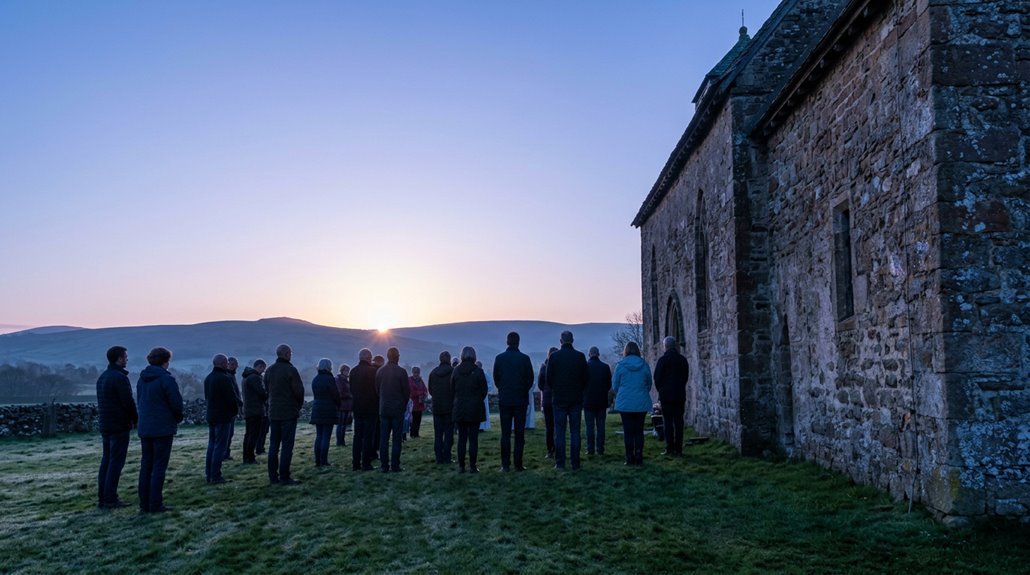
24 Mar 7 Easter Monday Church Services and Customs
You’ll find seven Easter Monday services: the Philippines’ dawn Misa de Aguinaldo with brass‑band processions; England’s royal Westminster Abbey Mass and gilded carriage; Germany’s candlelit liturgy beside an Easter fire; Poland’s Śmigus‑Dyngus Mass where the priest blesses water and parishioners sprinkle each other; Australia’s sunrise seaside Mass followed by a beach picnic; Ethiopia’s Lidet Mass with Ge’ez chants and a doro‑wat feast; and the USA’s ecumenical service that shares Scripture and communion across denominations. Keep going to discover more details.
Table of Contents
Philippines: Misa De Aguinaldo Easter‑Monday Mass & Processions
While many churches keep Easter Monday low‑key, the Philippines bursts into celebration with the Misa de Aguinaldo—an early‑morning Mass that blends solemn liturgy and lively processions. You’ll arrive before dawn, hear the rooster’s crow, and join a crowd of faithful gathered in the town plaza or church courtyard. The priest begins with a brief catechesis, then the congregation sings “Ang Himno ng Pagkabuhay” while brass bands play festive rhythms. After the Eucharist, you follow a colorful procession carrying the statue of the resurrected Christ, flanked by dancers, lanterns, and locals in traditional barong and terno. Street vendors sell bibingka and puto, adding sweet aromas to the air. The route winds through streets, stopping at historic landmarks where brief recite prayers for peace and gratitude. By midday, the celebration eases, but the spirit lingers, reminding you that Easter’s joy thrives in shared, vibrant faith.
England: Easter Monday Mass at Westminster Abbey – Royal Pageantry
You’ll notice the royal procession marching through the Abbey’s nave, accompanied by a choir that fills the space with solemn hymns. The monarch and senior family members take their seats in the choir stalls, underscoring the ceremony’s historic significance. This blend of regal presence and liturgical music makes the Easter Monday Mass a uniquely pageant affair.
Royal Procession and Music
Ever wondered how England’s royal tradition transforms Easter Monday into a spectacular rite? You’ll see a gilded carriage roll through the Abbey’s stone cloisters, escorted by a regiment of foot guards in scarlet tunics. The monarch, flanked by senior clergy, proceeds to the high altar while a brass fanfare bursts from the organ loft. You’ll hear the choir of Westminster Abbey summon a timeless anthem, its voices echoing through vaulted arches. The music shifts to a solemn hymn, then swells into a triumphant “Zadok the King,” linking Easter’s resurrection with the crown’s continuity. As the procession pauses for the priest’s blessing, you feel history and faith intertwine, creating an unforgettable, regal celebration.
Royal Family Attendance
Where does the royal family sit when Easter Monday Mass fills Westminster Abbey? You’ll find them in the historic Prince’s Gallery, a raised dais that overlooks the nave and choir. The sovereign, consort, and their children occupy gilded seats, while senior courtiers and clergy flank them. As the choir lifts the Easter hymn, you notice the subtle exchange of glances between the monarch and the bishop, a silent affirmation of faith and duty. The crown’s presence draws a hush over the congregation, and the incense swirls around the royal pews, highlighting the pageantry of the ceremony. After the service, you watch the family rise, exchange a respectful bow, and join the procession that leads back through the Abbey’s ancient corridors.
Germany: Easter Monday Candlelight Mass & Traditional Easter Fire
You’ll experience the Easter Candlelight Tradition as the church fills with flickering flames that symbolize hope and resurrection.
The community gathers around the towering Easter Fire, a powerful reminder of light triumphing over darkness.
Together, the candlelit mass and fire create a shared, uplifting celebration of faith.
Easter Candlelight Tradition
When Easter Monday arrives in Germany, many churches dim the lights and invite you into a candlelit Mass that glows with reverence, while outside villages spark traditional Easter fires that blaze against the night sky, symbolizing resurrection and the triumph of light over darkness. You’ll notice the altar surrounded by dozens of beeswax candles, their flickering flames echoing the ancient practice of lighting the world’s darkness. The priest’s prayers weave around the soft glow, creating an intimate atmosphere that encourages personal reflection. As you kneel, the scent of incense mingles with the warm light, reinforcing the sense of renewal. After the service, you may join neighbors in sharing the candle’s glow, a simple yet powerful reminder that hope persists beyond the night.
Fire Symbolism and Community
Why does fire feel so essential to Easter Monday in Germany? You’ll notice the night sky blaze with communal bonfires, a tradition that links the Resurrection’s triumph to light overcoming darkness.
As you gather around the crackling flames, the church’s candlelight mass begins; priests light a single Paschal candle, then distribute smaller candles to the congregation. The fire’s warmth unites families, neighbors, and strangers, symbolizing the Holy Spirit’s presence.
You watch the flames dance, hearing hymns echo across the meadow, while the scent of burning wood mingles with incense. This shared ritual reinforces community bonds, reminding you that faith, like fire, spreads rapidly, illuminating hearts and forging collective hope on this holy day.
Poland: Śmigus‑Dyngus Easter‑Monday Mass – Blessings & Water Sprinkling
Ever wondered how Poland’s Easter‑Monday Mass blends ancient rites with playful tradition? You step into a church where the priest blesses water, invoking the Holy Spirit’s cleansing power. After the liturgy, parishioners gather outside, water buckets and spray bottles in hand. You join friends and family, gently sprinkling each other with cool water—a symbolic reminder of baptism and renewal. The ritual, called Śmigus‑Dyngus, dates back to pagan spring rites, yet the Church frames it as a blessing for health and fertility.
Children chase adults, laughing as they receive a splash, while elders offer a modest sprinkle, respecting the solemnity of the day. The priest may also sprinkle holy water on the crowd, merging sacred blessing with the communal fun. By participating, you experience a unique fusion of faith, folklore, and fellowship that marks the start of the Easter season in Poland.
Australia: Sunrise Easter‑Monday Mass on the Coast – Picnic Traditions
How does a sunrise service on Australia’s sun‑kissed coast feel? You stand on warm sand, the horizon blushing pink as the choir’s harmonies drift over surf. The priest lifts the Gospel, and the sea breeze carries incense, mingling sacred reverence with salty air. After the Mass, you join friends and family on picnic blankets, sharing lamingtons, fresh fruit, and chilled rosé. Children chase crabs while elders recount resurrection stories, their voices blending with gull cries. The tradition balances solemn worship with relaxed camaraderie, letting faith blossom beneath a golden sky. You feel the community’s pulse, a rhythm of prayer and celebration that mirrors the tide’s rise and fall. By midday, the beach buzzes with laughter, yet the morning’s spiritual imprint lingers, reminding you that Easter Monday in Australia is both holy and joyful, a perfect blend of reverence and seaside festivity.
Ethiopia: Lidet Easter‑Monday Mass & Fasting‑Break Feast
Leaving the sun‑kissed beaches behind, you step into Ethiopia’s highlands where Easter Monday, known as Lidet, unfolds with a solemn yet vibrant rhythm. Dawn bells echo across stone churches, drawing you to a liturgy that blends ancient Ge’ez chants with the resonant hum of the krar. Priests bless the “Mikael” bread, a round loaf symbolizing resurrection, while incense spirals upward, mingling with the crisp mountain air. After the mass, families gather for the fasting‑break feast, a joyous contrast to the preceding forty‑day abstinence. You’ll find doro wat simmering with berbere, injera spread like a golden canvas, and teff porridge sweetened with honey. Children chase each other, spilling splashes of tej, while elders share stories of saints. The communal table reflects unity: every plate passes hand to hand, every prayer rises together, sealing Lidet’s spirit of renewal and shared gratitude.
USA: Ecumenical Easter‑Monday Mass – Shared Scripture & Communion
What draws you to the bustling cathedrals and modest chapels across the United States on Easter Monday? You find a shared rhythm of Scripture and communion that transcends denominational lines. In cities like New York, Chicago, and Atlanta, ecumenical services bring Catholics, Lutherans, Methodists, and Episcopalians together. The liturgy opens with a common reading of the Resurrection narrative—often the Gospel of Mark—followed by a joint hymn that blends traditional chant with contemporary gospel. After the sermon, each tradition presents its own prayer, yet the congregation partakes in a single communion cup and wafer, symbolizing unity in Christ’s sacrifice. Pastors emphasize that the Eucharist isn’t a private rite but a public witness to the risen Lord. You leave the service feeling the echo of many voices singing “Alleluia,” a reminder that Easter Monday can be a bridge of faith across America’s diverse Christian landscape.
Frequently Asked Questions
What Is the Historical Origin of Easter Monday Celebrations?
You trace Easter Monday back to early Christian tradition, where it marked the day after the Resurrection when Jesus appeared to his disciples. The Roman Empire later merged this with pagan spring festivals celebrating renewal. Medieval Europe adopted the day for processions and feasting, linking it to the “Octave” of Easter. Over time, cultures added local customs—games, markets, and the “Emmaus” walk—making it a blend of religious remembrance and seasonal celebration.
How Do Different Christian Denominations Observe Easter Monday?
You’ll find Catholic and Anglican churches holding special Masses or Holy Communion, often emphasizing the Resurrection’s ongoing joy.
Lutherans typically continue the Easter Vigil’s themes with a celebratory service and hymns.
Orthodox Christians observe Bright Monday with processions, incense, and the “Agios” chant, focusing on the risen Christ’s appearances.
Some Methodist congregations gather for fellowship meals, while many evangelical churches host upbeat worship gatherings, sharing testimonies of new life.
Are There Specific Foods Traditionally Eaten on Easter Monday?
You’ll find that many cultures serve special dishes on Easter Monday. In the United Kingdom, you might enjoy a hot cross bun or a sweet simnel cake. In Italy, families often prepare lamb stew or a festive risotto. German households serve a hearty potato salad with ham, while Polish traditions include żurek soup and white sausage. In the United States, brunch features ham, eggs, and fresh berries, all celebrating the holiday’s feast.
Can Non‑Christians Participate in Easter Monday Services?
Yes, you can attend Easter Monday services even if you’re not Christian. Most churches welcome anyone who wants to experience the worship, music, and community. You’ll usually find a brief explanation of the liturgy, and the clergy often invite newcomers to join in prayers or hymns. Feel free to ask questions after the service; many congregations appreciate curiosity and will gladly share the meaning behind the traditions.
What Safety Measures Are Recommended for Easter Fire Traditions?
You should keep a fire extinguisher or a bucket of water nearby, clear all flammable decorations away, and never leave the blaze unattended.
Wear sturdy, non‑flammable clothing and keep children and pets at a safe distance.
Light the fire on a stable, non‑combustible surface, and ensure the area is well‑ventilated.
If wind picks up, extinguish it immediately, and always check local regulations before lighting anything.
Conclusion
You’ve seen how Easter Monday unfolds worldwide—each tradition weaving faith, culture, and community into a vibrant tapestry. From the Philippines’ lively processions to England’s regal liturgy, Germany’s glowing candlelight, Poland’s playful water rites, Australia’s sunrise picnics, Ethiopia’s fasting‑break feast, and the USA’s ecumenical fellowship, these customs remind you that the celebration of resurrection transcends borders, uniting believers in hope and joy.





No Comments