

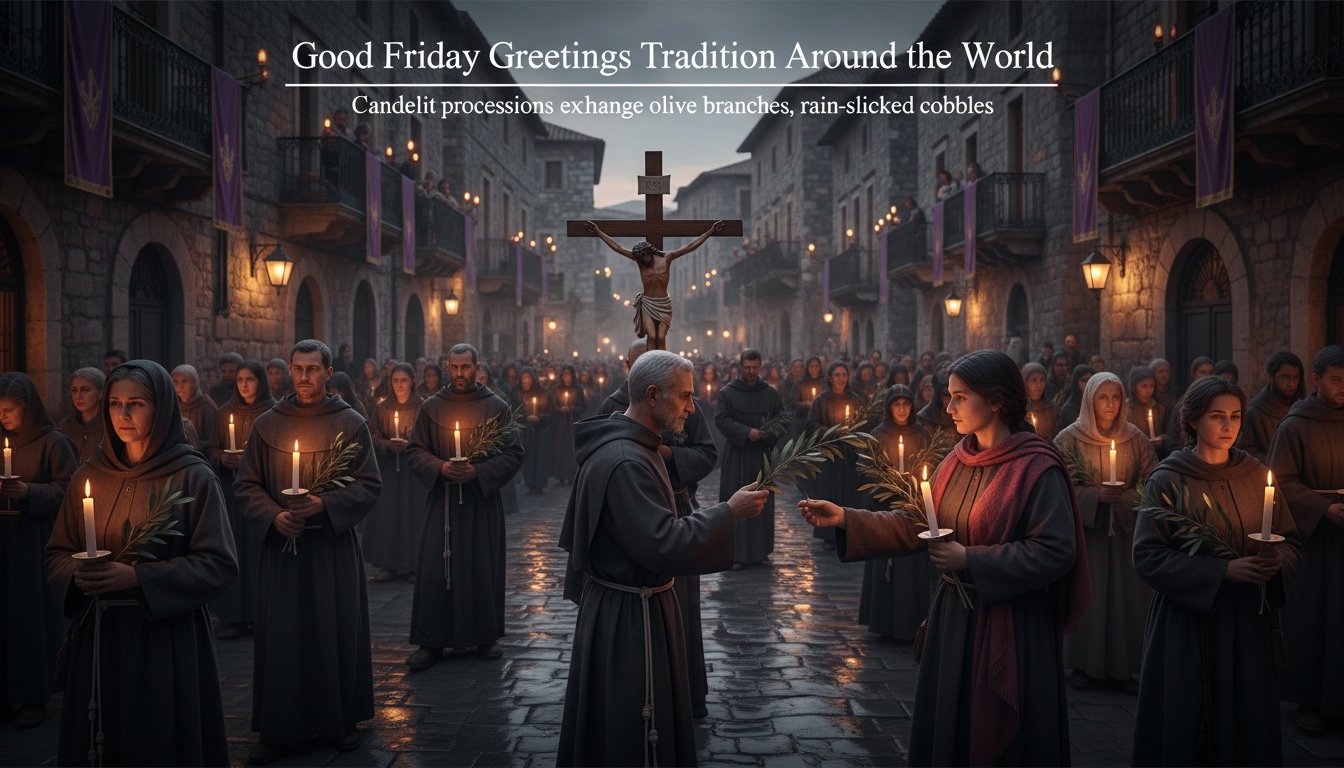
23 Feb Good Friday Greetings Tradition Around the World
You’ll find Good Friday greetings worldwide reflect profound cultural synthesis, from Nigeria’s ekombi “prayer in motion” dances to Spain’s elaborate Semana Santa processions featuring nazarenos in ceremonial attire. African communities blend traditional drumming with Christian observance, while Philippine devotees practice actual crucifixions at San Pedro Cutud. European traditions emphasize solemn mourning through symbolic hat-wearing, and Latin American countries showcase dramatic passion plays. These diverse expressions demonstrate how indigenous traditions merge with Christian theology, creating unique regional interpretations that extend far beyond simple greetings.
Key Takeaways
- African communities blend traditional greetings with Christian observances, incorporating indigenous languages and cultural expressions into Good Friday acknowledgments.
- European traditions feature solemn processional greetings, particularly in Spain’s Semana Santa where participants exchange respectful acknowledgments during pasos processions.
- Philippine Good Friday greetings often accompany dramatic passion plays and crucifixion reenactments, reflecting deep Catholic devotional practices.
- Latin American countries incorporate syncretic greeting traditions that blend pre-Columbian customs with Catholic observances during Semana Santa celebrations.
- Cross-cultural Good Friday greetings emphasize themes of mourning, reflection, and community solidarity while respecting local linguistic and cultural variations.
Good Friday Greetings and Customs Across Six Continents
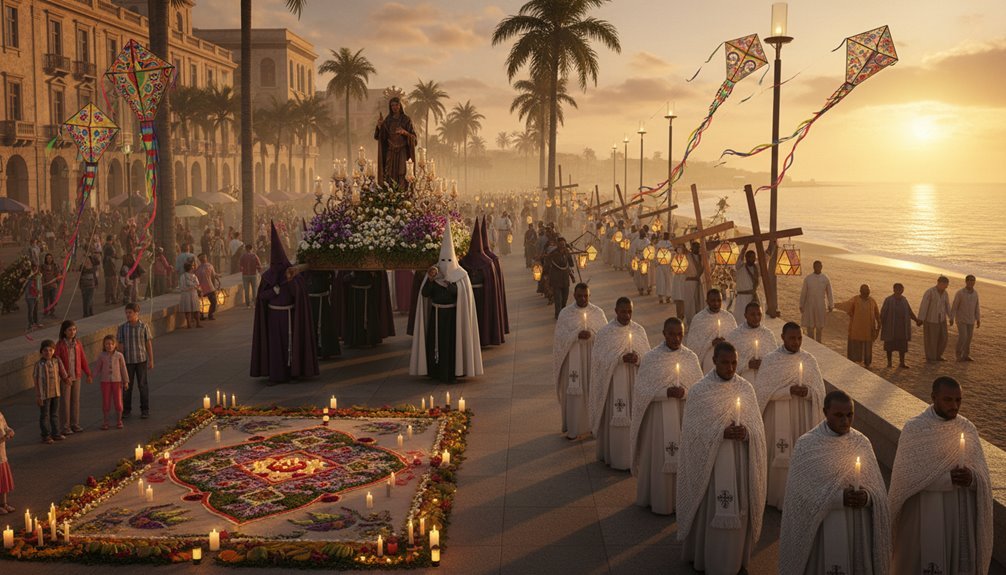
How does a solemn Christian observance manifest across vastly different cultural landscapes and geographical boundaries? You’ll discover that Good Friday traditions reveal remarkable cultural adaptations while maintaining core theological elements. In Africa, you’ll witness Nigerian Anglican churches integrating ekombi dances as “prayer in motion,” while Zimbabwean congregations blend Christian symbolism with ancestral Shona traditions through distinctive white attire.
Asia presents contrasting approaches—from Philippines’ intense penitential processions to India’s contemplative Syrian Christian masses featuring covered icons.
North American observances range from Mexico’s elaborate Passion re-enactments to Canada’s unique Judas effigy traditions.
South America showcases Brazil’s Brotherhood processions and Peru’s thirty-plus dramatic presentations.
You’ll find that regional cuisine plays integral roles: South Africa’s pickled fish preparations, Venezuela’s strict meat abstinence, and Samoa’s palusami feasts. African communities particularly emphasize the connection to Simon of Cyrene, the African man who carried Christ’s cross, reinforcing the continent’s theological participation in the Passion narrative.
Musical ensembles enhance worship through Nigeria’s Efik rhythms and New Zealand’s Maori haka integration, demonstrating Christianity’s remarkable capacity for cultural synthesis across continents.
Europe’s Solemn Services and Spain’s Dramatic Street Processions
While Good Friday observances across six continents demonstrate Christianity’s global adaptability, Europe’s ancient traditions reveal the historical foundations from which many international practices emerged. You’ll discover Spain’s Semana Santa processions exemplify Europe’s most theatrical expressions of Good Friday devotion, tracing back to 1521 when the Marqués de Tarifa introduced Via Crucis after his Holy Land pilgrimage.
Spain’s cofradías orchestrate elaborate street processions featuring pasos—intricately decorated floats exceeding 5,000 kilograms. You’ll witness nazarenos in hooded robes maintaining anonymity while 250+ costaleros shoulder these massive wooden structures. The logistics challenges become apparent as processions like Seville’s extend twelve hours, requiring precise coordination of thousands of participants.
Beyond major symbolism, minor symbolism permeates every element: spontaneous saetas sung from balconies, women’s black mantillas, and banners depicting Passion narratives. The pointed hats and face coverings worn by participants symbolize mourning for Jesus’ death, with hats traditionally removed on Easter Sunday to mark the resurrection. Zamora’s El Encuentro demonstrates Europe’s medieval heritage, where pasos “dance” face-to-face over nine hours, creating profound spiritual theater that contrasts sharply with other continents’ predominantly church-based observances.
Extreme Devotion: Philippines’ Crucifixions and India’s Passion Plays
Although Europe’s theatrical processions demonstrate profound devotion, Asia’s Good Friday observances push physical commitment to extraordinary extremes that challenge Western ecclesiastical boundaries. In the Philippines’ San Pedro Cutud, you’ll witness actual crucifixions where participants undergo nail penetration through hands and feet, seeking divine favor and sin remission. This extreme devotion evolved from 1960s stage plays into contemporary spectacle, despite Catholic Church disapproval. Over two dozen “Kristos” annually endure this physical embodiment of Christ’s suffering, supported by government tourism sponsorship and drawing international spectators. The ritual known as Pamagparaya involves various forms of blood sacrifice and self-flagellation performed publicly throughout the streets.
Conversely, India’s passion plays maintain theatrical boundaries while preserving spiritual significance. These dramatic reenactments, particularly in Kerala and Goa’s Christian communities, feature costumed performances of Christ’s final hours without physical harm. Unlike Philippine practices, Indian observances emphasize narrative representation over bodily mortification, demonstrating how cultural contexts shape religious expression within shared Christian traditions across Asian societies.
African Good Friday: Drumming, Community Meals, and Cultural Integration
If you observe Good Friday celebrations across African communities, you’ll witness a distinctive synthesis where traditional musical expressions merge seamlessly with Christian liturgical practices, creating worship experiences that honor both ancestral heritage and contemporary faith. Unlike the extreme physical devotion found in Filipino crucifixion reenactments, African observances emphasize collective participation through drumming, dance, and communal gathering that extends beyond denominational boundaries. Congregants traditionally wear black clothing on Good Friday to symbolically mourn Jesus’ death before transitioning to celebratory white garments for Easter Sunday resurrection services. You’ll find that post-service community meals serve as both spiritual sustenance and cultural preservation, transforming churches into spaces where religious observance intersects with indigenous food traditions and charitable outreach.
Traditional Music Integration
How does the rhythmic pulse of traditional African drumming transform Good Friday observances across the continent into profound expressions of cultural and spiritual identity? You’ll discover that traditional music integration during Good Friday ceremonies creates essential soundscape preservation that bridges Christian liturgy with indigenous practices. In Ashanti shrine drumming traditions, five male drummers and seven female singers with rattle shakers perform specific rhythms that call down healing spirits, maintaining oral histories through coded musical patterns. Ewe and Yoruba drum types support complex polyrhythms that coordinate multiple spiritual dimensions during religious observances. These drums don’t merely accompany worship; they function as talking historians, memorizing sacred narratives through rhythmic fabrics that strengthen community bonds and preserve ethnic identity within contemporary Christian contexts. The atumpan talking drums come in pairs with high and low tones that mimic the Twi language structure, allowing drummers to communicate sacred messages across distances during ceremonial gatherings.
Post-Service Community Meals
The communal feast transforms Good Friday’s solemn observance into a celebration of shared identity across African communities, where post-service meals integrate indigenous culinary traditions with Christian liturgical requirements. You’ll find distinctive regional variations: Nigerian Agudas serve frejon with coconut milk alongside drumming rituals, while Zambian Bemba communities share munkoyo from decorated gourds, pouring libations for ancestors. Angola’s fish calulu reflects Portuguese missionary influence, emphasizing meat abstinence after processions featuring Umbundu choirs. Conversely, Namibian and Tanzanian communities embrace kapana and mandazi at street gatherings, diverging from traditional fasting practices. Igbo covenant meals demonstrate profound spiritual significance through shared vessels and ritual hand-washing. These community meals transcend denominational boundaries, creating sacred spaces where African cosmology intersects with Christian observance through collective consumption and cultural continuity.
Central America’s Sawdust Alfombras and Easter Art Traditions
During “La noche que nadie duerme” (The night no one sleeps), entire neighborhoods collaborate from 9:00 PM Thursday until Good Friday’s 4:00 AM procession. Teams meticulously construct biblical scenes, Maya-Catholic hybrid imagery, and geometric patterns using stencils and strainers.
Unlike European processional traditions emphasizing permanence, these Guatemalan, Salvadoran, and Honduran communities create art destined for immediate destruction—embodying Christianity’s themes of sacrifice, resurrection, and spiritual transcendence through deliberate impermanence.
Sacred Foods: Hot Cross Buns, Fish Meals, and Religious Symbolism
What transforms ordinary bread into sacred sustenance across cultures? You’ll discover that hot cross buns represent one of Christianity’s most enduring food traditions, bridging ancient pagan customs with modern religious observance. Cross symbolism predates Christianity, originally marking Egyptian moon phases and Greek sacrificial offerings to goddess Eostre. When 14th-century monks at St. Alban’s Abbey distributed marked buns to pilgrims in 1361, they established a tradition linking bread with spiritual nourishment.
You’ll find that Lent traditions surrounding these spiced breads carried profound meaning—the cross represented Christ’s crucifixion while interior spices symbolized embalming preparations. Elizabeth I’s 1592 decree restricting sales to holy days demonstrates their sacred significance. Across Britain, Australia, and former Commonwealth nations, you’ll encounter families maintaining these customs alongside Good Friday fish meals, which honor Catholic fasting requirements. These practices transform simple ingredients into vessels of remembrance, connecting contemporary believers with centuries of shared faith.
Island Traditions: Jamaica’s Death Omens and Bermuda’s Beach Customs
How dramatically do Caribbean islands diverge in their Good Friday observances, transforming this solemn Christian holiday into distinctly contrasting cultural expressions? You’ll find Jamaica omens deeply rooted in Obeah practices, where practitioners interpret supernatural signs as death harbingers. Screaming birds, unnaturally lengthening shadows, and clocks stopping at 3pm—the crucifixion hour—signal impending community loss through blood-like rain and ominous cloud formations.
Conversely, Bermuda KiteFest presents celebratory traditions at Horseshoe Bay Beach, where you’ll witness homemade wooden kites symbolizing Christ’s ascension. These cross-shaped constructions, crafted from traditional dowels and tissue paper, compete for prizes including “Loudest Kite” and “Best Design.” The event’s international recognition among the world’s twenty most unique Easter celebrations demonstrates how geographical proximity doesn’t guarantee cultural similarity. While Jamaican traditions emphasize supernatural foreboding through divination practices, Bermudian customs celebrate resurrection through communal beach festivities, illustrating how colonial histories and indigenous influences create divergent religious interpretations across Caribbean societies.
Peru’s Miraculous Crucifix and South America’s Historic Processions
Where else can you witness such profound convergence of African spirituality, colonial trauma, and Catholic devotion than in Peru’s veneration of El Señor de los Milagros (Lord of Miracles)? This tradition exemplifies how Peru’s miraculous cultural synthesis transforms suffering into sacred celebration.
Originally painted by enslaved Angolan artist Benito or Pedro Dalcon in 1651, the crucifixion image survived devastating earthquakes in 1655, 1687, and 1746—each survival deepening devotional fervor among Lima’s Afro-Peruvian community.
You’ll find similar patterns across South America’s processions, where colonial-era religious art becomes focal points for indigenous and African spiritual expression.
October’s Mes Morado draws millions to Lima’s streets, where purple-robed devotees carry the two-ton platform through 24-hour processions.
This practice parallels Ecuador’s Quito processions and Colombia’s Semana Santa traditions, demonstrating how South American Good Friday observances blend pre-Columbian ritual structures with Catholic liturgical calendars, creating uniquely syncretic expressions of faith and cultural resistance.
Frequently Asked Questions
What Are Appropriate Good Friday Greeting Messages to Send to Friends?
You’ll find appropriate Good Friday greeting messages should follow good friday etiquette by emphasizing reverence and solemnity. Prayer focused messages work best, such as “May you find peace in Christ’s sacrifice” or “Wishing you reflection and grace today.” Unlike celebratory holidays, you shouldn’t use jovial language. Instead, you’ll want to focus on themes of sacrifice, redemption, and spiritual contemplation that honor the sacred nature of this observance.
How Do You Respectfully Wish Someone a Meaningful Good Friday?
You’ll convey meaningful Good Friday wishes through thoughtful greeting ideas that emphasize solemn reflection rather than celebration. Consider respectful reflection prompts like “May this day bring you peace and contemplation” or “Wishing you a blessed time of reflection.” Academic research shows cross-cultural observances prioritize reverence—from European silence traditions to Polish tableau veneration. You’re acknowledging sacred suffering while encouraging spiritual introspection, mirroring global practices that emphasize penance, prayer, and communal solidarity during Christianity’s most solemn observance.
Are There Traditional Good Friday Cards or Digital Greetings People Exchange?
Yes, you’ll find both traditional physical cards and contemporary digital greetings exchanged on Good Friday. Traditional crafts include customizable cards from services like Greeting Card Universe, featuring solemn religious imagery and biblical quotations.
Digital platforms now dominate through WhatsApp statuses and Facebook posts sharing inspirational messages. While digital memes aren’t prevalent given the day’s solemnity, artistic digital content emphasizing sacrifice and reflection has become standard practice globally across Christian communities.
What Languages and Phrases Are Commonly Used for Good Friday Wishes?
You’ll encounter diverse languages and greetings reflecting regional expressions across Christian traditions. Romance languages employ “Santo/Santa” variations, while Scandinavian cultures favor “Long Friday” constructions. Eastern European traditions predominantly use “Great Friday” terminology, as evidenced in Polish “Wielki Piątek” and Greek “Μεγάλη Παρασκευή.” Common phrases include “Blessed Good Friday,” “Peace be with you,” and liturgical expressions emphasizing Christ’s sacrifice, demonstrating how linguistic patterns mirror theological emphases within respective cultural contexts.
When Is the Best Time to Send Good Friday Greetings?
When to time your Good Friday greetings optimally occurs during early morning hours (6-9 AM recipient’s local time) or evening reflection periods (6-8 PM).
Best sending tips include avoiding midday delivery (12-3 PM) when observant Christians maintain contemplative silence commemorating the crucifixion.
Research indicates morning greetings align with traditional devotional practices, while evening messages suit post-service reflection.
You’ll maximize appropriateness by considering recipients’ denominational customs and worship schedules when scheduling delivery.
Conclusion
You’ve witnessed how Good Friday transcends mere religious observance, functioning as a cultural nexus where local traditions intersect with Christian liturgy. From Spain’s processional theater to the Philippines’ somatic devotion, you’re observing what anthropologist Victor Turner termed “communitas”—ritual practices that simultaneously preserve ecclesiastical orthodoxy while accommodating indigenous expressions. These diverse manifestations demonstrate Christianity’s remarkable adaptability, where universal theological concepts find particularized cultural expression across continents, creating distinct yet interconnected sacred geographies.










No Comments