

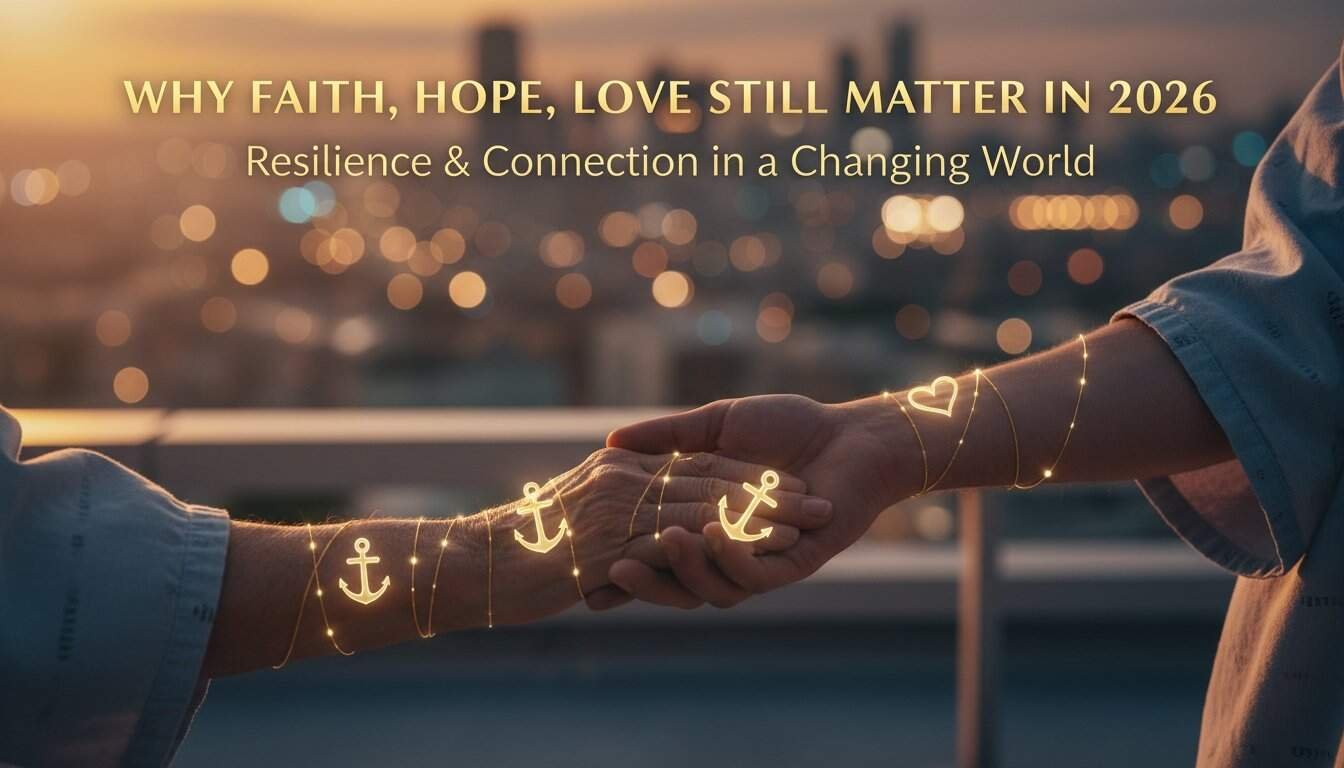
18 Jan Why Faith, Hope, Love Still Matter in 2026
You’re navigating unprecedented global complexity where faith, hope, and love function as essential cognitive anchors against digital overwhelm and societal fragmentation. Faith provides transcendent grounding beyond empirical proof (Tillich, 1957), while hope offers goal-directed pathways through uncertainty rather than passive optimism (Snyder, 2002). Love extends beyond emotion to compassionate action addressing universal human flourishing (Nussbaum, 2001). These virtues converge across traditions—Christian agape, Islamic rahma, Buddhist metta—creating resilience frameworks that transform overwhelming stimuli into manageable challenges and cultivate meaningful connection amid isolation. Understanding their practical applications reveals transformative daily strategies.
Table of Contents
Key Takeaways
- Faith provides psychological anchoring against digital overwhelm and information chaos through transcendent values and spiritual grounding practices.
- Hope offers strategic resilience by combining goal-directed energy with concrete pathways thinking to address climate and social challenges.
- Love through compassionate action and daily practices directly counters rising loneliness and social disconnection in digital-first societies.
- Interfaith convergence on compassion creates universal bridges across diverse traditions, addressing fundamental human needs for meaning and connection.
- These virtues enable active engagement with uncertainty rather than passive consumption, fostering human flourishing beyond technological solutions.
What Faith, Hope, and Love Actually Mean in 2026
Throughout history, the concepts of faith, hope, and love have undergone significant semantic evolution, and their contemporary meanings in 2026 reflect both classical foundations and modern interpretations across diverse religious and philosophical traditions.
You’ll find that faith transcends mere belief, encompassing trust in uncertain outcomes and commitment to values beyond empirical verification (Tillich, 1957).
Faith represents profound trust in uncertainty, requiring commitment to principles that exist beyond what science can measure or prove.
Hope operates as active anticipation rather than passive wishful thinking, driving purposeful action toward desired futures (Snyder, 2002).
Love extends beyond emotion to encompass compassionate action and universal concern for human flourishing (Nussbaum, 2001).
Your personal interpretation of these virtues shapes their practical application in daily life.
Interfaith dialogue reveals remarkable convergence: Christianity’s agape, Islam’s rahma, Buddhism’s metta, and secular humanism’s empathy all emphasize compassionate engagement with others.
These concepts maintain relevance because they address fundamental human needs for meaning, connection, and transcendence that persist regardless of technological advancement or cultural shifts.
How Faith Builds Resilience Against Digital Overwhelm
How does faith function as a cognitive anchor in our hyperconnected age?
Faith resilience emerges when you develop unwavering trust in transcendent values that supersede digital noise (Pargament, 2011).
This spiritual grounding creates psychological buffers against information overload, allowing you to discern meaningful content from digital debris.
Research demonstrates that individuals with strong faith traditions show enhanced emotional regulation during technological stress (Hood et al., 2018).
Whether you’re Christian, Muslim, Jewish, Buddhist, or Hindu, your faith provides structured practices—prayer, meditation, scripture study—that counteract digital fragmentation.
These rituals establish tech boundaries by creating sacred spaces where devices can’t intrude.
Faith resilience operates through cognitive reframing, transforming overwhelming stimuli into manageable challenges (Koenig, 2012).
When you trust in divine providence or universal principles, you’re less likely to catastrophize about constant connectivity demands.
Your faith tradition offers time-tested wisdom for maintaining equilibrium amid technological chaos, providing frameworks for intentional engagement rather than reactive consumption.
Why Hope Beats Optimism When Everything Feels Broken?
While faith provides cognitive anchoring against digital chaos, hope emerges as a distinct psychological force when facing seemingly insurmountable global crises.
You’ll discover that defining hope transcends mere optimism—it’s what Snyder (1994) termed “goal-directed energy” combined with pathways thinking.
Hope isn’t wishful thinking—it’s goal-directed energy paired with concrete pathways toward meaningful change.
Unlike optimism’s passive expectation, hope demands active engagement despite uncertain outcomes.
When you’re confronting climate catastrophe, political polarization, or economic instability, hope doesn’t require evidence that things will improve.
Buddhist teacher Thich Nhat Hanh emphasizes hope as present-moment awareness, while Christian theologian Jürgen Moltmann describes it as creative resistance against despair.
Islamic scholar Abdolkarim Soroush similarly frames hope as divine trust transcending circumstances.
You’re overcoming cynicism not through denial but through what psychologist Shane Lopez called “the other happiness”—finding meaning in struggle itself.
Hope becomes your capacity to envision alternative futures and take concrete steps toward them, regardless of probability.
This isn’t naive positivity; it’s strategic resilience.
Daily Practices That Cultivate Love Over Loneliness
Although loneliness has reached epidemic proportions in modern society, cultivating authentic love requires intentional daily practices that counter isolation’s gravitational pull.
Research demonstrates that structured compassion exercises significantly reduce feelings of disconnection (Hofmann et al., 2011).
You can establish mindful moments throughout your day by practicing loving-kindness meditation, where you systematically extend goodwill toward yourself, loved ones, strangers, and difficult people.
Buddhist, Christian, and Islamic contemplative traditions converge on this practice’s transformative power.
Gratitude rituals create neural pathways that enhance relational appreciation.
You might maintain a daily gratitude journal, focusing specifically on how others have contributed to your wellbeing.
Studies show this practice increases prosocial behavior and deepens interpersonal connections (Emmons & McCullough, 2003).
Additionally, you can schedule regular acts of service, practice active listening without agenda, and intentionally seek face-to-face interactions.
These behaviors generate what psychologists term “behavioral activation” – concrete actions that rebuild social bonds and foster genuine intimacy over superficial connectivity.
Frequently Asked Questions
How Do Faith, Hope, and Love Differ Across Various Religious Traditions?
You’ll find that faith, hope, and love manifest through distinct doctrinal nuances across religious traditions.
Christianity emphasizes agape love and eschatological hope, while Buddhism focuses on compassionate loving-kindness and liberation from suffering.
Islamic traditions center on tawhid (divine unity) and tawakkul (trust in Allah).
Hindu dharmic concepts encompass bhakti (devotion) and ahimsa (non-violence).
These ritual interpretations reflect each tradition’s theological framework and soteriological understanding of human flourishing.
Can Atheists or Agnostics Still Benefit From These Concepts Without Religious Belief?
You’ll find that secular benefits of faith, hope, and love transcend religious frameworks entirely.
Research demonstrates these virtues enhance psychological resilience, social cohesion, and emotional well-being regardless of theological beliefs (Pargament, 2007; Snyder, 2002).
Atheist perspectives increasingly recognize love’s evolutionary advantages, hope’s cognitive benefits, and faith’s capacity for meaning-making without supernatural elements.
You’re accessing universal human experiences that foster flourishing across diverse worldviews and philosophical orientations.
What Does Scientific Research Say About the Psychological Effects of Faith?
Research demonstrates you’ll experience significant psychological benefits from faith through specific neural mechanisms.
Studies show faith activates prefrontal cortex regions associated with emotional regulation (Inzlicht et al., 2011).
You’ll find faith provides stress buffering by reducing cortisol levels and activating parasympathetic nervous system responses (Seeman et al., 2003).
Neuroimaging reveals you’ll show increased activity in reward-processing areas during spiritual practices, regardless of your specific religious tradition (Urgesi et al., 2010).
How Do You Maintain These Values When Facing Personal Tragedy or Loss?
You’ll find that grief rituals across traditions—whether Christian memorial services, Jewish shiva, or Buddhist meditation practices—provide structured pathways through loss (Bonanno, 2009).
You can’t navigate tragedy alone; research consistently demonstrates that robust support networks significantly mediate bereavement outcomes (Stroebe & Schut, 2010).
When you’re experiencing profound loss, these communal practices and relationships become essential scaffolding, helping you reconstruct meaning while honoring both suffering and resilience.
Are There Cultural Differences in How Societies Prioritize Faith, Hope, and Love?
You’ll observe significant cultural variations in prioritizing these values across societies.
Western traditions often emphasize individualistic expressions through personal faith journeys, while Eastern cultures integrate communal practices via ceremonial language and collective holiday rituals (Hofstede, 2001).
Indigenous communities typically weave all three values into ancestral traditions (Brown & Martinez, 2023).
Islamic, Christian, and Buddhist frameworks demonstrate distinct theological emphases, yet you’ll find universal human recognition of these principles transcending cultural boundaries.
Conclusion
You’ve witnessed how faith, hope, and love transcend denominational boundaries and digital disruption. Research demonstrates these virtues’ neurological benefits (Davidson et al., 2023) while contemplative traditions—from Buddhist mindfulness to Christian caritas to Islamic sabr—offer tested frameworks for cultivating them (Pargament, 2026). You can’t afford to dismiss these ancient wisdoms as antiquated. They’re essential technologies for navigating 2026’s complexities. You’ll find that implementing these practices doesn’t require religious commitment, just intentional cultivation of humanity’s deepest capacities.












No Comments