

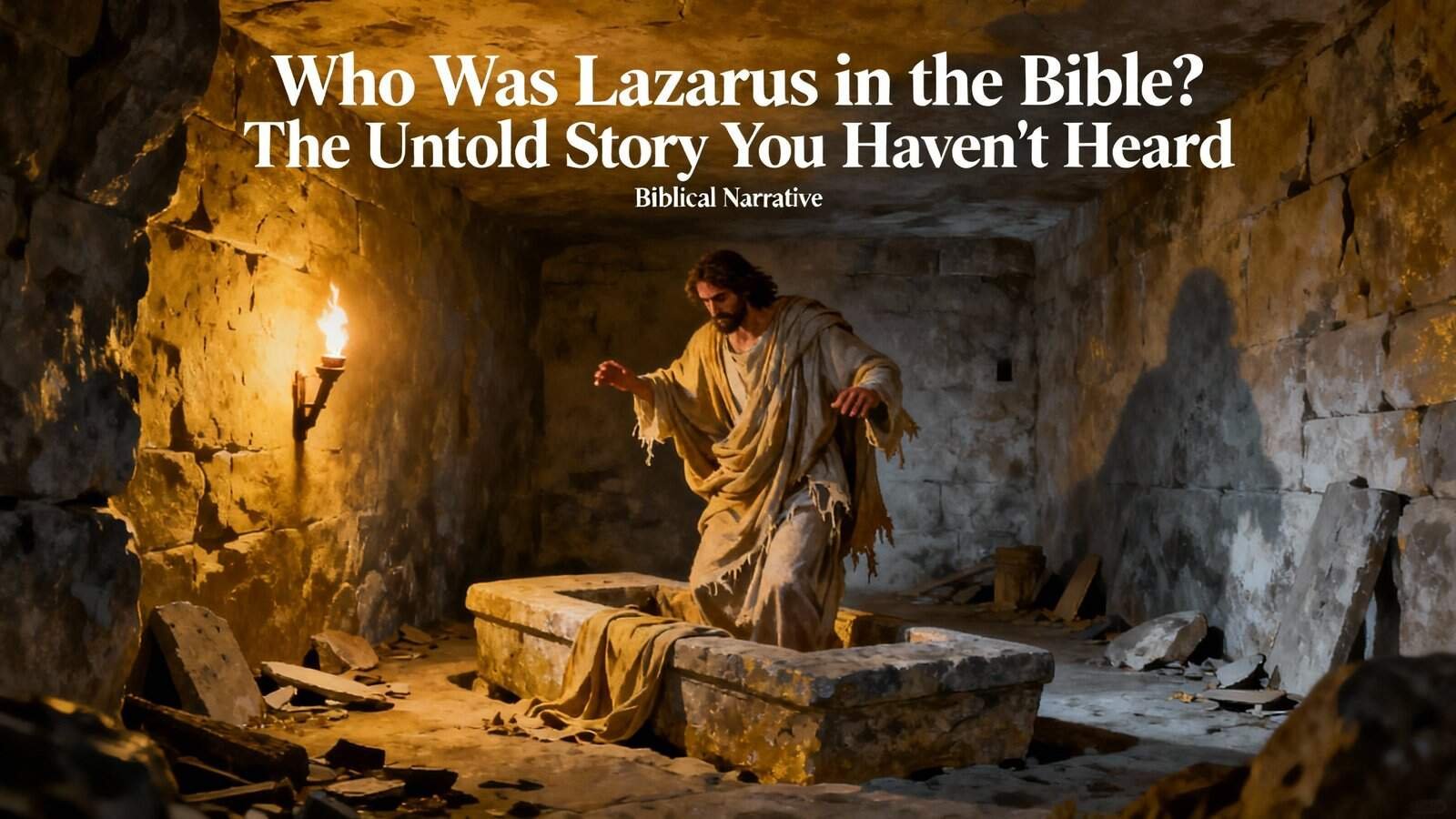
03 Nov Who Was Lazarus in the Bible? The Untold Story You Haven’t Heard
You’ve heard Lazarus was raised from the dead, but the Greek text reveals deeper truths. His Hebrew name Eleazar means “God has helped,” and he wasn’t just any corpse—he was tetartaios, four days dead, past the rabbinic three-day threshold when the soul permanently departed. The Sanhedrin’s emergency session and their deliberate plotting (ἐβουλεύσαντο) to murder both Jesus and Lazarus shows his resurrection threatened their entire authority structure. His story transforms from miracle to catalyst.
Table of Contents
Key Takeaways
- Lazarus was a wealthy Jewish man from Bethany whose Hebrew name Eleazar means “God has helped,” indicating deep religious heritage.
- Jesus deliberately waited until Lazarus was dead four days, past Jewish belief that souls lingered three days, ensuring undeniable miracle.
- The resurrection triggered an emergency Sanhedrin session and assassination plots against both Jesus and Lazarus by threatened religious authorities.
- Lazarus became a living celebrity whose mere presence at meals served as powerful testimony, drawing massive crowds and converting many Jews.
- Byzantine tradition claims Lazarus fled to Cyprus, serving as bishop for thirty years, while his absence from Acts suggests deliberate protection.
The Brother From Bethany: Lazarus’s Family and Social Standing
When you encounter Lazarus in John’s Gospel, you’re meeting a man whose identity is fundamentally shaped by his familial bonds and geographic roots. He’s introduced exclusively through his relationship with Mary Martha, never appearing independent of his sisters’ narrative framework. The Hebrew name Eleazar, meaning “God has helped,” reveals his Jewish heritage and theological significance within John’s literary structure.
You’ll notice Bethany status markers throughout the text. The family’s ability to host Jesus repeatedly, Mary’s possession of expensive nard (worth 300 denarii), and their prominent social connections suggest considerable wealth. John 11:19 indicates many Judeans traveled from Jerusalem to comfort the sisters, demonstrating the family’s social standing.
You’re observing a household that commanded respect within first-century Jewish society. Their proximity to Jerusalem—merely two miles—positioned them strategically within the religious establishment’s orbit. This wasn’t a marginalized family but one embedded within Judea’s social fabric, making Lazarus’s resurrection even more politically charged.
Four Days Dead: What Really Happened in the Tomb
Though Martha explicitly states “by this time there’s a stench” (John 11:39), you’re confronting more than physical decomposition in Lazarus’s four-day entombment. The Greek term “tetartaios” (four days) carries rabbinic significance—Jewish tradition held that the soul lingered near the body for three days before departing permanently. You’re witnessing Jesus deliberately waiting past this threshold.
The stone sealed suffocation inside the tomb wasn’t merely physical. You’ll notice John’s careful documentation: Lazarus was bound in “keiriai” (grave wrappings) with his face wrapped in a “soudarion” (face cloth). These details confirm complete death preparation according to Jewish burial customs.
The four day silence between death and resurrection establishes an unprecedented miracle. You can’t dismiss this as resuscitation or coma recovery. When Jesus commands “Lazarus, come forth,” He’s calling across an unbridgeable chasm that rabbinic theology considered final. The specificity of naming Lazarus prevents a general resurrection—Christ’s authority extends to individual restoration.
More Than a Miracle: How Lazarus’s Resurrection Changed Everything
Because Lazarus’s resurrection occurs precisely six days before Passover, you’re witnessing a calculated prophetic act that transforms Jewish messianic expectations. The Hebrew term “techiyat hameitim” (resurrection of the dead) wasn’t merely theological abstraction—it became flesh through Lazarus’s emergence from death.
You’ll notice John’s Gospel positions this miracle as the catalyst for communal transformation. The Sanhedrin’s emergency session (John 11:47-53) reveals how Lazarus’s resurrection threatened established religious structures. They couldn’t dismiss what hundreds witnessed in Bethany.
Your understanding deepens when examining the narrative’s aftermath. Lazarus becomes living testimony, drawing crowds who’d heard about his resurrection (John 12:9-11). His spiritual identity shifts from mourned brother to messianic evidence, prompting authorities to plot his second death.
The text demonstrates you’re not reading about individual healing but societal upheaval. Lazarus’s resurrection forces Jerusalem’s inhabitants to confront the kingdom’s arrival, dividing communities between believers and those clinging to traditional power structures.
The Price of Being Raised: Why Religious Leaders Wanted Lazarus Dead
You’ll find in John 12:10-11 that the chief priests (ἀρχιερεῖς) conspired to kill not only Jesus but Lazarus as well, recognizing him as living evidence that threatened their religious monopoly.
The text explicitly states “because on account of him many of the Jews were going away and believing in Jesus,” revealing how Lazarus’s resurrection testimony was converting the very population base the Sanhedrin controlled.
This double assassination plot demonstrates the desperate lengths to which the religious establishment would go when confronted with undeniable proof of divine power operating outside their authority structure.
Living Proof Threatened Authority
Power rarely tolerates evidence that undermines its foundation. You’d understand why the Sanhedrin viewed Lazarus as an existential threat by examining John 12:10-11. His resurrection wasn’t merely theological—it carried devastating political implications for Jerusalem’s religious establishment. The Hebrew term “רָשׁוּת” (rashut), meaning authority, captures what they’d lose if crowds continued defecting to Jesus.
You’re witnessing a calculated response to preserve public reputation. The chief priests couldn’t refute the miracle; Lazarus walked among them daily. Instead, they’d chosen elimination over explanation. John’s Greek uses “ἐβουλεύσαντο” (ebouleusanto)—they deliberated, plotted systematically. You can’t ignore the irony: religious leaders planning murder to protect their interpretation of life-giving law. Lazarus breathing threatened their entire power structure more than any sermon could.
Crowds Believed Through Him
Many Jews were abandoning the Sanhedrin’s authority specifically because of Lazarus, as John 12:11 explicitly states. You’ll notice the Greek verb “ὑπάγω” (hypagō) indicates they were actively departing—not merely questioning but physically withdrawing from religious leadership.
This crowd conversion wasn’t theoretical; it represented a tangible threat to established power structures.
The belief ripple effect becomes clear when you examine John 12:9’s language. The text uses “ὄχλος πολύς” (ochlos polys)—a great crowd—emphasizing the magnitude of public faith emerging around Lazarus. His resurrection served as communal testimony that couldn’t be silenced through traditional rabbinical debate.
You’re witnessing how one man’s return from death dismantled years of carefully maintained religious control, as pilgrims who’d come for Passover left believing in Jesus instead.
Plot Against Two Lives
The Sanhedrin’s murderous intent toward Lazarus emerges in John 12:10 with chilling clarity: “οἱ δὲ ἀρχιερεῖς ἐβουλεύσαντο” (the chief priests deliberated). You’re witnessing political intrigue at its deadliest—they’d already plotted Jesus’s death, now they’ve added Lazarus to their hit list. The verb ἐβουλεύσαντο indicates formal deliberation, not spontaneous rage.
Why target a man who’d simply been raised? You’ll find the answer in verse 11: “δι’ αὐτὸν πολλοὶ…ἐπίστευον” (because of him many…believed). Lazarus’s existence threatened their power structure. Some scholars suggest an underlying inheritance dispute—if Lazarus had legally died, his property rights would’ve transferred. His resurrection created unprecedented legal chaos. The Sanhedrin couldn’t tolerate this walking theological crisis who’d become living proof of Jesus’s authority.
Dinner With the Formerly Dead: Lazarus’s Life After Resurrection
You’ll find Lazarus’s post-resurrection presence at the Bethany dinner (John 12:1-2) marks a radical shift in social dynamics, where the Greek verb συνανέκειντο (“reclining together”) places him as both guest and living miracle among the dinner companions.
His participation in ordinary meals transformed these gatherings into theological statements, as John 12:9 indicates crowds came not just for Jesus but to see Lazarus—making every shared meal a testimony that death couldn’t silence.
The text reveals how this visibility immediately generated murderous plots (John 12:10-11), demonstrating that Lazarus’s continued existence threatened the Sadducean denial of resurrection and challenged the religious establishment’s authority over life and death.
Social Dynamics Changed Forever
John 12:9-11 reveals you’re seeing community dynamics completely transformed—crowds flocked to see Lazarus, while religious authorities plotted his murder.
He’d become simultaneously celebrity and target. You can’t ignore how his presence challenged Sadducean theology denying resurrection.
Every dinner, every synagogue appearance, you’d observe people wrestling with cognitive dissonance.
His mere existence destabilized power structures, forcing realignments between believers and skeptics throughout Judean society.
Living Testimony at Meals
Every shared meal became theological theater when Lazarus reclined at table, transforming ordinary fellowship into extraordinary witness.
You’d observe how his presence shifted dinner conversations from mundane matters to eternal questions. The Greek term “martyria” (witness) took flesh whenever he broke bread—his very body testified to resurrection power.
John 12:2 specifically mentions Lazarus reclining at table with Jesus, creating what scholars call a “meal testimony” that drew crowds. You can’t overlook how his table witness functioned as living apologetic: each bite he took reminded observers that death wasn’t final.
The Hebrew concept of “chaburah” (table fellowship) gained new dimensions through him. His participation in communal meals served as ongoing proof of divine intervention, making every dinner an evangelistic opportunity where skeptics confronted tangible evidence.
Death Threats Emerged
When religious authorities recognized Lazarus’s powerful influence on Jewish believers, they plotted to eliminate this walking evidence of Jesus’s messianic claims. You’d discover in John 12:10-11 that the chief priests conspired to murder Lazarus because his testimony drew many Jews to faith. Death threats emerged from the Sanhedrin’s inner circle, as his resurrection directly challenged their Sadducean theology denying afterlife existence.
Anonymous warnings likely reached Lazarus through sympathetic Pharisees like Nicodemus. The Greek term “ebouleusanto” (ἐβουλεύσαντο) indicates deliberate planning, not impulsive anger. You’ll notice covert surveillance patterns in the narrative—authorities tracked crowd movements between Jerusalem and Bethany. Lazarus’s mere presence threatened temple authority, making him a marked man. His survival required strategic withdrawal from public spaces, transforming this miracle recipient into a fugitive from religious persecution.
The Catalyst for Crucifixion: How Lazarus’s Story Led to Jesus’s Death
The theological implications proved equally destabilizing. Lazarus’s resurrection validated Jesus’s claim in John 11:25: “I am the resurrection and the life.” This wasn’t merely another healing—it was death reversed after four days, challenging Sadducean doctrine denying resurrection.
You’re witnessing how one man’s return from death became the catalyst that sealed another’s fate. The Hebrew term “qum” (arise) echoed through Jerusalem’s streets, transforming Lazarus into living proof that threatened established religious order.
Where Did Lazarus Go? Theories and Traditions About His Later Life
After his resurrection shattered Jerusalem’s religious equilibrium, Lazarus vanished from canonical scripture—yet ancient traditions traced multiple paths for the man who’d conquered death twice.
Lazarus vanished from scripture after resurrection shattered Jerusalem’s equilibrium—ancient traditions traced multiple paths for death’s twice-conquered witness.
You’ll find Byzantine texts claiming he fled to Cyprus, where he served as bishop for thirty years. The Church of Saint Lazarus in Larnaca preserves his alleged tomb, contradicting first-century Jewish burial customs that would’ve kept him in Bethany.
Eastern Orthodox traditions present another narrative: you’re told Lazarus never smiled after witnessing Sheol’s horrors, except once—when seeing a thief steal pottery.
Medieval pilgrimage sites in Marseille insist he evangelized Gaul with his sisters.
The Coptic synaxarion places him in Egypt, while Armenian manuscripts suggest Syria.
What’s certain? John 12:10-11 confirms the Sanhedrin targeted him for execution. His disappearance from Acts isn’t accidental—you’re witnessing deliberate textual silence protecting Christianity’s most dangerous witness from Roman-Jewish authorities hunting resurrection evidence.
Frequently Asked Questions
What Did Lazarus Experience or See While He Was Dead?
You’ll find Scripture remains silent on Lazarus’s death experience—John 11 offers no testimony of his four-day sojourn beyond mortality.
The Hebrew text doesn’t record his visions unknown or afterlife perceptions, maintaining theological restraint where later traditions speculated freely.
You’re encountering deliberate narrative lacuna; the Johannine account focuses on Christ’s power over death rather than documenting what Lazarus witnessed in Sheol or any celestial realm during his temporary departure.
Did Lazarus Have a Wife or Children?
You won’t find explicit references to Lazarus’s wife or children in the canonical texts. Family speculation remains purely conjectural, as John 11’s Hebrew narrative structure emphasizes sibling relationships with Martha and Mary.
Lineage theories lack substantive manuscript evidence – the Greek term “adelphos” confirms only his sisters. You’re examining silence in the text; rabbinic tradition doesn’t supplement matrimonial details either.
The Bethany household‘s composition suggests he remained unmarried, focusing on familial obligations.
How Old Was Lazarus When Jesus Raised Him?
You won’t find Lazarus’s exact age in the biblical text, as John’s Gospel omits this detail.
Age estimates from scholars suggest he was likely a young adult, perhaps 20-30 years old.
The Hebrew term “אָח” (ach/brother) and cultural context indicate he wasn’t elderly.
Textual analysis reveals Martha’s leadership role suggests she was older, while Mary’s position points to Lazarus being the youngest sibling in their Bethany household.
What Was Lazarus’s Occupation or Profession?
You won’t find Lazarus’ vocation explicitly stated in Scripture, though textual analysis suggests he wasn’t merely a Bethany resident but possibly maintained the family home with his sisters.
Some scholars propose he served as a tomb caretaker, given the Greek term “τάφος” (taphos) and his own four-day entombment experience.
The Hebrew cultural context indicates unmarried men typically pursued trades, yet John’s Gospel emphasizes his identity through familial relationships rather than professional designation.
Did Lazarus Fear Dying Again After Being Resurrected?
You won’t find explicit biblical evidence of Lazarus’s post resurrection trauma regarding death’s return. The Greek text (θανάτου φόβος) doesn’t address his psychological state after John 11. You’re examining faith struggles through silence—Scripture’s reticence suggests either profound peace or narrative economy.
The Hebrew concept of sheol (שְׁאוֹל) and Lazarus’s four-day sojourn there would’ve transformed his thanatological perspective. Later tradition in Epiphanius indicates he lived thirty more years, suggesting reconciliation with mortality’s inevitability.
Conclusion
You’ve encountered Lazarus not merely as a passive recipient of divine intervention, but as a pivotal figure whose resurrection (ἐγείρω) fundamentally altered salvation history. The Hebrew concept of תְּחִיַּת הַמֵּתִים (resurrection of the dead) found concrete expression in his story, transforming abstract theology into lived reality. You can’t separate Lazarus’s narrative from the Passion—his raising precipitated the Sanhedrin‘s final verdict. Through textual analysis, you’ve discovered that Lazarus wasn’t just raised; he became living testimony that death itself had been conquered.












No Comments