

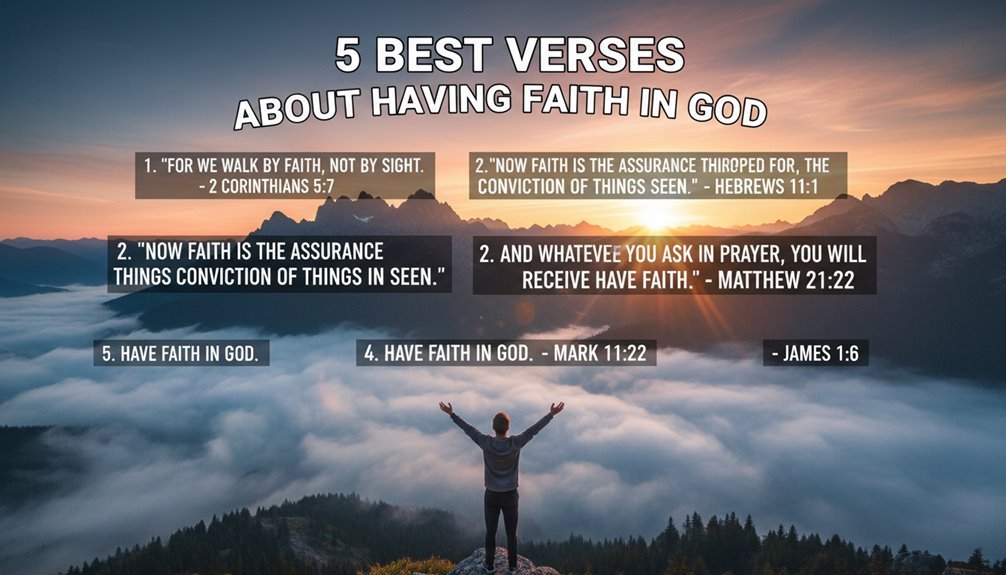
08 Apr 5 Best Verses About Having Faith in God
You’ll find Hebrews 11:1 defining faith as confidence in God’s promises, while Matthew 21:22 shows how belief fuels prayer and unlocks answers. Psalm 56:3 reminds you to swap fear for trust during trials, and James 2:17 insists that true faith shows up in deeds. These verses together illustrate how faith shapes daily decisions, strengthens prayer life, steadies you in hardship, and moves you to act. Keep exploring to discover deeper insights.
5 Bible Verses That Define Faith in God
Ever wonder which verses truly capture what faith looks like? You’ll find that Hebrews 11 — often called the “Hall of Faith” — lists Abraham’s trust, Noah’s obedience, and Moses’ courage, showing faith as confident reliance on God’s promises. James 2:17 reminds you that faith without works is dead, urging you to pair belief with action. In Romans 10:17, Paul tells you that hearing the word fuels faith, so listening to Scripture builds your confidence. Meanwhile, 2 Corinthians 5:7 tells you to walk by faith, not by sight, encouraging you to trust God’s unseen guidance. When you read Psalm 46:10, you’re invited to “Be still, and know that I’m God,” a call to surrender and trust His sovereignty. These verses together define faith as a dynamic, lived trust that shapes thoughts, deeds, and daily decisions.
How Hebrews 11:1 Guides Everyday Faith
When you read Hebrews 11:1—“Now faith is the assurance of things hoped for, the conviction of things not seen”—you’re reminded that everyday trust isn’t abstract; it’s a concrete confidence that shapes decisions, relationships, and habits. You can treat each morning as a test of that assurance, choosing to step forward even when outcomes remain hidden.
When a project feels risky, you recall the verse’s promise and commit, trusting the process rather than demanding proof.
In relationships, you extend grace, believing that love will blossom despite current tensions.
Your habits—budgeting, health, learning—become acts of faith, because you expect future reward even if the payoff isn’t visible yet.
How Matthew 21:22 Strengthens Faith in Prayer
Why does Matthew 21:22—“If you believe, you’ll receive whatever you ask for in prayer”—feel like a promise that powers every petition? It tells you that belief isn’t a vague feeling; it’s the engine that activates God’s response. When you truly trust that He hears you, you stop doubting the outcome and start speaking requests with confidence. That confidence reshapes your mindset, turning prayer from a desperate plea into a partnership with the divine. You begin to align your desires with His will, because belief naturally filters out selfish motives. As you experience answered prayers, your faith compounds, reinforcing the habit of praying boldly. The verse also reminds you that the “whatever” isn’t unlimited; it respects God’s perfect wisdom. Yet, the core message stays clear: sincere belief unlocks a channel through which God delivers what you ask, strengthening your prayer life each day.
How Psalm 56:3 Keeps Faith Strong in Trials
Matthew 21:22 shows that belief powers prayer, and the same principle resurfaces in the midst of hardship.
Psalm 56:3 says, “When I’m afraid, I put my trust in you.” In a trial, fear spikes, but you redirect that surge into reliance on God. You acknowledge the anxiety, then consciously choose trust, turning panic into a spiritual anchor. The verse invites you to speak the truth aloud, reinforcing mental focus on God’s faithfulness rather than the looming danger. As you repeat the promise, your nervous system calms, and your perspective shifts from “I can’t survive this” to “God is with me.” This simple act of verbalizing trust builds resilience, because each declaration rewires your brain to expect divine support. Consequently, you face trials with steadier hearts, confident that God’s presence steadies every trembling step.
How James 2:17 Turns Faith Into Action
James 2:17 declares, “Faith by itself, if it isn’t accompanied by action, is dead,” urging you to translate belief into tangible deeds. When you internalize this truth, you stop treating faith as a private sentiment and begin letting it shape your daily choices. A simple act—like offering a meal to a neighbor—becomes evidence that your trust in God isn’t idle. Scripture repeatedly pairs belief with service, so each concrete step validates your conviction.
Consider moments when you volunteer, mentor, or speak encouragement. Those actions echo the verse’s demand: faith must work outward. By aligning your agenda with God’s purpose, you demonstrate that your trust produces fruit. The result isn’t just personal satisfaction; it signals to others that your faith is alive, active, and transformative. Let every deed be a living testimony of the faith you claim.
Frequently Asked Questions
What Is the Difference Between Faith and Belief?
You’ll find that faith is a lived trust that pushes you to act, even when evidence is thin, while belief is a mental acceptance of a proposition, often based on information or authority. Faith compels you to step forward, relying on hope and commitment; belief simply registers an idea in your mind. In practice, faith fuels perseverance and behavior, whereas belief stays mostly intellectual.
Can Faith Be Measured or Quantified?
You can’t measure faith like a temperature or a weight; it’s an inner conviction that resists precise numbers. While surveys might gauge how often people claim to trust God, those figures only hint at attitudes, not the depth of personal experience.
Spiritual practices—prayer, worship, service—can reveal growth, yet the true intensity remains subjective, living in your heart rather than any statistical scale.
How Does Cultural Background Affect Personal Faith?
Your cultural background shapes the stories you hear, the rituals you practice, and the values you inherit, so it colors how you interpret and express faith.
You’ll notice familiar symbols, language, and community expectations guiding your belief system, while also feeling tension when those norms clash with personal experiences.
This blend of tradition and individual reflection creates a unique faith journey, influencing both the depth of your conviction and the way you live it out.
Is Faith Compatible With Scientific Reasoning?
Yes, faith can coexist with scientific reasoning. You’ll find that both seek truth—science explores the how, while faith often addresses the why. When you treat scientific evidence as a tool for understanding the natural world, you can still hold personal beliefs that give meaning beyond data. Embracing curiosity and humility lets you appreciate empirical findings without feeling they diminish your spiritual convictions.
What Role Does Doubt Play in Strengthening Faith?
You find that doubt isn’t a weakness; it’s a catalyst. When you question, you dig deeper, examine reasons, and confront assumptions.
That scrutiny forces you to articulate why you believe, turning vague trust into solid conviction.
Each lingering uncertainty becomes a prompt to seek evidence, pray, or study, and the resulting answers reinforce your faith.
In short, doubt pushes you to strengthen, clarify, and ultimately solidify what you hold dear.
Conclusion
Remember, these verses aren’t just ancient words—they’re a roadmap for your daily walk. Let Hebrews 11:1 shape how you see belief, let Matthew 21:22 fuel your prayers, let Psalm 56:3 steady you in hardship, and let James 2:17 push you into action. When you let these truths guide you, your faith becomes a living, breathing force that transforms every moment. Keep them close, and let your life reflect the power of true faith.








No Comments