


14 Nov The Most Terrifying and Scary Bible Verses Explained
You’ll encounter Scripture’s most terrifying passages revealing divine judgment through unquenchable fire (πῦρ ἄσβεστον), from Sodom’s destruction by gophrith va’esh to Gehenna’s perpetual flames. These texts depict immediate death strikes (Ananias and Sapphira’s ekpsychō), earth swallowing rebels alive into Sheol, and the mashchit destroyer claiming Egypt’s firstborn. Jesus warns of outer darkness (σκότος ἐξώτερον) with gnashing teeth, while Revelation’s lake of fire represents the second death (deuteros thanatos). Each judgment demonstrates how covenant rebellion triggers irreversible divine wrath.
Table of Contents
Key Takeaways
- Jesus warns of Gehenna where “their worm doesn’t die and fire isn’t quenched,” depicting unending torment for the condemned.
- God commanded complete annihilation of Canaanite populations, including infants and children, through divine “herem” destruction.
- The earth opened its mouth and swallowed Korah’s rebellion alive into Sheol, demonstrating immediate supernatural judgment.
- Ananias and Sapphira dropped dead instantly for lying to the Holy Spirit about their donation to the church.
- God’s destroyer killed every Egyptian firstborn in one night, from Pharaoh’s palace to prisoners’ dungeons.
The Destruction of Sodom and Gomorrah With Fire and Brimstone
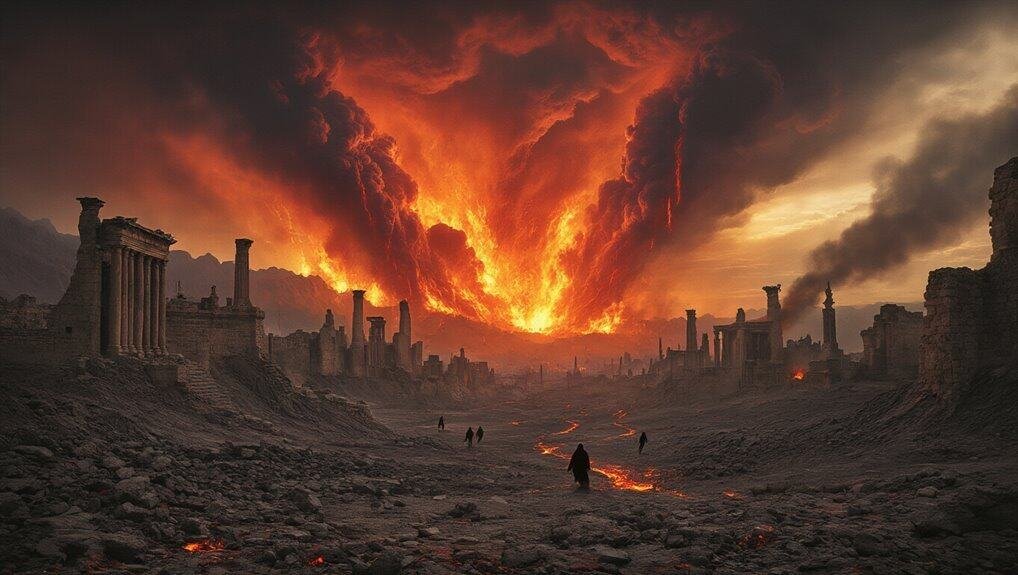
When you encounter Genesis 19‘s account of Sodom and Gomorrah’s destruction, you’re reading one of Scripture’s most visceral depictions of divine judgment—a narrative that has shaped Western consciousness for millennia. The Hebrew text uses “gophrith va’esh” (sulfur and fire) to describe the catastrophe, emphasizing both the totality and supernatural nature of the cities’ annihilation.
You’ll find archaeological evidence supporting this account in the Jordan Valley‘s ash layers and burnt pottery fragments dating to the Middle Bronze Age. The destruction wasn’t merely punitive—it served as an eternal warning. Peter calls it a “hypodeigma” (2 Peter 2:6), a pattern of coming judgment.
The angels’ urgency in evacuating Lot reveals divine judgment’s inexorable nature once decreed. You’re witnessing God’s holiness confronting rampant wickedness, particularly “cry” (za’aqah) of injustice that had reached heaven. This isn’t arbitrary wrath but measured response to systemic evil that had corrupted entire populations beyond redemption.

God Commands the Annihilation of the Canaanites Including Women and Children
The divine judgment at Sodom finds its most troubling parallel in Deuteronomy 20:16-17 and 1 Samuel 15:3, where God commands Israel to practice “herem”—complete devotion to destruction—against the Canaanite peoples. You’ll struggle with these texts where divine justice appears inseparable from moral ambiguity. The Hebrew term “herem” means dedicating something completely to God through destruction, leaving nothing alive that breathes.
When you examine 1 Samuel 15:3, you’re confronted with Samuel’s command to Saul: “Kill both man and woman, infant and nursing child.” The archaeological record confirms Canaanite practices included child sacrifice to Molech, temple prostitution, and systemic violence. Yet you can’t easily reconcile genocide with divine morality. Some scholars argue these accounts represent later theological interpretations rather than historical commands. Others maintain God’s judgment addressed cultures so corrupted they’d destroy Israel’s covenantal purpose.
You’re left wrestling with texts that resist simple explanations.
Ananias and Sapphira Struck Dead for Lying to the Holy Spirit
Deception in the nascent church triggers immediate divine judgment in Acts 5:1-11, where you’ll encounter Ananias and Sapphira‘s fatal encounter with apostolic authority. They’d sold property but kept back (Greek: νοσφίζομαι, nosphizomai – “to embezzle”) part of the proceeds while claiming they’d given everything. Peter confronts them separately, declaring they’ve lied not to humans but to the Holy Spirit (πνεῦμα τὸ ἅγιον).
You’re witnessing God’s establishment of moral accountability within the ekklesia. The couple’s death isn’t about the money—it’s about hypocrisy and testing God’s Spirit. They’d witnessed Barnabas’s genuine generosity (Acts 4:36-37) and sought similar praise through deception.

Peter gives each spouse opportunity for early repentance, asking Sapphira directly about the price, but she maintains the lie. Their immediate deaths (ἐκψύχω, ekpsychō – “breathe out one’s life”) demonstrate that God won’t tolerate corruption in His newly formed community, establishing a precedent of holiness.
The Angel of Death Kills Every Firstborn in Egypt
You’re confronting the tenth plague (מַכַּת בְּכוֹרוֹת, makat bechorot) where God’s destroyer passes through Egypt at midnight, striking dead every firstborn from Pharaoh’s house to the dungeon’s prisoners (Exodus 12:29).
The Hebrew verb נָגַף (nagaph, “to strike”) appears repeatedly as Pharaoh’s hardened heart—both self-induced and divinely strengthened—brings this catastrophic judgment upon his nation.
Only those households marked with the Passover lamb’s blood (דַּם הַפֶּסַח, dam hapesach) on their doorposts and lintel escape the destroyer, establishing the typological pattern of redemption through substitutionary sacrifice that echoes throughout Scripture.
Pharaoh’s Fatal Stubbornness
When Moses confronted Pharaoh with God’s command to release the Israelites, the Hebrew text reveals a complex interplay between divine sovereignty and human responsibility that culminates in Egypt’s most devastating judgment.
You’ll notice the Hebrew verb “chazaq” (to harden) appears with Pharaoh’s heart, indicating both self-hardening and divine hardening—a theological tension demonstrating moral obstinacy’s consequences.
Pharaoh’s refusal wasn’t mere political resistance; it represented defiance against YHWH’s authority.
The phrase “heavy heart” (kabed leb) in Egyptian religious texts meant one couldn’t pass into the afterlife—ironically foreshadowing Pharaoh’s spiritual fate.
His stubbornness triggered divine justice through ten escalating plagues, each targeting Egyptian deities.
You’re witnessing how willful rebellion transforms into judicial hardening, where God confirms the choice Pharaoh repeatedly made, resulting in national catastrophe.
Blood on Doorposts
The tenth plague marks the climax of divine judgment against Egypt, where the Hebrew term “mashchit” (destroyer) describes the agent of death passing through Egyptian homes at midnight.
You’ll find the blood’s ritual symbolism in Exodus 12:7, where “dam” (blood) on doorposts becomes a covenant sign distinguishing Israel from Egypt. The lamb imagery prefigures Christ’s sacrifice—John 1:29’s “amnos” (lamb) directly connects to Passover’s protective faith.
You’re witnessing theological precision: the blood isn’t magical but represents obedient trust. The Hebrew “pesach” means “to pass over,” indicating divine discrimination based on faith-response, not ethnicity.
This terrifying night demonstrates God’s sovereignty over life and death while establishing redemptive patterns that’ll echo throughout Scripture, from Israel’s exodus to humanity’s ultimate deliverance through substitutionary atonement.
Midnight Mass Death
At midnight precisely, death swept through Egypt with devastating efficiency, striking down every firstborn from Pharaoh’s palace to the dungeon’s depths. You’re witnessing the Hebrew term “mashchit” (destroyer) manifest in Exodus 12:23, where God’s judgment becomes tangible reality.
The nocturnal symbolism isn’t coincidental—darkness represents divine judgment throughout Scripture. You’ll notice midnight marks the moment when human power reaches its weakest point, emphasizing Egypt’s helplessness against Yahweh’s sovereignty. The Israelites’ midnight vigil contrasts sharply with Egyptian chaos; while protected households waited in reverent anticipation, unprotected homes experienced catastrophic loss.
The Greek Septuagint uses “olothreuo” (to destroy utterly), underscoring the completeness of this judgment. You’re seeing covenant theology enacted—those under blood protection lived while those rejecting God’s provision perished.
Jesus Warns of Eternal Torment Where the Worm Never Dies
You’ll find Jesus’ warning about “where their worm doesn’t die and the fire isn’t quenched” (Mark 9:48) draws directly from Isaiah 66:24‘s description of corpses being consumed outside Jerusalem.
The Greek word γέεννα (gehenna) refers to the Valley of Hinnom, Jerusalem’s burning trash dump where maggots continuously fed on refuse and fires smoldered perpetually.
Jesus transforms this tangible location of decay and destruction into a metaphor for judgment, employing imagery his first-century Jewish audience would’ve immediately recognized as the ultimate disgrace—unburied bodies left to rot and burn.
Gehenna’s Historical Context
When Jesus spoke of a place “where their worm doesn’t die and the fire isn’t quenched” (Mark 9:48), he wasn’t crafting new imagery but drawing from Isaiah 66:24 and the physical reality of Gehenna—the Valley of Hinnom (Hebrew: גֵּי הִנֹּם, gê-hinnōm) southwest of Jerusalem.
You’ll find Gehenna’s origins rooted in child sacrifice to Molech during Ahaz’s reign (2 Chronicles 28:3), transforming the valley into Jerusalem’s cursed garbage dump.
Unquenchable Fire Imagery
Fire imagery repeatedly appears throughout Jesus’s teachings as the primary metaphor for divine judgment, with the phrase “unquenchable fire” (Greek: πῦρ ἄσβεστον, pyr asbeston) occurring three times in Mark 9:43-48 alone.
You’ll find this judicial imagery draws from Isaiah 66:24, where rebellious corpses burn perpetually outside Jerusalem.
The eternal flames represent God’s unstoppable justice—fire that can’t be extinguished by human effort.
When Jesus warns “their worm doesn’t die,” He’s combining two devastating images: maggots (σκώληξ, skolex) consuming decaying flesh and fire destroying what remains.
You’re encountering covenant curse language from Deuteronomy 28, where disobedience brings complete destruction.
This isn’t merely punitive; it’s covenantal judgment enacted against those who’ve rejected God’s kingdom.
The unquenchable nature emphasizes finality—once kindled, divine judgment can’t be reversed.
The Earth Opens to Swallow Korah and His Followers Alive

The ground split apart beneath their feet, and the earth opened its mouth to swallow Korah, Dathan, Abiram, and their households alive into Sheol (Numbers 16:31-33).
You’re witnessing divine judgment executed through unprecedented geological symbolism—the Hebrew verb “bara” (created) emphasizes God’s sovereign creation of this unique chasm specifically for punishment.
This leadership rebellion against Moses’ authority represented defiance against God’s appointed order.
The earth’s “mouth” (peh) consuming them alive demonstrates immediate divine retribution without natural death’s intermediary.
They descended to Sheol conscious, experiencing the terror of burial while breathing.
The communal punishment extending to households reflects ancient Near Eastern corporate responsibility—rebellion’s consequences weren’t individualistic.
The Hebrew “yarad” (descend) paired with “chay” (alive) creates theological tension: they’re simultaneously living yet entering death’s realm.
This supernatural geological event served as an unmistakable sign to Israel that challenging divinely established leadership brings catastrophic consequences, literally opening the ground beneath your feet.
Bears Maul Forty-Two Youth for Mocking Elisha
Divine judgment through nature’s agents continues in 2 Kings 2:23-24, where two bears emerge from the forest to maul forty-two youths who’d mocked Elisha’s baldness.
You’ll find the Hebrew term “na’ar” doesn’t necessarily mean small children but refers to young men aged twelve to thirty, explaining the severity of child consequences for challenging prophetic authority.
The historical context reveals Bethel‘s significance as a center of idolatrous calf worship, where these youths weren’t just teasing but threatening God’s prophet.
Their taunt “go up” mockingly referenced Elijah’s ascension, essentially telling Elisha to die and leave them alone.
You’re witnessing deliberate rebellion against divine representation.
Some textual variants suggest different numbers, but most manuscripts confirm forty-two victims.
The bears didn’t randomly attack—God sent them as covenant enforcers.
When you examine this passage, you’re observing how seriously ancient Israel’s covenant required respect for prophetic offices, especially during critical spiritual transitions.
The Lake of Fire and Second Death in Revelation
Eternal separation from God manifests most terrifyingly in Revelation’s depiction of the lake of fire, where you’ll encounter the Greek term “limne tou puros” (λίμνη τοῦ πυρός) appearing six times throughout the book.
This eschatological imagery culminates in Revelation 20:14-15, where death and Hades are thrown into this burning lake alongside those not found in the Book of Life.
You’re confronting what John calls the “second death” (deuteros thanatos), a concept distinct from physical death. While symbolic interpretation debates whether this represents literal flames or metaphorical anguish, the text’s Jewish apocalyptic context suggests you’re reading imagery meant to convey ultimate divine judgment.
The lake’s eternal nature parallels gehenna references in Matthew 25:41, originally prepared for Satan and his angels. You’ll notice Revelation 21:8 lists specific sins leading to this fate, emphasizing moral accountability rather than arbitrary punishment in God’s final reckoning.
Outer Darkness Where There Is Weeping and Gnashing of Teeth
When Jesus warns about being “cast into outer darkness” (εἰς τὸ σκότος τὸ ἐξώτερον), you’re encountering a uniquely Matthean phrase appearing three times in his Gospel (8:12, 22:13, 25:30), each within parables addressing covenant unfaithfulness.
Jesus’s outer darkness warnings appear exclusively in Matthew’s parables addressing covenant unfaithfulness.
The metaphorical imagery draws from ancient banquet customs where you’d find honored guests inside a brightly lit hall while excluded individuals remained in the darkness outside.
The phrase “weeping and gnashing of teeth” (ὁ κλαυθμὸς καὶ ὁ βρυγμὸς τῶν ὀδόντων) appears six times in Matthew, once in Luke.
You’ll notice the gnashing (βρυγμός) indicates rage rather than pain—it’s the same verb used in Acts 7:54 when Stephen’s accusers gnashed their teeth in fury. This isn’t depicting physical torment but the anguish of eternal separation from God’s presence.
The darkness symbolizes complete absence of divine light, contrasting with Christ as “light of the world” (John 8:12).
You’re seeing judgment portrayed through exclusion from the messianic banquet, not torture chambers.
Frequently Asked Questions
Why Does a Loving God Allow Such Violent Punishments in Scripture?
You’re encountering divine justice through ancient Near Eastern literary forms where hyperbolic language conveyed moral pedagogy.
The Hebrew word “chesed” (steadfast love) coexists with “mishpat” (judgment) throughout scripture.
You’ll find these passages served as boundary markers for covenant communities, using dramatic imagery common to their era.
They’re not prescriptive violence but descriptive warnings about rejecting God’s moral order, teaching through extreme consequences what separation from divine holiness ultimately means.
How Should Modern Christians Interpret These Disturbing Passages Today?
You’ll need contextual reading to understand these passages through their ancient Near Eastern framework, recognizing Hebrew terms like *herem* (devotion to destruction) reflected wartime conventions, not prescriptive commands.
Seek pastoral guidance when wrestling with difficult texts – they’ll help you see how the Greek *kairos* (appointed time) shapes interpretation.
Read these verses within salvation history’s arc, understanding God’s progressive revelation culminating in Christ’s teachings about enemy love and redemptive justice.
Are These Verses Meant to Be Taken Literally or Metaphorically?
You’ll find both literal interpretations and metaphorical readings have validity depending on the specific passage’s genre. Apocalyptic texts like Revelation employ symbolic language (Greek: apokalypsis), while historical narratives often demand literal understanding.
You must examine the Hebrew literary forms – whether mashal (parable) or historical chronicle. Context determines hermeneutical approach: prophetic oracles frequently use metaphor, whereas Torah commandments typically require literal application within their ancient Near Eastern framework.
Do Other Religions Have Similarly Frightening Texts in Their Scriptures?
Yes, you’ll find similarly unsettling passages across religious traditions. Hindu epics like the Mahabharata describe cosmic destruction cycles (pralaya) and divine wrath that parallels biblical apocalyptic literature.
Islamic hadiths contain vivid descriptions of Jahannam’s torments, echoing Gehenna imagery. The Sanskrit term “krodha” (wrath) mirrors the Greek “orgē” in intensity.
These texts serve comparable theological functions: they’re establishing divine justice, encouraging righteousness, and expressing ultimate cosmic order through fearsome imagery.
How Can Parents Explain These Scary Bible Verses to Children?
You’ll need age appropriate explanations that contextualize difficult passages through their ancient Near Eastern setting.
When discussing divine judgment in texts like Genesis 19 or Revelation, frame them within Hebrew concepts of mishpat (justice) and chesed (mercy).
Use emotion focused conversations to address children’s fears while explaining the Greek word apokalypsis means “unveiling,” not destruction.
Emphasize God’s protective nature, adapting theological complexity to their developmental stage through progressive disclosure of meaning.
Conclusion
You’ve explored Scripture’s most sobering passages—texts that reveal God’s holiness (Hebrew: *qadosh*) and justice (*mishpat*). These verses aren’t meant to terrorize but to demonstrate sin’s gravity and divine righteousness. The Greek term *phobos* (fear) in Scripture often means reverent awe, not mere terror. As you’ve seen, these accounts consistently show God’s patience before judgment and His desire for repentance (*metanoia*). They’re ultimately pointing you toward grace—the same holy God provides redemption through Christ.





No Comments