

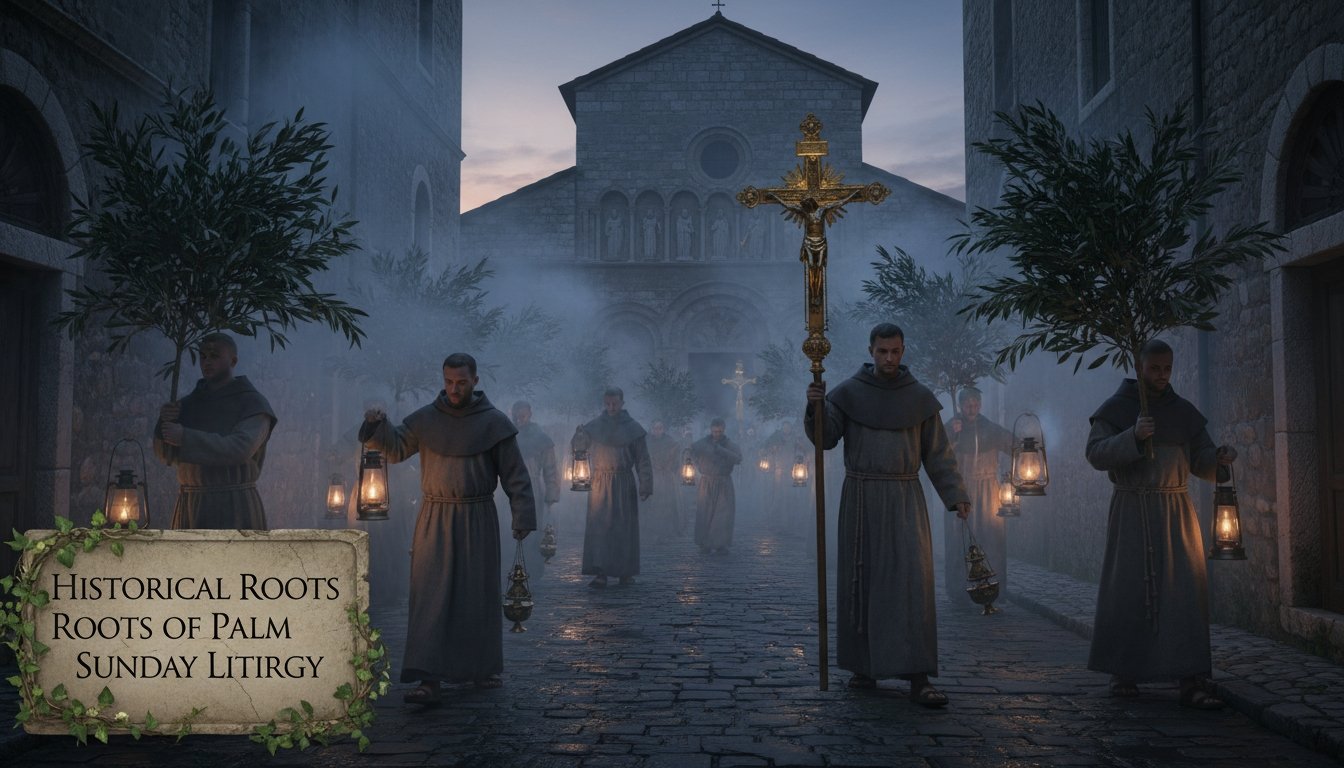
27 Feb Historical Roots of Palm Sunday Liturgy
The historical roots of the Palm Sunday liturgy stretch back to the 4th century, when early Christian communities in Jerusalem commemorated Jesus’ triumphal entry. They waved palm branches and spread cloaks, symbolizing victory, triumph, and the Messiah’s kingship. This ritual spread across the Byzantine Empire, linking to the Jewish Festival of Tabernacles. Over time, the liturgy developed processions, hymns, and the blessing of palms. If you’d like to explore more about how these traditions emerged and evolved, the outline provides additional details.
Key Takeaways
- Palm Sunday observances trace back to the 4th century, originating in Jerusalem as commemorations of Jesus’ triumphal entry.
- Palm branches symbolize victory, triumph, and honor, reflecting Jesus’ kingship and the expectations of the Messiah.
- Palm Sunday is connected to the Jewish Festival of Tabernacles, involving the waving of palm fronds in both traditions.
- Liturgical rites for Palm Sunday, including processions, hymns, and the blessing of palms, emerged as the Christian church grew after Jesus‘ death.
- Palm Sunday traditions spread across Christendom, adapting to local cultural and liturgical contexts.
The Origins of Palm Sunday Observances
When did the observances of Palm Sunday first begin?
The origins of Palm Sunday can be traced back to the 4th century AD. Early Christian communities in Jerusalem started commemorating Jesus’ triumphal entry into the city, with people waving palm branches and spreading cloaks on the road. This ritual reenactment soon spread throughout the Byzantine Empire.
The Symbolic Meaning and Significance of Palm Branches in Palm Sunday Processions
Why are palm branches so significant in Palm Sunday processions? They symbolize victory, triumph, and honor. In ancient times, palm branches were carried by those welcoming victorious kings and generals. When Jesus entered Jerusalem, the crowds waved palm branches to greet Him as their long-awaited Messiah. The palms represent Jesus’ kingship and the people’s belief that He’d liberate them from Roman rule.
Today, we wave palms to commemorate Christ’s triumphal entry and recognize His role as the King of Kings. They remind us of His ultimate victory over sin and death through His death and resurrection. The palms point us to the glory and majesty of Jesus, the true and rightful ruler over all.
Palm Sunday’s Connections to the Jewish Festival of Tabernacles
The connections between Palm Sunday and the Jewish Festival of Tabernacles run deeper than you might expect. Both events involve the waving of palm branches, a symbolic gesture that dates back to ancient Jewish traditions. During Tabernacles, palm fronds were used to construct temporary shelters, known as sukkahs, which commemorated the Israelites’ time in the wilderness. On Palm Sunday, palm branches were strewn before Jesus as he entered Jerusalem, a nod to his role as the Messiah. This shared emphasis on palms underscores the deep roots of Palm Sunday within the Jewish liturgical calendar. Understanding these parallels sheds light on the rich tapestry of religious symbolism that underpins this pivotal Christian celebration.
The Emergence of Palm Sunday Rites in Early Christianity
As the Christian church grew in the centuries following Jesus’ death, the rites and observances surrounding Palm Sunday began to take shape. Early Christian communities commemorated Christ’s triumphant entry into Jerusalem, which marked the start of his Passion. They developed liturgies featuring processions, hymns, and the blessing of palm branches. By the 4th century, these practices had spread across the Mediterranean world. Churches held outdoor processions where worshippers carried palms and reenacted Jesus’ journey. Inside, the liturgy incorporated readings, prayers, and the distribution of blessed palms. Over time, Palm Sunday evolved into a major feast, solidifying its place in the Christian calendar. The emergence of these rites in early Christianity underscores the deep significance of this day for the faithful, who continue to celebrate Christ’s life and sacrifice.
The Spread and Adaptation of Palm Sunday Traditions Across Christendom
The Palm Sunday traditions spread rapidly across Christendom, with various regions adopting the symbolic use of palm branches. Over the centuries, these customs evolved, reflecting the cultural and liturgical needs of diverse Christian communities. Exploring these adaptations sheds light on the historical development and enduring significance of this pivotal celebration.
Liturgical Adoption Across Regions
Though the liturgical traditions of Palm Sunday spread across regions of Christendom, they didn’t simply transfer without adaptation. As the practices moved, they were incorporated into local customs and beliefs. In the East, for instance, olive branches replaced palm fronds, reflecting the flora of the region. In the West, the procession evolved to include relics or images of Christ. Across Europe, the liturgy was shaped by the architectural constraints and artistic styles of each locale. This process of cultural integration enriched the Palm Sunday celebration, ensuring its enduring relevance in diverse Christian communities.
Symbolic Significance of Palm Branches
Why were palm branches so significant in the Palm Sunday liturgy as it spread across Christendom? Palm branches symbolized victory, triumph, and rejoicing – fitting for welcoming Jesus’ triumphal entry into Jerusalem. As the Palm Sunday tradition took hold, palms became an integral part of the commemorative celebrations. Waving palms and covering Christ’s path evoked his kingly status and the crowd’s adoration. This visual imagery resonated across diverse cultures, allowing the Palm Sunday liturgy to take root wherever Christianity spread. The palms’ enduring symbolic power underscored the universality of this holy day, unifying believers in honoring Jesus’ pivotal journey to the cross.
Evolving Traditions Over Centuries
As the Palm Sunday tradition spread across diverse regions, Christians readily adapted the commemorative celebrations to their local cultures and contexts. Some Orthodox churches, for instance, incorporated the blessing of pussy willows alongside palms, while in parts of Europe, processions involved flower-adorned donkeys. The Spanish developed intricate sand and flower carpets lining the streets, while Latin American nations crafted colorful kites to symbolize Christ’s ascent. Across the globe, the observance evolved – incorporating distinct customs, foods, and rituals that reflected each community’s heritage. Yet, the core message of honoring Jesus’ triumphant entry into Jerusalem remained the unifying thread woven through these evolving Palm Sunday traditions.
Contemporary Palm Sunday Liturgy and Observances
How do contemporary Christians celebrate Palm Sunday today? They commemorate Jesus’ triumphant entry into Jerusalem, waving palm branches and singing hosannas. Many churches hold Palm Sunday processions, reenacting the biblical event. Worshippers carry palm fronds, often fashioned into crosses, to represent Christ’s victory. The liturgy often includes the reading of the Passion narrative, recounting Jesus’ suffering and crucifixion. Some churches distribute blessed palm branches to attendees, which they take home as symbols of faith. Contemporary observances emphasize Christ’s kingship and the people’s joyous welcome, foreshadowing the sorrow of Good Friday.
Though traditions have evolved, the core themes of Palm Sunday – reverence, hope, and anticipation of the Easter celebration – remain central to how believers commemorate this pivotal moment in Christian history.
Frequently Asked Questions
Is Palm Sunday Celebrated in Non-Christian Religions?
No, palm Sunday isn’t celebrated in non-Christian religions. It’s a Christian holiday commemorating Jesus’ entry into Jerusalem, and it’s exclusively observed by Christian denominations. Other religions have their own unique festivals and holy days that don’t include the tradition of waving palm branches. The palm Sunday celebration is rooted in the Christian faith and has no equivalent observance in non-Christian faiths.
How Long Do Palm Sunday Celebrations Typically Last?
Palm Sunday celebrations typically last about an hour. The service often includes a procession with palms, readings from the Gospels about Jesus’ entry into Jerusalem, hymns, and a sermon. The length may vary depending on the specific traditions of the church, but it’s generally a brief service commemorating this important event in the Christian calendar.
Can Palm Sunday Be Observed on a Different Date?
Yes, Palm Sunday can be observed on a different date. The date of Palm Sunday is determined by the date of Easter, which is a movable feast. Palm Sunday is always the Sunday before Easter, so if Easter falls on a different date, Palm Sunday will be observed on the corresponding Sunday.
Do All Christian Denominations Celebrate Palm Sunday the Same Way?
No, not all Christian denominations celebrate Palm Sunday the same way. While most observe it with a procession of palm branches and readings of the Passion narrative, the specific liturgical practices can vary.
Some churches emphasize the triumphant entry of Jesus, while others focus more on his impending suffering and death. The observance reflects each denomination’s theological perspectives and traditions.
Are There Any Special Dietary Restrictions for Palm Sunday?
No, there aren’t any special dietary restrictions for Palm Sunday. The day commemorates Jesus’ triumphal entry into Jerusalem, not specific dietary observances. Christians are free to enjoy their regular meals on this day, without any requirements to abstain from certain foods or follow particular fasting practices. The focus is on celebrating and remembering the biblical events, not adhering to dietary rules.
Conclusion
You’ve traced the historical roots of Palm Sunday observances, from their symbolic ties to the Jewish Festival of Tabernacles to their emergence and spread across early Christianity. Today, Palm Sunday liturgies continue to commemorate Jesus’ triumphal entry into Jerusalem, inviting believers to join in this timeless procession of praise and devotion.









No Comments