

14 Nov Essential Bible Verses for Christmas
You’ll find Christmas’s essential verses woven throughout Scripture, beginning with Isaiah’s prophecy of a virgin bearing Emmanuel (Isaiah 7:14) and culminating in Luke’s nativity account (Luke 2:1-20). Gabriel’s announcement to Mary (Luke 1:26-35), Joseph’s dream (Matthew 1:22-23), and the shepherds’ angelic encounter reveal God’s redemptive plan unfolding. The wise men’s journey (Matthew 2:1-12) and temple testimonies from Simeon and Anna (Luke 2:22-38) complete the biblical narrative that transforms waiting into worship and prophecy into presence.
Table of Contents
Key Takeaways
- Isaiah 7:14 prophesies the virgin birth and Emmanuel (“God with us”), fulfilled in Christ’s miraculous conception through Mary.
- Luke 2:10-11 records angels announcing to shepherds: “Fear not, I bring good news—today a Savior is born in David’s city.”
- Matthew 1:23 confirms Jesus fulfills Isaiah’s Emmanuel prophecy, demonstrating God dwelling among humanity through the incarnation.
- Luke 2:14 captures the heavenly host’s worship: “Glory to God in the highest, and on earth peace among those with whom he is pleased.”
- Isaiah 9:6 identifies the promised child as “Wonderful Counselor, Mighty God, Everlasting Father, Prince of Peace” who establishes an eternal kingdom.
The Prophet Isaiah Foretells the Messiah’s Birth
When you open the book of Isaiah during the Christmas season, you’re encountering prophecies written over 700 years before Christ’s birth that speak with stunning clarity about the coming Messiah. Isaiah’s prophetic poetry weaves Messianic imagery throughout chapters that’ve sustained God’s people through centuries of waiting.
You’ll discover the virgin prophecy in Isaiah 7:14, where the Immanuel promise first appears—”God with us.” This profound declaration anchored exilic hope for generations longing for deliverance. Isaiah’s words don’t merely predict; they paint vivid Isaianic themes of restoration through the Davidic covenant’s fulfillment.
As you read Isaiah 9:6-7, you’re witnessing the justice herald who’ll establish the peaceable kingdom. The prophet describes this child as “Wonderful Counselor, Mighty God, Everlasting Father, Prince of Peace.” Isaiah 60 reveals how this Messiah becomes light to the nations, drawing all peoples to God’s redemptive purpose. These verses form Christianity’s foundational understanding of Jesus’s identity and mission.

Gabriel’s Announcement to Mary in Nazareth
When you read Luke’s account of Gabriel visiting Mary, you’re witnessing one of Scripture’s most profound moments—God choosing an ordinary young woman from Nazareth to bear His Son.
Notice how Mary responds to the angel’s shocking revelation of divine conception with remarkable faith: “I am the Lord’s servant; may your word to me be fulfilled.”
Her humble acceptance reminds you that God’s greatest works often begin when His people simply say yes to His extraordinary plans.
Mary’s Humble Response
Her humble obedience didn’t emerge from understanding God’s complete plan. She didn’t comprehend how the Holy Spirit would overshadow her or how she’d explain her pregnancy to Joseph. Yet Mary’s quiet faith anchored her surrender.
She called herself “doulos”—a bondservant—demonstrating complete submission to God’s will.

When you face God’s unexpected calling, remember Mary’s response. She didn’t negotiate terms or demand explanations. Instead, she trusted the character of the One who called her, teaching you that true faith says “yes” before knowing all the details.
Divine Conception Revealed
Though Mary lived quietly in Nazareth, heaven’s most startling message would soon interrupt her ordinary life. You can imagine her astonishment when Gabriel appeared with an angelic revelation that would change history forever.
The angel declared she’d conceive a child through the Holy Spirit’s power, not through human means. This virgin conception fulfilled Isaiah’s ancient prophecy while demonstrating God’s sovereign ability to accomplish the impossible.
When you read Luke 1:26-35, you’re witnessing the moment heaven invaded earth with redemptive purpose. Gabriel’s announcement wasn’t merely informational—it revealed God’s plan to dwell among His people.
The divine conception proved that salvation wouldn’t come through human effort but through God’s miraculous intervention. You see here that nothing’s too difficult for the Lord who overshadows impossibility with His power.
God’s Chosen Servant
Gabriel’s words pierced through Mary’s humble dwelling with heaven’s most profound assignment: she’d become the mother of the Messiah. You can imagine her trembling as divine purpose settled upon young shoulders. She represented the chosen remnant of Israel, those faithful few who’d maintained pure devotion despite centuries of waiting.
Mary’s “yes” meant accepting a path that would lead through scandal, misunderstanding, and watching her Son become Isaiah’s suffering servant. Yet she surrendered completely: “I am the Lord’s servant.” You’ll find no hesitation in her response, only humble obedience that would reshape history. Her willingness reminds you that God doesn’t seek the powerful but the available. Through Mary, you witness how heaven partners with humanity’s humble faith to accomplish redemption’s greatest work.
Joseph’s Dream and the Fulfillment of Prophecy

This moment reveals how God orchestrates prophecy fulfillment through ordinary people facing extraordinary circumstances.
Matthew 1:22-23 confirms this was to fulfill Isaiah’s prophecy: “The virgin will conceive and give birth to a son, and they’ll call him Immanuel.”
You’re witnessing God’s sovereign plan unfold through a carpenter’s obedience. Joseph’s response teaches you about faith—he awakened and immediately obeyed, taking Mary as his wife.
His trust in divine revelation protected God’s redemptive plan, ensuring Christ’s birth would proceed exactly as prophesied centuries before.
The Journey to Bethlehem and Christ’s Humble Birth
Setting out from Nazareth, Mary and Joseph traveled roughly ninety miles to Bethlehem because Caesar Augustus had decreed a census requiring everyone to register in their ancestral towns (Luke 2:1-5). You can imagine their exhaustion after this arduous journey, with Mary heavy with child. The population census that brought them there fulfilled God’s ancient promise through Micah that the Messiah would come from David’s city.
When they arrived, you’d expect royalty to receive royal treatment. Instead, “there was no room for them in the inn” (Luke 2:7). Christ’s birth in a stable reveals God’s heart for the lowly. The manger symbolism speaks powerfully—the bread of life laid where animals feed, the Lamb of God resting in a feeding trough. You’ll find no accident in these details. Heaven’s King chose poverty’s entrance, teaching you that God’s kingdom operates differently than earthly powers. His humble arrival invites you to approach Him without fear.
Angels Proclaim Good News to the Shepherds
You’ll find profound comfort in the angels’ first words to the terrified shepherds: “Fear not, for behold, I bring you good news of great joy” (Luke 2:10).
Their heavenly proclamation transforms your deepest anxieties into worship as they declare “Glory to God in the highest” while announcing Christ’s birth.
When you’re overwhelmed by life’s uncertainties, remember that heaven’s response to fear isn’t explanation but invitation—to witness God’s glory breaking into ordinary moments.
Fear Not Message
When heaven’s glory suddenly pierced through the darkness of a shepherd’s field, the first words spoken weren’t of judgment or condemnation but of divine comfort: “Fear not.” You can imagine the terror that must have gripped those humble shepherds as the angel of the Lord appeared and God’s radiant glory shone around them (Luke 2:9).
Yet God’s Comforting Presence transforms fear into Courageous Faith. The angel’s message reveals how heaven approaches humanity—not with terror but with Peaceful Assurance. You’re invited to embrace this same Courageous Trust when life’s uncertainties overwhelm you.
The shepherds’ experience teaches that divine encounters begin with God calming our fears before revealing His purposes. Their transformation from terrified workers to bold proclaimers demonstrates how “fear not” isn’t merely consolation—it’s heaven’s invitation to participate in God’s redemptive plan.
Glory to God
After the angel’s reassuring words calmed the shepherds’ fears, heaven’s full splendor burst forth in an overwhelming display of divine celebration. You’ll find no greater worship focus in Scripture than this moment when countless angels filled the sky, proclaiming God’s divine majesty to humble shepherds watching their flocks.
“Glory to God in the highest, and on earth peace, goodwill toward men” became heaven’s praise songs breaking into earth’s darkness. You’re witnessing the angelic host declaring Christ’s eternal worth—not to kings or priests, but to ordinary workers in a field. This heavenly chorus reveals what matters most: God’s glory displayed through His Son’s arrival.
When you gather with your congregation this Christmas, remember that heaven couldn’t contain its joy at the Savior’s birth, and neither should you.
The Shepherds Visit the Newborn King
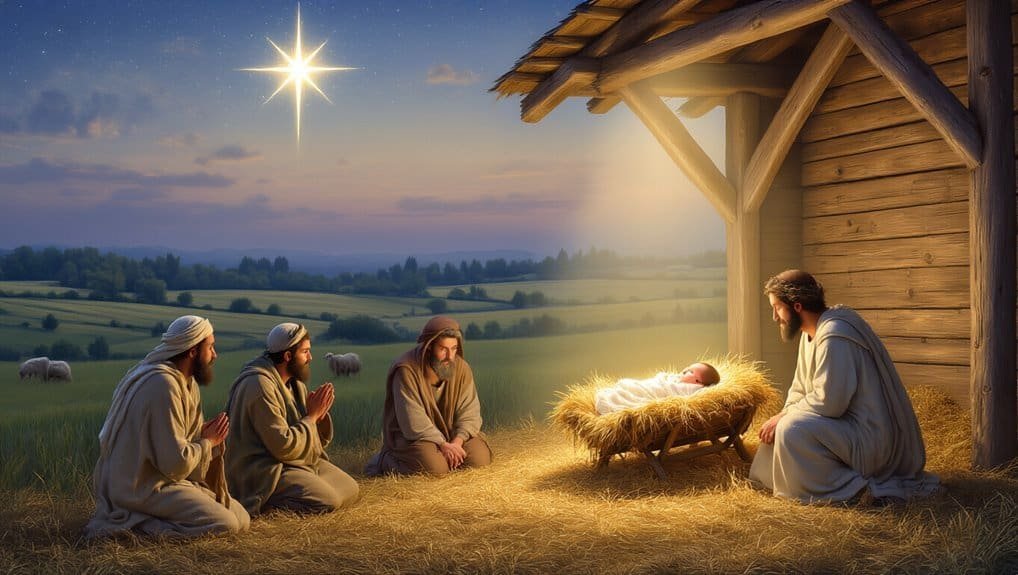
As the holy night unfolded in Bethlehem, God chose society’s most humble workers to receive heaven’s greatest announcement. The shepherds’ field vigil transformed into divine encounter when angels pierced through darkness with glory. You’ll find in Luke 2:8-20 that these outcasts became heaven’s first witnesses. They weren’t religious leaders or scholars—they were night-shift laborers watching sheep.
The shepherds’ awe erupted into immediate action. They said, “Let’s go to Bethlehem and see this thing that has happened.” You can’t miss their urgency—they hurried off and found Mary, Joseph, and the baby lying in a manger. When you’re touched by God’s revelation, you don’t delay. These shepherds teach you that faith responds quickly to God’s word. After seeing Jesus, they couldn’t contain their joy, spreading the word throughout the region. Everyone who heard their testimony marveled. You’re called to share that same wonder when encountering Christ.
The Wise Men Follow the Star From the East
While shepherds rushed to Bethlehem that holy night, God was orchestrating another divine appointment from distant lands.
You’ll find in Matthew 2:1-12 how wise men from the east followed an extraordinary star to worship the newborn King. These magi weren’t using ordinary ancient navigation methods—they were pursuing divine revelation written in the heavens.
Consider the star symbolism throughout Scripture. Numbers 24:17 prophesied “a star shall come out of Jacob,” and Revelation 22:16 reveals Christ as “the bright morning star.” You’re witnessing God’s cosmic announcement that transcended cultural boundaries.
The wise men’s journey teaches you that seeking Christ requires persistence and sacrifice. They traveled months, perhaps years, bringing costly gifts of gold, frankincense, and myrrh.
Their worship demonstrates that Christ’s kingship extends to all nations. When you celebrate Christmas, remember that God’s salvation plan always included the Gentiles—including you.
Simeon’s Blessing and Anna’s Testimony at the Temple
Mary and Joseph brought baby Jesus to the Temple in Jerusalem, fulfilling the Law of Moses, where two extraordinary encounters would confirm God’s redemptive plan. You’ll find this Temple testimony in Luke 2:22-38, where faithful patience meets divine promise.
Simeon, righteous and devout, had waited years for this holy encounter. The Spirit had promised he wouldn’t die before seeing the Messiah. When he held Jesus, his prophetic recognition burst forth: “My eyes have seen your salvation!” He blessed the family while revealing Christ would bring both salvation and division.
Anna, an elderly prophetess, approached at that exact moment. She’d served God through decades of widowhood, fasting and praying continuously. Her immediate response? She thanked God and spoke about Jesus to everyone awaiting redemption.
You’re witnessing how God honors those who wait faithfully. Both servants demonstrate that recognizing Christ requires spiritual readiness. Their testimonies remind you that encountering Jesus transforms waiting into proclamation.
Scripture’s Promise of Emmanuel – God With Us
When Isaiah prophesied “The virgin will conceive and give birth to a son, and will call him Immanuel” (Isaiah 7:14), he unveiled God’s ultimate promise to dwell among His people. This presence promised through Emmanuel explored the depths of divine love—God wouldn’t merely send help; He’d come Himself.
God wouldn’t merely send help; He’d come Himself—Emmanuel, the ultimate promise of divine presence.
You’ll find this covenant assurance woven throughout Matthew’s Gospel, where the angel confirms to Joseph that Mary’s child fulfills Isaiah’s ancient prophecy (Matthew 1:23). The name Emmanuel means “God with us,” transforming an abstract theological concept into flesh and blood reality.
Christ’s birth represents God’s comforting nearness, not as a distant deity but as One who shares your struggles, knows your weaknesses, and walks beside you.
This Christmas, remember that Emmanuel isn’t just historical fact—it’s present reality. Through Christ’s birth, death, and resurrection, you’re never alone. His presence remains with you always, just as He promised before ascending: “I am with you always” (Matthew 28:20).
Frequently Asked Questions
How Can I Use These Bible Verses in Christmas Cards or Decorations?
You’ll find meaningful ways to share God’s word through handmade bookmarks featuring verses like Luke 2:11 or Isaiah 9:6 as gifts for your church family.
Create scripture ornaments for your tree using calligraphy on wooden circles or glass baubles, displaying John 3:16 or Matthew 1:23.
Write verses inside your cards with personal reflections on Christ’s birth.
These tangible reminders help your congregation carry the sacred Christmas story throughout the season.
Which Bible Translations Are Best for Reading Christmas Scripture Passages?
You’ll find the ESV and NIV excellent for modern readability while maintaining accuracy.
For poetic language that enhances quiet reflection, consider the NKJV or NRSV.
The RSV serves beautifully in liturgical use during congregational readings.
If you’re seeking accessible translations for church gatherings, the NLT captures Scripture’s warmth.
Each version offers unique scriptural depth—choose based on whether you’re reading privately, teaching, or leading worship during this sacred season.
Are There Christmas Verses Appropriate for Teaching Young Children?
Yes, you’ll find Luke 2:8-11 about shepherds and angels perfect for little ones. They’ll grasp “a baby wrapped in cloths” from Luke 2:12 easily.
While teaching, you’re building faith foundations through simple carols that reinforce these verses. Your congregation’s children connect deeply when making nativity crafts depicting Mary, Joseph, and baby Jesus.
Matthew 2:11 about the wise men’s gifts sparks their imagination and helps them understand God’s greatest gift to humanity.
What Old Testament Prophecies About Jesus Aren’t Traditionally Read at Christmas?
You’ll discover profound Messianic foreshadowing throughout Scripture that’s rarely shared during Christmas services. The Servant prophecies in Isaiah 42 and 53 reveal Christ’s suffering mission, while Psalm 110’s Royal genealogy points to His eternal priesthood. Daniel’s Temple symbolism predicts the timing of His arrival, and Zechariah 9:9 foretells His humble entry. These passages deepen your congregation’s understanding of God’s redemptive plan beyond the familiar nativity readings you’re accustomed to hearing.
How Do Different Christian Denominations Interpret These Christmas Bible Verses?
You’ll find Catholic interpretation emphasizes Mary’s role in Luke’s nativity account, viewing her as Theotokos—God-bearer—while incorporating tradition alongside Scripture.
Evangelical emphasis centers on personal salvation through Christ’s birth, focusing on fulfilled prophecy and God’s redemptive plan.
You’ll notice Orthodox churches highlight the incarnation’s cosmic significance, while mainline Protestants often stress social justice themes within Matthew’s narrative.
Each tradition brings unique theological lenses that enrich your congregation’s understanding of Christmas texts.
Conclusion
You’ve explored the sacred scriptures that illuminate Christ’s birth story, from ancient prophecies to their divine fulfillment. These verses aren’t just historical accounts—they’re God’s living word speaking directly into your life today. As you celebrate Christmas, let these passages transform your heart and deepen your faith. Share them with others who need hope. Remember, the same God who orchestrated every detail of that first Christmas is working in your story right now.







No Comments