


21 Jan Emperor Claudius II: The Brutal Ruler Who Killed Valentine
You’ve encountered a persistent myth that confuses Emperor Claudius II with his persecution of Christians. Claudius II Gothicus (268-270 AD) was actually a competent military commander from Illyricum who saved Rome from Gothic invasion at the Battle of Naissus, earning the title “Gothicus.” He died from plague in 270 AD, not from any connection to Valentine’s martyrdom. The Valentine legend conflates different historical periods and figures, obscuring this emperor’s genuine military achievements that stabilized the empire during the Crisis of the Third Century.
Key Takeaways
- Emperor Claudius II (214-270 AD) rose to power through military ranks and seized imperial authority after Gallienus’s assassination in 268 AD.
- The Valentine execution legend appears to be historically unsubstantiated, as primary sources focus on Claudius’s military campaigns and plague-related death.
- Claudius II earned the title “Gothicus” after decisively defeating Gothic invaders at Naissus, killing 30,000-50,000 enemies in 269 AD.
- His reign emphasized brutal military efficiency, crushing rebellions and Germanic invasions while attempting to reunify the fragmented Roman Empire.
- Claudius II died from the Plague of Cyprian in January 270 AD, ending his brief but militarily significant reign.
Claudius II Gothicus: The Illyrian Emperor Who Saved Rome
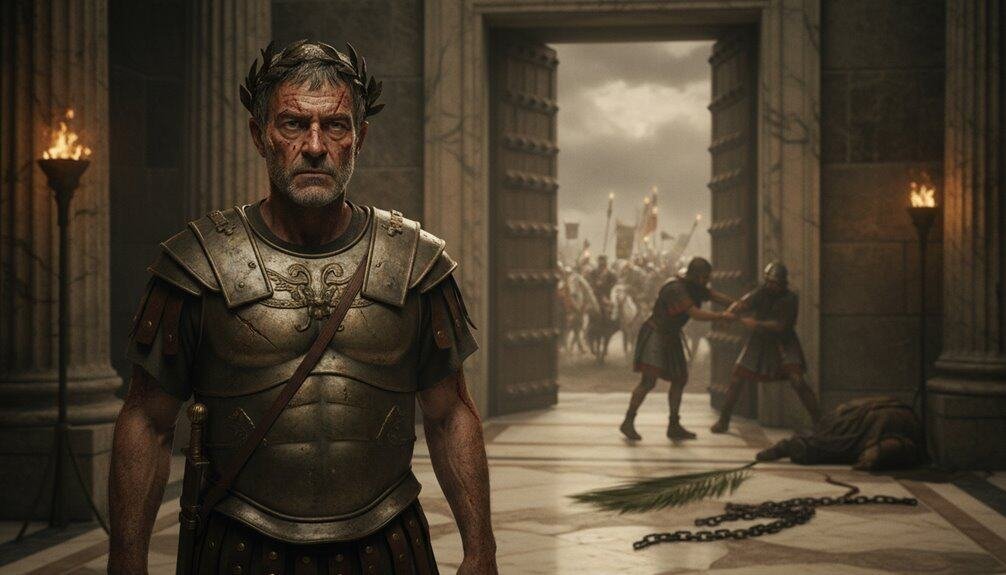
When barbarian invasions threatened to tear the Roman Empire apart in the third century, Marcus Aurelius Claudius emerged from the rugged provinces of Illyricum to become one of Rome’s most effective military emperors.
Born in Dardania in 214, you’ll find that Claudius rose through military ranks under Gallienus, commanding new cavalry units before seizing power in 268.
From humble provincial origins in Dardania, Claudius climbed military ranks under Gallienus before ultimately claiming imperial power in 268.
You can see Claudius’s strategic brilliance in his approach to Gothic warfare. He defeated a massive Gothic army of 320,000 at Naissus, killing 50,000 enemies and earning the title “Gothicus.” This victory staved off Gothic threats for a century. Unlike his predecessors, Claudius maintained excellent relationships with Senate politics, securing his position after Gallienus’s assassination.
His military reforms proved crucial. You’ll notice he appointed talented commanders like Aurelian, who later completed Rome’s restoration. Though Claudius died from plague in 270, his brief reign stabilized the empire’s central territories. He successfully reclaimed Hispania from Gothic control, demonstrating his commitment to restoring Roman territorial integrity.
Rise to Power After Gallienus: From Cavalry Commander to Augustus
You’ll find that Claudius’s ascension to imperial power followed a carefully orchestrated sequence of military proclamation and political legitimization in September 268 AD. His troops proclaimed him emperor immediately after Gallienus’s assassination outside Milan, leveraging his position as cavalry commander and his role in the conspiracy against the previous ruler. The Senate ratified his claim despite initial reservations, recognizing both the military reality of his control over elite forces and the urgent need for effective leadership against Gothic invasions threatening the empire’s survival.
Army Proclamation September 268
How did a cavalry commander ascend to absolute power within mere days of his emperor’s death? You’ll find Claudius’s rise stemmed from strategic positioning and military backing. His Illyrian origins provided the toughness valued by soldiers, while his cavalry ascent under Gallienus positioned him perfectly for succession. When Gallienus died outside Mediolanum in September 268, the army immediately proclaimed Claudius as Imperator Caesar Marcus Aurelius Claudius Augustus.
You can see how his cavalry command role made him the natural choice for soldiers seeking strong leadership. The army’s proclamation occurred directly after Gallienus announced Claudius as his successor. This swift transition from cavalry leader to Augustus demonstrated the military’s confidence in his abilities, facilitating rapid elimination of any opposition to his rule.
Senate Ratification Despite Opposition
Though military proclamation granted Claudius immediate imperial power, achieving true political legitimacy required navigating the complex web of senatorial opposition and rival claims to the throne. You’ll find that senators questioned this illicit succession, particularly given unproven regicide charges surrounding Gallienus’s death.
The empire’s fragmentation complicated ratification—Postumus’s Gallic Empire controlled western provinces while eastern territories remained under various usurpers’ influence. Claudius’s military experience as cavalry commander under Valerian and Gallienus provided crucial credentials, yet senate legitimacy became essential for unified command authority. Gothic invasions demanded immediate mobilization of resources across recognized territories. Senators ultimately ratified his position, understanding that imperial stability required backing a competent military leader despite succession irregularities during this critical crisis period.
Battle of Naissus: How Claudius II Crushed the Gothic Invasion
You’ll witness how Claudius II’s strategic brilliance transformed a massive Gothic invasion into Rome’s most decisive victory against barbarian forces. The emperor’s mobile tactics and feigned retreat maneuver at Naissus demonstrates the evolution of Roman military doctrine from static defense to dynamic battlefield management. This crushing defeat didn’t just repel invaders—it fundamentally altered the balance of power along Rome’s northern frontier for generations.
Gothic Forces Arrive
When the Gothic coalition assembled along the Danube frontier in late 268, their massive invasion force represented one of the most serious barbarian threats Rome had faced during the Crisis of the Third Century. You’d witness hundreds of thousands of warriors from Gothic tribes, Heruli, and other steppe peoples gathering with both naval fleets and land armies. The Gothic arrival created unprecedented challenges as these forces pushed across the Danube into Pannonia province during late 268 and early 269.
Multiple cities fell to their systematic looting campaigns as they penetrated deep into Roman Balkan territory. Contemporary sources recognized their strategic objective: Rome itself appeared vulnerable. Under emerging Illyrian leadership, particularly Claudius II, Rome’s military response would determine the empire’s survival against this existential threat.
Roman Battle Strategy
Facing this massive Gothic threat, Claudius II abandoned Rome’s traditional reliance on static frontier defenses and implemented a revolutionary mobile warfare strategy. You’ll find his approach prioritized cavalry units that shadowed and harassed Gothic forces across the Balkans, exploiting their supply difficulties caused by enormous numbers and captured loot.
Unlike previous emperors who relied on nonmilitary diplomacy or palace intrigue, Claudius II coordinated naval engagements to defeat Gothic fleets before land confrontation.
His commanders executed a sophisticated feigned retreat near Naissus, drawing pursuers into a trap where fresh reserves launched devastating counterattacks.
Aurelian’s heavy cavalry routed Gothic forces and stormed their fortified camp, demonstrating how coordinated mobile tactics could decisively defeat barbarian invasions.
Aftermath and Consequences
How completely did Claudius II’s victory at Naissus transform Rome’s strategic position in the third century? You’ll find the aftermath devastatingly decisive—30,000 to 50,000 Goths killed, thousands captured and integrated into Roman armies. The Gothic threat vanished for a century, marking a crucial reversal during Rome’s crisis period. While scattered Gothic forces remained until 271, Aurelian’s subsequent campaigns eliminated them entirely. This victory fundamentally altered Gothic diplomacy, forcing surviving tribes into defensive postures rather than offensive coalitions. The triumph earned Claudius the title “Gothicus” and demonstrated effective Illyrian reforms in military organization. Most significantly, you can trace this battle as the definitive end of major third-century Gothic invasions, restoring Roman dominance across vital Balkan territories and trade routes.
Germanic Wars and the Defense of Northern Italy
The retreat of Aureolus’s Roman forces from the Rhine-Danube frontier created a critical vulnerability that Germanic tribes exploited with devastating effectiveness. You’ll find that the Alamanni launched their third major invasion of northern Italy within a decade, crossing the Alps into the Po valley during the civil strife at Milan. This represented a systematic breakdown of Rome’s foreign policy along its northern borders.
Claudius II’s response demonstrated both military prowess and strategic clarity. After suppressing Aureolus’s rebellion at Mediolanum, he confronted the Alamanni at Lake Garda in late autumn 268. The battle resulted in a crushing Roman victory—only half the Germanic forces escaped alive. This triumph earned Claudius the title Germanicus Maximus and restored imperial control over northern Italy’s critical territories.
His success enabled a strategic pivot toward addressing the Gallic Empire while establishing forward defensive positions, effectively stabilizing Rome’s economic reforms and territorial integrity.
Restoring Roman Territories: Campaigns in Gaul and the East
Claudius II’s military momentum from his Germanic victories enabled him to launch systematic campaigns aimed at reclaiming territories lost during Rome’s crisis period. You’ll find his Gaul reconquest strategy focused on strategic priorities rather than comprehensive territorial recovery. Julius Placidianus successfully reclaimed southern Gaul east of the Rhone River, while Spanish provinces voluntarily abandoned the Gallic Empire and declared loyalty to Rome. These victories demonstrated the central government’s renewed capability to reassert imperial authority over breakaway territories.
However, Claudius II avoided full-scale engagement with rebellious cities like Augustodunum, dispatching only limited protective forces to Narbonese Gaul. Gothic invasions in 269 AD and Queen Zenobia’s expanding eastern power diverted critical military resources from complete Gallic operations. The Gallic Empire’s internal rebellions, particularly Autun’s revolt, revealed its weakening legitimacy. Claudius II’s territorial gains became a lasting tribute to Claudius II’s strategic vision, establishing foundations for Aurelian’s eventual complete destruction of the breakaway state.
Death From Plague and the Succession Crisis of 270 AD
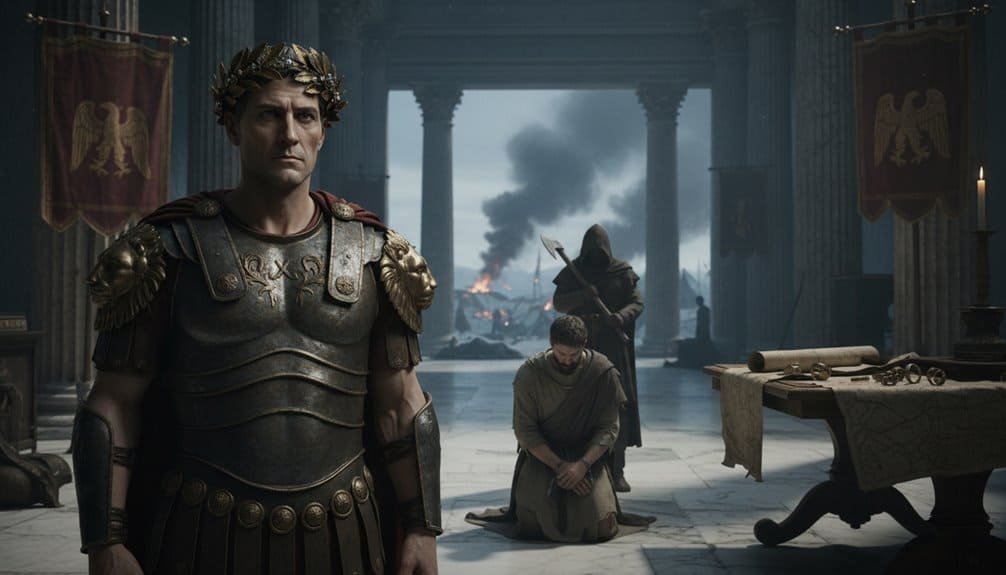
While Claudius II‘s military campaigns had restored Roman momentum against external threats, his sudden death from the Plague of Cyprian in January 270 AD plunged the empire back into the political chaos that had characterized the Third Century Crisis. The plague origins traced back to 249 AD, creating devastating mortality rates among military personnel and weakening Rome’s defensive capabilities during this critical period.
You’ll find that Claudius’s death after just 17 months triggered immediate succession disputes. His brother Quintillus briefly claimed imperial power with Senate support, ruling between 17-77 days before rival Danubian forces proclaimed Aurelian emperor. Political intrigue intensified as Quintillus faced military opposition, ultimately dying by suicide or assassination by his own troops.
Aurelian’s emergence from this crisis proved decisive. He systematically reunified the empire by crushing the breakaway Gallic and Palmyrene territories, ending the major territorial fragmentations by 274 AD.
Frequently Asked Questions
Did Claudius II Really Order the Execution of Saint Valentine?
You’ll find conflicting evidence about Claudius II’s execution of Valentine. While sources firmly establish February 14, 269 AD as Valentine’s martyrdom date, Claudius II’s documented persecution of Christians remains questionable. The accounts you’re examining come from later compilations like *Legenda Aurea*, raising apocryphal concerns. Archaeological evidence confirms Christian martyrdoms occurred during this period, but you can’t definitively verify Claudius personally ordered Valentine’s specific execution.
What Was Claudius Ii’s Policy on Marriage and Military Service?
You’ll find that Claudius II implemented sweeping imperial marriage policies that banned matrimony for young Roman men to boost military recruitment. These romantic bureaucracies reflected his belief that unmarried soldiers fought more effectively without familial distractions. He theorized that men without wives and children wouldn’t hesitate during combat deployment. This authoritarian policy prioritized state military needs over citizens’ personal rights, creating the circumstances that led to Valentine’s defiant resistance.
How Did Claudius II Treat Christians During His Reign?
You’ll find current historical sources show Claudius II pursued intermittent Christian persecution rather than systematic campaigns. Reliability debates surround specific martyrdom accounts, though evidence confirms anti-Christian legislation existed. You can see enforcement varied by local authorities’ discretion, with clergy facing execution for violating worship prohibitions. Roman military policy intersected with religious suppression, as Christians were viewed as abandoning traditional Roman practices essential to state loyalty.
What Evidence Exists Linking Claudius II to Valentine’s Martyrdom?
You’ll find limited historical evidence directly linking Claudius II to Valentine’s martyrdom. While multiple Valentine legends consistently place the execution during Claudius II’s reign around 269-270, scholars note there’s no documented Christian persecution under this emperor.
The hagiographic accounts that connect Claudius II to Valentine’s death are late-dating sources with legendary elements, making the historical connection questionable despite archaeological evidence supporting Valentine’s existence.
Why Did Claudius II Supposedly Ban Soldiers From Marrying?
You’ll find that Claudius II’s decision to ban marriage stemmed from military pragmatism rather than cruelty. He believed unmarried soldiers demonstrated superior combat effectiveness and loyalty compared to married men who prioritized family obligations. The emperor observed that married men actively avoided enlisting for military service, creating recruitment shortages during critical wartime periods. This authoritarian policy aimed to eliminate emotional distractions and strengthen Rome’s defensive capabilities against multiple invasion threats.
Conclusion
You’ve seen how Claudius II transformed from cavalry commander to savior of Rome’s northern frontiers. You’ve witnessed his decisive victory at Naissus that broke Gothic power and his systematic campaigns that restored imperial territories. You’ve observed how plague, not battlefield defeat, ended his reign in 270 AD. You’ll recognize that Claudius II’s military achievements weren’t enough to prevent the succession crisis that followed his unexpected death.












No Comments