


14 Nov Christmas Bible Verses From the King James Version
When you explore Christmas verses in the King James Version, you’ll discover Isaiah’s prophecy of a virgin bearing Immanuel, Gabriel’s announcement to Mary declaring “thou art highly favoured,” and Joseph’s angelic dream confirming Christ’s divine conception. You’ll witness shepherds receiving “good tidings of great joy,” wise men following the star with precious gifts, and Simeon’s temple blessing recognizing God’s salvation. These sacred passages reveal how God’s greatest gift—eternal life through His Son—transforms history through divine grace and sovereign purpose.
Key Takeaways
- Isaiah 7:14 prophesies a virgin shall conceive and bear a son called Immanuel, written 700 years before Christ.
- Luke 1:26-38 records Gabriel announcing to Mary she will conceive by the Holy Spirit and bear the Son of God.
- Luke 2:10 contains the angel’s announcement to shepherds of “good tidings of great joy” for all people.
- Matthew 2:13 shows God’s protection through angelic warning to Joseph to flee into Egypt with Mary and Jesus.
- First John 5:11 declares “God hath given to us eternal life, and this life is in his Son.”
The Prophecy of Christ’s Birth in Isaiah

When you open the book of Isaiah, you’ll discover remarkable prophecies written over 700 years before Christ’s birth that paint a vivid picture of the coming Messiah.
Isaiah 7:14 declares, “Therefore the Lord himself shall give you a sign; Behold, a virgin shall conceive, and bear a son, and shall call his name Immanuel.” This virgin prophecy stands as one of Scripture’s most profound revelations about Christ’s miraculous entry into our world.
You’ll find powerful Messianic imagery throughout Isaiah’s writings.
Chapter 9:6 proclaims, “For unto us a child is born, unto us a son is given: and the government shall be upon his shoulder.” Isaiah doesn’t merely predict an ordinary birth—he unveils divine mystery.
The prophet describes a child who’ll be called “Wonderful, Counsellor, The mighty God, The everlasting Father, The Prince of Peace.” These ancient words affirm that Christmas celebrates God’s ultimate gift to humanity.
The Angel’s Announcement to Mary
When you read Luke 1:26-38, you’ll encounter one of Scripture’s most profound moments as the angel Gabriel appears to a young virgin named Mary with news that would change history forever.
Gabriel’s divine message—that she’d conceive by the Holy Spirit and bear the Son of God—must have overwhelmed Mary’s heart, yet her response reveals extraordinary faith: “Behold the handmaid of the Lord; be it unto me according to thy word.”
In Mary’s humble submission to God’s will, you’re witnessing the beautiful intersection of heaven’s plan and human obedience that made the incarnation possible.
Gabriel’s Divine Message
Before any earthly sign revealed the coming Messiah, God sent the angel Gabriel to a virgin named Mary in Nazareth with history’s most transformative announcement. You’ll discover profound messenger symbolism in Gabriel’s appearance—God’s chosen herald bridging heaven and earth. The KJV captures this moment’s ethereal imagery: “Hail, thou that art highly favoured, the Lord is with thee” (Luke 1:28).
When you read Mary’s initial fear, you’re witnessing humanity’s natural response to divine encounter. Gabriel’s reassurance, “Fear not, Mary,” becomes God’s tender invitation to participate in redemption’s plan. The angel’s declaration that “with God nothing shall be impossible” isn’t mere comfort—it’s the foundation of your faith.
Through Gabriel’s message, you see God’s pattern: He chooses the humble, speaks personally, and transforms ordinary lives into extraordinary testimonies.
Mary’s Faithful Response
Though heaven’s messenger had delivered the most astounding news ever spoken to mortal ears, Mary’s response reveals a faith that transcends human understanding. You’ll find in Luke 1:38 her remarkable words: “Behold the handmaid of the Lord; be it unto me according to thy word.” Here stands humble obedience personified—a young woman accepting God’s extraordinary plan without demanding guarantees or seeking escape routes.
Consider Mary’s courageous faith. She didn’t request time to think, didn’t negotiate terms, didn’t list her inadequacies. Instead, she surrendered completely to divine purpose, knowing full well the social consequences she’d face. You’re witnessing trust that doesn’t calculate risks but rests in God’s sovereignty. Mary’s “yes” changed history, demonstrating that God accomplishes His greatest works through willing servants who embrace His will above their own.
Joseph’s Dream and Divine Reassurance
Through this dream interpretation, you’ll discover how God provided paternal reassurance to a righteous man facing an impossible situation.
The angel addressed Joseph’s deepest fears, commanding him not to be afraid to take Mary as his wife.
You’re witnessing divine comfort that transformed Joseph from a confused carpenter into the earthly guardian of the Messiah.
God didn’t leave Joseph to navigate this mystery alone. Instead, He offered clarity about the Holy Spirit’s work and revealed the sacred purpose of this miraculous conception—salvation for all people.
The Journey to Bethlehem and Christ’s Birth
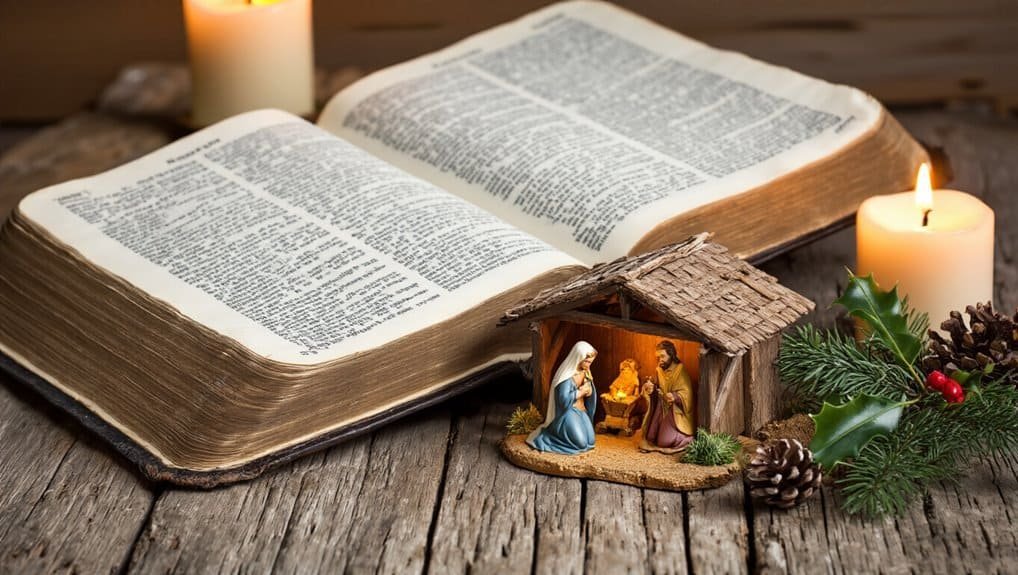
While Caesar Augustus decreed that all the world should be taxed, God orchestrated history’s most profound moment through an empire’s bureaucracy. You’ll find divine providence in Luke 2:1-7, where the census decree compelled Joseph and Mary’s journey from Nazareth to Bethlehem. They weren’t alone—countless families traversed the same caravan routes, fulfilling ancient prophecy without knowing it.
Picture Mary, heavy with child, traveling roughly ninety miles through rugged terrain. You’d have seen merchants, soldiers, and pilgrims crowding the dusty paths toward David’s city. When they arrived, Bethlehem overflowed with travelers seeking shelter. There wasn’t room in the inn, but God had prepared a humble birthplace.
In that lowly stable, Christ entered our world. You’ll discover heaven’s glory wrapped in swaddling clothes, lying in a manger. The Word became flesh, dwelling among us. What seemed like political inconvenience became God’s perfect timing—Micah’s prophecy fulfilled through Rome’s taxation.
The Shepherds and the Heavenly Host
Breaking through the darkness of that holy night, an angel of the Lord appeared to shepherds keeping watch over their flocks in the fields near Bethlehem. You can imagine their terror as God’s glory shone round about them. Yet the angel’s message wasn’t judgment but joy: “Fear not: for, behold, I bring you good tidings of great joy, which shall be to all people” (Luke 2:10).
These humble shepherds, engaged in their nightwatch reflections, became the first to hear heaven’s announcement. Suddenly, an angelic choir filled the sky, praising God and declaring, “Glory to God in the highest, and on earth peace, good will toward men” (Luke 2:14).
When the heavenly host departed, the shepherds didn’t hesitate. They hurried to Bethlehem, found Mary, Joseph, and the baby lying in a manger, and glorified God for all they’d witnessed. You’re called to share their wonder and proclaim Christ’s birth with equal joy.
The Visit of the Wise Men
You’ll notice God’s providence as the star guided them from Jerusalem to Bethlehem, stopping precisely over Christ’s location.
Their royal homage demonstrated profound faith—they bowed before a child in humble surroundings, acknowledging Him as King.
The secret gifts they presented held deep meaning: gold honoring His kingship, frankincense recognizing His deity, and myrrh foreshadowing His sacrificial death.
Through divine warning, they departed another way, protecting Jesus from Herod’s murderous plot.
Simeon’s Blessing in the Temple
When Mary and Joseph brought the infant Jesus to the temple for His presentation, they encountered Simeon, a righteous man who’d waited faithfully for Israel’s consolation. The Holy Ghost had revealed to this elderly witness that he wouldn’t die before seeing the Lord’s Christ. You can imagine his overwhelming joy during this temple encounter when he finally held the promised Messiah.
Taking Jesus in his arms, Simeon’s joyful declaration rang out: “Lord, now lettest thou thy servant depart in peace, according to thy word: For mine eyes have seen thy salvation” (Luke 2:29-30). His words confirmed the prophetic fulfillment of God’s ancient promises. He blessed Mary and Joseph, then prophesied that Jesus would become “a light to lighten the Gentiles, and the glory of thy people Israel.”
Through Simeon’s testimony, you’re reminded that God keeps His promises and rewards patient faith with divine revelation.
The Flight to Egypt and Return
Shortly after these sacred encounters in the temple, Joseph received an urgent warning that would test his faith and obedience. An angel appeared to him in a dream, commanding immediate action: “Arise, and take the young child and his mother, and flee into Egypt” (Matthew 2:13). You’ll notice Joseph didn’t hesitate or question God’s directive. He arose that very night, gathering Mary and Jesus for their Egypt escape from Herod’s murderous plot.
This flight wasn’t merely about physical survival—it fulfilled ancient prophecy: “Out of Egypt have I called my son” (Hosea 11:1). You’re witnessing God’s sovereign protection over His promised Messiah. When Herod died, Joseph’s return obedience proved equally swift. The angel’s instruction brought them back to Israel, though they settled in Nazareth rather than Bethlehem. Through Joseph’s faithful responses, you see how God orchestrates even persecution and exile to accomplish His redemptive purposes for mankind.
Scripture Verses About God’s Gift of Salvation

Christmas reveals God’s greatest gift to you—salvation through Jesus Christ, offered freely by His grace.
You’ll discover in these verses that eternal life isn’t earned through your works but received as an undeserved gift from a loving Father who sent His Son for your redemption.
These scriptures illuminate the heart of Christmas: God’s grace extended to you through Christ’s birth, life, death, and resurrection.
Eternal Life Through Christ
Your faith union with Christ secures what no earthly treasure can provide.
First John 5:11 affirms, “And this is the record, that God hath given to us eternal life, and this life is in his Son.”
You don’t earn this gift through works; it’s freely given through grace, purchased by Christ’s sacrifice.
Grace Freely Given
Grace stands as heaven’s most profound mystery—God’s unmerited favor extended to you despite your unworthiness. You can’t earn it through righteous deeds or purchase it with earthly treasures. This divine generosity flows from God’s heart directly to yours, transforming everything it touches.
At Christmas, you witness grace incarnate—the Word becoming flesh, dwelling among us. Christ didn’t come because you deserved rescue but because God’s love compelled Him. You’ve received what you couldn’t achieve: righteousness, peace, and eternal fellowship with the Father.
This gift cost heaven everything yet demands nothing from you except faith. You’re invited to rest in this truth: salvation isn’t your accomplishment but God’s completed work. His grace sufficient, His mercy inexhaustible.
Frequently Asked Questions
Why Does the King James Version Use “Virgin” Instead of “Young Woman”?
You’ll find the King James Version uses “virgin” in Isaiah 7:14 because its translators followed the Greek Septuagint’s rendering of the Hebrew word “almah.”
While Hebrew usage of “almah” can mean “young woman,” the Septuagint translated it as “parthenos” (virgin). The KJV translators believed this Mary translation best conveyed the miraculous nature of Christ’s birth, seeing Isaiah’s prophecy as divinely fulfilled through the Virgin Mary’s conception.
What Are the Differences Between Matthew and Luke’s Christmas Accounts?
You’ll find Matthew and Luke present distinct birth narratives with unique theological emphases. Matthew’s genealogical emphasis traces Jesus through David’s royal line, while Luke connects Him to Adam.
Their nativity perspectives differ remarkably—Matthew focuses on Joseph’s dreams and the Magi’s visit, whereas Luke highlights Mary’s experience and shepherds. Notice how angelic announcements appear differently: Gabriel speaks to Mary in Luke, while Matthew’s angel visits Joseph in dreams.
How Do I Memorize Christmas Bible Verses Effectively?
You’ll memorize Christmas verses most effectively through active recall and spaced repetition. Start by reading the verse aloud three times, then cover it and recite from memory.
Write it out by hand, checking for accuracy. Review the verse daily for a week, then every few days.
God’s Word takes root deeply when you’re actively engaging with it rather than passively reading. Let these sacred texts transform your heart through consistent, prayerful practice.
Which Christmas Traditions Come From the Bible Versus Church Tradition?
You’ll find the Bible directly describes Christ’s birth, the shepherds, wise men, and angelic announcement.
However, Nativity reenactments developed through church tradition to help you visualize these sacred events. Advent calendars aren’t biblical but arose from nineteenth-century German Christians counting days until Christmas.
While Scripture doesn’t prescribe December 25th or Christmas trees, these traditions help you prepare your heart to celebrate God’s greatest gift—His Son’s incarnation.
Are There Christmas Verses in Books Besides Matthew and Luke?
Yes, you’ll find Christmas-related verses throughout Scripture beyond Matthew and Luke’s nativity accounts. Isaiah’s prophetic promises foretell Christ’s virgin birth and His names: Wonderful, Counselor, Prince of Peace.
Micah pinpoints Bethlehem as His birthplace. While angels’ announcements appear primarily in Luke, John’s Gospel presents the Word becoming flesh. Galatians speaks of God sending His Son “in the fullness of time.” These passages deepen your understanding of Christmas’s theological significance.
Conclusion
As you’ve journeyed through these sacred passages from the King James Version, you’ve witnessed God’s magnificent plan unfold—from ancient prophecy to glorious fulfillment. These verses aren’t mere history; they’re your inheritance as a believer. Christ’s birth reveals the Father’s boundless love for you personally. This Christmas, let these timeless scriptures draw you deeper into worship, filling your heart with wonder at the mystery of Emmanuel—God with us, God with you.







No Comments