


15 Dec Christian Quiz 50 Bible Trivia Questions With Answers
You’ll discover essential biblical truths through these carefully selected trivia questions covering Scripture’s foundational narratives. From Adam’s creation from dust and placement in Eden’s garden to Cain’s tragic murder of Abel, these questions test your knowledge of humanity’s earliest history. You’ll explore Noah’s forty-day deluge, God’s covenant promises, and New Testament teachings that shaped Christian doctrine. Each question reinforces theological precision while strengthening your scriptural foundation through active engagement with God’s Word, preparing you for deeper spiritual insights ahead.
Table of Contents
Key Takeaways
- God formed Adam from dust on the sixth day and placed him in Eden to tend the garden.
- The Garden of Eden was located in Mesopotamia with four rivers, representing perfect communion between God and humanity.
- Cain murdered his brother Abel out of jealousy, becoming humanity’s first murderer and establishing the pattern of sin.
- Noah’s flood lasted over a year total, though rain fell for only forty days and nights initially.
- God marked Cain as a wanderer but mercifully protected him from vengeance despite his unrepentant defiance.
Who Was the First Man Created by God?

According to the biblical account in Genesis 2:7, God formed the first man, Adam, from the dust of the ground and breathed into his nostrils the breath of life, making him a living soul. The creation of Adam represents humanity’s unique position in God’s creation, distinguished from animals by receiving the divine breath directly from the Creator.
The creation of Adam occurred on the sixth day of creation week, after which God placed him in the Garden of Eden to tend and keep it. This placement established Adam’s role as steward over creation.
The biblical narrative presents Adam as both literally the first human and theologically representative of all humanity. His creation preceded Eve’s formation from his rib, establishing the foundation for marriage and human relationships within God’s perfect design.
You’ll find Adam’s name derives from the Hebrew word “adamah,” meaning ground or earth, emphasizing his earthly origin.
What Was the Name of the Garden Where Adam and Eve Lived?
You’ll find the answer to this fundamental question in Genesis 2:8, where Scripture identifies the Garden of Eden as the first dwelling place God prepared for humanity. This paradise served as mankind’s original home before sin entered the world, representing a state of perfect communion between God and His creation.
The Garden of Eden’s location remains one of biblical scholarship’s most discussed topics, with the text providing geographical clues through its mention of four rivers flowing from this primordial sanctuary.
Garden of Eden Location
Where exactly did God place the first humans according to Scripture? Genesis 2:8 states that “the Lord God planted a garden eastward in Eden; and there he put the man whom he’d formed.” This garden location was specifically “eastward in Eden,” indicating Eden was a larger region containing the garden.
The text provides geographical markers for eden’s boundaries in Genesis 2:10-14, describing four rivers: Pishon, Gihon, Hiddekel (Tigris), and Euphrates. These rivers flowed from Eden to water the garden before dividing into separate streams. While scholars debate the exact location, the biblical account places it in Mesopotamia, likely in modern-day Iraq or surrounding areas.
You’ll find that Scripture emphasizes the garden’s divine origin rather than precise geographical coordinates.
Paradise Before the Fall
You’ll find this pristine paradise described in Genesis as humanity’s original dwelling place, where God’s eternal presence was manifested directly. The text indicates Eden wasn’t merely a geographical location but represented perfect communion between Creator and creation.
Before sin’s entrance, this environment provided everything necessary for human flourishing—abundant food, meaningful work, and unbroken fellowship with God. The garden’s eastern placement and specific rivers mentioned in Scripture suggest actual geographical reality while symbolizing spiritual perfection that existed before the Fall corrupted creation’s original design.
First Human Home
According to Genesis 2:8, God planted a garden in Eden, eastward, where He placed the first humans Adam and Eve. This first human home represented perfect divine provision and fellowship. The Hebrew word “Eden” means “delight” or “pleasure,” reflecting paradise’s blissful nature before sin’s entrance.
The garden wasn’t merely Adam and Eve’s dwelling place—it was God’s special sanctuary where He walked with humanity in perfect communion, establishing the pattern for divine-human relationship.
You’ll find scholars debating the location of Eden throughout history. Genesis 2:10-14 describes four rivers flowing from Eden: Pishon, Gihon, Tigris, and Euphrates. While the Tigris and Euphrates remain identifiable, the other two rivers’ locations spark theological discussion. Some propose Mesopotamian origins, while others suggest the geography changed after Noah’s flood.
Which Son of Adam and Eve Killed His Brother?
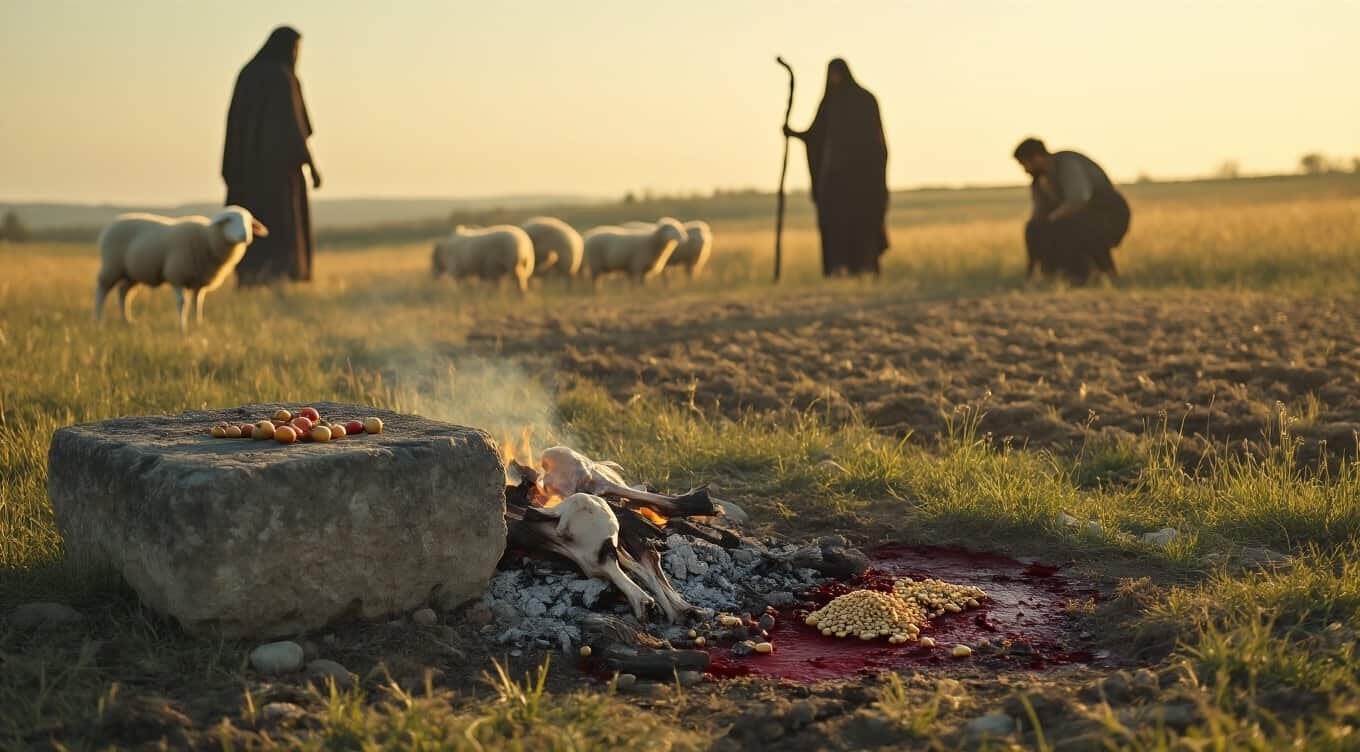
You’ll find that Cain, Adam and Eve’s firstborn son, murdered his younger brother Abel in what Scripture records as humanity’s first act of homicide. This tragic event stemmed from Cain’s jealousy when God accepted Abel’s offering but rejected his own, leading to anger that consumed him despite God’s warning about sin crouching at his door.
The Lord’s subsequent punishment involved marking Cain as a wanderer and fugitive, yet mercifully protecting him from vengeance while banishing him from His presence.
Cain’s Jealousy and Anger
When jealousy consumed Cain’s heart, he became the first murderer in human history by killing his younger brother Abel. You’ll find this tragic account in Genesis 4, where God’s acceptance of Abel’s offering but rejection of Cain’s sacrifice sparked devastating envy.
Cain’s rejection by God wasn’t arbitrary—Abel offered his best firstborn animals while Cain gave ordinary produce without the proper heart attitude.
Despite God’s warning that sin crouched at his door like a predator, Cain chose rebellion over repentance. His jealousy transformed into Cain’s murderous rage when he lured Abel into the field and struck him down. This pivotal moment introduced death through human violence into creation, establishing a pattern of sin’s destructive power that would plague humanity throughout Scripture.
The First Murder
After God confronted Cain about his bitter countenance, the eldest son of Adam and Eve made the fateful choice that would forever alter human history. Despite divine warning that sin crouched at his door, Cain’s sinful heart embraced murderous intent.
He lured his righteous brother Abel into the field, where he committed humanity’s first homicide. This tragic event represents the first sibling rivalry escalating to its ultimate conclusion. You’ll find in Genesis 4:8 that Cain “rose up against Abel his brother and killed him.” This premeditated act introduced death through violence into God’s creation.
When confronted afterward, Cain’s defiant response—”Am I my brother’s keeper?”—revealed his unrepentant spirit and established the pattern of human rebellion against divine authority.
God’s Punishment for Cain
God’s response to Cain’s heinous act demonstrates divine justice tempered with mercy. When you examine Cain’s punishment, you’ll discover God’s judgement wasn’t simply retributive but redemptive.
The Lord cursed Cain from the ground that had received Abel’s blood, declaring the earth would no longer yield its strength for him. He’d become a fugitive and wanderer upon the earth. Yet God’s mercy accompanied this severe sentence. When Cain feared others would kill him, God placed a protective mark upon him, warning that anyone who slew Cain would face sevenfold vengeance. This divine mark prevented Cain’s immediate execution while ensuring his continued exile.
God’s judgement thus balanced accountability with grace, demonstrating that even murderers can receive divine protection while bearing consequences for their sins.
How Many Days and Nights Did It Rain During Noah’s Flood?
Many Christians can readily recall that Noah’s flood lasted forty days and forty nights, yet this familiar answer requires careful examination of the biblical text. According to Genesis 7:12, rain indeed fell for exactly forty days and nights during this catastrophic divine judgment. However, you must distinguish between the rainfall duration and the total flood period.
The complete flood duration extended far beyond forty days. Genesis 7:24 states the waters prevailed upon the earth for 150 days. The ark didn’t rest on Ararat’s mountains until the seventh month, and Noah didn’t disembark until over a year later.
This distinction matters because it demonstrates God’s thoroughness in executing divine judgment while showing His mercy in preserving Noah’s family. You’ll find that understanding these biblical details enhances your comprehension of God’s justice and grace working together throughout Scripture’s foundational narratives.
What Sign Did God Give Noah as a Promise Never to Flood the Earth Again?

After the floodwaters receded and Noah offered sacrifices to the Lord, God established His covenant with humanity through a magnificent visual sign that would endure throughout all generations. You’ll find in Genesis 9:13 that God set His rainbow in the clouds as an eternal token of His promise never again to destroy the earth by flood.
This covenant sign represents God’s faithfulness and serves as a perpetual reminder that His mercy triumphs over judgment, demonstrating the divine commitment to preserve creation until His appointed time.
The Rainbow Covenant Sign
The rainbow stands as one of Scripture’s most recognizable covenant signs, representing God’s eternal promise to Noah and all humanity following the global flood. You’ll find this divine pledge recorded in Genesis 9:12-17, where God establishes His covenant using the rainbow as a perpetual reminder.
Unlike the ark of the covenant, which served as Israel’s sacred vessel, the rainbow appears universally in nature’s canvas. When you observe this meteorological phenomenon, you’re witnessing God’s faithfulness to His covenant promises.
The Hebrew word “qeshet” denotes both rainbow and bow, symbolizing God’s weapon of judgment set aside. This covenant remains unconditional and everlasting, demonstrating divine mercy over wrath for all generations.
God’s Eternal Promise Fulfilled
Every time you see a rainbow arcing across the sky, you’re witnessing God’s visible confirmation of His covenant promise to Noah that He’d never again destroy the earth by flood. This covenant demonstrates God’s righteous plan unfolding through history, revealing His mercy alongside His justice.
The rainbow serves as an enduring testament to divine faithfulness, reminding humanity that God keeps His promises across generations.
The Noahic covenant establishes fundamental principles for post-flood civilization while pointing toward ultimate redemption. Though God promised never again to destroy earth by flood, this doesn’t eliminate divine judgment entirely. Instead, it reveals God’s patience and grace, providing opportunity for repentance.
The rainbow ultimately symbolizes eternal hope in Christ, who fulfills all covenant promises and provides salvation from sin’s judgment through His sacrificial death and resurrection.
Who Was Called to Leave His Country and Go to the Land God Would Show Him?
When God issued His radical call to Abraham in Genesis 12:1, He commanded the patriarch to abandon everything familiar—his country, his people, and his father’s household—to journey toward an unspecified destination that would be revealed only through divine guidance.
This divine call represents one of Scripture’s most profound demonstrations of faith. You’ll notice that Abraham’s obedience preceded any detailed explanation of God’s promise. The Hebrew word “lech-lecha” literally means “go for yourself,” indicating both personal journey and divine purpose.
Abraham’s faith shines brightest when obedience precedes understanding—trusting God’s character over complete clarity.
Abraham’s response reveals the essence of biblical faith—trusting God’s character when you can’t see His complete plan. He left Ur of the Chaldeans around 2000 BC, embarking on what would become the foundational covenant relationship for all subsequent biblical history.
This call established the Abrahamic Covenant, through which God’s promise of blessing would ultimately reach all nations through Christ’s lineage.
What Did God Ask Abraham to Sacrifice on Mount Moriah?
God’s most devastating command to Abraham came years after the patriarch had received his promised son Isaac—He demanded that Abraham offer this beloved child as a burnt offering on Mount Moriah (Genesis 22:2). This divine directive represented the ultimate god’s test of faith, requiring Abraham to surrender the very promise through which God’s covenant would continue.
Abraham’s obedience was immediate and unwavering. He rose early, prepared the wood, and journeyed three days to the designated mountain. When Isaac questioned the absence of a sacrificial lamb, Abraham prophetically declared, “God will provide for himself the lamb” (Genesis 22:8).
As Abraham raised the knife, God’s angel intervened, providing a ram caught in nearby thickets. This pivotal moment demonstrated that God doesn’t desire human sacrifice but complete trust in His character. The account foreshadows God’s own sacrifice of His Son, establishing Mount Moriah’s significance in redemptive history.
Who Was Sold Into Slavery by His Brothers?
Among the twelve sons of Jacob, Joseph became the target of his brothers’ escalating jealousy and hatred, culminating in their decision to sell him into slavery rather than kill him outright. Joseph’s betrayal originated from his father’s favoritism, symbolized by the coat of many colors, and his prophetic dreams suggesting future authority over his siblings. This sibling rivalry intensified when Joseph reported his brothers’ misconduct to Jacob.
When you examine Genesis 37, you’ll find the brothers initially planned murder but Reuben intervened, suggesting they cast Joseph into a pit instead. However, when Midianite traders passed by, Judah proposed selling Joseph for twenty pieces of silver. The brothers deceived Jacob by presenting Joseph’s bloodied coat, claiming a wild beast had killed him. This pivotal moment demonstrates how God’s sovereignty operates through human sinfulness, as Joseph’s enslavement ultimately positioned him to preserve Israel during the coming famine.
What Were the Names of Joseph’s Two Sons?
You’ll find that Joseph, while serving as Egypt’s second-in-command, became father to two sons through his Egyptian wife Asenath. Manasseh, whose name means “causing to forget,” was born first, followed by Ephraim, meaning “fruitful.”
These sons would later become patriarchs of two of Israel’s most prominent tribes, fundamentally shaping the nation’s tribal structure and territorial inheritance.
Joseph’s Sons Named
The patriarch Joseph received two sons through his Egyptian wife Asenath during his years of prominence in Pharaoh’s court. These sons, born during Egypt’s seven years of abundance, would later become foundational to Israel’s tribal structure. The names of Joseph’s sons were Manasseh and Ephraim, recorded in Genesis 41:50-52.
The birth order of Joseph’s sons places Manasseh as the firstborn, followed by Ephraim. Joseph named Manasseh, meaning “God has made me forget all my trouble,” reflecting his gratitude for divine restoration. Ephraim, meaning “God has made me fruitful,” celebrated his prosperity in exile. You’ll notice these names reflect Joseph’s theological perspective, acknowledging God’s sovereignty despite his circumstances in foreign land.
Manasseh and Ephraim
Building upon this foundation, Manasseh and Ephraim occupy a unique position within Israel’s covenant history that extends far beyond their birth narrative. You’ll discover that Jacob’s prophetic blessing reversed birth order, granting the younger Ephraim prominence over his elder brother. This divine preference established Ephraim’s birthright as the leading tribe among Joseph’s descendants, ultimately producing Joshua and becoming synonymous with the northern kingdom of Israel.
Manasseh’s inheritance, though secondary in Jacob’s blessing, remained substantial. You’ll find both sons received full tribal status, effectively doubling Joseph’s portion among the twelve tribes. This adoption by Jacob elevated them from grandsons to sons, securing their permanent place within Israel’s covenant community. Their tribal territories in Canaan reflected this elevated status, with Ephraim receiving the more strategically advantageous central hill country.
Biblical Birth Order
When examining the chronological sequence of Joseph’s sons, Manasseh emerges as the firstborn, followed by his younger brother Ephraim. This biblical birth order holds profound significance in understanding Israel’s family lineage and God’s sovereign purposes.
Genesis 41:50-52 establishes this sequence, noting that both sons were born before the years of famine in Egypt.
You’ll discover that despite Manasseh’s birthright as firstborn, Jacob deliberately reversed the traditional blessing order in Genesis 48:13-20. When Joseph positioned his sons before his father, Jacob crossed his hands, placing his right hand upon Ephraim’s head and his left upon Manasseh’s. This prophetic act demonstrated God’s choice to elevate the younger son, establishing Ephraim’s future prominence among the tribes of Israel while maintaining proper recognition of the established family lineage.
Which Plague Was the Final One That Convinced Pharaoh to Let the Israelites Go?
After nine devastating plagues had struck Egypt, Pharaoh’s heart remained hardened against Moses’ repeated demands for Israel’s freedom. The tenth and final plague would break his stubborn resistance completely.
The plague devastation reached its climax when God struck down every firstborn son throughout Egypt, from Pharaoh’s heir to the firstborn of servants and livestock. This judgment passed over Israelite homes marked with lamb’s blood on their doorposts, demonstrating God’s protective covenant with His chosen people.
Unlike previous plagues that Pharaoh endured with defiance, this catastrophic loss shattered his resolve. The death angel’s work created such grief and terror that Pharaoh urgently summoned Moses and Aaron during the night, commanding them to leave immediately with all their people and possessions.
Pharaoh’s hardened heart finally yielded when confronted with the ultimate consequence of opposing God’s will. This final plague established the foundation for Passover, Israel’s most significant commemorative feast celebrating their deliverance from Egyptian bondage.
Who Led the Israelites Out of Egypt?
You’ll find that Moses stands as the central figure who led the Israelites out of Egyptian bondage, responding to God’s direct commissioning at the burning bush where the Lord revealed His sacred name “I AM WHO I AM” (Exodus 3:14).
His divine calling wasn’t merely a human appointment but represented God’s sovereign choice to use an initially reluctant shepherd who’d fled Egypt forty years earlier after killing an Egyptian taskmaster.
The Great Exodus that followed demonstrates how God’s faithfulness to His covenant promises with Abraham, Isaac, and Jacob culminated in the miraculous deliverance of approximately two million Israelites from four centuries of slavery.
Moses’ Divine Calling
Although Moses began life as a Hebrew infant condemned to death under Pharaoh’s oppressive decree, God orchestrated his preservation and placement within Egypt’s royal household to prepare him for Israel’s deliverance.
You’ll find Moses’ divine calling dramatically unfolds at the burning bush on Mount Horeb, where God appears as fire that doesn’t consume the foliage. This theophany marks the pivotal moment when Yahweh commissions Moses to confront Pharaoh and liberate His people. Despite Moses’ initial reluctance and protestations about his speaking abilities, God equips him with miraculous signs and Aaron as his spokesman.
The bush burning represents God’s holy presence and His covenant faithfulness to Abraham, Isaac, and Jacob. This divine calling transforms a reluctant shepherd into Israel’s greatest prophet and deliverer.
The Great Exodus
When Moses returned to Egypt with divine authority, he initiated the most spectacular deliverance in Old Testament history—the Exodus of approximately two million Israelites from four centuries of bondage.
You’ll discover that God systematically demonstrated His supremacy through the plagues of Egypt, each targeting specific Egyptian deities while progressively intensifying Pharaoh’s hardened heart. The tenth plague—death of the firstborn—finally broke Egyptian resistance, establishing the Passover as Israel’s foundational feast.
You’ll find that the crossing of the Red Sea represents the climactic miracle, where God parted waters to create dry passage for His people while destroying Pharaoh’s pursuing army. This pivotal event established Israel as God’s chosen nation and prefigured Christ’s redemptive work.
How Many Commandments Did God Give to Moses?
Most Christians immediately think of the Ten Commandments when asked about God’s laws given to Moses, but Scripture reveals a far more comprehensive legal framework. The covenant with Moses encompasses 613 commandments (mitzvot in Hebrew tradition), covering moral, ceremonial, and civil regulations that governed ancient Israel’s spiritual and societal life.
During Moses’ divine encounters on Mount Sinai, God delivered not only the famous Decalogue but also extensive legislation found throughout Exodus, Leviticus, Numbers, and Deuteronomy. These commandments addressed sacrificial systems, dietary laws, festivals, property rights, judicial procedures, and ethical conduct. You’ll discover that rabbinical scholars have meticulously catalogued 248 positive commands (“thou shalt”) and 365 prohibitive commands (“thou shalt not”).
While the Ten Commandments represent foundational moral principles, they’re merely the beginning of God’s comprehensive legal system. This broader understanding helps you appreciate the complexity of Old Testament law and Christ’s fulfillment of its requirements.
What Did the Israelites Worship While Moses Was on Mount Sinai?
Forty days into Moses’ absence on Mount Sinai, the Israelites succumbed to spiritual anxiety and constructed a golden calf to worship as their deity. You’ll find this pivotal moment recorded in Exodus 32, where Aaron facilitated the golden calf’s creation using donated jewelry. The people declared, “These are your gods, Israel, who brought you up out of Egypt!” This act of idol worship represented a catastrophic breach of the covenant they’d recently accepted.
The golden calf likely drew inspiration from Egyptian and Canaanite religious practices, where bull imagery symbolized strength and fertility. You should note that this wasn’t necessarily abandoning Yahweh entirely—many scholars suggest they may have viewed the calf as Yahweh’s representation or throne. However, God’s response was swift and severe. Moses’ intercession prevented Israel’s complete destruction, though consequences followed.
This incident demonstrates humanity’s tendency toward tangible religious expression and the dangers of compromising monotheistic worship with pagan elements.
How Many Years Did the Israelites Wander in the Wilderness?
You’ll find that the Israelites wandered in the wilderness for forty years according to biblical accounts in Numbers and Deuteronomy.
This prolonged journey resulted from their disobedience and lack of faith when they refused to enter the Promised Land after hearing the spies’ negative report.
The forty-year period carries profound spiritual significance that speaks to God’s discipline, patience, and faithfulness in preparing His people for their divine calling.
Biblical Account Details
When God delivered the Israelites from Egyptian bondage, He didn’t intend for their journey to the Promised Land to span four decades. You’ll find in Numbers 14:33-34 that their wilderness wandering resulted from disobedience and unbelief.
After the twelve spies returned from Canaan, ten gave fearful reports despite witnessing God’s miraculous provisions. Their lack of faith echoed humanity’s original rebellion in ancient biblical settings, where trust in God’s word was abandoned. The theological significance of Eden parallels this wilderness experience—both involved testing obedience and faith.
God decreed that generation would wander forty years, one year for each day the spies explored the land. Only Joshua and Caleb, who demonstrated unwavering faith, would enter the Promised Land alongside the next generation.
Reason For Wandering
Breaking down the biblical timeline reveals that the Israelites wandered precisely forty years in the wilderness—a period spanning from their exodus around 1446 BC to their entry into Canaan under Joshua’s leadership. You’ll discover the spiritual significance of this duration wasn’t arbitrary but divinely ordained.
Numbers 14:34 explicitly states God’s judgment: “After the number of the days in which ye searched the land, even forty days, each day for a year, shall ye bear your iniquities.” Their disobedience at Kadesh-barnea, when they refused to enter the promised land due to fear of the Canaanite giants, triggered this consequence.
Divine providence used this wilderness experience to purge the faithless generation and prepare their children for conquest. The forty-year period represents complete testing and transformation.
Spiritual Significance Today
Though the Israelites’ forty-year wilderness journey occurred millennia ago, modern believers can extract profound spiritual principles from this transformative period. You’ll discover that their wandering represents humanity’s spiritual pilgrimage between salvation and eternal glory.
The desert experience teaches crucial spiritual lessons about trusting God’s provision during seasons of uncertainty and testing. When you face prolonged difficulties, remember that God uses wilderness periods to refine character, deepen faith, and eliminate spiritual immaturity.
Biblical applications from this narrative include understanding that disobedience delays God’s promises, grumbling reveals heart attitudes, and divine discipline demonstrates His love. You can apply these truths by maintaining faith during trials, submitting to God’s timing, and viewing challenges as opportunities for spiritual growth rather than punishment.
Who Succeeded Moses as Leader of the Israelites?
How did God ensure continuity of leadership after Moses’ death? You’ll find the answer reveals divine wisdom in orchestrating seamless Biblical leadership transition. Joshua, son of Nun, served as the designated Successor to Moses, receiving both divine appointment and public commissioning.
Moses himself laid hands upon Joshua before the entire congregation, transferring leadership authority through God’s explicit command (Numbers 27:18-23). You’ll notice this wasn’t arbitrary selection—Joshua had proven himself as Moses’ military commander and faithful assistant for decades.
Joshua’s decades of faithful service as Moses’ military commander and assistant prepared him for divinely ordained leadership through formal commissioning.
The transition demonstrates God’s sovereignty in maintaining covenant promises despite human mortality. Joshua possessed the spiritual qualifications necessary: unwavering faith, military experience, and intimate knowledge of God’s law. When Moses died on Mount Nebo, Joshua seamlessly assumed leadership, ready to guide Israel into the Promised Land.
This succession pattern establishes biblical principles for leadership continuity that you’ll observe throughout Scripture, emphasizing divine calling, proper preparation, and formal recognition by the community.
What City’s Walls Fell Down After the Israelites Marched Around Them?
You’ll encounter one of Scripture’s most dramatic displays of divine power in the account of Jericho’s conquest, where God demonstrated His faithfulness to Israel through supernatural intervention. The city held profound strategic importance as the gateway to Canaan, making its fall essential for Israel’s successful occupation of the Promised Land.
Over seven days, the Israelites followed God’s specific instructions to march around Jericho’s fortified walls, culminating in their miraculous collapse through divine power rather than conventional warfare.
Jericho’s Biblical Significance
The ancient city of Jericho stands as one of Scripture’s most dramatic examples of divine intervention in warfare, where God demonstrated His power through the Israelites’ faithful obedience rather than conventional military strategy.
This biblical conquest marked a pivotal moment in the ancient israelite settlement of the Promised Land. You’ll find Jericho represents more than military victory—it symbolizes God’s faithfulness to His covenant promises. The city’s destruction established a pattern where Israel’s success depended entirely on following divine instructions rather than human wisdom.
Jericho’s fall demonstrated that no earthly fortress could withstand God’s will when His people acted in faith and obedience to His commands.
The Seven Day March
When Joshua received God’s unconventional battle strategy for Jericho, the divine instructions required Israel to march silently around the fortified city once daily for six consecutive days, followed by seven circuits on the seventh day accompanied by priestly trumpet blasts and a unified shout from the entire assembly.
You’ll notice these seven day marches represented biblical warfare tactics that defied human military logic. Rather than siege engines or battering rams, God commanded spiritual obedience through ritualistic procession. The ark of the covenant led Israel’s formation, symbolizing divine presence in battle.
This strategic pattern demonstrated that victory belonged to the Lord, not human strength. When Israel completed their final circuit and shouted collectively, Jericho’s walls collapsed supernaturally. You can see how God’s methods often contradict worldly wisdom, requiring faith over conventional approaches to achieve His purposes.
Which Judge Had Incredible Strength That Came From His Long Hair?
Among Israel’s most renowned judges, Samson possessed supernatural strength directly tied to his uncut hair, which symbolized his Nazirite vow to God. You’ll find his remarkable story recorded in Judges 13-16, where his mother received divine instructions before his birth regarding Samson’s Nazarite vow. This sacred commitment required him to abstain from wine, avoid contact with corpses, and never cut his hair.
Samson’s supernatural strength manifested in extraordinary feats: killing a lion barehanded, slaying thirty Philistines, and defeating a thousand men with a donkey’s jawbone. However, his relationship with Delilah led to his downfall. After persistent questioning, he revealed that his strength came from his uncut hair. While he slept, she’d his head shaved, breaking his covenant with God and removing his power. The Philistines captured him, gouged out his eyes, and imprisoned him. When his hair grew back, Samson’s strength returned, enabling him to destroy the Philistine temple.
Who Was the First King of Israel?
Saul, son of Kish from the tribe of Benjamin, became Israel’s first monarch around 1050 BCE. Despite initial reluctance from Samuel, who warned about kingship’s consequences, God directed the selection process.
Saul’s reign began promisingly—he stood head and shoulders above others and demonstrated early military success against the Ammonites.
However, Saul’s disobedience led to his eventual rejection by God. His failures set the stage for the united kingdom’s transition to David, establishing the Davidic dynasty that would define Israel’s monarchy.
This transformation from theocratic judges to human kingship fundamentally altered Israel’s governmental structure and spiritual relationship with God.
Who Killed Goliath With a Sling and Stone?
While King Saul’s reign faced mounting challenges, a young shepherd named David emerged as Israel’s unlikely hero during the Philistine crisis at the Valley of Elah. When the giant warrior Goliath of Gath taunted Israel’s army for forty days, demanding single combat, David volunteered to face him. You’ll find in 1 Samuel 17 that David rejected Saul’s armor, choosing instead his shepherd’s staff, five smooth stones, and a sling.
David’s victory over Goliath demonstrates God’s power working through faith rather than conventional military might. The young shepherd declared he came “in the name of the Lord of hosts” and struck Goliath’s forehead with a single stone, killing him instantly. This triumph wasn’t merely physical prowess but spiritual warfare.
Biblical accounts of David’s courage reveal his unwavering trust in God’s deliverance. His victory catalyzed Israel’s rout of the Philistine army and established David’s reputation throughout the kingdom.
How Many Wives Did King Solomon Have?
You’ll find that King Solomon maintained an extraordinary household of 700 wives and 300 concubines, totaling 1,000 women according to 1 Kings 11:3. These marriages served primarily as political alliances to secure diplomatic relationships with surrounding nations, reflecting ancient Near Eastern royal practices.
However, Scripture reveals that these foreign wives ultimately led Solomon’s heart away from exclusive devotion to Yahweh, resulting in divine judgment and the eventual division of his kingdom.
Solomon’s 700 Royal Wives
King Solomon’s marital arrangements stand as one of the most striking examples of political alliance-building and personal excess in biblical history. You’ll discover that Solomon’s 700 royal wives weren’t simply personal choices but strategic diplomatic marriages securing international treaties and trade agreements.
These unions violated God’s explicit commands against multiplying wives (Deuteronomy 17:17) and marrying foreign women who’d lead Israel astray.
The biblical reasons for recording this information demonstrate how even wisdom can’t substitute for obedience. Despite Solomon’s renowned intelligence, his marital wisdom failed catastrophically. These foreign wives introduced idol worship, dividing his heart from the Lord. 1 Kings 11:3-4 reveals that “his wives turned away his heart” in his old age.
You’re witnessing how political expediency corrupted spiritual faithfulness, ultimately contributing to Israel’s kingdom division.
300 Concubines Total Count
Beyond Solomon’s 700 royal wives, Scripture records an additional 300 concubines, bringing his total number of women to an astounding 1,000 (1 Kings 11:3). This unprecedented scale of concubinage frequency reflects ancient Near Eastern polygamous practices among royalty, where political alliances were cemented through marital arrangements.
Concubines held lower social status than wives but served similar diplomatic functions. You’ll notice Scripture presents these numbers matter-of-factly, emphasizing the magnitude of Solomon’s deviation from God’s design for marriage. The text doesn’t glorify these polygamous practices but documents historical reality.
This extraordinary household size demonstrates Solomon’s wealth, power, and ultimately his spiritual downfall, as these foreign women “turned his heart after other gods” (1 Kings 11:4).
Biblical Consequences Explained
Solomon’s massive polygamous household triggered severe divine judgment that fractured Israel permanently. You’ll discover that his foreign wives led him into idolatry, directly violating God’s covenant commands. His spiritual condition deteriorated as he built high places for pagan deities, effectively abandoning exclusive Yahweh worship.
Scripture records God’s anger burned against Solomon because his heart turned away from the Lord who’d appeared to him twice.
The consequences were catastrophic: God promised to tear the kingdom from Solomon’s lineage, leaving only one tribe for David’s sake. While divine forgiveness remained available through repentance, Solomon’s choices initiated Israel’s division into northern and southern kingdoms. His legacy demonstrates how personal compromise can produce generational judgment, affecting entire nations beyond individual consequences.
Which Prophet Was Taken up to Heaven in a Whirlwind?
The prophet Elijah stands as one of only two individuals in biblical history who bypassed physical death through divine translation to heaven. You’ll find this extraordinary event recorded in 2 Kings 2:11-12, where Elijah’s earthly ministry concludes with supernatural intervention.
As he walked with his successor Elisha, “a chariot of fire and horses of fire” suddenly appeared, separating the two prophets. Elijah’s fiery chariot then carried him heavenward in a whirlwind, demonstrating God’s power over natural law.
Divine intervention transcended earthly limitations as supernatural forces carried God’s faithful prophet beyond the natural realm in magnificent celestial transportation.
This prophetic vision witnessed by Elisha wasn’t merely symbolic—it represented God’s approval of Elijah’s faithful service. You’ll notice Elisha’s response included tearing his garments and crying “My father, my father!” The mantle that fell from Elijah became instrumental in confirming Elisha’s calling.
This miraculous translation prefigures the believer’s hope of transformation, illustrating that God can transcend death’s limitations for His chosen servants.
Who Was Thrown Into a Den of Lions?
Daniel’s unwavering commitment to prayer despite royal decree led to his miraculous preservation in Babylon’s lion den. You’ll find this dramatic account in Daniel chapter 6, where jealous administrators conspired against the Hebrew exile. King Darius, manipulated into signing an irrevocable law forbidding prayer to anyone except himself, reluctantly condemned Daniel when he continued his thrice-daily prayers toward Jerusalem.
Daniel’s unwavering faith remained steadfast even facing certain death. He understood that compromise with idolatrous decrees violated covenant obligations to Yahweh. When cast among hungry lions, God’s protection manifested through angelic intervention, shutting the predators’ mouths throughout the night.
Darius discovered Daniel unharmed at dawn, prompting the king’s decree acknowledging Israel’s God as the living deity who delivers His servants. You’ll notice this narrative demonstrates divine sovereignty over earthly powers and validates faithful obedience despite persecution. Daniel’s preservation foreshadows God’s ultimate deliverance of His covenant people through tribulation.
Which Prophet Was Swallowed by a Great Fish?
You’ll find that Jonah’s story begins with his deliberate disobedience to God’s command to preach repentance to Nineveh, leading him to flee by ship toward Tarshish instead.
When God sent a great storm, the sailors cast Jonah overboard, and the Lord appointed a great fish to swallow him for three days and three nights. Jonah’s prayer from within the fish’s belly demonstrates both his recognition of God’s sovereignty and his plea for deliverance, which God graciously granted.
Jonah’s Disobedient Mission
When God commanded Jonah to preach against the wickedness of Nineveh, the prophet fled in the opposite direction, boarding a ship bound for Tarshish in direct defiance of divine instruction. Jonah’s reluctance stemmed from his understanding of God’s merciful nature—he feared the Assyrians might repent and receive divine forgiveness rather than judgment. This Hebrew prophet’s disobedience illustrates humanity’s tendency to prioritize personal preferences over divine calling.
God’s persistence manifested through supernatural intervention: He sent a violent storm that threatened the vessel. When the sailors discovered Jonah’s rebellion through casting lots, they reluctantly threw him overboard at his own insistence. The great fish that swallowed Jonah served as both divine judgment and preservation, demonstrating God’s sovereignty over creation and His determination to accomplish His redemptive purposes despite human resistance.
Three Days Inside
Though Jonah’s confinement within the great fish lasted three days and three nights, this period represented far more than mere physical imprisonment—it constituted a profound spiritual transformation that would reshape the prophet’s understanding of divine mercy and mission.
You’ll discover that Jonah’s three day meditation within the creature’s belly parallels Christ’s own burial and resurrection timeline, establishing a prophetic type that Jesus himself referenced.
During this early spiritual awakening, Jonah composed his penitential psalm recorded in chapter two, demonstrating his renewed submission to God’s will.
You can observe how this miraculous preservation wasn’t punitive but redemptive—preparing Jonah for successful ministry to Nineveh. The fish becomes God’s instrument of grace rather than judgment, illustrating divine patience with reluctant servants.
Prayer and Deliverance
From the depths of his aquatic prison, Jonah’s desperate prayer represents one of Scripture’s most vivid demonstrations of how genuine repentance transforms crisis into deliverance.
You’ll find in Jonah 2:1-9 a profound theological framework for understanding God’s redemptive power. Jonah’s experience parallels your own spiritual struggles—whether you’re seeking deliverance from darkness or deliverance from addiction, his prayer reveals essential truths.
Notice how Jonah acknowledges God’s sovereignty, confesses his rebellion, and declares unwavering faith despite impossible circumstances. His prayer doesn’t manipulate God but submits to divine will. You can apply these principles: honest confession, recognition of God’s holiness, and steadfast trust.
Jonah’s deliverance came through surrender, not self-effort—a pattern Scripture consistently demonstrates for all believers facing overwhelming trials.
Who Was the Queen That Came to Test Solomon’s Wisdom?
Among Scripture’s most captivating diplomatic encounters stands the visit of the Queen of Sheba to King Solomon’s court, recorded in both 1 Kings 10:1-13 and 2 Chronicles 9:1-12. You’ll discover that this unnamed queen traveled from her distant kingdom—likely modern-day Ethiopia or Yemen—to personally examine Solomon’s legendary wisdom and wealth.
The queen’s visit wasn’t casual tourism but a strategic diplomatic mission. She’d heard reports of Solomon’s wisdom and came with “hard questions” to test his reputation. You’ll find that Solomon answered every inquiry, demonstrating God’s gift of unprecedented understanding. Her response reveals the profound impact: “The half wasn’t told me” (1 Kings 10:7).
Beyond testing Solomon’s wisdom, she brought substantial gifts including gold, spices, and precious stones. This exchange established important trade relationships and demonstrated how God’s blessing on Israel attracted international recognition, fulfilling His promise that all nations would be blessed through Abraham’s descendants.
What Was the Name of the Babylonian King Who Destroyed Jerusalem?
You’ll encounter Nebuchadnezzar II as the Babylonian monarch who orchestrated Jerusalem’s catastrophic destruction in 586 BCE, marking one of history’s most pivotal moments in Jewish exile. The biblical narrative across 2 Kings, 2 Chronicles, and Jeremiah provides detailed accounts of his systematic siege, temple demolition, and deportation of Judah’s population to Babylon.
Understanding Nebuchadnezzar’s reign from 605-562 BCE illuminates how God used this pagan ruler as His instrument of judgment against covenant-breaking Israel.
Nebuchadnezzar’s Historical Identity
When you encounter the name Nebuchadnezzar in biblical accounts, you’re reading about one of history’s most powerful and consequential rulers—Nebuchadnezzar II, who reigned over the Neo-Babylonian Empire from approximately 605 to 562 BC. Nebuchadnezzar’s military conquests extended far beyond Jerusalem, encompassing vast territories from Egypt to Persia. His systematic campaigns reshaped the ancient Near East’s political landscape permanently.
Nebuchadnezzar’s Babylonian empire represented the pinnacle of Mesopotamian civilization, featuring architectural marvels like the Hanging Gardens and the rebuilt Tower of Babel. Archaeological evidence confirms his extensive building projects and military campaigns documented in biblical texts. You’ll find his reign mentioned throughout Jeremiah, Ezekiel, and Daniel, where he’s portrayed as God’s instrument of judgment against Judah while simultaneously demonstrating divine sovereignty over earthly kingdoms.
Jerusalem’s Destruction Timeline
Nebuchadnezzar II orchestrated Jerusalem’s destruction through a carefully planned siege that lasted approximately eighteen months, from January 588 BC to July 586 BC according to biblical chronology. You’ll find this devastating campaign detailed in 2 Kings 25 and Jeremiah 52, where Scripture records the systematic dismantling of Judah’s capital.
The siege culminated when Babylonian forces breached Jerusalem’s walls on the ninth day of the fourth month. Jerusalem’s destruction wasn’t merely military conquest—it represented divine judgment upon covenant unfaithfulness. The temple’s destruction occurred one month later when Nebuzaradan, captain of the guard, burned Solomon’s temple along with the royal palace and prominent houses. You can trace this timeline through multiple biblical witnesses that confirm these precise chronological markers for this pivotal moment in salvation history.
Biblical Account Details
Scripture identifies Nebuchadnezzar II (also spelled Nebuchadrezzar) as the Babylonian monarch who orchestrated Jerusalem’s destruction in 586 BC. You’ll find his name mentioned throughout 2 Kings, Chronicles, Jeremiah, and Daniel. The biblical texts detail his eighteen-month siege that culminated in breaching Jerusalem’s walls, burning Solomon’s Temple, and deporting Judah’s population to Babylon.
Nebuchadnezzar’s campaigns devastated the land’s agricultural systems, affecting garden species diversity as cultivated areas were abandoned. The exile created profound environmental impacts when terraced vineyards and olive groves fell into disrepair.
Daniel presents him as God’s instrument of judgment, while Jeremiah prophesied his coming seventy years before restoration. You can trace his reign from approximately 605-562 BC, during which he established Babylon as the dominant Near Eastern power and fulfilled biblical prophecies regarding Judah’s punishment.
Who Rebuilt the Walls of Jerusalem After the Exile?
How did Jerusalem’s protective barriers rise again from rubble and ruin after decades of Babylonian destruction? You’ll find the answer in Nehemiah’s extraordinary leadership during the fifth century BC. When Nehemiah received devastating reports about Jerusalem’s broken walls and burned gates, he petitioned King Artaxerxes of Persia for permission to return and rebuild.
Nehemiah’s leadership proved instrumental in organizing the massive reconstruction project. He strategically assigned different groups to work on specific wall sections, creating accountability and efficiency. Despite fierce opposition from Sanballat, Tobiah, and other enemies who threatened military action, Nehemiah armed the workers and maintained constant vigilance.
The Israelites’ restoration culminated remarkably when they completed the entire wall in just fifty-two days. This achievement wasn’t merely architectural—it represented spiritual renewal and covenant faithfulness. Nehemiah’s combination of practical planning, persistent prayer, and unwavering determination demonstrates how God uses dedicated leaders to accomplish His purposes for His people’s restoration.
In Which City Was Jesus Born?
You’ll find Jesus’s birthplace clearly documented in the Gospels of Matthew and Luke, which both identify Bethlehem of Judea as the city where Christ was born. This wasn’t coincidental—Bethlehem’s selection fulfilled the messianic prophecy recorded in Micah 5:2, which declared that Israel’s ruler would come from this small town in Judah.
Understanding Bethlehem’s historical significance and prophetic importance provides crucial context for comprehending how Jesus’s birth location authenticated His identity as the promised Messiah.
Bethlehem: The Birthplace
The cultural impact of Bethlehem resonates throughout Christian tradition, making it Christianity’s most revered birthplace. Archaeological evidence supports first-century habitation, while the Church of the Nativity, built in 339 AD, marks the traditional site.
Bethlehem’s selection wasn’t coincidental; it demonstrates God’s sovereign plan unfolding through seemingly ordinary circumstances, transforming an obscure village into history’s most significant birthplace.
Biblical Historical Context
When examining the biblical accounts of Jesus’ birth, you’ll discover that both Matthew and Luke explicitly identify Bethlehem as the birthplace, yet each Gospel provides distinct historical frameworks that illuminate different aspects of this pivotal event.
Matthew’s narrative emphasizes fulfillment of Micah’s prophecy, connecting Jesus to David’s lineage through Bethlehem’s significance as the “City of David.” Luke’s account introduces the Roman census under Quirinius, providing crucial biblical historical details that explain Joseph and Mary’s journey from Nazareth.
The cultural context of biblical times reveals Bethlehem’s modest status—a small Judean town approximately six miles south of Jerusalem. This humble setting contrasts sharply with Roman imperial power, highlighting God’s sovereign choice to enter human history through ordinary circumstances rather than palatial grandeur, demonstrating divine humility.
Who Were Jesus’s Earthly Parents?
While most Christians can readily identify Mary as Jesus’s mother, understanding the full biblical account of Christ’s earthly parentage requires examining both the genealogical records and the unique circumstances of his virgin birth.
Joseph and Mary comprised the holy family that raised Jesus in Nazareth. Mary, a virgin from Nazareth, conceived Jesus through the Holy Spirit’s supernatural intervention (Luke 1:26-38).
Joseph, a righteous carpenter and descendant of David, initially planned to divorce Mary quietly upon learning of her pregnancy but received angelic confirmation to proceed with marriage (Matthew 1:18-25).
The genealogies in Matthew and Luke trace Jesus’s lineage through Joseph, establishing his legal right to David’s throne. Though not Jesus’s biological father, Joseph provided legitimate paternal authority and Davidic heritage.
Scripture emphasizes Jesus’s dual nature: divinely conceived yet raised within human family structures, fulfilling messianic prophecies requiring Davidic descent while maintaining his divine origin.
At What Age Did Jesus Begin His Public Ministry?
According to Luke’s Gospel, Jesus was approximately thirty years old when he began his public ministry (Luke 3:23). This timing holds profound theological significance, as thirty marked the traditional age when Levitical priests entered full temple service (Numbers 4:3). Jesus’ age at the start of ministry wasn’t coincidental but fulfilled divine timing.
Jesus’ baptism details reveal the formal inauguration of his public work. John the Baptist baptized Jesus in the Jordan River, where the Holy Spirit descended like a dove and the Father’s voice proclaimed, “This is my beloved Son” (Matthew 3:16-17). This trinitarian manifestation marked the transition from Jesus’ private life in Nazareth to his redemptive mission.
You’ll notice the Gospels provide limited information about Jesus’ life between ages twelve and thirty, often called the “silent years.” His public ministry, spanning approximately three years, began at this divinely appointed age when religious and cultural authority was recognized.
How Many Disciples Did Jesus Choose?
After establishing his ministry at age thirty, Jesus deliberately selected twelve apostles to form his inner circle of disciples. This wasn’t arbitrary—the number twelve held profound significance in Jewish tradition, representing the twelve tribes of Israel and symbolizing completeness in God’s covenant plan.
Jesus’ selection of twelve apostles wasn’t random—it deliberately echoed the twelve tribes of Israel, symbolizing God’s complete covenant plan.
You’ll find these twelve listed in Matthew 10:2-4, Mark 3:16-19, and Luke 6:13-16. They included Simon Peter, Andrew, James and John (sons of Zebedee), Philip, Bartholomew, Matthew, Thomas, James son of Alphaeus, Simon the Zealot, Judas son of James, and Judas Iscariot.
Christ’s inner circle received intensive training through direct observation of his ministry, private teachings, and hands-on evangelistic experience. They witnessed miracles, heard parables explained, and learned discipleship principles that would later shape the early church.
These twelve became the foundation stones of Christianity, carrying Christ’s message throughout the known world after his resurrection and ascension.
Who Baptized Jesus in the Jordan River?
You’ll find that John the Baptist, also known as John the Forerunner, baptized Jesus Christ in the Jordan River as recorded in all four Gospels.
This pivotal event demonstrates John’s divinely appointed role as the herald who prepared the way for the Messiah’s public ministry. The Jordan River’s historical significance as Israel’s boundary into the Promised Land provides profound theological symbolism for Christ’s entry into His redemptive mission.
John the Baptist’s Role
The pivotal moment when Jesus approached the Jordan River to be baptized by John the Baptist represents one of Christianity’s most theologically significant events, marking the formal beginning of Christ’s earthly ministry. John the Baptist’s role in preparing the way for Jesus fulfilled Old Testament prophecies, particularly Isaiah’s declaration about a voice crying in the wilderness. His ministry centered on John the Baptist’s message of repentance, calling people to turn from sin and prepare their hearts for the coming Messiah.
When Jesus requested baptism, John initially protested, recognizing Christ’s sinlessness. However, Jesus insisted it was necessary “to fulfill all righteousness” (Matthew 3:15). This baptism publicly identified Jesus with humanity’s need for salvation while demonstrating His submission to God’s will. The Trinity’s manifestation during this event—Father’s voice, Son’s presence, Spirit’s descent—affirmed Jesus’s divine identity and mission.
Jordan River Significance
Beyond its role as the baptismal site, you’ll discover that the Jordan River carries profound symbolic weight throughout Scripture, making it the perfect location for Christ’s baptism by John.
The Jordan river crossing under Joshua’s leadership marked Israel’s entrance into the Promised Land, establishing patterns of divine intervention and covenant fulfillment. When you examine the jordan river baptism of Jesus, you’re witnessing theological continuity—just as Israel crossed from wilderness into promise, Christ’s baptism represents humanity’s transition from spiritual death to life.
The river’s association with cleansing, prophetic ministry, and God’s miraculous power creates rich typological connections. Elijah and Elisha’s ministry centered here, reinforcing the Jordan’s significance as a place where heaven touches earth through divine revelation.
Biblical Account Details
All four Gospels identify John the Baptist as Christ’s baptizer, though each account contributes unique theological emphases to this pivotal moment. Matthew’s narrative highlights Jesus’s submission to “fulfill all righteousness,” demonstrating His obedience to divine will. Mark’s concise account emphasizes the Spirit’s immediate descent. Luke connects Jesus’s baptism to His messianic mission through genealogy. John’s Gospel focuses on the Baptist’s testimony regarding Christ’s identity.
You’ll notice that John initially protested, recognizing his unworthiness to baptize the sinless Son of God. Unlike humanity’s need for baptism due to sin’s consequences inherited from the pre fall garden, Jesus’s baptism wasn’t for cleansing but identification with sinful humanity and inauguration of His public ministry, fulfilling His redemptive purpose.
What Was Jesus’s First Miracle?
When studying Christ’s earthly ministry, you’ll discover that His first recorded miracle occurred at a wedding celebration in Cana of Galilee, where He transformed water into wine (John 2:1-11). This first public miracle demonstrates Jesus’s divine authority over creation’s natural elements while revealing His character of compassion and provision.
The narrative shows Jesus attending the celebration with His mother Mary and newly called disciples. When wine ran short, threatening social embarrassment for the hosts, Mary approached Jesus with the need. Initially hesitant, Jesus instructed servants to fill six stone water pots with water, then draw some out for the master of ceremonies to taste.
The water into wine transformation astonished witnesses, as the quality surpassed what was previously served. This miracle initiated Jesus’s public ministry, manifested His glory, and strengthened His disciples’ faith. The event foreshadows Christ’s sacrificial work and establishes His identity as God’s Son with power over natural laws.
Which Disciple Walked on Water With Jesus?
Among Christ’s twelve apostles, Peter stands as the sole disciple who walked on water alongside Jesus during the miraculous event recorded in Matthew 14:22-33, Mark 6:45-52, and John 6:16-21.
When the disciples encountered Jesus walking on the Sea of Galilee during a storm, Peter boldly requested permission to join Him on the water’s surface.
You’ll notice that Peter’s miraculous walking demonstrates both the power of faith and its limitations. Initially, the disciple’s faith enabled him to step out of the boat and walk toward Jesus. However, when Peter focused on the surrounding storm rather than Christ, fear overcame him, causing him to sink. Jesus immediately rescued Peter, gently rebuking him for his doubt.
This account illustrates that while Peter alone experienced miraculous walking on water among the disciples, it also reveals the essential connection between unwavering faith and supernatural manifestations in biblical narratives.
How Many Loaves and Fishes Did Jesus Use to Feed the 5,000?
You’ll find that Jesus used five barley loaves and two small fish to miraculously feed the multitude of five thousand men, plus women and children, as recorded in all four Gospels (Matthew 14:17-21, Mark 6:38-44, Luke 9:13-17, John 6:9-13).
This miraculous provision demonstrates Christ’s divine power over creation and His compassion for human need, while the twelve baskets of leftover fragments reveal God’s abundant grace that exceeds our requirements.
The account also prefigures the Eucharist and illustrates Jesus as the Bread of Life who satisfies spiritual hunger.
Biblical Account Details
Biblical scholars consistently examine the precise details recorded in Scripture regarding Christ’s miraculous feeding of the five thousand, particularly focusing on the specific quantities mentioned across the Gospel accounts. You’ll find that Matthew, Mark, Luke, and John all record five barley loaves and two small fish as the starting provisions.
The biblical geography places this miracle near Bethsaida, where the garden landscape provided a grassy area for the multitude to sit. Mark’s Gospel specifically mentions the “green grass,” indicating springtime during Passover season.
You should note that the original Greek text describes the fish as “opsarion,” meaning small preserved fish, likely pickled or dried. The twelve baskets of leftover fragments demonstrate God’s abundant provision beyond human calculation.
Spiritual Significance Explained
Beyond the historical details lies profound spiritual symbolism woven throughout Christ’s miraculous provision. The five loaves represent God’s grace transforming human inadequacy into divine abundance. Two fish symbolize faith’s multiplication—small offerings becoming extraordinary blessings when surrendered to Christ’s authority. You’ll discover the biblical significance of faith through the disciples’ initial doubt contrasted with Jesus’s unwavering confidence in heavenly provision.
The twelve baskets of leftovers aren’t coincidental; they represent Israel’s twelve tribes and complete restoration. This miracle demonstrates how God uses apparent scarcity to reveal His limitless power. Through spiritual growth through suffering, the disciples learned dependence upon divine intervention rather than human resources. Christ’s feeding ministry prefigures the Eucharist, where spiritual nourishment transcends physical hunger, establishing eternal covenant relationship between Creator and creation.
Who Betrayed Jesus for Thirty Pieces of Silver?
The infamous betrayal of Jesus Christ stands as one of Scripture’s most pivotal moments, executed by Judas Iscariot, one of the twelve apostles who walked closely with the Messiah for three years. This devastating act of treachery fulfilled ancient prophecy while demonstrating humanity’s capacity for moral failure even among Christ’s closest followers.
You’ll find this account primarily in Matthew 26:14-16, where Judas approaches the chief priests seeking payment for delivering Jesus. The agreed price of 30 pieces of silver represents approximately four months’ wages for a laborer, yet also fulfills Zechariah’s prophecy regarding the Messiah’s valuation. This betrayal enabled Jesus’s arrest in Gethsemane through Judas’s identifying kiss, marking the beginning of Christ’s passion.
The theological implications resonate throughout Christian doctrine, illustrating God’s sovereignty working through human sin to accomplish redemption. Judas’s subsequent remorse and suicide underscore the devastating consequences of rejecting divine grace, contrasting sharply with Peter’s repentance and restoration.
What Did Pilate Wash to Show He Was Innocent of Jesus’s Death?
Pontius Pilate carried out one of history’s most symbolically charged acts when he washed his hands before the crowd, declaring himself innocent of Jesus’s blood in Matthew 27:24. Pilate’s hand washing drew from Jewish ceremonial law, specifically Deuteronomy 21:6-8, where elders washed their hands over a heifer to declare innocence in unsolved murders. This dramatic gesture demonstrated Pilate’s understanding of Jewish customs while attempting to transfer responsibility for Jesus’s execution to the crowd.
Pilate’s public declaration, “I am innocent of this man’s blood; see to it yourselves,” revealed his recognition of Jesus’s innocence while simultaneously capitulating to political pressure. The Roman governor understood that condemning an innocent man contradicted justice, yet feared uprising more than moral compromise. This symbolic act couldn’t absolve him of responsibility, as he alone possessed the authority to execute or release Jesus. His hand washing ultimately became a futile attempt to escape culpability for history’s most significant crucifixion.
On Which Day of the Week Did Jesus Rise From the Dead?
When did Christianity’s most pivotal event occur? You’ll find the answer reveals fundamental theological significance that shaped Christian worship practices for millennia.
Jesus’ resurrection day occurred on Sunday, the first day of the week according to Jewish calendar reckoning. Matthew 28:1, Mark 16:2, Luke 24:1, and John 20:1 all testify that women discovered the empty tomb “on the first day of the week” at dawn.
This timing wasn’t coincidental. Sunday represents new creation’s beginning, contrasting Saturday’s Sabbath rest. Early Christians recognized this symbolism, gradually shifting their primary worship from Saturday to Sunday in commemoration of Christ’s victory over death.
The resurrection’s Sunday occurrence established what theologians call the “Lord’s Day” (Revelation 1:10). You’ll notice this pattern throughout church history—Sunday became Christianity’s distinctive worship day, differentiating it from Judaism’s Saturday observance. This weekly celebration reminds believers that Christ’s resurrection initiated God’s new covenant and eternal kingdom.
How Many Days After His Resurrection Did Jesus Ascend to Heaven?
Forty days elapsed between Christ’s resurrection and His ascension into heaven, as Luke explicitly records in Acts 1:3. During these crucial days after resurrection, Jesus appeared to His disciples multiple times, providing “convincing proofs” of His victory over death. You’ll find these appearances documented throughout the Gospels and Acts, where Christ ate with them, taught them, and commissioned them for ministry.
The forty-day period wasn’t arbitrary but served specific purposes. Jesus used this time to strengthen His followers’ faith, explain Old Testament prophecies concerning Himself, and prepare them for their apostolic mission. His ascension to heaven occurred on the Mount of Olives, witnessed by the eleven apostles who watched Him rise until a cloud received Him.
This timeline establishes critical doctrine: Christ’s bodily resurrection was real, His post-resurrection ministry was intentional, and His ascension marked the completion of His earthly work before beginning His heavenly intercession.
Who Replaced Judas as the Twelfth Apostle?
After Judas Iscariot’s betrayal and subsequent suicide, the remaining eleven apostles faced the crucial task of restoring their number to twelve, maintaining the symbolic completeness that Christ had established.
Acts 1:15-26 records this pivotal moment when Peter addressed the gathered believers about selecting Judas’s replacement.
The apostleship qualifications were clearly defined: the candidate must have accompanied Jesus throughout His earthly ministry, from John’s baptism until the ascension, and witnessed the resurrection. Two men met these criteria: Joseph called Barsabbas (also known as Justus) and Matthias.
Rather than making this decision themselves, the apostles prayed for divine guidance and cast lots, trusting God’s sovereign choice. The lot fell upon Matthias, who was immediately numbered among the twelve apostles. This selection restored the apostolic college to its complete number, ensuring continuity with Christ’s original establishment and preparing them for their Pentecost mission.
Which Apostle Was Known as the Apostle to the Gentiles?
You’ll find Paul’s divine appointment confirmed in Acts 9:15, where God declares him “a chosen vessel unto me, to bear my name before the Gentiles.” This calling distinguished Paul’s ministry from Peter’s, who focused on Jewish evangelism.
Paul’s missionary journeys across the Mediterranean world demonstrate his faithful execution of this commission. Through three major expeditions, he established churches throughout Asia Minor, Macedonia, and Achaia.
His epistles reveal deep theological understanding of Gentile inclusion in God’s covenant promises, explaining how non-Jews could receive salvation through faith in Christ.
On What Island Was Paul Shipwrecked?
When fierce winds and treacherous seas battered Paul’s prison ship during his voyage to Rome, the vessel ultimately ran aground on Malta, as recorded in Acts 28:1. You’ll find this Mediterranean island became the unexpected setting for Paul’s three-month ministry following the dramatic shipwreck described in Acts 27.
The storm’s aftermath revealed God’s providential care, as all 276 passengers and crew survived unharmed, fulfilling the angel’s promise to Paul. Malta’s inhabitants showed extraordinary kindness to the shipwrecked travelers, providing warmth and shelter during winter months.
During this unexpected stop in the apostle’s journey, Paul performed remarkable miracles, including healing the island’s chief official Publius and his father. These supernatural works opened doors for widespread evangelism among Malta’s population. You can see how God transformed what appeared to be a devastating setback into a strategic opportunity for gospel advancement, demonstrating His sovereignty over even the most challenging circumstances in Paul’s missionary travels.
How Many Books Are in the New Testament?
Twenty-seven distinct books comprise the New Testament canon, representing the foundational collection of Christian Scripture that emerged from first-century apostolic testimony. You’ll find this number of books consistently recognized across major Christian denominations, from Roman Catholic to Protestant traditions.
The canonical structure includes four Gospels documenting Christ’s earthly ministry, Acts recording the early church’s formation, twenty-one epistles providing doctrinal instruction, and Revelation presenting prophetic vision. Each biblical account contributes essential theological elements to Christianity’s doctrinal framework.
Historical canonization occurred through careful apostolic scrutiny, with church fathers evaluating authenticity, apostolic authorship, and doctrinal consistency. The Council of Carthage (397 AD) formally ratified these twenty-seven books, though widespread acceptance preceded official recognition.
You’re engaging with texts spanning approximately fifty years of composition, from Matthew’s Gospel (c. 50-60 AD) through John’s Revelation (c. 95 AD). This collection provides comprehensive coverage of Christian origins, theological foundations, practical discipleship guidance, and eschatological expectations.
Who Wrote the Most Books in the New Testament?
Why does the apostle Paul stand as the New Testament’s most prolific author? You’ll find his name attached to thirteen epistles, making him the most productive among new testament writers. Paul’s letters include Romans, 1 and 2 Corinthians, Galatians, Ephesians, Philippians, Colossians, 1 and 2 Thessalonians, 1 and 2 Timothy, Titus, and Philemon.
These writings constitute nearly half of the New Testament’s twenty-seven books. Paul’s extensive correspondence addressed crucial theological issues, church governance, and Christian living across diverse communities throughout the Roman Empire.
His letters demonstrate remarkable theological depth, covering justification by faith, spiritual gifts, church unity, and pastoral leadership.
While some scholars debate Pauline authorship of certain epistles, traditional attribution assigns these thirteen books to Paul. Among prolific authors in biblical literature, Paul’s contribution remains unmatched in the New Testament canon. His writings continue shaping Christian doctrine and practice across denominations worldwide, establishing foundational principles for believers throughout church history.
Which Apostle Was Exiled to the Island of Patmos?
The apostle John received his divine revelation while exiled on Patmos, a small rocky island in the Aegean Sea approximately sixty miles southwest of Ephesus. The Roman Empire commonly used this desolate location as a penal colony for political prisoners and religious dissidents. John’s exile occurred during Emperor Domitian’s reign (81-96 AD), when Christians faced severe persecution for refusing to worship Caesar as divine.
Revelation 1:9 confirms John’s presence on the island, where he states he was “on the island called Patmos because of the word of God and the testimony of Jesus.” The apostle’s exile wasn’t merely punitive—God used this isolation for prophetic purposes. During his imprisonment, John received the apocalyptic visions recorded in Revelation, Christianity’s final canonical book.
Patmos island measured only ten miles long and six miles wide, making it an effective prison. Yet this remote location became the setting for Scripture’s most detailed prophetic revelation about Christ’s return.
What Is the Shortest Verse in the Bible?
This verse’s brevity doesn’t diminish its theological significance. You’re witnessing Jesus’s complete identification with human grief, revealing His dual nature as fully God and fully man. The aorist tense indicates a momentary burst of tears rather than prolonged weeping.
Biblical record accuracy confirms this verse’s authenticity across ancient manuscripts. While other contenders exist—like 1 Chronicles 1:25 in some translations—John 11:35 consistently maintains its status. You shouldn’t mistake brevity for simplicity; this verse encapsulates Christianity’s central truth: God enters human suffering, experiencing our pain firsthand before demonstrating victory over death itself.
How Many Chapters Are in the Book of Psalms?
Moving from individual verses to entire books, Psalms contains exactly 150 chapters, making it the longest book in the Bible by chapter count. You’ll discover that each psalm functions as an individual composition, which explains why they’re numbered as separate chapters rather than verses within larger chapters.
Different psalm themes emerge throughout this collection: praise psalms (like Psalm 100), lament psalms (such as Psalm 22), wisdom psalms (including Psalm 1), and royal psalms (like Psalm 2). These thematic categories help you understand the varied purposes these ancient songs served in worship and personal devotion.
Psalm structure analysis reveals sophisticated Hebrew poetry techniques, including parallelism, chiasmus, and acrostic patterns. You’ll notice that many psalms follow specific structural frameworks: invocation, complaint, petition, expression of trust, and vow of praise. This systematic organization demonstrates the careful literary craftsmanship underlying what might initially appear as spontaneous emotional expressions in ancient Israel’s worship traditions.
Which Book Comes After Proverbs in the Old Testament?
After completing your study of Proverbs’ practical wisdom teachings, you’ll encounter Ecclesiastes as the next book in the Old Testament canonical order. This positioning isn’t coincidental—Ecclesiastes builds upon Proverbs’ wisdom foundation by examining life’s deeper philosophical questions about meaning and purpose.
Ecclesiastes, traditionally attributed to Solomon, presents a more contemplative approach to wisdom literature. While Proverbs offers straightforward guidance for righteous living, Ecclesiastes wrestles with life’s apparent contradictions and uncertainties. You’ll notice this thematic progression reflects the Old Testament canon’s careful arrangement of wisdom books.
The book’s Hebrew title “Qoheleth” means “gatherer” or “preacher,” emphasizing its role in collecting life’s observations. Though written before the Intertestamental period, Ecclesiastes addresses timeless human struggles that resonated throughout subsequent centuries. Understanding this sequential placement helps you appreciate how biblical wisdom literature develops from practical instruction toward profound existential reflection on humanity’s relationship with God.
What Does the Name “Emmanuel” Mean?
When you encounter the name “Emmanuel” in biblical texts, you’re discovering one of Scripture’s most profound theological declarations—”God with us.” This Hebrew name, transliterated as “Immanu El,” combines the preposition “immanu” (with us) and “El” (God), creating a powerful statement about divine presence among humanity.
The name “Emmanuel” means “God with us” and first appears in Isaiah 7:14 as a prophetic sign to King Ahaz. Matthew 1:23 explicitly connects this prophecy to Jesus Christ, interpreting the virgin birth as fulfillment of Isaiah’s declaration. While Jesus wasn’t commonly called Emmanuel during his earthly ministry, this title encapsulates Christianity’s central doctrine of the Incarnation.
You’ll find that Emmanuel represents more than mere proximity—it signifies God’s intimate involvement in human experience. Through Christ’s birth, life, death, and resurrection, believers understand that God doesn’t remain distant but actively participates in humanity’s struggles and triumphs, embodying divine compassion and redemptive love.
In Which Book Would You Find the Beatitudes?
You’ll find the Beatitudes in the Gospel of Matthew, specifically in Matthew 5:3-12, where they form the opening section of Jesus’ Sermon on the Mount. These eight declarations begin with “Blessed are…” and establish fundamental principles of Christian discipleship and kingdom ethics.
The Beatitudes in Matthew 5:3-12 open Jesus’ Sermon on the Mount, establishing core principles for Christian living and discipleship.
The Sermon on the Mount represents Jesus’ comprehensive teaching on righteous living, with the Beatitudes serving as its theological foundation. Each beatitude presents a character trait that God blesses, followed by a corresponding promise or reward.
Understanding Beatitudes meaning requires recognizing their paradoxical nature—they describe blessedness through characteristics the world often considers weaknesses: poverty of spirit, meekness, mourning, and persecution. Jesus redefines true happiness and success according to divine standards rather than worldly measurements.
While Luke’s Gospel contains similar teachings in Luke 6:20-23, Matthew’s version provides the most complete and detailed account, making it the primary biblical reference for studying these foundational Christian principles.
What Is the Last Word in the Bible?
The final word of Scripture carries profound theological significance, as “Amen” concludes the Book of Revelation and the entire biblical canon in Revelation 22:21. This Hebrew term, meaning “truly” or “so be it,” serves as humanity’s collective affirmation of God’s eternal truth.
The Apostle John strategically places “Amen” after invoking grace upon all saints, creating a bridge between divine promise and human response. Its biblical significance resonates throughout Scripture, appearing over 100 times as both worship expression and doctrinal confirmation.
When you encounter this final “Amen,” you’re participating in the same affirmation that echoes through heaven’s throne room. It’s not simply an ending but a beginning—your acknowledgment that Christ’s words are faithful and true, sealing Scripture’s testimony with unwavering conviction and anticipation of His glorious return.
You’ll discover the word’s purpose extends beyond mere closure—it’s a declaration of faith in Christ’s promised return.
Frequently Asked Questions
How Many Books Are in the Bible?
You’ll find sixty-six books in most Protestant Bibles, though the number of books in the Bible varies depending on denominational traditions.
Catholic Bibles contain seventy-three books, while Eastern Orthodox collections include even more. These differences stem from varying opinions on the canon of scripture that developed throughout church history.
You’re encountering centuries-old debates about which writings constitute divinely inspired, authoritative Scripture for Christian faith and practice.
What Are the Names of the Four Gospels?
The four gospels are Matthew, Mark, Luke, and John. You’ll find these foundational texts positioned at the New Testament’s beginning, each offering distinct theological perspectives on Christ’s life and ministry.
Matthew targets Jewish audiences, Mark emphasizes Jesus’s actions, Luke provides detailed historical accounts, while John focuses on Christ’s divinity. Together, they form Christianity’s canonical witness to Jesus’s earthly mission and redemptive work.
Who Wrote the Book of Revelation?
You’ll find that John the Apostle wrote Revelation, though some scholars debate whether it’s the same John who penned the Gospel. He received these apocalyptic visions while exiled on Patmos around 95 AD.
This prophetic literature contains Christ’s revelations about end times, judgment, and God’s ultimate victory. John’s authorship is supported by early church fathers and internal evidence within the text itself.
What Does “Hallelujah” Mean?
“Hallelujah” means “Praise the Lord” or “Praise Yah,” derived from Hebrew “hallelu” (praise) and “Yah” (shortened form of Yahweh). You’ll find this expression carries profound spiritual meaning as a declaration of worship and adoration to God.
Its religious significance spans both Old and New Testament contexts, representing humanity’s response to God’s glory, power, and redemptive works throughout salvation history.
Which Verse Contains God’s Promise in John 3:16?
John 3:16 itself contains God’s promise: “For God so loved the world that he gave his one and only Son, that whoever believes in him shan’t perish but have eternal life.” You’ll find this verse demonstrates the profound depth of God’s love through Christ’s sacrificial gift.
It’s Christianity’s most celebrated promise, offering eternal life to all who believe in Jesus as their Savior.
Conclusion
You’ve explored fundamental biblical narratives and theological concepts through these questions, from creation’s genesis to Revelation’s culmination. This trivia reinforces your understanding of Scripture’s metanarrative—God’s redemptive plan unfolding from Eden’s innocence through humanity’s fall, covenant promises, and Christ’s incarnation. You’ll find that consistent study strengthens your doctrinal foundation and deepens scriptural literacy. Continue engaging with God’s Word systematically, allowing these foundational truths to inform your theological understanding and spiritual growth.












No Comments