


30 Aug What Do Bible Accurate Angels Look Like?
You’ll discover biblical angels aren’t the gentle beings of popular art but awe-inspiring creatures that terrified prophets. Scripture describes Seraphim with six wings crying “Holy, holy, holy,” four-faced Cherubim covered in eyes, and the Ophanim—wheels within wheels blazing with divine fire. These formidable messengers caused Daniel to collapse and Isaiah to cry out in fear. Their first words were often “Do not be afraid” because their very presence evoked terror. There’s much more to uncover about these heavenly warriors.
Table of Contents
Key Takeaways
- Biblical angels appear as terrifying beings with multiple wings, faces, and eyes, not as gentle humans with wings.
- Seraphim have six wings and cry “Holy, holy, holy,” while Cherubim possess four faces: human, lion, ox, and eagle.
- The Ophanim appear as interlocking wheels covered with countless eyes, representing God’s omnipresence and omniscience.
- Angels typically greet humans with “Fear not” because their overwhelming presence naturally evokes terror and awe.
- Biblical angels serve as powerful warriors and messengers, with one angel destroying 185,000 soldiers in a single night.
The Seraphim: Six-Winged Beings of Fire
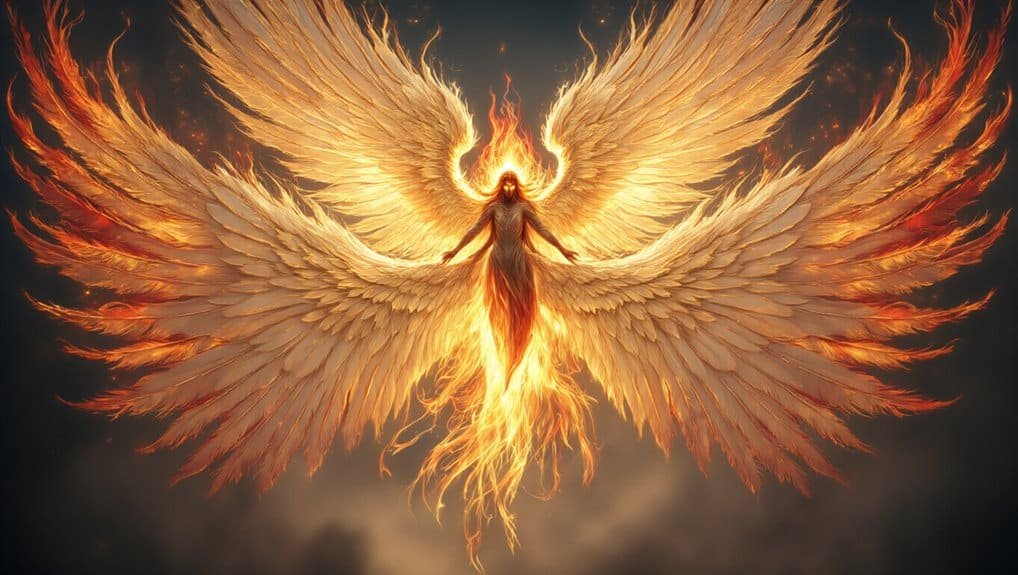
Among the celestial beings described in Scripture, the seraphim stand as perhaps the most awe-inspiring manifestation of divine glory. When you encounter these beings in Isaiah 6:2, you’ll find they possess six wings—two covering their faces, two covering their feet, and two for flight. Their very name means “burning ones,” reflecting their association with divine fire and purifying holiness.
The seraphim characteristics reveal their primary function: they’re throne guardians who perpetually worship God. You’ll notice they cry “Holy, holy, holy” in endless adoration, their voices shaking the temple’s foundations. Their appearance embodies divine fire—not merely as illumination but as God’s consuming purity.
When Isaiah sees them, he’s overwhelmed by his own unworthiness. One seraph touches his lips with a burning coal, demonstrating their role as agents of purification. These beings don’t appear throughout Scripture; they’re unique to Isaiah’s throne room vision, where they exemplify perfect worship and absolute holiness.
Cherubim: Four-Faced Guardians of God’s Throne
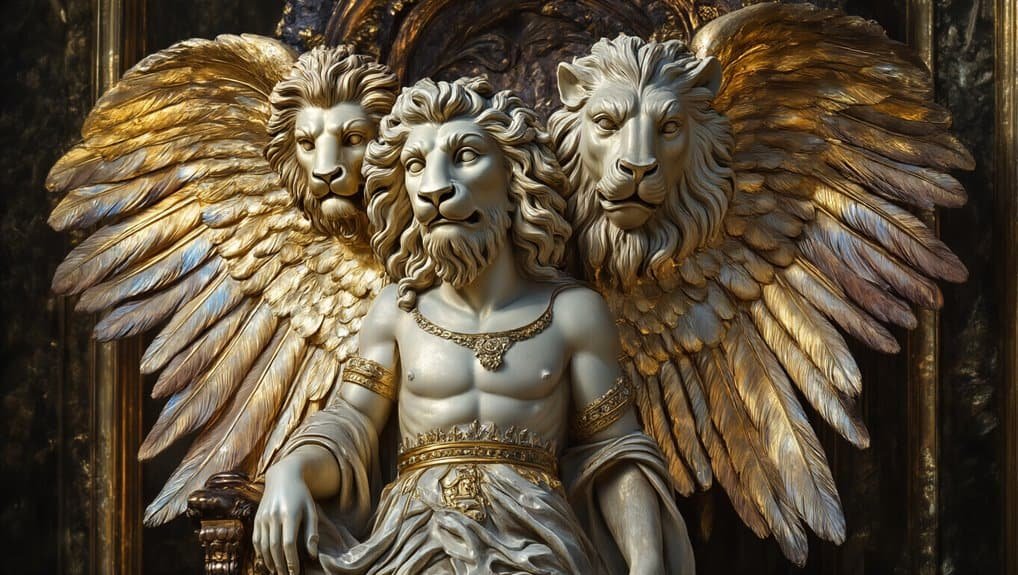
You’ll find the cherubim described in Ezekiel’s vision as extraordinary beings with four distinct faces—human, lion, ox, and eagle—each representing different aspects of God’s creation and sovereignty.
Their multiple wings enable them to move in any direction without turning, while their eyes cover their entire bodies, symbolizing God’s omniscient watchfulness over His throne.
Scripture first introduces these powerful guardians in Genesis 3:24, where God stations them at Eden’s entrance with flaming swords to protect the way to the tree of life.
Four Distinct Faces
The prophet Ezekiel’s vision reveals that each cherub possesses four distinct faces: human, lion, ox, and eagle. You’ll find this extraordinary biblical description in Ezekiel 1:10 and 10:14, where the prophet meticulously records his divine encounter.
Each face carries profound angelic symbolism: the human face represents intelligence and God’s image, the lion embodies royal strength and courage, the ox signifies service and sacrifice, while the eagle denotes swiftness and heavenly perspective.
When you examine these four faces collectively, you’re witnessing a complete representation of creation’s nobility. The cherubim’s tetramorphic appearance demonstrates their comprehensive nature as guardians who perceive all directions simultaneously, requiring no turning to survey God’s throne room.
This unique anatomy reflects their supreme vigilance and readiness to execute divine commands.
Wings and Movement
Six wings distinguish the cherubim’s extraordinary anatomy, with each pair serving a specific divine purpose in their celestial movement.
You’ll find in Ezekiel 1:11 that two wings stretch upward, touching those of neighboring cherubim, while two cover their bodies in reverent humility. The remaining pair propels their winged movement through heavenly realms.
These celestial dynamics defy earthly physics—they move straight forward without turning, guided by the spirit’s direction.
You’re witnessing supernatural locomotion where each creature maintains perfect synchronization with its companions. Their wings create a thunderous sound “like the voice of the Almighty” (Ezekiel 1:24), reflecting divine power in motion.
This coordinated flight pattern demonstrates complete submission to God’s will, as they never deviate from their ordained path.
Eden’s Sacred Guardians
Flaming swords and cherubim stand as eternal sentinels at Eden’s eastern gate, barring humanity’s return to paradise after the Fall (Genesis 3:24).
You’ll find these sacred beings throughout Scripture as Eden’s guardians, positioned strategically to preserve God’s holiness. They’re not mere decorative figures but active heavenly watchmen enforcing divine protection over sacred spaces.
When you examine Ezekiel’s vision, you’ll discover cherubim possess four faces—human, lion, ox, and eagle—representing creation’s fullness under God’s dominion.
Their multiple wings enable swift movement in any direction without turning, demonstrating omnidirectional vigilance. These guardians don’t simply observe; they actively participate in God’s throne room, bearing His glory and executing His will.
Their presence at Eden’s threshold reminds you that approaching God requires reverence, purity, and divine permission.
The Ophanim: Wheels Within Wheels Covered in Eyes

You’ll encounter the Ophanim in Ezekiel’s extraordinary vision as celestial beings composed of interlocking wheels covered with countless eyes, moving in perfect synchronization with the cherubim above them.
Their omnidirectional movement without turning represents God’s omnipresence, while the eyes covering their rims signify divine omniscience—God’s complete awareness of all creation.
These “wheels within wheels” demonstrate a cosmic order that transcends earthly physics, revealing how heaven’s inhabitants operate beyond human spatial limitations.
Ezekiel’s Vision Description
The prophet Ezekiel’s encounter with the Ophanim represents one of Scripture’s most enigmatic and awe-inspiring visions.
You’ll find his detailed account in Ezekiel 1:15-21, where he describes seeing “a wheel on the ground beside each creature with its four faces.” These aren’t ordinary wheels—they’re intersecting rings that move in any direction without turning, their rims “high and awesome” and covered with eyes all around.
This divine revelation transcends human comprehension.
The wheels move in perfect synchronization with the living creatures above them, sharing the same spirit. Ezekiel’s symbolism suggests God’s omniscience through the countless eyes and His omnipresence through the wheels’ unrestricted movement.
You’re witnessing a theophany that demonstrates divine mobility, awareness, and sovereignty over creation.
Multiple Eye Symbolism
When you examine the countless eyes covering the Ophanim’s rims, you’re encountering one of Scripture’s most profound symbols of divine perception.
These eyes aren’t mere decoration—they represent God’s omniscience, His ability to see all things simultaneously across time and space. The Hebrew text emphasizes their continuous, unblinking watchfulness, suggesting perpetual awareness without fatigue or limitation.
You’ll find this symbolic meaning reinforced throughout biblical literature, where eyes consistently denote knowledge, judgment, and providential care.
The Ophanim’s multiple eyes transcend human visual limitations, illustrating how divine perception operates beyond temporal constraints. They see not just physical reality but spiritual truth, moral conditions, and hidden intentions.
This imagery reminds you that nothing escapes God’s sight—every action, thought, and circumstance remains fully visible to His all-encompassing gaze.
Celestial Movement Patterns
Beyond their symbolic function as divine observers, the Ophanim’s movement patterns reveal equally profound theological truths about God’s sovereignty and presence.
You’ll notice Ezekiel describes their motion as perfectly synchronized—they move “straight forward” without turning, demonstrating divine choreography that transcends earthly physics. When the living creatures move, the wheels move; when they stop, the wheels stop. This unified celestial navigation reflects God’s omnidirectional authority.
The wheels’ ability to move in any direction without rotation suggests God’s immediate access to all creation.
You’re witnessing a visual theology where movement itself becomes revelation. The Ophanim don’t merely transport; they embody divine omnipresence through their impossible mechanics, teaching that God’s throne-chariot operates beyond spatial limitations.
Why Angels Always Say “Do Not Be Afraid”
If you’ve ever wondered why biblical angels consistently greet humans with “Fear not” or “Do not be afraid,” you’re encountering one of Scripture’s most revealing patterns about divine-human encounters.
This angelic reassurance appears throughout both Testaments—from Gabriel’s words to Mary (Luke 1:30) to the angel’s command at Christ’s tomb (Matthew 28:5).
You’ll find this pattern stems from humanity’s instinctive terror when confronting the holy. Angels’ overwhelming presence—their blazing appearance, multiple wings, and otherworldly forms—naturally evokes dread in mortal beings.
The Hebrew word “yare” (fear) used in these encounters encompasses both reverent awe and visceral terror.
This divine comfort serves a crucial purpose: it enables communication. Without this reassurance, humans remain paralyzed, unable to receive God’s message.
The command “Fear not” isn’t merely consolation—it’s necessary protocol that bridges the chasm between divine holiness and human frailty, allowing God’s purposes to unfold through angelic mediation.
Ezekiel’s Vision of Living Creatures
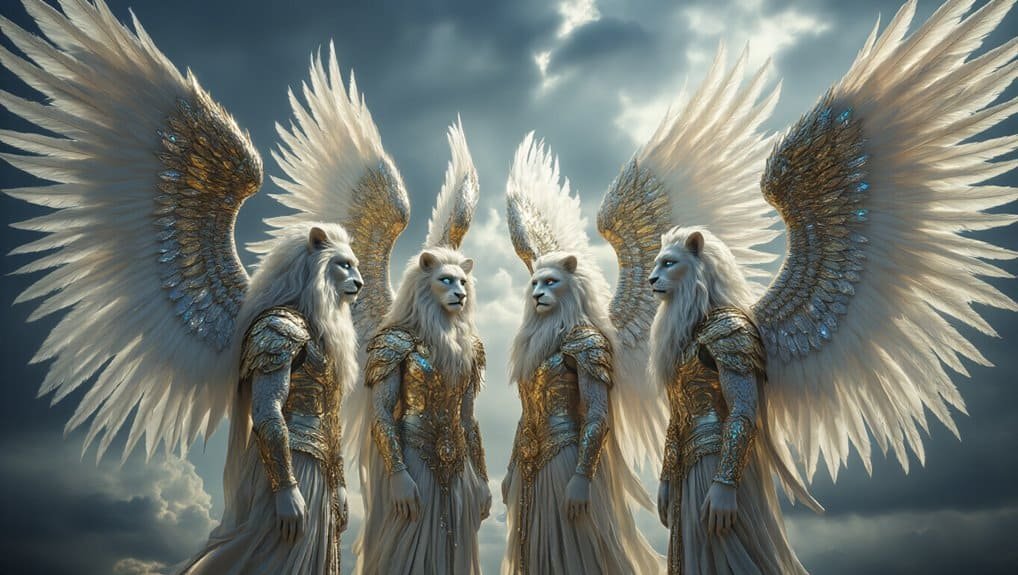
Among the most startling descriptions of heavenly beings in Scripture, Ezekiel’s vision of the living creatures (Ezekiel 1:4-28) challenges every conventional notion of angelic appearance.
Ezekiel’s vision shatters every conventional notion of how heavenly beings appear.
You’ll encounter beings with four faces—human, lion, ox, and eagle—each representing different aspects of God’s creation. Their bodies gleam like burnished bronze, and they’re covered with eyes, even under their wings.
These living creatures move without turning, propelled by the Spirit’s direction. Above them, you’ll find a crystalline expanse supporting God’s throne.
Ezekiel’s symbolism reveals divine attributes: the lion represents sovereignty, the ox signifies strength, the eagle denotes swiftness, and the human face reflects intelligence. Their wheels within wheels, also covered in eyes, demonstrate God’s omnipresence and omniscience.
When you study this passage, you’re witnessing the prophet’s attempt to describe the indescribable—the intersection of heaven and earth, where God’s mobile throne-chariot appears in overwhelming glory.
The Appearance of Angels in Daniel’s Visions
When you examine Daniel’s visions, you’ll encounter angels that contrast sharply with Ezekiel’s complex beings.
Gabriel appears to Daniel as a man who can fly swiftly, speaking in human language and touching him with hands that resemble our own (Daniel 8:15-16, 9:21).
Yet Daniel’s throne vision reveals celestial beings of terrifying majesty, including the “Ancient of Days” with clothing white as snow and hair like pure wool, surrounded by thousands upon thousands of ministering spirits (Daniel 7:9-10).
Gabriel’s Human-Like Form
While many biblical angels appear as terrifying, otherworldly beings, Gabriel’s manifestation to Daniel stands in stark contrast as remarkably human in form.
You’ll notice in Daniel 8:15-16 that Gabriel’s appearance resembles “the appearance of a man,” suggesting human-like features that made him approachable rather than overwhelming.
When he touched Daniel and spoke, you see none of the cosmic terror associated with cherubim or seraphim. Instead, Gabriel’s human-like form enabled direct communication and instruction.
His physical presence didn’t require Daniel to fall prostrate from supernatural dread but allowed for coherent dialogue.
You’ll find this anthropomorphic presentation serves a specific purpose: delivering God’s interpretive messages through a familiar, comprehensible vessel.
Gabriel’s approachable manifestation demonstrates divine accommodation to human limitations in receiving revelation.
Throne Vision Beings
Daniel’s throne visions reveal angelic beings of breathtaking complexity and divine majesty that dwarf Gabriel’s human-like presentation.
You’ll encounter the Ancient of Days served by thousands upon thousands of celestial attendants, their forms radiating otherworldly power.
Daniel 7:9-10 depicts these beings as streams of fire flowing from the divine throne, establishing throne imagery as central to understanding angelic hierarchy.
You’re witnessing beings who embody divine authority through their proximity to God’s seat of judgment.
The “man dressed in linen” in Daniel 10:5-6 appears with a body like beryl, face like lightning, and eyes like flaming torches.
His voice resonates like a multitude, demonstrating how these throne-room angels transcend human comprehension while maintaining recognizable features that communicate God’s sovereign power.
Isaiah’s Encounter With the Seraphim in the Temple
As Isaiah stood in the temple during the year of King Uzziah’s death, he witnessed a vision that would forever alter his understanding of divine majesty.
You’ll find in Isaiah 6:1-3 that he saw the Lord seated on a throne, high and exalted, with the train of His robe filling the temple. Above Him stood the Seraphim, each possessing six wings: two covering their faces, two covering their feet, and two for flight.
These celestial beings engaged in antiphonal Seraphim worship, calling to one another: “Holy, holy, holy is the Lord Almighty; the whole earth is full of his glory.”
Their voices shook the doorposts and thresholds while smoke filled the temple. Isaiah’s vision reveals these “burning ones” as divine attendants who shield themselves from God’s overwhelming holiness while perpetually proclaiming His transcendent nature.
Their threefold declaration emphasizes God’s absolute otherness and separation from creation.
The Difference Between Biblical Angels and Popular Culture Depictions
When you compare biblical descriptions of angels with their modern representations, you’ll discover a striking disconnect between scripture’s awe-inspiring beings and popular culture’s sanitized versions.
You’ve likely seen cherubs depicted as chubby infants with tiny wings, yet Ezekiel describes cherubim as four-faced creatures with wheels covered in eyes. This reflects widespread cultural misconceptions about angelic beings.
Biblical accuracy reveals angels as formidable messengers who often terrify those who encounter them. Scripture repeatedly shows people falling prostrate in fear, while angels command “Do not be afraid.
You won’t find this reaction to greeting card angels or Renaissance paintings of serene, feminine figures with harps.
Popular culture has domesticated these powerful beings into comfortable, non-threatening entities. Yet biblical texts present angels as warriors, throne guardians, and cosmic beings whose appearance defies human comprehension.
When you examine scripture carefully, you’ll recognize that authentic angelic encounters inspire holy fear, not warm comfort.
The Hierarchy of Heavenly Beings in Scripture
Scripture reveals a complex celestial hierarchy that positions various classes of angels in distinct roles and ranks within God’s divine order. You’ll find nine angelic orders mentioned throughout biblical texts, arranged in three triads according to traditional interpretation.
The highest tier includes Seraphim, Cherubim, and Thrones—beings who exist in God’s immediate presence. Isaiah 6:2 describes Seraphim with six wings, while Ezekiel depicts multi-faced Cherubim bearing God’s throne.
The middle triad comprises Dominions, Virtues, and Powers—celestial governors who execute divine commands throughout creation.
Finally, you encounter Principalities, Archangels, and Angels in the lowest tier, who interact most directly with humanity. This heavenly hierarchy isn’t merely organizational; it reflects God’s ordered cosmos where each being fulfills its designated purpose.
When you study these distinctions, you’re glimpsing how heaven’s authority flows from throne to earth.
Angels as Warriors and Destroyers in Biblical Accounts
Throughout biblical narratives, you’ll encounter angels wielding devastating power as God’s instruments of judgment and warfare. These celestial warriors don’t resemble the gentle guardians of popular imagination.
In 2 Kings 19:35, a single angel annihilates 185,000 Assyrian soldiers overnight, demonstrating the terrifying scope of angelic warfare. You’ll find similar accounts in Exodus 12:23, where the destroyer passes through Egypt, and in 2 Samuel 24:16, where an angel extends his hand to destroy Jerusalem.
Scripture reveals angels executing divine judgment with precision and authority. They’re not autonomous agents but operate under God’s direct command.
Angels execute divine judgment with precision, never acting independently but only under God’s direct command.
In Revelation, you’ll witness angels pouring out bowls of wrath, sounding trumpets of doom, and binding Satan himself. The angel of death in 1 Chronicles 21:15 stands between heaven and earth with a drawn sword, ready to strike.
These accounts underscore a sobering truth: angels serve as both protectors and destroyers, perfectly fulfilling God’s purposes.
Frequently Asked Questions
Do Biblically Accurate Angels Have Free Will to Disobey God?
You’ll find that angels possess free will within the divine hierarchy, as evidenced by the angelic rebellion led by Lucifer in Isaiah 14 and Ezekiel 28.
Scripture reveals that one-third of heaven’s hosts chose to follow Satan’s insurrection against God. This demonstrates that despite their exalted position, angels aren’t automatons but moral agents capable of choosing obedience or defiance, though rebellion results in eternal judgment and expulsion from God’s presence.
Can Humans Become Angels After Death According to Scripture?
You’ll find Scripture maintains a clear distinction between human souls and angelic beings.
According to biblical texts, you don’t transform into angels after death – humans and angels represent separate orders within God’s creation. The angelic hierarchy existed before humanity’s creation, as evidenced in Job 38:7.
Your human soul retains its distinct nature eternally; you’re destined for resurrection, not incorporation into angelic ranks, as Christ affirmed in Matthew 22:30.
Are Biblically Accurate Angels Male, Female, or Genderless Beings?
You’ll find that angelic beings transcend human gender representation throughout scripture.
While angels appearing to humans often present as male figures, their essence remains fundamentally genderless as spiritual beings.
The angelic hierarchy—from seraphim to archangels—exists beyond biological categories.
They’re neither male nor female but pure spirits serving God’s purposes.
Scripture’s masculine pronouns reflect ancient linguistic conventions rather than actual gender, as Christ confirmed angels don’t marry or reproduce.
How Many Total Angels Exist According to Biblical Texts?
You’ll find biblical texts don’t specify exact celestial numbers for angels, though scripture suggests vast multitudes exist.
Daniel 7:10 mentions “thousands upon thousands” serving God, while Revelation 5:11 describes “myriads of myriads.”
Within the angelic hierarchy, you’ll encounter various orders—from archangels to cherubim—but God’s word emphasizes their innumerable host rather than precise counting.
The texts reveal their overwhelming abundance serves to glorify the Creator’s majesty.
Do Biblically Accurate Angels Eat Food or Require Sustenance?
You’ll find biblical angels don’t require angel sustenance as mortals do. Scripture reveals they’re spiritual beings who exist beyond physical needs.
However, you can observe instances where angels appear to eat with humans, like in Genesis 18-19. These manifestations suggest accommodation rather than necessity.
Divine nourishment for angels comes from God’s presence itself, not material food. They’re sustained by their Creator’s power, transcending earthly requirements for survival.
Conclusion
You’ve discovered that Scripture’s celestial beings aren’t the gentle figures you’ve imagined. They’re terrifying manifestations of God’s glory—multi-faced cherubim, eye-covered wheels, and six-winged seraphim that necessitate divine reassurance. These warriors and throne guardians reflect God’s awesome majesty rather than human comfort. As you’ve examined these texts, you’ve encountered beings whose very appearance overwhelms mortal comprehension, reminding you that heaven’s reality transcends earthly imagination and demands profound reverence.










No Comments