

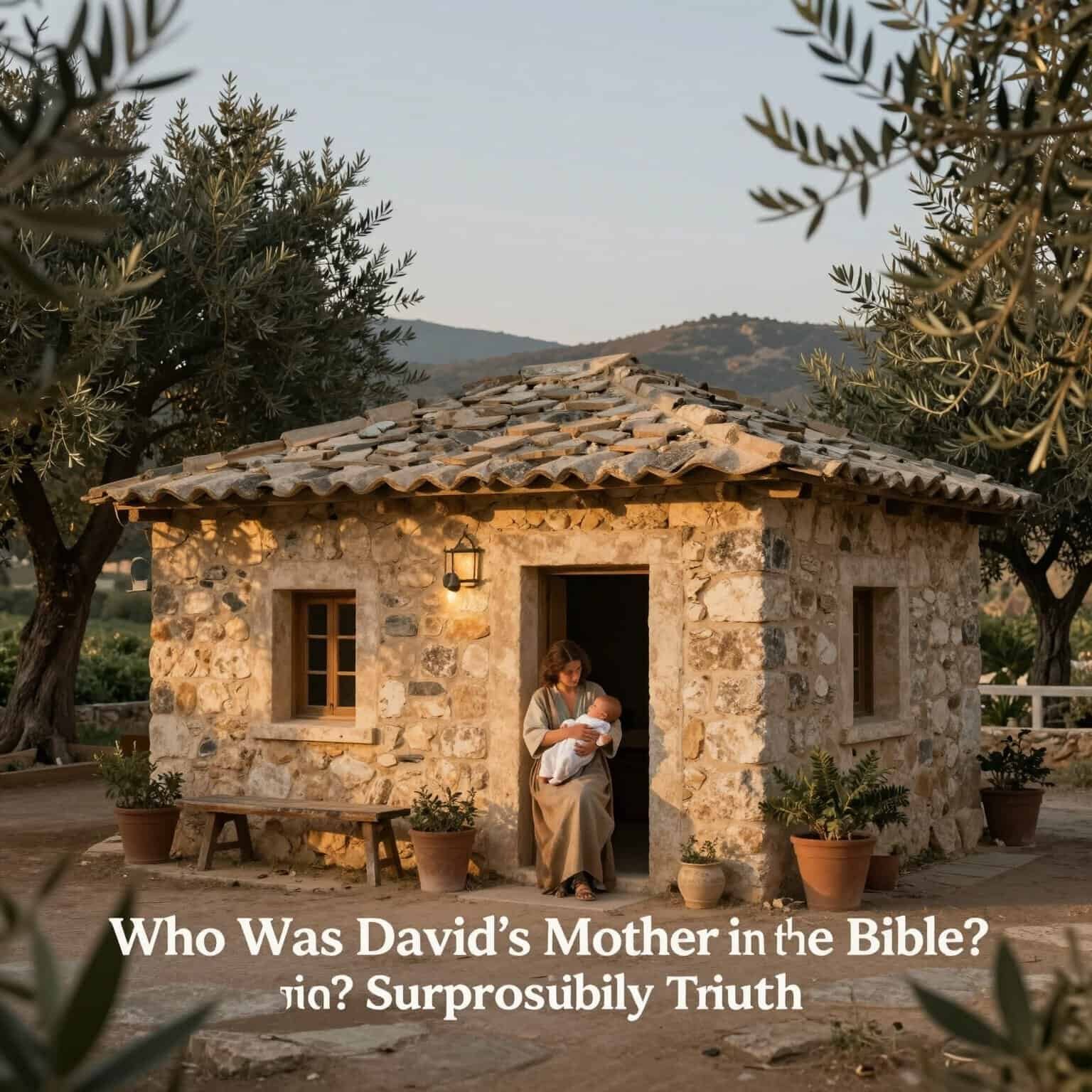
24 Apr Who Was David’s Mother in the Bible? Surprising Truth
The Bible never gives David’s mother a name; it only lists Jesse’s sons and traces David’s paternal line, reflecting the Old Testament’s patrilineal focus and the theological point that God, not genealogy, chose him. Rabbinic tradition later calls her Nitzevet, but that name is a medieval addition, not a historical record. If you keep going, you’ll discover what this silence tells us about faith and narrative.
Table of Contents
What the Bible Actually Says About David’s Mother
What does the Bible actually say about David’s mother? You’ll find that none of the canonical books names her. In 1 Samuel 16:1‑13 and 1 Chronicles 2:13‑15 the text lists Jesse’s sons but never mentions a mother, and Ruth 4:17‑22 traces David’s paternal line without any maternal reference. The Old Testament’s genealogical focus stays strictly patrilineal, so the mother’s identity remains absent. You also won’t discover any extra‑biblical Near Eastern inscription that records her name. This silence doesn’t imply she was unimportant; it simply reflects the literary conventions of the period, which prioritized male lineage for covenantal purposes. As you read the narrative, you see God’s selection of David emphasized over any family detail, reinforcing the theological point that divine election, not human genealogy, drives the story.
Scriptural Reasons for Leaving David’s Mother Unnamed
Why does the biblical text leave David’s mother unnamed?
You’ll notice that the narrative prioritizes patrilineal descent, a common Old‑Testament pattern. The genealogies in 1 Samuel 16 and 1 Chronicles 2 list Jesse’s sons to stress the royal line, while Ruth 4 traces David’s paternal ancestry without mentioning mothers. This focus reflects a theological agenda: God’s election of David rests on his father’s house, not on maternal heritage.
The text also emphasizes divine selection over human pedigree (1 Samuel 16:7), so naming the mother would add little to the theological point.
Moreover, the Hebrew Bible often omits women’s names when they aren’t central to the covenantal narrative, as seen with other figures. By keeping the mother unnamed, the writers keep the story’s eye on God’s purpose and the royal lineage, preserving the theological message without unnecessary detail.
The Rabbinic Tradition of Nitzevet: Origin and Meaning
Ever wondered how the name Nitzevet entered Jewish tradition? You’ll find that the Talmud and Midrash first mention her as Jesse’s wife, calling her Nitzevet or Nitzebet. These sources link her to the tribe of Judah by naming her a daughter of Adael, which gives David a respectable maternal line. Rabbinic commentators portray her as a steadfast supporter, highlighting her faith and encouragement during David’s early shepherd years.
Though the biblical text stays silent, medieval Jewish writers kept the story alive, using Nitzevet to illustrate a mother’s moral influence on a future king. Scholars treat the name as a later legendary addition rather than a historical fact, noting that it never appears in the Hebrew Bible or contemporary inscriptions. Still, the tradition enriches the narrative, offering a symbolic mother who embodies devotion and piety in the lineage of Israel’s greatest ruler.
How Mothers Were Viewed in Ancient Israel’s Genealogies
How did ancient Israel record mothers in its family histories? While genealogies in the Hebrew Bible focus almost exclusively on fathers, they occasionally acknowledge mothers—typically to highlight tribal affiliations, prophetic lineage, or moral influence. You’ll notice that when a mother appears, the text usually ties her to a clan or a notable ancestor, as with Hannah’s link to the tribe of Levi or Ruth’s Moabite background that legitimizes David’s lineage. These brief mentions serve a purpose: they confirm the child’s eligibility for a covenantal role or underscore a divine promise. You also see mothers used to explain a hero’s character, like the piety of the mother of Samuel, which frames his prophetic calling. Though the patriarchal focus dominates, these occasional maternal references remind you that women could affect identity, status, and destiny within Israel’s genealogical record.
Archaeology’s Limits on Naming David’s Mother
While we’ve seen how occasional maternal mentions serve theological and tribal purposes, the archaeological record offers little help in identifying David’s mother. You’ll notice that every inscription, seal, and ostracon from the Iron II period mentions the “House of David” or military officials, but none records a woman’s name attached to the dynasty. The Tel Dan Stele, the Mesha Stele, and the Jerusalem Bullae all confirm Judah’s political reality, yet they remain silent on queens or mothers. Even the excavation of Bethlehem’s settlement layers yields pottery and architecture, not epigraphic evidence of a maternal figure. This silence isn’t accidental; ancient Near Eastern record‑keeping prioritized male lineage, land ownership, and military deeds. Consequently, archaeology can corroborate David’s reign and his father’s family, but it can’t supply a name for his mother. You must rely on textual tradition, not material finds, for any speculation.
Why the Bible Emphasizes David’s Paternal Line Over His Mother
Why does the biblical narrative focus almost exclusively on David’s father, Jesse, and his tribal ancestry rather than his mother? You’ll notice that the text repeatedly lists Jesse’s lineage, tracing David back to Judah and to the house of Israel. This patrilineal emphasis serves theological and legal purposes: inheritance, kingship, and covenant promises are passed through the male line. In ancient Israel, a king’s legitimacy hinged on his paternal pedigree, so the writers highlighted Jesse to confirm David’s right to rule. Moreover, the biblical authors used genealogy to demonstrate God’s faithfulness to the patriarchs, not to detail personal histories. Mothers, though influential in private life, rarely appear in official records because their roles didn’t affect dynastic succession. Consequently, the narrative omits David’s mother, keeping the focus on the lineage that validates his messianic and royal credentials.
Modern Scholarship on the Silent Mother of David
Modern scholars treat the silence surrounding David’s mother as a textual gap that reveals more about the composition of the biblical record than about any lost historical figure. You’ll find that most experts view the omission as a deliberate literary choice, not an accidental loss.
The Hebrew Bible consistently records patrilineal ancestry, so the absence of a maternal name aligns with its genealogical agenda. Contemporary critics point out that the later rabbinic name Nitzevet appears only in medieval commentary, which they classify as a legendary embellishment rather than a source. Comparative studies show similar silences for other ancient Israelite figures, suggesting a broader cultural pattern.
Some scholars entertain the possibility that oral tradition once preserved a name, but they agree that no epigraphic or textual evidence survives. In short, the modern consensus treats the silent mother as a narrative device that underscores divine election over human lineage.
What the Missing Mother’s Name Reveals About Faith and Historical Narrative
Ever wondered what the silence around David’s mother tells us about faith and the way history is shaped? You’ll notice that the biblical text leaves her unnamed, forcing you to focus on divine election rather than lineage. This omission nudges you to see faith as a force that works through ordinary families without needing every detail recorded.
When later traditions like the Nitzevet legend surface, you recognize how communities fill gaps to affirm theological points, yet you also see scholars treating those names as later embellishments. The missing name pushes you to value the narrative’s purpose: highlighting God’s choice of David despite humble origins. It also reveals how history is constructed—texts preserve what the authors deemed essential, while oral memory may have kept other pieces that never entered the canon.
In short, the silence teaches you that faith and historical narrative often prioritize meaning over exhaustive genealogy.
Frequently Asked Questions
Did David’s Mother Have Any Recorded Role in His An?
You won’t find any explicit biblical episode where David’s mother steps into the story. The text lists Jesse’s sons but never mentions her actions or influence. Rabbinic tradition later calls her Nitzevet, crediting her with nurturing and supporting David, yet that name never appears in Scripture. So, according to the biblical record, she’s no recorded role in his anointing.
Is There Any Evidence That Nitzevet Was a Historical Figure?
You won’t find any solid evidence that Nitzevet was a real person. The name appears only in later rabbinic and medieval writings, not in the biblical text or contemporary inscriptions. Scholars treat it as a legendary addition, a tradition that grew after the fact. So, while Nitzevet may have cultural significance, archaeology and early sources give her no historical footing.
Why Does the Bible Focus on Patrilineal Genealogy Over Maternal Lines?
You’ll notice the Bible tracks patrilineal lines because ancient Israel’s legal and tribal identity hinged on fathers. Inheritance, land rights, and covenant promises passed through male descendants, so scribes recorded fathers to define status and fulfill prophetic expectations. Women mattered socially and spiritually, yet their names rarely entered official genealogies, which served as legal registers rather than full family histories. This focus reflects cultural norms, not a denial of maternal influence.
Could Oral Tradition Have Preserved David’s Mother’s Name?
You can’t be sure, but it’s plausible. Oral tradition often kept family details that the written text omitted, especially for women. Communities might’ve remembered a name like Nitzevet, passing it down through songs or stories.
Yet no surviving manuscript records it, so any name you hear today comes from later rabbinic legend, not the biblical record.
Do Any Non‑Biblical Ancient Texts Mention David’s Mother?
You won’t find any ancient non‑biblical texts that name David’s mother.
The surviving Near‑Eastern inscriptions—like the Tel Dan Stele, the Mesha Stele, and Egyptian records—mention the “House of David” or his reign, but none record his mother’s identity.
Rabbinic literature later offers the name Nitzevet, yet that tradition isn’t attested in contemporaneous secular sources.
Conclusion
You’ve seen how the Bible’s silence on David’s mother isn’t a simple omission but a deliberate focus on his paternal lineage, cultural norms, and theological aims. By digging into scripture, rabbinic lore, and archaeology, you realize the missing name actually highlights how ancient Israel viewed women’s roles, preserved royal legitimacy, and shaped narrative authority. This insight reshapes your understanding of faith, history, and the power of what’s left unsaid.










No Comments