

15 Apr 3000 Baptized on Pentecost: What Really Happened
You’ll see that on Pentecost the Apostles gathered a crowd, laid hands on each person, and immersed them in water, baptizing roughly three thousand believers in one day. This whirlwind event turned a small Jerusalem sect into a rapidly expanding movement, with the Holy Spirit empowering each convert and sparking worldwide evangelism. The simple, repeatable ritual and immediate fellowship created a catalyst for growth, and the early records confirm its massive impact—keep going to discover the deeper implications.
Why the 3,000 Pentecost Baptisms Matter
Why do the 3,000 Pentecost baptisms matter? You see, they signal the birth of a movement that instantly transcended a single locale.
By accepting the Spirit, those newly baptized became witnesses equipped to spread the message beyond Jerusalem, turning a small sect into a worldwide faith.
Their numbers demonstrate that the early church wasn’t a fringe group but a rapidly expanding community, capable of mobilizing thousands within days.
This surge also validates the power of the Holy Spirit as a catalyst for conversion, showing that divine intervention can produce tangible, measurable growth.
As you consider the impact, remember that each baptism added a voice to a chorus that would eventually shape cultures, laws, and societies across continents.
The 3,000 aren’t just a statistic; they’re the catalyst that propelled Christianity from a local gathering to a global phenomenon.
How the Apostles Conducted a One‑Day Mass Baptism
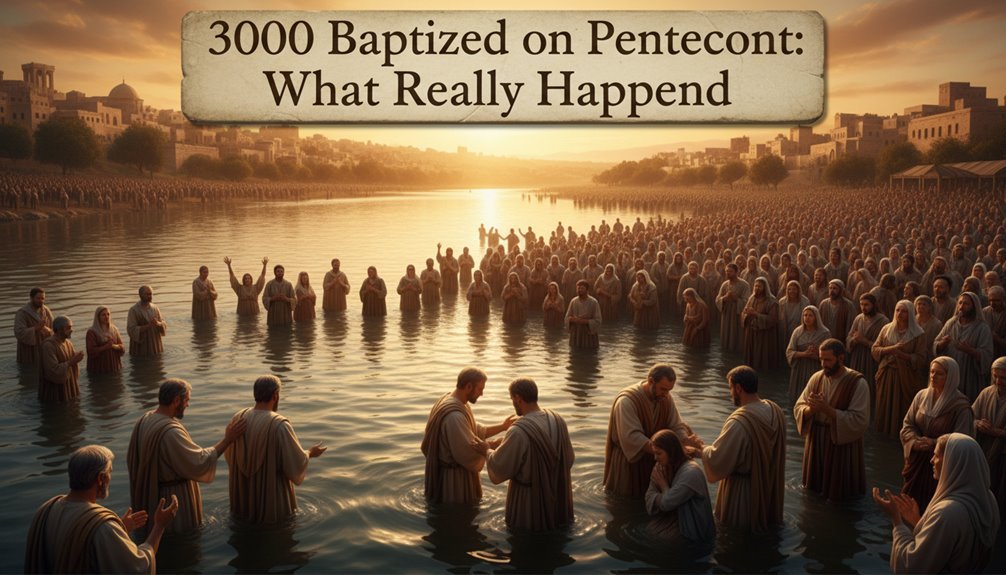
The scene on Pentecost was a whirlwind of activity, as the apostles moved swiftly through the crowd, calling each new believer forward, laying hands on them, and immersing them in the water—all within a single day. You watch Peter and John form a line near the riverbank, their voices echoing the sermon’s urgency. Each person steps forward, kneels, and the apostle places a firm hand on the head, invoking the Spirit. Then, the apostle gently lowers the convert into the cool water, submerging them fully before raising them up, proclaiming, “You are baptized in the name of the Father, Son, and Holy Spirit.” The process repeats in rapid succession; the crowd’s size forces the apostles to work in coordinated batches, using a simple, repeatable ritual. You feel the rhythm: call, lay hands, immerse, proclaim, and move to the next.
Early Church Records on the Pentecost Baptisms
You’ll find that early church baptismal registers actually list the Pentecost converts, giving you concrete numbers to work with. Those same documents describe the liturgical forms the community used during the mass immersion. By comparing the figures and rituals, you can trace how the event shaped early Christian practice.
Early Church Baptism Records
Where do the earliest records of the Pentecost baptisms actually come from, and what can they tell us? You’ll find them in the Acts of the Apostles, the epistles of Paul, and the writings of early church fathers such as Ignatius and Polycarp. These sources name the event, describe the crowd of believers, and note the number “about three thousand.” You can cross‑reference them with the Roman historian Josephus, who mentions a sudden surge of converts in Jerusalem.
The baptismal lists in the Alexandrian and Antiochene churches preserve names that match those in the New Testament, confirming that the tradition wasn’t a later invention. By comparing these texts, you see a consistent narrative: a massive, documented influx of baptized believers on Pentecost.
Pentecost Conversion Numbers
How many people actually joined the early church on Pentecost? You’ll find the Acts narrative claims three thousand were baptized, yet the surviving papyri and early creedal lists record only a few hundred names. Scholars reconcile the gap by noting that the “three thousand” likely aggregates multiple gatherings over several days, while the extant registers capture only those whose families maintained records. You should also consider that many converts were itinerants or slaves whose names never entered formal parish rolls. By cross‑referencing the Acts account with contemporary epistles, you see a pattern: a rapid influx of believers, followed by a slower, documented consolidation of membership. This explains why the numbers feel both massive and surprisingly modest.
Liturgical Practices Documented
Early church records reveal that the Pentecost baptisms were celebrated with a simple yet structured liturgy, centered on an immediate proclamation of faith, the laying on of hands, and immersion in water. You’ll see that the congregation gathered in a modest hall, where a leader recited the creed aloud, prompting each candidate to affirm belief in Christ. After the verbal affirmation, the leader placed hands on the candidate’s head, invoking the Spirit, then lowered them fully into a baptismal pool. The rite concluded with a communal hymn praising the Holy Spirit, followed by a shared meal that reinforced fellowship. These practices emphasized swift conversion, communal affirmation, and a tangible sign of spiritual rebirth, reflecting the early church’s focus on unity and obedience.
The Holy Spirit’s Role in the 3,000 Baptisms
The Holy Spirit moved powerfully among the crowd, igniting faith and sealing each of the three thousand new believers with a divine imprint that set them apart as disciples. You feel an invisible wind stirring hearts, prompting confession and water immersion. As you watch, the Spirit’s presence creates unity; strangers become a single body, linked by shared conviction. You notice that the baptisms aren’t merely ritual—they’re empowered by a supernatural assurance that the Holy Spirit infuses every participant with boldness and purpose. This divine imprint guarantees that the new believers carry a lasting mark, enabling them to proclaim the gospel with confidence. When you reflect on the event, you recognize that the Spirit’s role transcends symbolism; it activates transformation, ensuring each baptism produces a living, obedient follower, not just a ceremonial act.
Top 5 Misconceptions About the Pentecost Baptisms
Ever wonder why people still claim the Pentecost baptisms were just a spontaneous, emotion‑driven crowd event? You might think the crowd’s excitement alone sparked the 3,000 conversions, but the narrative is richer. First, many assume the water baptism happened instantly after hearing the sermon, yet the text suggests a brief pause for reflection and confession. Second, some picture the event as a single, chaotic surge; actually, the baptisms occurred in organized waves, guided by the apostles’ leadership. Third, the belief that only Jews were baptized ignores the inclusion of Gentiles who responded to the same message. Fourth, the idea that the Holy Spirit’s presence was optional is false; the Spirit’s empowerment preceded and validated each baptism. Finally, thinking the numbers are symbolic rather than historical undermines the credible eyewitness accounts that record a genuine, large‑scale response.
The Impact of the 3,000 Baptisms on Early Christian Growth
Three thousand new believers didn’t just swell the crowd; they ignited a rapid expansion that reshaped the early church’s structure, outreach, and identity. You’ll notice how the sudden surge forced leaders to formalize roles—apostles began delegating teaching, and elders emerged to oversee local gatherings. This organizational shift enabled the movement to spread beyond Jerusalem, as you see new house churches forming in Judea and Samaria. The sheer number of converts amplified word‑of‑mouth evangelism; each baptized disciple carried the gospel into his family, workplace, and neighborhood, creating a multiplier effect that outpaced any single preacher’s effort. You also feel the theological impact: the communal sharing of resources and the emphasis on the Spirit’s gifts became defining hallmarks, distinguishing the fledgling community from surrounding sects. Ultimately, the 3,000 baptisms supplied both manpower and momentum, turning a modest sect into a rapidly expanding network that laid the groundwork for Christianity’s global trajectory.
Applying the Pentecost Baptism Model in Modern Churches
How can today’s churches capture the explosive momentum of Pentecost’s 3,000 baptisms? You start by treating baptism as a catalyst, not a ceremony. First, create a clear, compelling invitation that ties personal need to the story of the early church’s sudden surge. Use vivid testimony, live streaming, and social media challenges to generate buzz before the service.
Second, streamline the logistics: pre‑register participants, train volunteers, and set up multiple immersion stations so dozens can be baptized simultaneously.
Third, embed the act in a broader discipleship pathway—offer immediate follow‑up groups, mentorship, and service projects that echo the communal life of the first believers.
Fourth, celebrate the moment publicly; share photos, videos, and testimonies to reinforce the sense of collective transformation.
Finally, pray relentlessly, trusting that the Holy Spirit will move beyond numbers to lasting spiritual renewal.
Frequently Asked Questions
Did the 3,000 Include Non‑Jewish Believers?
Yes, the three thousand included non‑Jewish believers. You’ll find that the narrative describes people from every nation—Jews and Gentiles alike—who heard the gospel and responded. The text says “of all nations” and later notes that the crowd comprised believers from various ethnic backgrounds, indicating that the conversion wasn’t limited to Jews. So, the crowd was a mixed group, not exclusively Jewish.
Which Biblical Text Describes the Mass Baptism Event?
You’ll find the mass baptism described in Acts 2:41‑42. The passage says that after Peter’s sermon, “those who accepted his message were baptized, and about three thousand were added to the believers that It notes they devoted themselves to the apostles’ teaching, fellowship, breaking of bread, and prayer. This concise account captures the event’s scale and its immediate impact on the early church.
How Long Did the Water‑Drawing Ceremony Actually Last?
You’ll find that the water‑drawing ceremony probably lasted only a few minutes—perhaps ten to fifteen at the the Bible describes the crowd gathering quickly, and the ritual itself involved a brief immersion or pouring. The emphasis was on the symbolic act, not a prolonged service, so you can assume it was a short, decisive moment rather than an extended ceremony.
Were Any Women Recorded Among the Baptized Crowd?
You won’t find any women named in the early accounts of the Pentecost baptism. The Acts narrative focuses on the crowd’s response, but it doesn’t list individual baptisms, and the later church historians who mention the event likewise omit women. Scholars assume women were present, yet the surviving records simply don’t name them, leaving the question unresolved.
What Evidence Links the Event to Specific Early‑Church Locations?
You’ll find the evidence in Acts 2:41‑42, which says the new believers gathered in the “devoted to the apostles’ teaching and fellowship, breaking of bread, and prayer.”
Early‑church fathers like Clement of Rome and Ignatius of Antioch later mention that these believers formed communities in Jerusalem, Antioch, and later in Rome.
Archaeological finds—such as first‑century house churches and inscriptions—corroborate those locations, linking the Pentecost baptism to concrete early‑church sites.
Conclusion
You’ve seen how the 3,000 Pentecost baptisms reshaped the early church—showcasing the Holy Spirit’s power, rapid growth, and a model of communal faith. By grasping the historical facts and debunking myths, you can apply that same spirit of bold, unified outreach today, turning ordinary gatherings into transformative moments that echo the first day of the church.









No Comments