

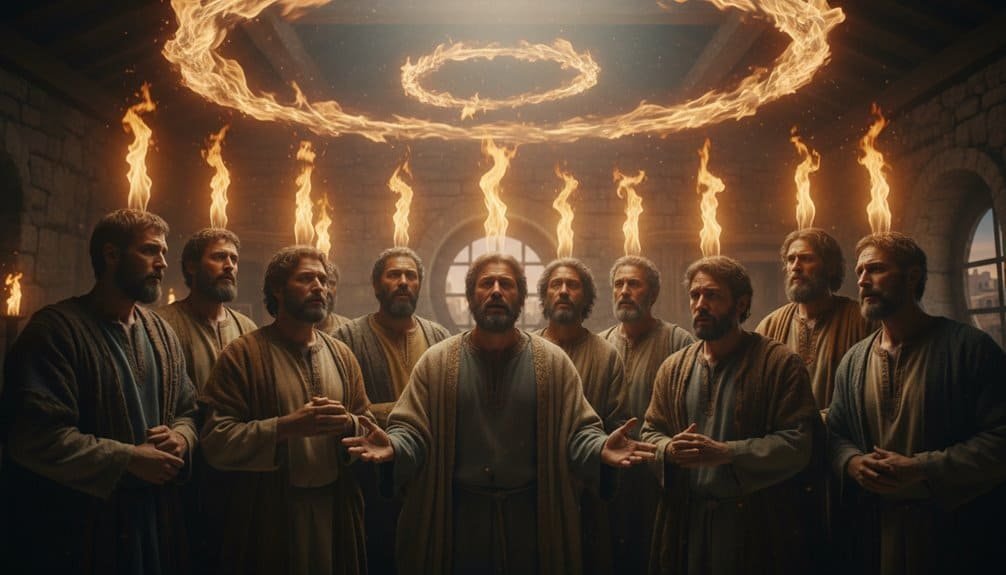
17 Apr What the Tongues of Fire at Pentecost Mean
You’ll see that the tongues of fire at Pentecost symbolize the Holy Spirit’s empowering presence, a spiritual fire that ignites your heart, unites diverse languages, and marks each follower with a divine seal. This fire is not a literal flame but a refining heat that transforms character, fuels courage, and deepens fellowship. It signals personal empowerment and the promise of the Spirit’s ongoing work in you, and if you keep exploring, you’ll uncover how to recognize and experience that authentic fire today.
Table of Contents
What Do the Tongues of Fire Symbolize in Acts 2?
How do the tongues of fire in Acts 2 illustrate the Holy Spirit’s work? You see the flames as a visual cue that the Spirit is both powerful and pure, igniting believers with divine energy. Each tongue represents a distinct language, showing that the Spirit breaks cultural barriers and unites diverse peoples. The fire’s movement signifies rapid, transformative change—just as a spark spreads, the Spirit spreads the gospel quickly. Its warmth conveys comfort, assuring you that the Holy presence isn’t hostile but nurturing. Moreover, fire refines metal; similarly, the Spirit purifies hearts, burning away impurity and shaping character. The visible tongues also validate the event, giving witnesses tangible proof that something extraordinary is occurring. In this way, the flames embody the Spirit’s ability to empower, unify, and sanctify every follower who receives them.
How the Holy Spirit’s Fire Differs From Physical Flames (Tongues of Fire Explained)
You’ll notice that the Holy Spirit’s fire isn’t a literal blaze but a spiritual heat that refines your heart. Its tongues symbolize divine presence rather than combustion, pointing to renewal instead of destruction. This transformative fire ignites faith, reshaping you from the inside out.
Spiritual vs. Physical Heat
Ever wonder why the Pentecostal “tongues of fire” feel so different from ordinary flames? You feel a warmth that doesn’t burn skin but kindles devotion. Physical heat raises temperature, causes pain, and can destroy. Spiritual heat, by contrast, inflames the heart, sharpens perception, and fuels purpose without leaving scars. When the Holy Spirit’s fire touches you, it ignites conviction, urging you to act, pray, and love. It’s an inner furnace that refines character, not a blaze that chars flesh. You may notice a sudden clarity, a surge of courage, or a gentle trembling—signs that the divine heat is at work, transforming from inside out while your body stays cool.
Symbolic Meaning of Tongues
The heat you felt isn’t just a metaphor; it’s a visual language that the Holy Spirit uses to communicate. When tongues of fire appear, they symbolize divine presence, not combustion. Each flickering strand represents a unique spiritual gift, a personal call to worship, and a reminder that God’s power can ignite without scorching. You see the flames as letters, each spelling out purpose, courage, and love. The fire’s color—bright amber, deep crimson—mirrors the Holy Spirit’s warmth and intensity, while its movement conveys the Spirit’s dynamic, ever‑shifting guidance. Unlike physical fire that consumes, this fire refines, illuminating truth and empowering you to speak God’s truth boldly.
Transformative Power of Fire
Fire, in its divine form, doesn’t burn flesh—it refines souls. When the Holy Spirit descends, you feel a gentle heat that awakens awareness, not a destructive blaze. This fire purifies thoughts, melting pride and fear while preserving the core of your being. It ignites conviction, urging you to act with love and truth. Unlike a candle’s flame that consumes oxygen, the Spirit’s fire expands, drawing in fellowship and deepening faith. You’ll notice a calm confidence, as if an invisible furnace reshapes your character, aligning it with God’s purpose. Embrace this transformative power; let it melt the old self and forge a renewed, radiant spirit that shines outward.
Where Do ‘Tongues’ Come From in the Bible?
Where do the “tongues” spoken of in Acts and the epistles actually originate? You’ll find they trace back to the Old Testament, where the Spirit’s “breath” lifts people into prophetic speech (e.g., Numbers 11:25‑26). The Hebrew word *ruach*—wind, breath, spirit—carries the same idea of divine empowerment. In the New Testament, Pentecost marks the Spirit’s fulfillment of that promise: the apostles receive a “baptism of fire” that ignites foreign tongues (Acts 2:4).
Paul later clarifies that these utterances aren’t random sounds but “the Spirit speaking through us” (1 Cor 14:2‑4). The apostolic letters treat tongues as a sign for believers, a means of edifying the church when interpreted (1 Cor 14:5‑19). So, the phenomenon springs from a biblical pattern: God’s Spirit moving from Old‑covenant prophetic bursts to New‑covenant charismatic expression, always linked to His breath and fire.
Why Did the Fire Rest on Their Heads Instead of All Around? (Tongues of Fire Insight)
Why did the fire settle on each believer’s head instead of spreading everywhere? You see, the flame’s placement signals personal empowerment rather than a chaotic blaze. By hovering over heads, the Spirit marks each individual with a visible seal of divine approval, echoing the Old Testament practice of an anointing oil that rested on a chosen one’s brow.
This focused illumination also mirrors the Hebrew concept of “shekhinah” dwelling where God is present, suggesting that God’s presence can be intimate and specific within a crowd. Moreover, a head‑level fire avoids the danger of burning the assembly, reinforcing that the Spirit’s power is protective, not destructive. The visual of tongues of fire thus becomes a metaphor for a holy, personal infilling that equips you to speak boldly, rather than an indiscriminate fire that would consume everything in its path.
Early‑Church Interpretations vs. Modern Views on Tongues of Fire
How did early Christians understand the flaming tongues at Pentecost compared with today’s interpretations? You’ll find that the patristic writers saw the fire as a visible sign of the Holy Spirit’s sanctifying presence, a divine seal confirming the birth of the Church. Augustine linked the tongues to the “spiritual fire” that purifies believers, while Chrysostom emphasized the prophetic fulfillment of Joel’s “outpouring.” Their focus remained symbolic, communal, and theological.
Modern scholars, however, often treat the tongues as a narrative device illustrating early charismatic experience. Some interpret the fire literally, arguing it marks a historical event; others view it metaphorically, representing inner transformation or a collective identity marker. Contemporary Pentecostal and Charismatic groups tend to stress personal empowerment, seeing the fire as a catalyst for speaking in unknown languages. By contrast, academic exegesis stresses linguistic, cultural, and literary contexts, treating the flaming tongues as a theological metaphor rather than a supernatural phenomenon.
Five Frequent Misconceptions About Modern Speaking‑in‑Tongues
You might think modern speaking‑in‑tongues is just random gibberish, but that’s a misconception. It’s not merely an emotional outburst; there’s often structure and meaning behind the sounds.
And while some claim it’s a universal language, the reality is far more nuanced.
Myth: Random Gibberish
Ever since Pentecost, many believers have heard the claim that modern speaking‑in‑tongues is merely random gibberish, but that notion overlooks both biblical context and linguistic research. You might think the sounds lack pattern, yet scholars have identified consistent phonetic structures, recurring syllable clusters, and syntactic echoes of known languages. When you listen closely, you’ll hear rhythmic stress, vowel harmony, and consonant distribution that mirror natural speech. Brain‑imaging studies show activation in language centers, not just the limbic system, indicating genuine linguistic processing. Moreover, early church fathers described tongues as intelligible to those with spiritual discernment, not chaotic noise. So, rather than dismissing them as meaningless babble, recognize that they exhibit organized linguistic features that point beyond random utterance.
Myth: Solely Emotional
Even though many people assume speaking‑in‑tongues is just an emotional outburst, the phenomenon actually involves structured linguistic activity that goes far beyond feeling alone. You might notice rhythmic patterns, repeated phonemes, and syntactic clusters that mirror natural language rules. These patterns aren’t random; they reflect the brain’s capacity to organize sound into meaningful units, even when the content isn’t consciously understood. Neuro‑imaging studies show activation in language‑processing regions alongside limbic areas, indicating that cognition and emotion cooperate rather than compete. Recognizing this dual nature helps you see tongues as a disciplined, embodied prayer language, not merely a cathartic release. It also explains why practitioners can experience both deep reverence and clear, repeatable utterances during worship.
Myth: Universal Language
Why do so many claim that speaking‑in‑tongues is a universal language? You might hear that the ecstatic utterances transcend cultural barriers, that every listener instantly understands the divine message. In reality, the phenomenon is rooted in personal prayer, not a global code. You’ll find that the sounds often reflect the speaker’s native phonetics, making them recognizable only to those familiar with that language. The Holy Spirit’s purpose isn’t to provide a literal translation for all humanity; it’s to edify the individual and the local assembly. When you assume a universal grammar, you overlook the biblical warning that tongues are meant for personal edification and, when interpreted, for communal instruction—not a one‑size‑fits‑all linguistic miracle.
How to Experience the Holy Spirit’s Fire Today (Tongues of Fire Application)
How can you tap into the same fire that ignited the disciples on Pentecost? First, quiet your mind and invite the Holy Spirit with genuine prayer, asking for a fresh out. Gather with believers who pursue God earnestly; corporate worship amplifies the Spirit’s presence. When you sense a stirring, breathe deeply, focus on God’s love, and let gratitude overflow. Speak aloud Scripture that speaks of fire—“His presence is a consuming fire”—and claim it over your life. Allow the Holy Spirit to guide your words; don’t force them, just let them flow. If you feel warmth, tingling, or an inner glow, acknowledge it as a sign of divine fire. Keep a journal of these moments, noting emotions, thoughts, and any new insights. Regularly repeat this practice, trusting that the Spirit will deepen the flame each time you seek it.
How to Recognize Authentic Tongues of Fire in Your Life
Ever felt a surge of warmth that seems to lift your spirit and sharpen your thoughts? That sensation often marks the presence of authentic tongues of fire.
First, notice a deep, inner conviction that aligns with Scripture, not a fleeting emotional high.
Second, observe a tangible transformation: sins lose their grip, love expands, and you begin serving others instinctively.
Third, listen for a new, reverent language that flows naturally, not forced or rehearsed.
Fourth, check the fruit—peace, joy, patience, and kindness should blossom in your daily life.
Finally, seek confirmation through prayer and wise counsel; the Holy Spirit affirms truth, not doubt.
When these signs converge, you’re experiencing genuine fire, not mere hype.
Trust the Spirit’s gentle leading, stay humble, and let the flame refine your character and witness.
Frequently Asked Questions
Can the Tongues of Fire Be Seen in Non‑Christian Traditions?
Yes, you’ll find fire‑like spirit symbols in many non‑Christian faiths. In Hinduism, the sacred flame (agni) represents divine presence and purification, often appearing in rituals and mythic visions. Buddhist Tibetan texts describe radiant, fiery a that illuminate enlightened minds. Indigenous shamanic traditions speak of spirit fire that enters the body during trance, granting power and prophecy. Even Zoroastrian ceremonies use literal fire to embody divine truth, mirroring the metaphorical “tongues of fire.”
Do Women Experience Tongues of Fire Differently Than Men?
You’ll find that personal experience varies more than gender does. Most reports describe the same intense warmth, visual flames, and spoken or sung language regardless of being male or female. Some women note a deeper emotional resonance, while some men emphasize a stronger physical sensation, but these differences stem from individual temperament, cultural background, and spiritual expectations—not from any inherent gender‑based distinction.
Is There a Connection Between Tongues of Fire and Prophetic Dreams?
You’ll find a clear link: both tongues of fire and prophetic dreams are described as Spirit‑driven communications, so they often appear together in Scripture and personal testimony.
When the Holy Spirit ignites your speech, it can also stir vivid, symbolic dreams that reveal future events or divine guidance.
Many believers report that the same Holy presence behind speaking in tongues also inspires their prophetic visions, confirming a unified, supernatural source.
Can Speaking in Tongues Be Taught or Learned Deliberately?
You can learn to speak in tongues, but it isn’t a simple skill you master like a language class. Most traditions view it as a spontaneous, Spirit‑led gift that emerges through prayer, worship, and openness to divine influence.
You can practice vocal exercises, study biblical examples, and seek mentorship, yet the authentic flow often depends on personal faith and spiritual readiness rather than deliberate instruction alone.
Do the Tongues of Fire Have Any Health or Physiological Effects?
You won’t notice any direct physiological changes from the tongues of fire; they’re symbolic, not a physical stimulus. The intense emotions they evoke can raise heart rate, deepen breathing, and trigger a mild adrenaline surge, which feels energizing. But medically, there’s no evidence that the phenomenon alters hormone levels, brain chemistry, or health outcomes beyond typical stress‑or‑excitement responses.
Conclusion
You’ve seen how the tongues of fire at Pentecost symbolize the Holy Spirit’s empowering presence, distinct from ordinary flames, and rooted in biblical “tongues” imagery. Whether you lean on early‑church insights or modern interpretations, the key is recognizing genuine, transformative fire in your life. Embrace the Spirit’s warmth, let it ignite your faith, and let its authentic power shape your daily walk.









No Comments