

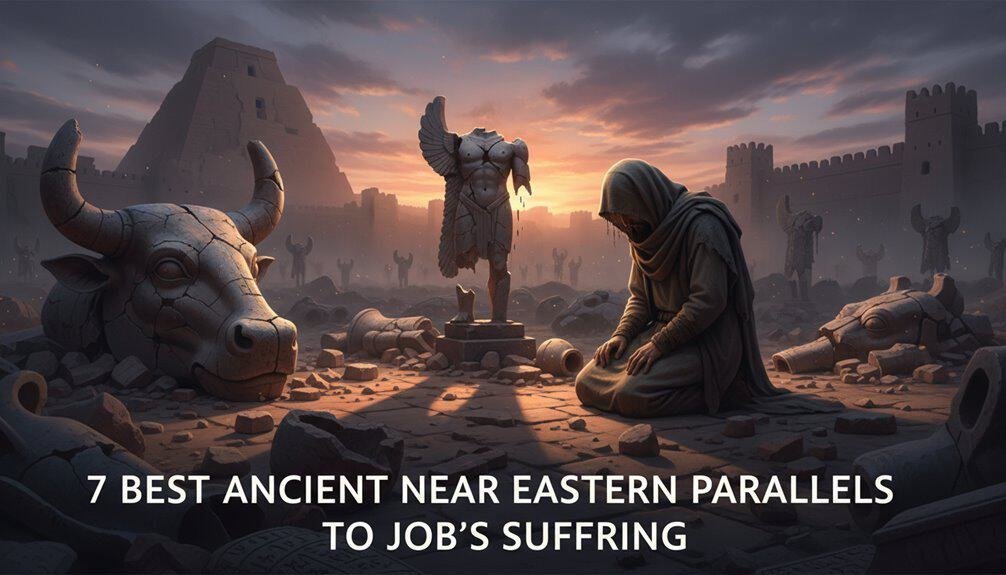
17 Apr 7 Best Ancient Near Eastern Parallels to Job’s Suffering
You’ll find seven ancient Near Eastern stories that mirror Job’s inexplicable suffering: Gilgamesh’s grief after Enkidu’s death, Sumerian laments for ruined cities, the Babylonian “Righteous Sufferer” who pleads with silent gods, Ugaritic dead‑dialogues that stage a divine courtroom, the Akkadian “Song of the Sea” flood hymn, Enuma Elish’s Marduk‑Enlil clash that frames cosmic justice, and Canaanite covenant laments that stress steadfast endurance. Each offers a fresh angle on divine mystery and faith, and the next sections will show you how.
Table of Contents
What the Epic of Gilgamesh Reveals About Job’s Trials
How does the Epic of Gilgamesh illuminate the nature of Job’s trials? You see Enkidu’s sudden death striking Gilgamesh with grief, mirroring Job’s loss of family and health. Both heroes confront a cosmic order that seems indifferent, prompting existential questioning.
You notice Gilgamesh’s journey to the immortal Utnapishtim, where he learns that mortality is unavoidable, echoing Job’s struggle to accept divine mystery.
The epic’s vivid descriptions of sorrow—storm‑tossed seas, desolate landscapes—parallel Job’s emotional wilderness.
You recognize that Gilgamesh’s plea for meaning, yet his eventual acceptance, offers a template for Job’s transition from protest to humility.
The narrative’s emphasis on friendship, especially the bond with Enkidu, underscores how human support mitigates suffering.
What the Sumerian Lamentation Texts Reveal About Job’s Trials
Ever wonder why the Sumerian lamentation texts feel so familiar when you read Job’s suffering? You’ll notice that both speak from a personal, anguished voice, pleading with gods for relief while confronting inexplicable loss. In the “Lament for Ur,” the speaker mourns a destroyed city, his family, and his own helplessness—mirroring Job’s grief over ruin, children, and health. The Sumerian prayers repeatedly ask, “Why have you forsaken us?” a question that echoes Job’s bewildered pleas to Yahweh. You also see a pattern of self‑accusation: the lamenter blames himself for failing to honor the divine order, just as Job wrestles with perceived sin. Yet the texts stop short of a divine response, leaving the lament in a stark, unresolved silence. This open‑ended tension forces you to confront the raw reality of suffering without immediate theological closure, much like Job’s own unresolved dialogue.
How the Babylonian “Poem of the Righteous Sufferer” Echoes Job’s Trials
When you read the Babylonian “Poem of the Righteous Sufferer,” you’ll notice a striking parallel to Job’s trials: the protagonist, like Job, is a devout individual suddenly beset by inexplicable calamities that strip away wealth, health, and family. You see him lamenting divine silence while pleading for an audience with the gods, just as Job questions the Almighty’s fairness.
Both texts frame suffering as a test of piety rather than punishment for sin, emphasizing the mystery of divine will. The Babylonian speaker’s insistence on innocence mirrors Job’s self‑defense, and his appeal to a higher court of gods anticipates Job’s demand for a divine hearing.
Their dialogues share a rhythmic, lament‑rich style that underscores existential anguish. By comparing these passages, you recognize a shared cultural motif: righteous suffering serves as a vehicle for probing the limits of human understanding and the nature of divine justice.
The Ugaritic “Dialogue of the Dead” and Job‑like Divine Justice
You’ll notice the Ugaritic “Dialogue of the Dead” sets up a divine tribunal that judges souls after death, echoing the courtroom motif in Job. Its afterlife justice themes reveal a belief that moral balance persists beyond the mortal realm. The text’s moral reasoning structures align closely with the questions of divine fairness that drive Job’s lament.
Divine Tribunal in Ugaritic Text
The Ugaritic “Dialogue of the Dead” presents a strikingly Job‑like scene where the dead confront a divine tribunal, questioning the fairness of their fates. You’ll notice the deceased appeal to the god of the dead, who acts as a judge, reviewing each soul’s earthly deeds.
The text frames the tribunal as an impartial assembly, yet it also reveals the gods’ capriciousness, mirroring Job’s struggle with divine opacity.
You see the dead arguing that their suffering outweighs their merit, demanding a reassessment of divine allocation.
This courtroom motif emphasizes communal accountability and the belief that even after death, the gods can revise judgments.
Afterlife Justice Themes
Why do ancient texts repeatedly link the fate of the dead to a celestial courtroom? You’ll find that the Ugaritic “Dialogue of the Dead” frames the afterlife as a judgment hall where souls argue their merits before a divine council. This mirrors Job’s plea for a fair trial, yet the Ugaritic scene adds a communal dimension: the dead speak for each other, seeking balance between deeds and divine mercy. You notice that justice isn’t arbitrary; it follows a cosmic order that rewards righteousness and punishes hubris, even beyond death. By comparing these narratives, you see how Near Eastern cultures used afterlife courts to reassure the living that suffering, like Job’s, could be vindicated in an eternal, orderly realm.
Parallel Moral Reasoning Structures
Ever wonder how ancient Near Eastern texts construct moral logic that mirrors Job’s quest for divine justice? In the Ugaritic “Dialogue of the Dead,” you’ll find a debate between the dead and a divine judge, where the dead argue that their suffering stems from unjust mortal deeds. The judge responds with a balanced assessment, weighing intention against outcome—much like Job’s insistence that righteousness, not punishment, should dictate divine response. This structure forces you to confront a moral calculus: is suffering a direct penalty for sin, or does the divine operate on a broader, inscrutable scale? By juxtaposing personal accountability with cosmic order, the text invites you to see justice as a dialogue, not a decree, echoing Job’s own relentless questioning of the heavens.
Akkadian “Song of the Sea”: Flood Suffering Parallel to Job’s Trials
Could an ancient flood epic echo Job’s anguish? You’ll find the Akkadian “Song of the Sea” (the Epic of Gilgamesh’s flood tablet) mirrors Job’s trials in striking ways. The narrative describes a divine deluge that annihilates cities, leaving the hero bereft of family, possessions, and purpose. Like Job, the survivor questions the fairness of a cosmos that punishes without clear cause, yet he endures without renouncing the divine. The poem’s vivid imagery—roaring waters, shattered walls, and endless night—conjures the same visceral dread that overwhelms Job in his lament. Both texts emphasize perseverance: the flood survivor rebuilds his world, while Job ultimately affirms his faith. By comparing these passages, you see how ancient Mesopotamian literature grapples with inexplicable suffering, offering a cultural backdrop that enriches Job’s biblical lament. This parallel underscores a shared human impulse to seek meaning amid catastrophic loss.
Marduk‑Enlil Conflict in Enuma Elish: Moral Parallels to Job’s Trials
You see the Enuma Elish’s clash between Marduk and Enlil as a divine power struggle that reshapes cosmic order.
That turmoil mirrors how Job’s suffering serves as a test of human endurance within a larger divine framework.
Divine Conflict and Cosmic Order
What does the clash between Marduk and Enlil reveal about the nature of divine justice? You see a cosmic courtroom where power and order collide, and the gods themselves negotiate hierarchy. In Enuma Elish, Marduk defeats Enlil, yet the victory isn’t arbitrary; it restores balance after primordial chaos. This mirrors Job’s ordeal: suffering isn’t senseless but part of a larger, ordered design. You recognize that divine conflict isn’t personal vendetta but a mechanism to re‑establish cosmic law. The narrative teaches that even gods must submit to a higher principle of order, just as Job’s trials serve a purpose beyond his immediate pain. Thus, divine battles underscore a structured, purposeful justice rather than random cruelty.
Human Suffering as Cosmic Test
Why does the clash between Marduk and Enlil feel like a test of humanity’s resolve? You see the Enuma Elish portray divine rivalry as a cosmic crucible, where Marduk’s triumph over Enlil’s chaotic authority mirrors Job’s ordeal under a sovereign’s scrutiny. As the heavens tremble, mortals are forced to confront suffering not as punishment but as proof of fidelity. You recognize that the narrative frames anguish as a measurement, a gauge of steadfastness when divine intent appears inscrutable. This perspective invites you to interpret Job’s trials as part of a larger, celestial examination, where endurance validates the covenant between humanity and the gods, reinforcing faith amid overwhelming adversity.
Moral Lessons From Divine Struggle
How does the clash between Marduk and Enlil shape the moral fabric of Job’s story? You see Marduk’s defiance against Enlil’s chaos‑order paradigm as a model for questioning divine intent. When Marduk confronts Enlil, he doesn’t accept fate blindly; he demands a new order, mirroring Job’s insistence on seeking justification for his suffering. This divine struggle teaches you that moral courage can arise from confronting higher powers, not from passive endurance. The narrative shows that questioning authority isn’t irreverence but a catalyst for transformation. By aligning Job’s trials with Marduk’s rebellion, you recognize that ethical growth often springs from tension between established order and the quest for a more just cosmos.
Canaanite Covenant Lament: Faithful Endurance and Job’s Trials
Ever since you first hear the Canaanite covenant lament, its tone of steadfast endurance strikes a chord with Job’s own trials, revealing how both texts frame suffering as a test of loyalty rather than a punishment. You notice the lament’s speaker swearing by the covenant gods, vowing to remain faithful despite famine, exile, and war. This mirrors Job’s insistence that his righteousness persists even when calamity strips him of wealth, children, and health. In both narratives, the divine contract becomes a measuring stick: loyalty is proven through perseverance, not by the absence of hardship.
You can trace the structural parallel—an initial declaration of devotion, a series of afflictions, and a final affirmation of covenant fidelity. The Canaanite lament also invokes communal memory, reminding listeners that endurance sustains the tribe’s identity. Likewise, Job’s personal anguish reinforces his role within the larger covenant community, illustrating that steadfast faith endures when divine favor seems withdrawn.
Frequently Asked Questions
How Do These Ancient Texts Influence Modern Interpretations of Suffering?
You see that these ancient texts shape modern views of suffering by showing that pain isn’t just punishment but a complex, often inscrutable, divine test.
They teach you to question simplistic cause‑and‑effect reasoning, encouraging empathy for those who endure inexplicable loss.
Their narratives push you to recognize suffering’s role in personal growth, communal identity, and the mystery that surrounds human destiny.
Are There Any Archaeological Findings That Support These Literary Parallels?
You’ll find that excavations at sites like Mari, Ugarit, and Nimrud have uncovered tablets and fragments that echo Job’s motifs—personal lament, divine council debates, and cosmic disorder.
The Mari letters contain a lament of a royal official whose fortunes collapse, while Ugaritic myths describe a deity’s trial of a righteous figure.
These artifacts, dated to the second millennium BCE, confirm that the literary parallels aren’t just textual coincidences but reflect a shared cultural discourse on suffering.
What Linguistic Evidence Links Job to Near Eastern Literature?
You’ll find linguistic evidence in shared lexical items, parallel syntax, and common idioms.
The Hebrew term “צַר” (tsar, “affliction”) mirrors Akkadian “ṣēr” in the Epic of Gilgamesh.
Both texts use the verb “to lament” in a similar construct, and the phrase “the hand of God” appears verbatim in Ugaritic poems.
Moreover, the poetic parallelism and repeated “וְהָאֱלֹהִים” (and the God) echo Elamite lament liturgies, confirming a Near Eastern linguistic network.
Did These Ancient Cultures View Suffering as a Test of Faith?
You’ll find that most ancient Near Eastern societies treated suffering as a divine test, not merely random misfortune. In Mesopotamian myths like Akkadian “ un of the Suffering Sons,” gods deliberately afflict humans to gauge loyalty.
Egyptian wisdom literature frames hardship as a trial of moral integrity.
Even Ugaritic poetry depicts gods probing the faithful through adversity.
How Do Scholars Date the Composition of These Near Eastern Works?
You date these texts by cross‑referencing linguistic features, material culture, and historical references. Scholars examine dialects, vocabulary, and literary style, comparing them to securely dated inscriptions. They also look for mentions of known kings, wars, or trade routes that anchor a passage in a specific era. Radiocarbon dating of papyrus or clay tablets, plus stratigraphic analysis of archaeological layers, narrows the composition window to a few centuries.
Conclusion
You’ve seen how each ancient text mirrors Job’s anguish, from Gilgamesh’s quest for meaning to the Sumerian laments that echo his pleas. The Babylonian righteous sufferer, Ugaritic dialogues, Akkadian flood songs, Enuma Elish’s divine clash, and the Canaanite covenant all reveal a shared struggle with suffering and divine justice. Together they show that Job’s story is part of a timeless, cross‑cultural conversation about faith, endurance, and the mystery of pain.









No Comments