

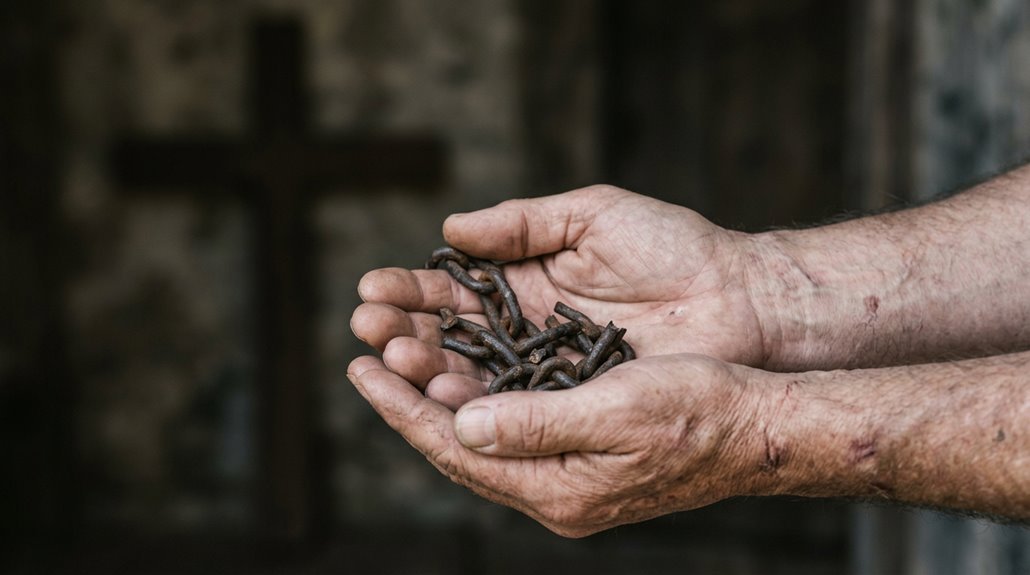
21 Mar Pierced for Our Transgressions: the Costly Love That Ends Your Self-Condemnation
You’re invited to let the costly, sacrificial love that pierces your transgressions replace the relentless self‑condemnation that holds you back. This love surrenders pride, frees you from the inner ledger of shame, and rewrites your story with unconditional grace. By embracing vulnerability and trusting that love’s burden is also a gift, the inner critic loses its grip and compassionate self‑talk rises. Keep going, and you’ll discover how this transformation unfolds in mind, brain, and heart.
Table of Contents
What Is Costly Love?
What exactly is costly love? It’s the kind of love that demands you surrender your pride, your self‑reliance, and even your sense of worth to receive grace. You feel the weight of every failure, every sin, yet you let that weight be lifted by a love that doesn’t calculate cost. It’s not a cheap, transactional affection; it’s a deep, sacrificial commitment that meets you where you’re broken and refuses to abandon you. When you accept it, you stop bargaining with yourself, stop tallying your flaws, and instead let the love’s generosity rewrite your story. It asks you to be vulnerable, to trust that the love’s cost isn’t your burden but its own. In that exchange, you discover freedom: the freedom to be loved despite your imperfections, and the power to let go of self‑condemnation.
Theological Roots of Self‑Condemnation & Healing Through Costly Love
Why do you feel the weight of every misstep crushing your spirit? You trace that pressure to ancient theology that paints sin as a debt you owe the divine. Scripture often frames humanity as “fallen,” and the law as a mirror exposing your failures. That language creates an inner ledger where each transgression adds a tally you can’t erase, feeding self‑condemnation.
Yet the same texts also reveal a counter‑narrative: a costly love that pays the price for you. The crucifixion, for instance, is presented not as a punishment you deserve but as a substitutionary sacrifice that nullifies the debt. When you internalize that love, the ledger empties; the divine’s grace overwrites your tally. You begin to see yourself not as a perpetual offender but as a beloved recipient of mercy. This shift dismantles the self‑critical loop, opening space for healing rooted in the very love that bore your sins.

How Sacrificial Love Breaks the Inner Critic?
When you truly grasp the depth of sacrificial love, the inner critic loses its grip. You start seeing that the relentless voice that labels you unworthy is fed by a narrative of isolation. Sacrificial love, however, offers a counter‑story: it demonstrates that worth isn’t earned by performance but given freely. As you internalize this, the critic’s accusations feel hollow because they clash with the reality of being loved despite flaws. You notice the critic’s volume dimming when you recall moments when someone chose you over your mistakes.
This shift rewires your self‑talk; you replace “I’m a failure” with “I’m embraced, even when I stumble.” The inner critic, deprived of its ammunition, retreats, allowing compassion to occupy the space it once dominated. In this way, sacrificial love dismantles the harsh inner dialogue and restores a healthier, more balanced self‑view.
Psychological Mechanisms Behind Painful Love’s Attack
Do you ever feel a love that should heal instead tearing you apart? You notice that your brain’s threat system spikes when affection feels conditional. The amygdala flags intimacy as potential danger, triggering cortisol surges that amplify emotional pain.
Simultaneously, the prefrontal cortex struggles to reframe the experience, leaving you stuck in a loop of self‑blame. Attachment scripts—formed in childhood—activate, making you interpret love’s criticism as personal failure.
Mirror neurons then replay the partner’s distress, causing you to internalize their hurt as your own. This neuro‑emotional feedback loop fuels a cycle where love’s attack reinforces the inner critic, deepening shame.

Literary Cases Where Costly Love Redeems the Soul
You’ll notice how characters who surrender everything for love often become vessels of redemption, their sacrifice reshaping the narrative’s moral core. Their journeys show that unconditional forgiveness can heal even the deepest wounds, turning pain into a catalyst for spiritual renewal. This pattern invites you to explore how literature uses costly love to restore the soul.
Redemptive Sacrifice in Fiction
The lover’s suffering isn’t gratuitous; it mirrors the protagonist’s inner turmoil, creating a bridge between guilt and grace. When the sacrificial act culminates—whether through death, betrayal, or renunciation—you witness a tangible shift: the condemned soul loosens its shackles, and redemption feels attainable.
These moments compel you to confront your own capacity for self‑abnegation, suggesting that love, when costly, can rewrite destiny and dissolve the darkness that once seemed immutable.
Healing Through Unconditional Forgiveness
The lover’s sacrifice sets the stage for a deeper, quieter miracle: unconditional forgiveness that heals both the wounded and the wounding. You feel the weight of betrayal lift as the narrative shows the betrayer’s remorse met with a mercy that spares retribution. In *A Tale of Two Cities*, Sydney’s self‑immolation forces Charles to confront his own hatred, and the ensuing forgiveness restores his humanity.
In *The Kite Runner*, Amir’s pilgrimage to rescue Hassan’s son becomes a conduit for at, allowing him to forgive himself and break the cycle of guilt. These stories teach you that love, when offered without condition, transforms pain into redemption, allowing the soul to breathe anew.
Signs You’re Stuck in Self‑Condemnation
Ever wonder why you keep replaying every mistake in your head, feeling trapped in a loop of self‑criticism? You notice you’re constantly berating yourself, turning minor slip‑ups into catastrophes. You avoid eye contact because you fear judgment, even from yourself, and you replay the same harsh inner dialogue daily. You feel a heavy weight of guilt that never lifts, and you’re quick to blame yourself for outcomes beyond your control. You isolate, assuming you don’t deserve support, and you sabotage opportunities that could bring relief. Your self‑talk is riddled with absolutes—“I’m worthless,” “I always fail.” You dread starting new projects, fearing they’ll confirm your inadequacy. Physical tension builds: clenched jaw, tight shoulders, shallow breathing. You notice a persistent sense of shame that colors every decision, and you struggle to celebrate any achievement, however small. These patterns signal you’re stuck in self‑condemnation.
Turning Ego Into Compassion After the Piercing
You can trace your ego back to the fears that sparked it, then stay present enough to notice when those old patterns surface.
By holding that awareness without judgment, you create space for genuine compassion to arise.
Let that compassion guide your next actions, turning self‑criticism into caring service.
Recognize Ego’s Roots
Why do we cling to ego’s familiar patterns after the piercing?
You notice the ego’s voice whispering “I’m not enough” or “I must control.” Those messages trace back to early survival strategies: fear of abandonment, need for approval, and the desire to prove worth. Recognizing this origin lets you see the ego not as a monster but as a protective child. When you trace the feeling to a specific memory—perhaps a childhood criticism or a parental expectation—you expose its hidden motive. Label the impulse, then ask, “What does this part truly need?” By naming the need for safety, love, or validation, you can meet it with compassion instead of judgment. This shift dissolves the ego’s grip, opening space for authentic self‑acceptance.
Practice Mindful Presence
Having uncovered the ego’s hidden motives, you can now settle into mindful presence, allowing each breath to become a bridge from judgment to compassion. Notice the sensation of air entering your nostrils, the rise and fall of your chest, and let these physical cues anchor you in the now. When thoughts of self‑criticism arise, acknowledge them without clinging, then gently return focus to the breath. This simple loop—inhale, observe, exhale—creates space for kindness to replace harsh inner dialogue. As you practice, you’ll feel the ego’s grip loosen, replaced by a calm awareness that embraces imperfection. Keep this routine short but consistent; even a few minutes each day reshapes how you relate to yourself and the world.
Invite Compassionate Action
How can you transform the sting of self‑judgment into a catalyst for kindness? First, notice the ego’s alarm bell and label it without shame. Then, redirect that energy toward a concrete act: a supportive text, a listening ear, or a small deed for someone else. Treat the piercing as a signal that you’re alive, capable of change. When the urge to criticize surfaces, pause, breathe, and ask, “What would a compassionate version of me do now?” Choose the answer that eases another’s burden, even if it’s as simple as offering a smile. By repeatedly pairing self‑awareness with outward kindness, you rewire the ego’s sting into a steady stream of purposeful, loving action.
Frequently Asked Questions
How Can I Measure Progress in Overcoming Self‑Condemnation?
You measure progress by tracking thoughts, feelings, and actions daily. Log moments when you notice self‑criticism, then note how long it lasts and how intensely you feel it.
Compare those entries over weeks, watching for shorter spikes and milder intensity. Celebrate concrete shifts—like choosing self‑compassion instead of blame, or completing tasks without inner sabotage.
Use a simple rating scale (1‑10) to quantify change, and revisit your logs monthly to see the trend.
Are There Specific Prayer Practices That Enhance Costly Love?
Yes, you can adopt prayer practices that deepen costly love. Begin with a simple, heartfelt confession, then repeat a mantra like “I am loved despite my flaws.” Follow with a gratitude list focused on divine grace, and finish by asking for the strength to extend that love to yourself and others. Meditate on a sacred image for a few minutes, letting the feeling of unearned love settle in your heart. This routine cultivates humility and transforms self‑condemnation into compassionate acceptance.
What Role Does Community Support Play in Healing?
You’ll find that community support fuels healing by offering accountability, encouragement, and shared wisdom.
When you lean on trusted friends or a faith group, their prayers and honest feedback remind you that you’re not alone in your struggle. Their presence softens shame, models healthier habits, and creates a safe space for vulnerability. This collective strength accelerates the transformation from self‑condemnation to the costly love that restores your heart.
Can Costly Love Be Applied to Non‑Religious Contexts?
Yes, you can apply costly love outside religion. Think of it as sacrificing personal comfort to nurture another’s growth, even when it hurts you.
In friendships, you might give time or resources despite feeling depleted, because you value the other’s healing.
In activism, you endure hardship to support a cause you love.
The key is intentional, self‑transcending love that transforms both giver and receiver, regardless of spiritual framing.
How Do Cultural Differences Affect the Perception of Sacrificial Love?
You’ll find cultural differences shape sacrificial love by shifting what you deem worthy of sacrifice, how openly you display devotion, and whether you value individual heroism or communal duty. In collectivist societies, you’re praised for giving up personal gain for family or group harmony, while individualist cultures often glorify personal sacrifice for a cause or lover. Religious narratives, gender roles, and social norms further color whether you see such love as noble, obligatory, or even tragic.
Conclusion
You’ve seen how costly love—sacrificial, painful, and unconditionally given—shatters the inner critic and heals self‑condemnation. By embracing this piercing compassion, you transform ego into empathy, allowing grace to replace shame. The path isn’t easy, but each step toward receiving and extending such love rewrites your story, freeing you from the relentless cycle of self‑judgment and inviting a life rooted in authentic, restorative love.












No Comments