

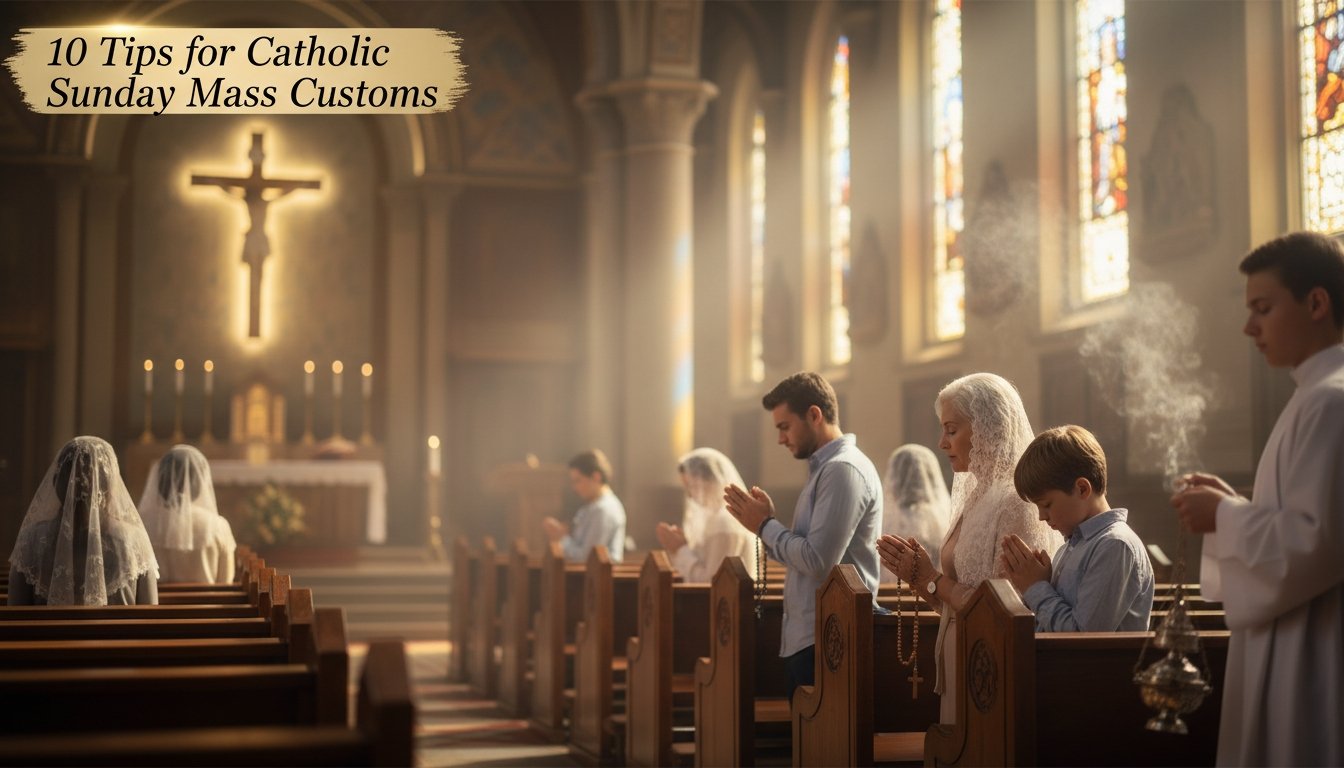
08 Mar 10 Tips for Catholic Sunday Mass Customs
Engage in Catholic Sunday Mass customs by understanding the significance of Palm Sunday, actively participating in the procession and Passion reading, and incorporating blessed palms into your home prayer life. Make the sign of the cross on your forehead, lips and heart before the Gospel, and wave your palm branch high during the joyful “Hosanna” chant. These rituals will deepen your connection to the sacred mysteries of Holy Week and the triumph of Easter. To fully immerse yourself in this special time, continue exploring the depth of Catholic liturgical observances.
Table of Contents
Key Takeaways
- Dress modestly and respectfully for Mass, avoiding casual or revealing clothing.
- Actively participate in Mass rituals, such as making the sign of the cross, kneeling, standing, and sitting when appropriate.
- Follow the congregation’s lead for responses and chants during the liturgy.
- Receive communion reverently, either on the tongue or in the hand, and return to your seat prayerfully.
- Engage in personal prayer and reflection before and after Mass to deepen your spiritual experience.
The Meaning and Significance of Palm Sunday
Why is Palm Sunday so significant in the Catholic tradition? It marks the start of Holy Week, commemorating Jesus’ triumphal entry into Jerusalem, where he was hailed as the Messiah. The faithful carry palms, recalling the palm branches people laid in his path. This joyful celebration foreshadows Christ’s impending passion and death on the cross. The palms are blessed and distributed, reminding us of the salvation Jesus brings. You’ll often see palm crosses or other palm-woven items in homes, a tangible reminder of this holy day.
Palm Sunday sets the stage for the most sacred time of the liturgical year, leading up to Easter, the pinnacle of the Catholic faith.
The Ritual Blessing and Distribution of Palms
You’ll start with the blessing of the palms during the Palm Sunday liturgy.
The priest will then distribute the blessed palms to the congregation.
This ritual commemorates Jesus’ triumphant entry into Jerusalem.
Blessing of Palms
The blessing of palms marks the start of Holy Week, the most sacred time in the Catholic liturgical calendar. During this ritual, parishioners receive palm fronds that are blessed and distributed.
The palms represent Jesus’ triumphal entry into Jerusalem, where people waved palm branches to welcome him. This custom dates back to the 4th century and symbolizes your faith and devotion.
After the palms are blessed, you’ll carry them in a procession, reenacting Christ’s journey.
The palms are then taken home and displayed as a reminder of this important day and the start of the Passion of our Lord.
Distribution of Palms
How does the ritual blessing and distribution of palms unfold during the Catholic Sunday Mass? The priest blesses the palm branches, typically at the start of the service. Parishioners then come forward to receive their palm. This commemorates Jesus’ triumphal entry into Jerusalem, when people waved palm branches to welcome him. Holding the blessed palms, the congregation joins in the opening procession, reenacting Christ’s procession. The palms are often kept and used for ashes on Ash Wednesday the following year, as a symbol of penance and repentance. The distribution of palms is a meaningful tradition, connecting the faithful to Christ’s passion and resurrection.
Reenacting Christ’s Entry Into Jerusalem: the Palm Sunday Procession
On Palm Sunday, Catholics reenact Christ’s triumphant entry into Jerusalem by carrying blessed palm branches in a procession. These symbolic palm branches commemorate the joyous occasion when people welcomed Jesus with shouts of praise. As you participate in this ritual, you’ll connect with the celebratory atmosphere that surrounded Christ’s arrival.
Commemorating Christ’s Arrival
What better way to commemorate Christ’s triumphant arrival in Jerusalem than by reenacting His grand procession? On Palm Sunday, Catholics carry palms and join a solemn procession, recalling Jesus’ entry into the holy city. You’ll process around the church, waving palms and singing hymns. It’s a vivid reminder of that momentous day when crowds hailed Jesus as the Messiah. The palms blessed during this ritual will be kept and used later to make the ashes for Ash Wednesday. This annual reenactment connects you to Christ’s life and passion, inviting you to welcome Him anew into your heart.
Symbolic Palm Branches
The palm branches carried during the Palm Sunday procession serve as a symbolic representation of Christ’s triumphant entry into Jerusalem. They commemorate the day when people waved palm branches and hailed Jesus as the Messiah. Today, the palms remind you of this joyous occasion and Christ’s kingship. As you receive your blessed palm, hold it high, joining the faithful in this centuries-old tradition. The palm’s green leaves symbolize life, hope, and victory, while its branches represent peace. Cherish this tangible link to Jesus’ life and your faith.
The Reading of the Passion Narrative
Typically, on Palm Sunday and Good Friday, the Passion narrative is solemnly read during the Catholic Sunday Mass. The reading features the account of Jesus’s final hours, including his trial, crucifixion, and death. The narrative’s dramatic dialogue is often divided among various readers, with the congregation responding to certain parts. This participation helps the faithful enter more deeply into the events. The reading’s solemn tone and the congregation’s active involvement make the Passion narrative a poignant moment of the liturgy, reminding worshipers of the tremendous sacrifice at the heart of the Christian faith.
Observing Holy Week: From Palm Sunday to Easter Sunday
How does one observe the sacred days of Holy Week, from Palm Sunday to Easter Sunday? On Palm Sunday, you’ll wave palms, commemorating Jesus’s triumphant entry into Jerusalem.
During Holy Week, you’ll attend solemn Masses and services, reflecting on Christ’s Passion.
On Holy Thursday, you’ll witness the washing of the feet and the consecration of the Eucharist.
On Good Friday, you’ll venerate the Cross and recall Jesus’s death.
Then, on the glorious Easter Vigil and Easter Sunday, you’ll celebrate Christ’s Resurrection with joyous hymns and feasting.
These rituals connect you to the central mysteries of the Christian faith, fostering spiritual renewal during this most sacred time of year.
Customary Attire and Dress for Palm Sunday Mass
When attending Palm Sunday Mass, you’ll want to dress in your Sunday best. Modest and respectful attire is expected, so avoid overly casual or revealing clothing. Remember, your appearance should reflect the solemnity of the occasion.
Appropriate Clothing Choices
What sort of attire is considered appropriate for attending Palm Sunday Mass? As a general rule, you’ll want to wear clothing that’s modest, neat, and respectful. Avoid overly casual or revealing outfits. Men might opt for dress pants, a button-down shirt, and a tie. Women can wear dresses, skirts, or dress pants with a nice blouse. Avoid wearing shorts, tank tops, or anything too tight or short. The key is to dress in a way that reflects the solemnity and reverence of the occasion. Remember, you’re coming to worship, so let your attire demonstrate your respect for the sacred liturgy.
Etiquette Regarding Dress
Typically, the attire for attending Palm Sunday Mass should reflect the solemnity and reverence of the occasion. Wear your Sunday best – modest, clean, and neat clothing. Avoid shorts, tank tops, or anything too casual or revealing. Gentlemen should opt for slacks and a collared shirt, while ladies can choose a dress, skirt, or blouse and slacks. Remember, you’re coming to worship, not to draw attention to yourself. Your appearance should honor God and the sacredness of the liturgy. By dressing appropriately, you’ll show respect for the celebration and your faith community.
Incorporating Palms Into Home Decor and Prayer
How can you incorporate palms into your home decor and prayer? After Palm Sunday, you can use the blessed palms to create beautiful displays. Weave them into wreaths or garlands to hang on your walls or doors. Place them in vases or jars to display. You can also fold the palms into crosses or other shapes and set them around your home as reminders of your faith.
During prayer, hold the palms as a tangible connection to the triumphal entry of Jesus into Jerusalem. Use them to meditate on His sacrifice and your own spiritual journey. Incorporating palms into your home and prayer life can deepen your connection to the rhythms of the liturgical calendar and your Catholic faith.
The Symbolism Behind the Waving of Palms
The waving of palms on Palm Sunday carries profound symbolic meaning within the Catholic tradition. It commemorates Jesus’ triumphant entry into Jerusalem, where the people welcomed him by waving palm branches. This gesture represents the people’s reverence and joy at his arrival as their long-awaited Messiah.
The palms also symbolize victory, as they were often used to honor important figures in ancient times. Today, the waving of palms reminds Catholics of Christ’s kingship and foreshadows his ultimate victory over sin and death through his crucifixion and resurrection. This ritual allows the faithful to participate actively in reliving and celebrating this pivotal moment in salvation history.
Participating in the Palm Sunday Liturgy: Responses and Gestures
During the Palm Sunday liturgy, you actively participate by following along and engaging in the various responses and gestures. You hold your palm branch high as the procession begins, joining in the joyful “Hosanna” chant. When the Gospel is read, you make the sign of the cross on your forehead, lips, and heart, pledging to keep Christ’s word in your mind, on your lips, and in your heart. You listen attentively to the Passion narrative, responding with reverence. Throughout the service, you kneel, stand, and sit as directed, fully immersing yourself in the sacred rituals. Your active participation strengthens your connection to the community and deepens your spiritual experience of this holy day.
Palm Sunday as the Gateway to the Easter Triduum
Why is Palm Sunday considered the gateway to the Easter Triduum? Palm Sunday marks the start of Holy Week, the most sacred time in the Catholic liturgical calendar. It commemorates Jesus’ triumphant entry into Jerusalem, which sets the stage for his passion, death, and resurrection. During the Triduum, the faithful participate in the three-day observance of the central events of our faith – the Last Supper, the Crucifixion, and the Resurrection. Palm Sunday’s procession with palms and the reading of the Passion narrative prepare us to fully enter into these profound mysteries. It’s a time to renew our commitment to Christ and our baptismal promises. The Triduum liturgies flow seamlessly from one to the next, culminating in the joy of Easter. Palm Sunday opens the door to this most significant week in the Church’s year.
Frequently Asked Questions
Can I Receive Communion if I’m Not Catholic?
You can’t receive communion if you’re not Catholic. Communion is a sacrament reserved for Catholics who’ve been baptized and confirmed, and who are in a state of grace. If you’re not Catholic, you can still attend Mass and participate in other parts of the service, but you won’t be able to receive communion.
How Long Should I Kneel During Mass?
You should kneel during the Eucharistic Prayer and when the priest elevates the consecrated host and chalice. The length of time can vary, but it’s generally 5-10 minutes. However, if you’re unable to kneel, you can stand or sit. The most important thing is to participate in the Mass respectfully and with reverence.
Is It Acceptable to Wear Jeans to Mass?
Wearing jeans to Mass is generally acceptable, though some parishes may have a more formal dress code. It’s best to check with your local church or dress in a way that shows respect for the sacred nature of the celebration. The key is to come prepared to worship, not necessarily in your Sunday best.
Can I Take My Palm Home After Mass?
Yes, you can take your palm home after Mass. It’s a tradition to take the blessed palm from Palm Sunday and display it in your home as a symbol of Christ’s triumphant entry into Jerusalem. You can keep the palm for the whole year until the next Palm Sunday, when you should replace it with a new one.
Why Do We Make the Sign of the Cross?
You make the sign of the cross to invoke the Holy Trinity and bless yourself. It’s a physical expression of your Catholic faith, reminding you that you’re protected by the power of the Father, the Son, and the Holy Spirit. It’s a gesture you’ll use throughout the Mass, from the beginning to the end, as a way to keep your mind focused on God.
Conclusion
You’ve explored the rich customs and significance of Palm Sunday. Remember, these ancient traditions invite you to enter more deeply into the sacred mysteries of Holy Week. As you observe this solemn yet joyful day, let the palms and procession inspire your own journey toward the triumph of Easter.











No Comments