


22 Feb 100 Fun Bible Family Feud Questions for Game Night
You’ll discover Bible Family Feud questions covering Old Testament heroes like Moses parting the Red Sea and David defeating Goliath, plus New Testament miracles including Jesus feeding five thousand and walking on water. Questions span the twelve apostles, biblical landmarks like Jerusalem and Jericho, archaeological artifacts, Scripture numbers, and famous verses from Psalms and John 3:16. These reverent trivia challenges transform game night into meaningful fellowship while testing your biblical knowledge. Continue exploring to unlock comprehensive strategies and detailed question categories.
Key Takeaways
- Old Testament heroes like Moses, David, and Abraham provide exciting character-based questions about faith, courage, and biblical adventures.
- New Testament miracles and apostle stories offer dynamic question categories covering Jesus’ healing powers and early church experiences.
- Biblical artifacts and archaeological discoveries create unique question opportunities linking ancient history with scriptural truth and modern findings.
- Famous Bible verses like John 3:16 and Psalm 23 generate memorable family feud rounds with high recognition value.
- Strategic gameplay techniques include mastering the defer strategy, proper buzzer timing, and organizing teams by biblical knowledge strengths.
How to Set Up Your Bible Family Feud Game Night
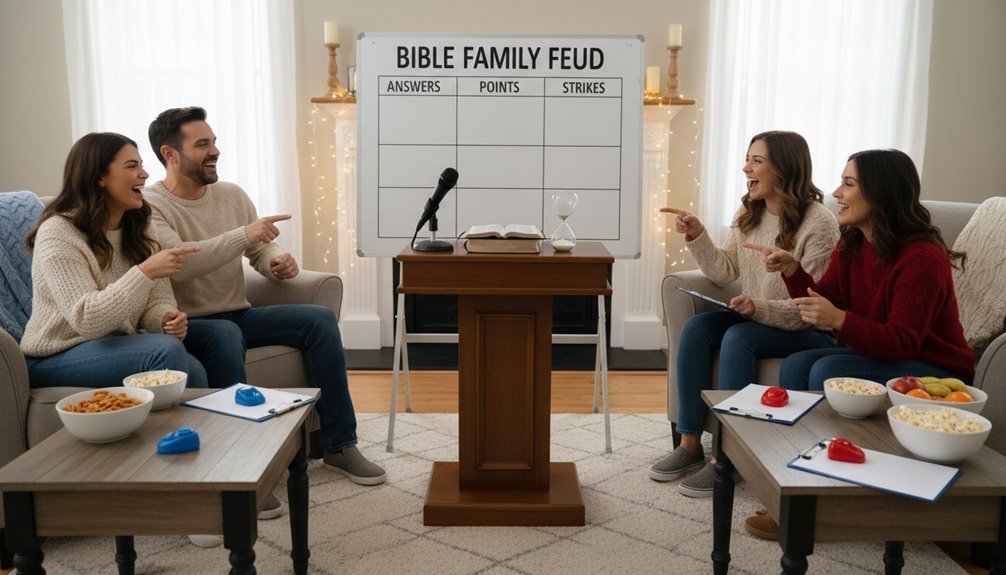
How can you transform an ordinary game night into a meaningful gathering that builds biblical knowledge while bringing families together? Setting up your Bible Family Feud requires careful preparation that honors God’s Word while creating an engaging atmosphere.
You’ll need two teams with three to six players each, designating one person as host. Position two long tables parallel to each other with several feet between them. Place a podium centered at one end with a bell or buzzer attached. Create a visible game board for tracking answers and scores.
Unlike games with unrelated topics or offbeat themes, Bible Family Feud centers on Scripture, making every question an opportunity for spiritual growth. Each team stands behind their table, with the first player positioned at the podium, one hand behind their back and one ready to buzz in. The game encourages collaborative learning as family members discuss potential answers together before responding. This setup ensures smooth gameplay while maintaining reverent focus on biblical truths that strengthen faith and fellowship.
Old Testament Heroes and Stories Family Feud Questions
When you explore Old Testament heroes and their remarkable journeys, you’ll discover countless opportunities to create engaging Family Feud questions that celebrate God’s faithful servants.
Moses’ extraordinary leadership offers rich material for your game night. You can craft questions around his confrontations with Pharaoh, the miraculous Red Sea crossing, or receiving the Ten Commandments on Mount Sinai. Abraham’s unwavering faith provides equally compelling content, from his obedient departure to the Promised Land to his willingness to sacrifice Isaac.
Samson’s incredible strength and tragic downfall through Delilah’s betrayal creates dramatic two word discussion ideas. David’s triumph over Goliath and his psalms inspire reverent gameplay moments. Nehemiah’s remarkable 52-day wall reconstruction demonstrates God’s provision.
Joseph’s rise from slavery to governor in Egypt after being sold by his jealous brothers showcases God’s ability to transform difficult circumstances into blessing. These biblical narratives prevent your game from drifting into unrelated topics while maintaining spiritual focus. Each hero’s story offers multiple angles for questions that honor Scripture while creating memorable fellowship experiences for your family and friends.
New Testament Miracles and Disciples Bible Trivia
You’ll find that exploring Jesus’ miraculous works through family trivia brings His divine power into vivid focus for your group. The New Testament records dozens of extraordinary healings, resurrections, and nature miracles that demonstrate Christ’s authority over sickness, death, and creation itself. Testing your family’s knowledge of the twelve apostles and their own miraculous ministry will deepen everyone’s appreciation for how God worked through ordinary people to accomplish extraordinary things. The apostles performed miracles that served as objective testimony supporting their preaching and helped fuel the remarkable growth of the early church.
Jesus’ Miraculous Works
What better way to explore Christ’s divine power than through Family Feud questions about His miraculous works? You’ll discover thirty-seven recorded miracles spanning healing, nature, exorcism, and resurrection categories. These extraordinary acts demonstrate Jesus’ authority over sickness, storms, demons, and death itself.
When crafting questions about Christ’s miracles, you’ll want to focus on authentic Gospel accounts rather than subtopic inaccuracies or unrelated fiction. Consider asking about the wine at Cana, feeding five thousand, walking on water, or raising Lazarus. Your family will engage deeply with Scripture while learning about miraculous catches of fish, calmed storms, cleansed lepers, and restored sight.
These questions celebrate Christ’s compassionate ministry while creating meaningful discussions about faith. Many miracles showcase Jesus performing distance healing without physical presence, demonstrating His divine authority transcends earthly limitations. You’re not just playing games—you’re exploring the very foundations of Christian belief through interactive Scripture study.
Twelve Apostles Facts
After prayer on a mountain, Jesus deliberately chose twelve apostles to form the foundation of His new covenant community. This mountain symbolism deliberately echoes Mount Sinai, where God established His covenant with Israel’s twelve tribes. You’ll discover fascinating apostles dynamics when studying their backgrounds—fishermen like Peter, Andrew, James, and John formed the inner circle, while Matthew collected taxes and Simon championed revolutionary causes. None were professional religionists, yet Christ transformed these ordinary men into extraordinary witnesses.
Their initial mission involved preaching in pairs throughout Galilee, healing the sick, and driving out demons. After Christ’s resurrection and the Holy Spirit’s arrival, these same apostles turned the world upside down, establishing churches and boldly proclaiming the gospel to earth’s ends despite fierce persecution. The apostles held unique authority that distinguished them from ordinary disciples, as their preaching and teaching became the canonical foundation of the New Testament.
Famous Biblical Cities and Landmarks Family Feud Style

How deeply do biblical cities and landmarks resonate through Scripture’s most pivotal moments? Unlike any unrelated topic in modern game design, these sacred locations form the backbone of God’s redemptive story. You’ll find Jerusalem standing as Scripture’s crown jewel—where Jesus walked, died, and will return. The Temple Mount, Calvary, and David’s city pulse with eternal significance.
Consider Jericho’s fallen walls demonstrating God’s faithfulness as Israel entered the Promised Land. The Jordan River witnessed both miraculous crossings and Jesus’ baptism, marking divine transitions. From the Mount of Olives, Christ ascended while delivering prophecies that continue proving Scripture’s accuracy.
Even distant Babylon reminds us of God’s sovereignty over nations and His people’s ultimate deliverance. These landmarks aren’t merely geographical markers—they’re testimonies of God’s unchanging character. When you explore these locations through Family Feud questions, you’re celebrating the very foundations where faith took root and flourished throughout biblical history.
Biblical Artifacts and Religious Symbols Trivia Questions
Where else can you witness God’s enduring presence than through the remarkable artifacts that survived millennia to confirm Scripture’s truth? These sacred discoveries transform your understanding of Biblical history from abstract concepts into tangible realities you can touch and examine.
The Yahweh Ṣebaot inscription from 800 BCE proves ancient Israelites worshipped the “Lord of Hosts” exactly as Scripture records. Darius I’s quadrilingual jar validates the Persian rulers mentioned throughout Ezra and Nehemiah. The ivory cherub from Syria illuminates the mysterious guardians described in Exodus and Kings.
Even controversial artifacts like the Turin Shroud spark meaningful theology debates about Christ’s crucifixion while maintaining archaeology ethics in scholarly discussion. The Lion and Calf Bowl beautifully depicts Isaiah’s messianic prophecy of peaceful coexistence.
You’ll discover these artifact-based questions don’t just entertain—they strengthen faith by demonstrating how archaeology consistently supports Biblical accounts, making your game night both educational and spiritually enriching.
Scripture Numbers and Ages Bible Family Feud Format
Biblical numbers reveal God’s perfect timing and divine purpose throughout Scripture’s most pivotal moments. When you’re crafting fun trivia questions about ages and numbers, you’ll discover fascinating patterns that make excellent Family Feud challenges.
God’s perfect timing unfolds through Scripture’s numbers, creating fascinating patterns that transform ordinary trivia into meaningful Family Feud challenges.
Consider Jesus beginning His ministry at thirty—the same age David became king. Moses was eighty when God called him to confront Pharaoh, proving it’s never too late for divine purpose. Your age trivia can highlight young Joseph at seventeen when his brothers sold him, contrasting sharply with Methuselah’s record-breaking 969 years.
Create engaging questions about census requirements: “Name ages when Levites could serve in the temple” (answers: twenty-five to fifty). Challenge players with “How long did Jesus fast in the wilderness?” (forty days).
These numerical elements aren’t mere statistics—they’re God’s intentional design woven throughout redemption history. You’ll find that Scripture’s precise timing creates memorable, meaningful trivia that strengthens biblical literacy while bringing families together.
Bible Books and Famous Verses Game Night Questions
You’ll discover that the most quoted Bible verses create exciting game opportunities that strengthen Scripture knowledge across generations. Popular verses like John 3:16 and Jeremiah 29:11 naturally spark memorable family feud rounds where teams compete to name God’s most treasured promises. These scripture memory games transform beloved passages into interactive experiences that honor God’s Word while building lasting spiritual connections.
Most Quoted Bible Verses
When believers gather around God’s Word, certain verses rise above others as treasured gems that have shaped countless lives across generations. You’ll discover that John 3:16 leads global searches with over 2 million monthly queries, proving its enduring impact on hearts worldwide. Jeremiah 29:11 and Philippians 4:13 follow closely, each capturing 82,000 searches monthly.
Unlike any irrelevant topic or unrelated theme, these verses carry eternal significance. Psalm 23 dominates BibleGateway’s rankings, claiming six of the top seven spots. You’ll find Psalms represent 39 of the top 100 most-read verses in 2024, with Psalm 91 joining Psalm 23 as reader favorites. Exodus 34:6-7 stands as the Hebrew Scriptures’ most internally referenced passage, echoing God’s mercy throughout Scripture’s pages.
Popular Scripture Memory Games
How can families transform ordinary game night into vibrant Scripture memory sessions that stick? These engaging activities turn verse memorization into joyful experiences. Try Sparkle Game where children recite verses word-by-word around a circle—hesitation means sitting down. The Books of Bible Memory Matching uses illustrated cards to help families learn all sixty-six books through visual gameplay. Balloon-based verse practice adds physical movement as teams juggle balloons while reciting Scripture. Action challenges like First Letter prompts turn verses into secret codes, while Treasure Hunt connects hiding God’s word with Psalm 119:11. Skip unrelated humor and unrelated snacks initially—let Scripture itself provide the entertainment. These games create lasting memories through repetition, peer encouragement, and active participation that honors God’s word.
Winning Strategies for Bible Family Feud Success
Why do some teams consistently triumph in Bible Family Feud while others struggle to find their footing? Success requires more than biblical knowledge—it demands strategic thinking rooted in wisdom.
Master the defer strategy after winning face-offs. While no team has historically chosen deferral, Scripture teaches us that “the humble will be exalted.” Let opponents face pressure guessing all answers, then steal with collective wisdom. Position yourself at the podium with proper buzzer technique: one hand behind your back, one ready to respond.
Develop praise focused strategies that honor God throughout gameplay. Celebrate correct answers with gratitude rather than boastfulness. Practice competition etiquette by encouraging opponents and maintaining fellowship.
During team play, assign members based on biblical strengths—some excel in Old Testament narratives, others in New Testament teachings. Remember that three strikes end your turn, so discuss answers thoughtfully. When stealing opportunities arise, huddle prayerfully and target remaining board answers strategically.
Frequently Asked Questions
Can We Use Modern Bible Translations or Only King James Version?
You can absolutely use modern translations for your Bible Family Feud game! Version differences shouldn’t create denominational disputes during family time. Whether you choose ESV, NIV, or NASB, focus on God’s unchanging truth rather than translation ethics debates. These Bible study tools help everyone participate meaningfully. Let family dynamics center on Scripture’s wisdom, not which version you’re using. God’s Word transforms hearts regardless of translation choice.
What Happens if Teams Give Slightly Different Versions of Same Answer?
When you give slightly different versions of the same biblical answer, you’ll receive credit if your response matches the board’s intent. God’s Word remains consistent despite translation variances, and your game should reflect this truth. Whether you say “Moses” or “Moses the Lawgiver,” the same answer variance won’t penalize your team. Focus on the scriptural essence rather than exact phrasing—let grace guide your gameplay decisions.
How Do We Handle Answers That Are Theologically Disputed Between Denominations?
You’ll want to accept answers reflecting different denominational perspectives when they’re biblically supported, weighing doctrinal disagreements fairly. Focus on Scripture’s clear teachings rather than disputed interpretations. When handling phrasing variants of theological concepts, allow responses that capture the biblical essence, even if expressed differently. Remember, you’re fostering unity around God’s Word, not creating division over secondary matters that faithful Christians have long debated.
Should We Allow Participants to Use Bibles During Gameplay for Reference?
You shouldn’t allow participants to use notes or Bibles during gameplay. This Bible reference policy maintains the game’s integrity while testing your genuine scripture knowledge. Though translation differences are allowed in answers, using devices would eliminate the fun challenge of recalling God’s Word from memory. Trust the Holy Spirit to bring verses to remembrance as you compete together in Christian fellowship.
What Age Groups Work Best for Bible Family Feud Games?
You’ll find Bible Family Feud works beautifully across all age groups, from elementary children to grandparents. The game’s age appropriateness shines when you mix generations together, creating wonderful fellowship opportunities. While there’s accessibility variance between casual Bible readers and scholars, you can adjust difficulty levels accordingly. Children bring enthusiasm, teens add energy, adults provide wisdom, and seniors share deep scriptural knowledge. This blessed combination makes every game night memorable.
Conclusion
You’ve discovered how Bible Family Feud transforms ordinary game nights into meaningful fellowship opportunities. As you gather your family and friends, you’re not just playing games—you’re diving deeper into God’s Word together. These questions will spark conversations about faith, create lasting memories, and strengthen your spiritual bonds. Let Scripture guide your fun, and watch how laughter and learning intertwine. Your game night becomes a celebration of biblical truth and community fellowship.








No Comments