


23 Feb Biblical Feminism: Strong Women God Actually Celebrates
You’ll find Scripture celebrates women who exercised remarkable authority that challenges modern assumptions about biblical gender roles. Deborah commanded Israel’s army and judged the nation for forty years. Miriam led prophetic worship and guided Israel through wilderness wanderings. Esther wielded strategic political influence to prevent genocide. Mary Magdalene became the first resurrection witness, earning the title “apostle to the apostles.” These patterns reveal God’s consistent elevation of female voices to accomplish what conventional leadership couldn’t achieve.
Key Takeaways
- Deborah exemplified combined spiritual and judicial authority, leading Israel to victory and forty years of peace as both prophet and judge.
- Esther demonstrated strategic courage by leveraging her position to save the Jewish people, transforming vulnerability into protective leadership.
- Miriam and Huldah provided prophetic voices that shaped worship, community celebration, and influenced major national religious reforms.
- Lydia and Anna established early Christian communities through hospitality, evangelism, and recognition of Jesus as Messiah in temple worship.
- Biblical women consistently transformed challenging circumstances into decisive action, prioritizing community welfare over personal safety and conventional expectations.
Deborah: The Judge Who Led Israel’s Army Into Battle

In twelfth-century Israel, one woman shattered every conventional boundary of leadership when God appointed Deborah as both prophet and judge over His people. You’ll find her contrasting leadership style unprecedented among Israel’s judges—she fused prophetic authority with judicial wisdom while commanding military strategy from her palm tree court between Ramah and Bethel.
When Canaanite king Jabin’s 900 iron chariots oppressed Israel for twenty years, Deborah demonstrated battlefield diplomacy by summoning Barak to Mount Tabor. She didn’t merely issue orders; she prophesied victory and accompanied him into battle, embodying Moses-like authority that combined spiritual and temporal power.
Her strategic mind recognized that Israel’s liberation required divine intervention against superior military technology. Through careful orchestration of God’s timing and Barak’s forces, she secured Sisera’s defeat and Jael’s decisive action. This victory established forty years of peace and restored Israel’s covenant relationship with God. Deborah earned the title “mother in Israel” for her protective role over the nation during this critical period.
Miriam: The Prophet Who Guided Israel Through the Wilderness
How does one woman’s quick thinking along the Nile River evolve into prophetic leadership that sustains an entire nation through forty years of wilderness wandering? You’ll discover Miriam’s transformation from protective sister to recognized prophetess reveals God’s celebration of female leadership.
When you examine Exodus 2:1-10, you see Miriam’s courage protecting infant Moses from Pharaoh’s deadly decree. Her strategic approach to Pharaoh’s daughter secured Moses’ survival and Hebrew upbringing. This wasn’t an unrelated topic to her later prominence—it established her leadership foundation.
Exodus 15:20-21 identifies Miriam as prophetess, leading women in victory worship after the Red Sea crossing. She initiated communal celebration through dance and song, demonstrating worship leadership alongside Moses and Aaron. The Song of Miriam is viewed as an ancient, possibly oldest Israelite poem.
Throughout wilderness wandering, rabbinic tradition connects Miriam to Israel’s supernatural water supply. Her death at Kadesh coincided with the well’s disappearance, underscoring her vital role. Modern applications include recognizing women’s prophetic calling and worship leadership in faith communities.
Esther: The Queen Who Risked Everything to Stop Genocide
When Esther concealed her Jewish identity in the Persian court, she couldn’t have anticipated that this strategic silence would position her to prevent the systematic extermination of her people. Mordecai’s counsel to hide her ethnicity proved providential when Haman’s genocidal decree threatened all Jews across the empire’s 127 provinces.
Esther’s strategy demonstrates sophisticated political maneuvering. Rather than immediately revealing Haman’s plot, she orchestrated two banquets, building suspense while creating the optimal moment for revelation. This calculated approach maximized her influence over King Ahasuerus.
Her public courage emerges most powerfully when she approached the throne uninvited, risking execution under Persian law. The three-day fast she called reveals her understanding that divine intervention required human action. By declaring “if I perish, I perish,” Esther embodied sacrificial leadership.
Her ultimate revelation—exposing both her Jewish identity and Haman’s treachery—transformed potential victimhood into decisive victory, establishing Purim as eternal commemoration of deliverance.
Mary Magdalene: First Person to Witness Jesus’ Resurrection
Among all the followers who abandoned Jesus during his crucifixion, Mary Magdalene remained steadfast, positioning herself as the primary witness to Christianity’s most pivotal moment. You’ll notice her consistent presence throughout the passion narrative—at the cross, observing the burial, and arriving first at the tomb while darkness still lingered. Her prominence isn’t accidental; all four Gospels name her first among women disciples, indicating her leadership role.
When Mary Magdalene encountered the risen Christ, you’re witnessing a deliberate divine choice. Jesus appeared first to a woman in a patriarchal society where women’s testimony held minimal legal weight. Her commission as “apostle to the apostles” subverts cultural expectations while establishing resurrection credibility—if early Christians fabricated this account, they wouldn’t have chosen a female first witness. Her declaration “I have seen the Lord” becomes Christianity’s foundational proclamation, demonstrating God’s elevation of faithful women despite societal limitations.
Lydia: The Merchant Who Started Europe’s First Christian Church
Lydia’s cultural difference as an Asian businesswoman operating in a Roman province positioned her uniquely to bridge diverse communities. After her baptism, she persuaded Paul to stay in her home, which became Europe’s first Christian church.
Her household’s conversion created the foundation for the Philippian congregation Paul later addressed in his epistle.
Through Lydia’s hospitality, resources, and leadership, Christianity gained its essential European stronghold, demonstrating how God strategically uses women’s influence to advance His kingdom.
Anna, Huldah, and the Forgotten Women Who Spoke for God
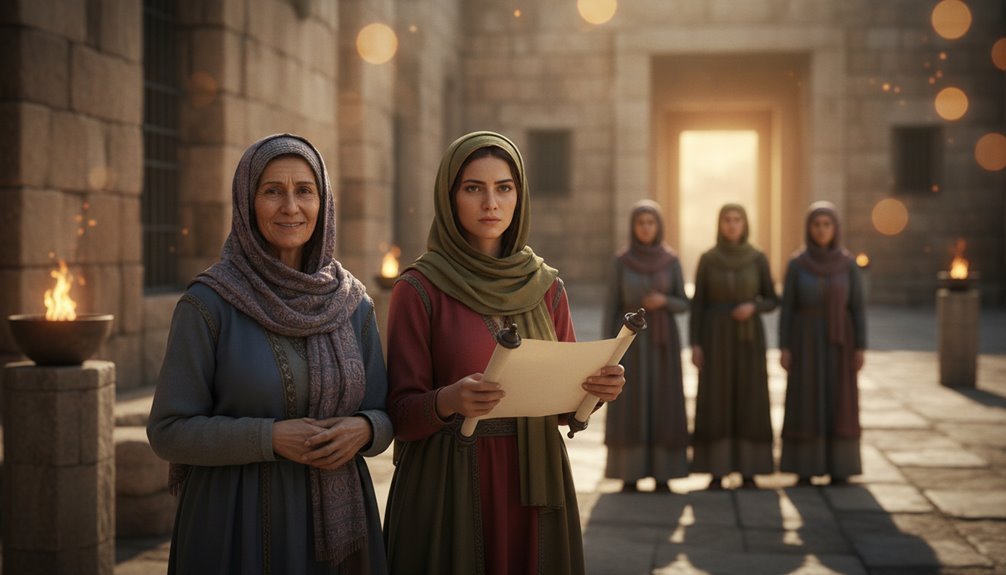
How often do modern believers overlook the profound truth that God consistently chose women as His prophetic voices throughout biblical history? You’ll discover that prophetesses like Anna and Huldah weren’t exceptions—they were divinely appointed spokespersons who challenged conventional gender roles of their time.
Anna, the 84-year-old widow from Asher’s tribe, devoted her life to temple worship through continuous prayer and fasting. When infant Jesus arrived, she immediately recognized Him as Messiah and proclaimed His identity to Jerusalem’s faithful. Her prophetic authority wasn’t questioned—it was celebrated.
Similarly, Huldah held such respected prophetic status that King Josiah’s officials consulted her about the discovered Law scroll. She confirmed its authenticity and pronounced divine judgment, directly influencing national reform. Both women demonstrate God’s pattern of elevating female voices to deliver crucial revelations, proving that spiritual authority transcends cultural limitations when God calls His servants.
How God Used Women to Accomplish What Men Couldn’t
Why did the Almighty repeatedly choose women to fulfill missions that seemingly insurmountable circumstances had rendered impossible for men? Scripture reveals a deliberate pattern where God strategically positioned women to accomplish what male leadership couldn’t achieve.
Deborah commanded when men hesitated, orchestrating military victory through prophetic authority. Esther’s queenly access enabled her to reverse genocide where male advocates lacked influence. Jochebed’s maternal defiance preserved Moses when male resistance would’ve triggered immediate execution. Rahab’s enemy position provided reconnaissance advantages unavailable to Israelite men. Ruth’s outsider status allowed lineage preservation that male heirs had failed to secure.
These women didn’t accidentally stumble into success—they possessed unique positional advantages their circumstances afforded. Each took calculated ethical risk that modern leadership theory recognizes as strategic positioning. God didn’t bypass men arbitrarily; He utilized women whose specific situations, relationships, and social access created opportunities that male contemporaries simply didn’t possess for accomplishing His redemptive purposes.
5 Leadership Lessons From Biblical Women That Apply Today
What distinguishes biblical women’s leadership approaches from conventional models reveals timeless principles that transcend cultural contexts.
You’ll discover that Deborah’s forty-year tenure demonstrates sustained leadership through consistent judicial wisdom before military action.
Her approach emphasizes preparation and relationship-building as foundational to effective governance.
Esther’s strategic courage shows you how to leverage positional influence for protective leadership.
She didn’t allow her minority status to create discouraged leadership but instead transformed vulnerability into strategic advantage through careful timing and bold advocacy.
Miriam’s worship leadership reveals how you can unite communities through celebratory expression, while Huldah’s prophetic authority demonstrates intellectual credibility in high-stakes consultation.
Both refused to let silent voices characterize their ministries.
Phoebe’s apostolic representation teaches you that effective leadership often involves cross-cultural bridge-building and ecclesiastical authority.
These women consistently transformed challenging circumstances into opportunities for decisive action, modeling leadership that prioritizes community welfare over personal safety.
Frequently Asked Questions
Why Don’t Most Churches Today Allow Women in Leadership Roles Like Biblical Times?
You’ll find theology debates over biblical interpretation create restrictive policies, despite Scripture showcasing women leaders like Deborah and Priscilla.
Cultural shifts toward complementarian doctrine emerged centuries after Christ, emphasizing male headship over egalitarian readings.
Churches often selectively interpret Paul’s writings while ignoring his commendations of female ministers.
Historical exegesis reveals early Christianity celebrated women’s leadership roles that many denominations now prohibit through doctrinal constraints.
Did Jesus Have Female Disciples Beyond the Women Who Supported His Ministry Financially?
Yes, you’ll find extensive evidence that Jesus had female disciples beyond financial supporters. Luke 8:1-3 shows women traveling with the Twelve, proclaiming God’s kingdom. They’re eyewitnesses from Galilee to crucifixion, first resurrection witnesses, and Luke identifies them as Gospel sources. Despite modern disallowed topics around gender politics, biblical texts clearly present women as full disciples, not merely benefactors.
Were There Cultural Reasons Why God Chose Women for These Specific Leadership Moments?
Yes, God strategically chose women during these leadership moments because cultural dynamics created power vacuums where traditional male authority structures had collapsed or proven inadequate. You’ll notice women stepped forward when patriarchal systems failed—during Egypt’s oppression, the judges’ chaos, and monarchy transitions. Their outsider status actually became advantageous, allowing them to operate with different approaches and perspectives that male leaders couldn’t or wouldn’t employ in these critical situations.
How Do Complementarian Christians Interpret These Examples of Female Biblical Leaders?
You’ll find complementarian interpretations frame biblical women’s leadership examples as operating under male authority or divine exception rather than normative patterns. They argue Deborah judged due to absent male leadership, Esther acted through Mordecai’s guidance, and Priscilla taught alongside Aquila. These female leaders supposedly demonstrate delegated authority or temporary roles that don’t establish ongoing precedent for women’s ecclesiastical leadership over men.
What Happened to Women’s Church Leadership Roles Between Biblical Times and Today?
Women’s leadership roles declined dramatically after Constantine legalized Christianity. You’ll find biblical narrative gaps between early church practices and later restrictions. The Council of Laodicea (360 AD) formalized gender roles by banning women’s ordination. Leadership dynamics shifted as institutional hierarchy replaced house churches where women led. Cultural context moved from Jewish-Hellenistic flexibility to Roman patriarchal structures, fundamentally transforming women’s ecclesiastical authority and ministerial functions.
Conclusion
You’ve witnessed how Scripture consistently portrays women as God’s chosen instruments for pivotal moments in salvation history. These narratives aren’t anomalies—they’re theological statements about divine empowerment transcending cultural gender norms. When you examine the Hebrew and Greek texts, you’ll find that God deliberately selected women for leadership roles requiring courage, wisdom, and prophetic authority. Their stories demonstrate that biblical femininity isn’t passive submission but active participation in God’s redemptive plan.











No Comments