

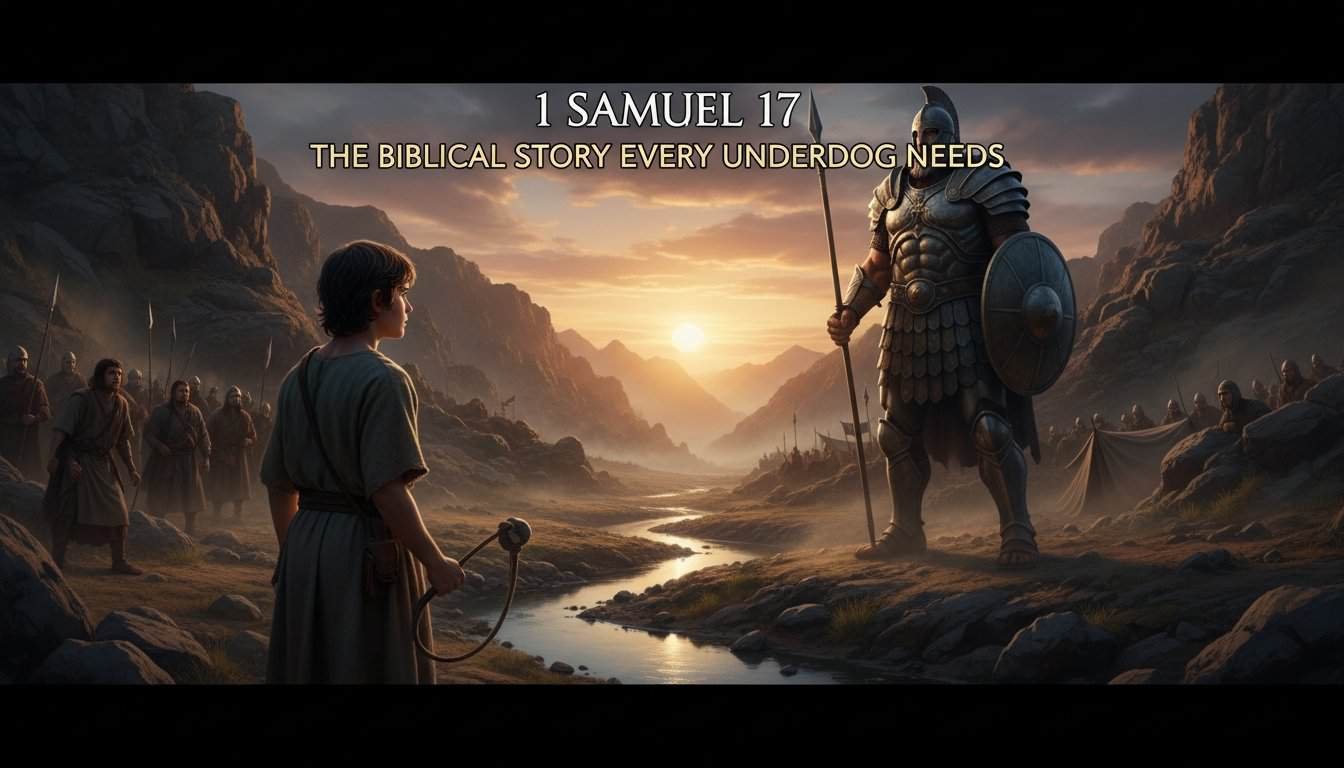
03 Feb Why 1 Samuel 17 Is the Biblical Story Every Underdog Needs
You’ll find 1 Samuel 17 essential because David’s victory demonstrates how covenant faith transforms impossible circumstances into inevitable outcomes. When you face overwhelming opposition, David’s rejection of Saul’s armor and choice of his sling (qela’) reveals that God’s power operates through unconventional means rather than worldly strength. David’s pastoral experience with predators prepared him for Goliath’s 125-pound bronze armor, proving that faithfulness in small battles equips you for greater spiritual warfare ahead.
Key Takeaways
- David’s victory demonstrates that unconventional tactics and unique skills can overcome seemingly insurmountable advantages.
- Faith in divine purpose transforms impossible circumstances into opportunities for breakthrough and victory.
- Past faithfulness in small challenges builds the courage and competence needed for life’s greatest battles.
- Strategic reframing shifts focus from opponent’s strengths to your own distinctive advantages and preparation.
- Spiritual confidence anchors underdogs when physical resources appear insufficient for the challenge ahead.
What Made David vs Goliath History’s Greatest Upset?
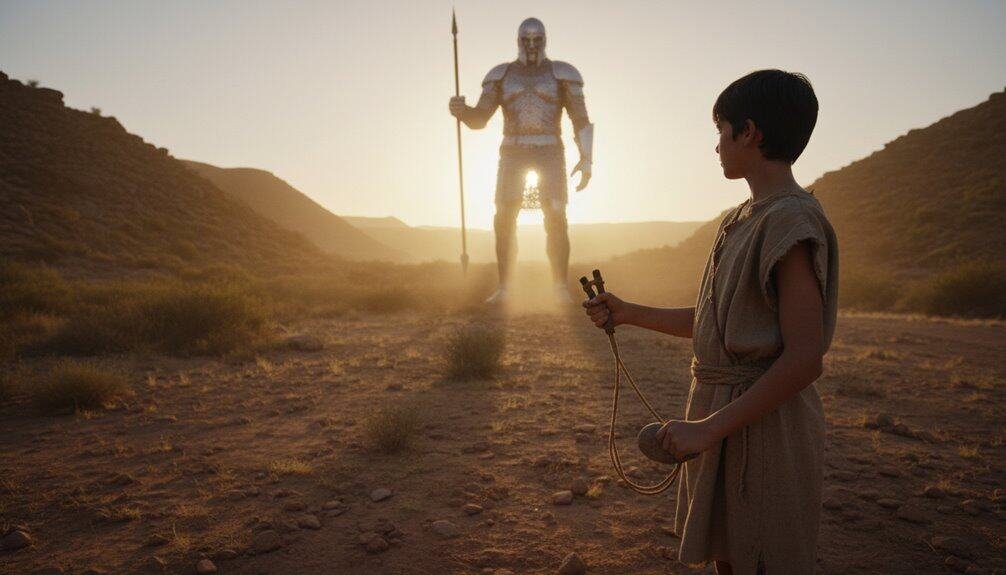
How does a shepherd boy armed with stones defeat a seasoned warrior whose bronze armor alone weighs over 125 pounds? You’ll find the answer lies in strategic misperceptions that transformed an irrelevant underdog into history’s most unlikely victor.
Goliath’s psychological framework operated on conventional warfare assumptions. His *gibbowr* (mighty warrior) status blinded him to asymmetrical combat possibilities. When he saw David’s youth and shepherd’s tools, he dismissed the threat entirely—a fatal miscalculation.
David’s *qela’* (sling) represented precision weaponry requiring skill over strength. His pastoral background provided combat experience protecting livestock from predators. While Goliath expected close-quarters combat where his bronze armor and iron spear would dominate, David employed projectile warfare that rendered heavy armor counterproductive.
The Hebrew narrative emphasizes David’s spiritual conviction transcending physical limitations. His faith-grounded confidence contrasted sharply with Israel’s paralyzed army. David’s unwavering belief that God’s power would enable his victory transformed what appeared impossible into inevitable triumph. Goliath’s mockery revealed contempt for unconventional tactics, creating vulnerability David exploited with devastating accuracy.
How the Confrontation Unfolded in the Valley of Elah
Where could two opposing armies position themselves for maximum tactical advantage while maintaining defensive security? You’ll find the answer in the Valley of Elah‘s strategic geography. The Philistines positioned themselves between Socoh and Azekah at Ephes-dammim, controlling the western approach from Gath. Saul’s Israelites occupied the opposite hillside, protecting the eastern route to Bethlehem and Jerusalem.
This valley tactics created a military standoff where neither force could advance without devastating losses climbing exposed slopes. The dry creek bed (Wadi es-Sunt) formed a natural no-man’s land filled with white pebbles—the very stones David would select.
The terrain psychology worked powerfully: Goliath’s taunts echoed across this half-mile-wide vale for forty days, psychologically wearing down Israel’s resolve. The Shephelah’s buffer zone geography perfectly illustrated the broader conflict between coastal Philistines and mountain-dwelling Israelites, making this confrontation inevitable in God’s redemptive plan. The Elah Valley’s function as a corridor between the Coastal Plain and Hill Country made it the natural battleground where these two civilizations would ultimately clash.
Why David’s Faith Overpowered Goliath’s Weapons
When Goliath strode into the Valley of Elah, his trust rested entirely on what the eye could see—bronze armor weighing 125 pounds, a spear shaft like a weaver’s beam, and the intimidating presence of his shield-bearer. His confidence embodied the worldly mindset that Psalm 20:7 warns against: trusting in chariots and horses rather than the name of Yahweh.
David’s faith overcomes doubt precisely because it wasn’t anchored to material weaponry. While Saul offered his own armor—mirroring Goliath’s bronze helmet and coat of mail—David rejected it, demonstrating that his trust lay elsewhere. He’d witnessed God’s faithfulness during shepherding experiences, creating unshakeable conviction that this battle belonged to the LORD.
David’s courage under pressure stemmed from reframing the confrontation spiritually rather than militarily. He recognized Goliath’s challenge as defiance against the living God, not merely a contest of strength. When the stone struck true, followed by Goliath’s own sword delivering death, faith-guided action had repurposed the enemy’s tools for divine victory.
What David’s Victory Teaches About Facing Impossible Odds
What distinguishes David’s triumph from mere underdog folklore lies in his deliberate reframing of impossible circumstances through covenant theology rather than human assessment. When you face overwhelming odds, David’s methodology reveals that your perspective determines your outcome. The Israelites operated from an unrelated premise—measuring their strength against Goliath’s physical advantages. This detached comparison inevitably produced despair because flesh can’t overcome superior flesh.
David’s revolutionary approach centered on covenant relationship with Yahweh. He understood that Goliath’s defiance targeted the living God (Elohim chayyim), not Israel’s military capabilities. Your impossible circumstances require similar reframing: measuring challenges against God’s power rather than your limitations. David’s past experiences defending sheep established divine faithfulness patterns, creating confidence for present crises. When you ground faith in God’s proven character rather than abstract hope, impossible becomes inevitable. Victory preceded physical combat because spiritual warfare determines material outcomes.
Frequently Asked Questions
What Happened to Goliath’s Head After David Cut It Off?
After David severed Goliath’s head, you’ll find in 1 Samuel 17:54 that he transported it specifically to Jerusalem as public proof of victory.
The Hebrew text emphasizes this deliberate act – while Goliath’s weapons went to David’s tent, the head served as undeniable evidence of the giant’s defeat.
This display triggered immediate Philistine fear and flight, establishing David’s reputation throughout Israel’s territories.
Why Did David Choose Exactly Five Stones From the Brook?
You’ll find David’s five stone choice reflects practical wisdom and Hebrew symbolism. The brook selection provided smooth stones optimal for slinging accuracy. He knew Goliath had four brothers, requiring preparation for potential additional combatants. The number five represents God’s grace in Hebrew numerology, while “eben” (stone) combines “av” (father) and “ben” (son), symbolizing divine strength through covenant relationship.
How Did the Philistines React When They Saw Their Champion Fall?
You witness immediate panic when the Philistines see Goliath fall.
The Hebrew text uses *wayyānūsū* (they fled), indicating sudden, chaotic retreat without resistance.
Their champion’s death triggers complete demoralization—no counterattack, just desperate flight toward Gath and Ekron.
This demonstrates how biblical warfare psychology worked: when you eliminate the representative warrior, entire armies collapse.
David’s underdog resilience shattered their military confidence instantaneously.
What Rewards Did King Saul Actually Give David After the Victory?
You’ll notice Saul didn’t immediately fulfill the promised Davidic rewards from 1 Samuel 17:25-27. Instead, he appointed David as a military officer over a thousand men. The marriage to Michal came later in chapter 18, but with treacherous conditions requiring Philistine foreskins. Saul’s jealousy emerged as David’s success grew, transforming initial favor into permanent enmity. The Hebrew narrative shows delayed, manipulated reward fulfillment rather than honest compensation.
Did David Keep Goliath’s Armor and Weapons as Trophies?
Yes, David kept Goliath’s weapons as victory trophies. According to 1 Samuel 17:54, you’ll see David placed the giant’s armor in his tent, while carrying Goliath’s head to Jerusalem.
David’s armor collection proved significant later—he retrieved Goliath’s sword from Nob’s sanctuary in 1 Samuel 21:9, telling Ahimelech “there’s none like it.”
These trophies served as tangible reminders of God’s faithfulness.
Conclusion
You’ll find that David’s triumph transcends mere military victory—it demonstrates covenant faithfulness in action. When you examine the Hebrew נער (na’ar), you’re seeing David as more than a shepherd boy; he’s YHWH’s chosen instrument. The Philistine’s חרפה (cherpah) against Israel becomes your reminder that God’s צבאות (tzeva’ot) defeats human arrogance. You’re witnessing theodicy vindicated through divine intervention, where covenant relationship trumps physical strength every time.











No Comments