

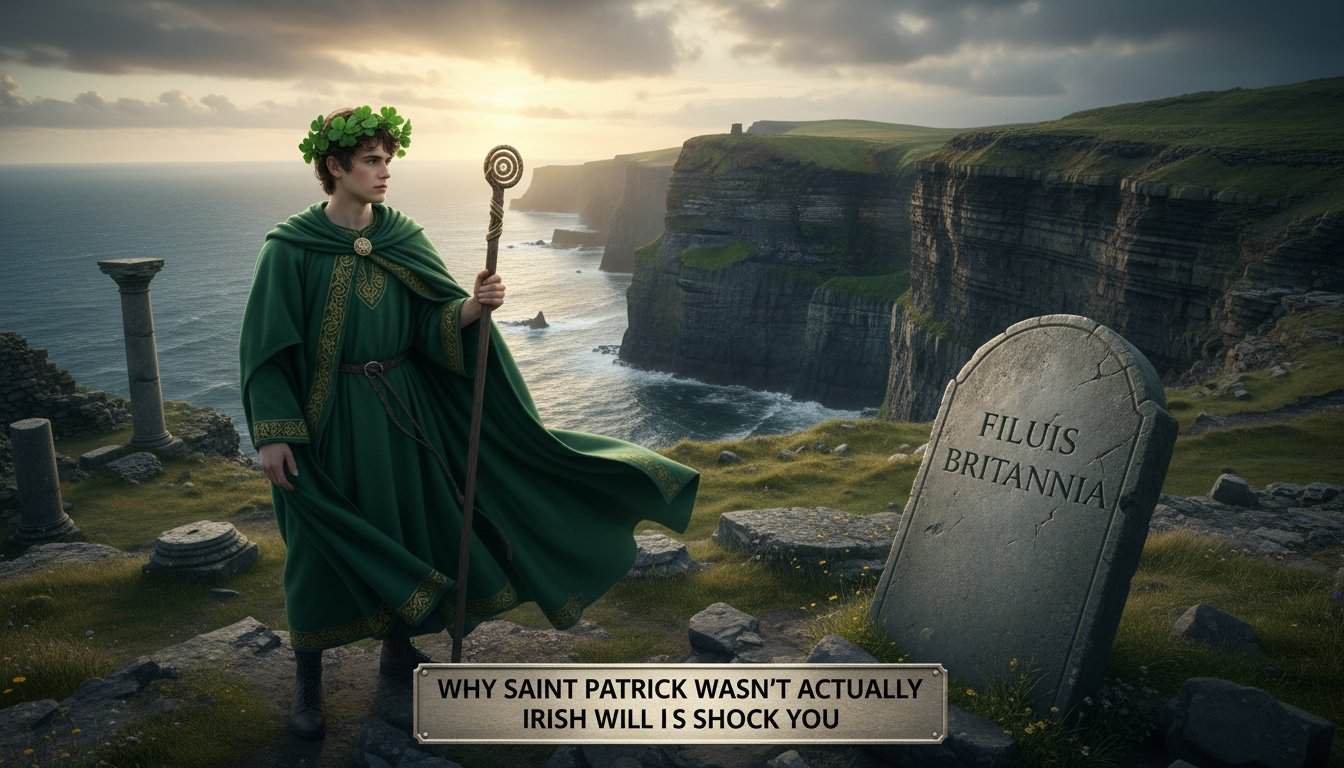
24 Jan Why Saint Patrick Wasn’t Actually Irish Will Shock You
Saint Patrick wasn’t Irish—he was Romano-British, born into a wealthy Christian family in late 4th-century Wales. You’ve been celebrating a foreign missionary who was kidnapped by Irish raiders at sixteen and enslaved for six years as a shepherd. After escaping, he chose to return as a missionary to the very people who enslaved him. The snake-driving legend is metaphorical, and many traditions you associate with him were added centuries later. Continue exploring to uncover how this British bishop became Ireland’s patron saint.
Key Takeaways
- Saint Patrick was actually Romano-British, born into a wealthy Christian family in late 4th-century Wales, not Ireland.
- Irish raiders enslaved sixteen-year-old Patrick around 401, forcing him to work as a shepherd for six years.
- Patrick’s missionary calling came through divine visions during captivity, instructing him to evangelize his former captors.
- He deliberately chose to return to Ireland as a foreign missionary bishop to convert the people who enslaved him.
- Modern commercialized celebrations wrongly portray Patrick as Celtic Irish rather than his documented Romano-British missionary identity.
How Did Irish Raiders Kidnap A Romano-British Teenager Named Patrick?
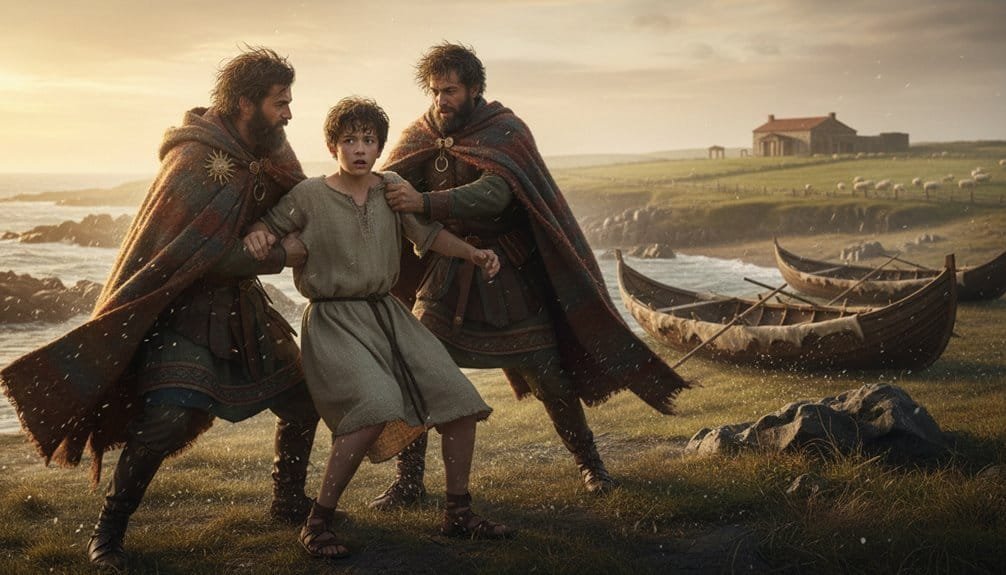
How did a teenager from Roman Britain end up becoming Ireland’s patron saint? You’ll discover that Patrick’s journey began with a violent kidnapping that changed his life forever.
Irish raiders targeted Patrick’s wealthy Romano-British family villa when he was just sixteen years old. These weren’t random attacks—they represented organized expeditions across the Irish Sea during the fifth century. The raiders operated along what historians now recognize as Medieval Tradeways Rivals, competing maritime routes between Britain and Ireland.
Patrick’s father Calpurnius served as both a deacon and local official, making their family’s villa an attractive target. The raiders transported Patrick across the Irish Sea into six years of brutal enslavement as a herdsman in western Ireland. During his captivity, Patrick worked as a shepherd and strengthened his relationship with God through constant prayer.
This kidnapping wasn’t unusual—it exemplified systematic slave trading that characterized Irish-British relations during this period. Commentary on Graffiti Traditions from this era reveals similar stories of cross-cultural forced migration, showing Patrick’s experience reflected broader historical patterns of raiding and enslavement.
Why Did Patrick Return To Ireland After Six Years Of Slavery?
Why would someone voluntarily return to the land where they suffered six years of brutal enslavement? Patrick’s decision makes sense within its historical context and the productive theology he developed during captivity.
Patrick’s return to Ireland defied human logic but reflected the transformative power of faith over suffering.
You’ll find that slavery fundamentally transformed Patrick’s faith. Daily prayers while herding sheep converted him from nominal to fervent Christianity, strengthening his devotion to the Holy Trinity. This spiritual awakening prepared his heart for evangelistic purpose despite his initially uneducated state.
Divine visions prompted his return. God spoke to Patrick in dreams, instructing him to become Ireland’s missionary. After escaping when a voice announced a ship waited 200 miles away, Patrick returned home and entered theological training. He spent years, possibly decades, studying before ordination.
Patrick’s productive theology emphasized love over vengeance. He returned without malice, eager to convert his former captors, expressing genuine love for Irish neighbors and fully identifying with them despite the dangers.
What’s The Real Story Behind Patrick “Driving Snakes” From Ireland?
You’ve probably heard that Saint Patrick drove all the snakes out of Ireland, but here’s what’ll surprise you: Ireland never had snakes to begin with. The island has been snake-free since before the last ice age, and Ireland’s National Museum confirms no fossil evidence of snakes ever existing there. This famous legend isn’t about literal reptiles—it’s actually a metaphor for Patrick’s role in converting Ireland’s pagan population to Christianity.
No Snakes Ever Existed
What if one of Ireland’s most famous legends never could have happened in the first place? You’ll discover that snakes never inhabited Ireland, making Patrick’s legendary feat impossible. The National Museum of Ireland confirms zero snake evidence in fossil records throughout history. When glaciers melted after the Ice Age, rising waters submerged land bridges connecting Ireland to snake-populated regions. Ireland became isolated 8,500 years ago—before snakes could migrate there.
Naturalist Nigel Monaghan verifies no banishable snakes ever existed. This myth vs history reveals fascinating contradictions in Irish folklore. The symbolism vs reality shows Patrick’s legend represents spiritual triumph over evil, not literal snake removal. Even ancient Roman writer Gaius Julius Solinus noted Ireland’s snake absence centuries before Patrick’s arrival, proving the island’s naturally serpent-free status predated Christianity.
Metaphor For Pagan Conversion
The absence of actual snakes reveals the true meaning behind Patrick’s legendary feat—it represents the systematic conversion of Ireland’s pagan population to Christianity.
You’re witnessing myth vs. memory in action, where later church leaders transformed Patrick’s modest missionary work into legendary proportions.
The “snakes” symbolized druids and pagan practitioners whom Patrick supposedly expelled through Christian conversion.
However, you’ll find the reality differs significantly. Patrick employed syncretism rather than expulsion, incorporating pagan elements like bonfires and sun symbols into Christian practices. This approach maintained cultural continuity while gradually shifting religious allegiance.
The dramatic snake-driving narrative emerged centuries after Patrick’s death, when seventh and twelfth-century church writers needed powerful imagery to establish Patrick’s dominance over Irish ecclesiastical authority and justify Christianity’s eventual triumph over paganism.
How Did Patrick Blend Christian And Irish Pagan Traditions?
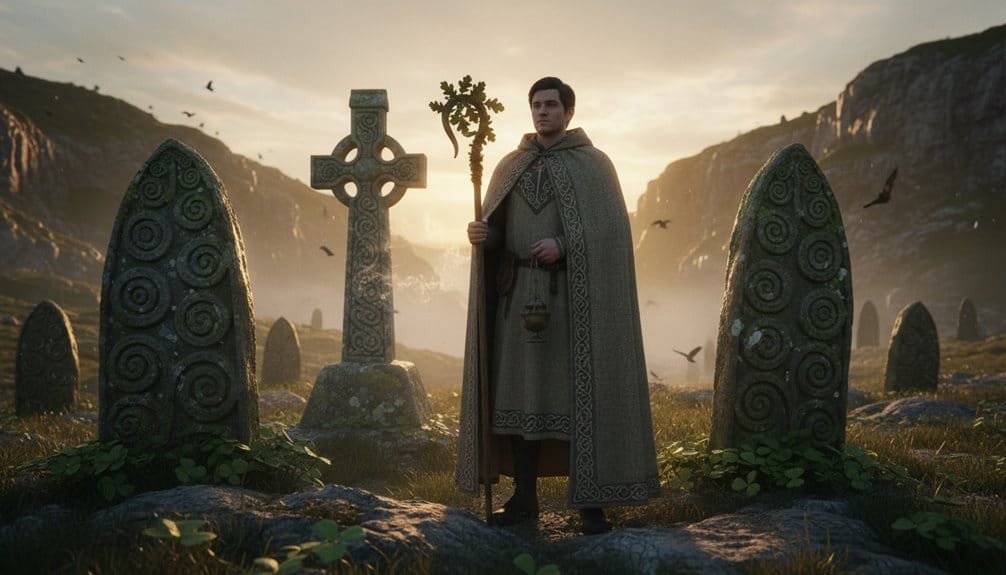
How exactly did a Romano-British missionary successfully convert an entire island steeped in ancient Celtic traditions? Patrick employed a sophisticated strategy of religious syncretism that blended Christian teachings with existing pagan practices rather than eliminating them outright.
You’ll find this integration throughout Irish legends and Green myths that persist today. Patrick adopted the sacred bonfire tradition, repurposing these ceremonial fires to represent Christ as “the light of the world.” He strategically overlapped the pagan Beltane feast with Easter celebrations, ensuring smooth transitions between observances.
The three-leafed shamrock became his most famous teaching tool, providing a visual parallel for the Trinity doctrine using Ireland’s abundant native plant. Patrick also converted druidic worship sites, particularly holy wells, by rededication rather than destruction. This approach allowed communities to maintain connections to ancestral locations while shifting their theological framework, creating lasting religious practices that blended Celtic and Christian elements.
Why Patrick Became Ireland’s Patron Saint Despite Being British
Despite his Romano-British origins, Patrick’s path to becoming Ireland’s beloved patron saint stemmed from a paradoxical combination of personal trauma and cultural authenticity that no native Irish missionary could replicate.
You’ll find Patrick’s foreign status actually enhanced his effectiveness. His six years of brutal enslavement forced complete cultural immersion—he mastered Irish dialects and understood pagan practices with unmatched depth. When he returned as an ordained bishop, Patrick possessed unique dual authority: official Continental Christian backing and genuine Irish cultural fluency.
His British linguistics background enabled sophisticated communication strategies that resonated across Ireland’s diverse tribal regions. Archaeological symbolism from Patrick’s missionary sites reveals deliberate fusion of Christian iconography with existing Celtic sacred spaces, demonstrating strategic cultural sensitivity.
Patrick’s outsider perspective allowed him to navigate Ireland’s complex political landscape without tribal loyalties complicating his mission. His foreign origins paradoxically proved his spiritual calling’s authenticity—choosing Ireland over comfortable Romano-British life demonstrated divine purpose rather than personal ambition.
How Modern St. Patrick’s Day Myths Distort Historical Reality
You’ve likely celebrated St. Patrick’s Day without realizing that modern festivities completely disconnect the Romano-British missionary from his actual historical identity. Today’s commercialized celebrations transform Patrick into a stereotypical Celtic figure, despite documented evidence of his Roman Britain origins and Christian educational background under continental European instruction. These popularized myths replace the complex reality of a foreign missionary’s work with simplified Irish cultural symbols that Patrick himself never mentioned in his authenticated writings.
Romano-British Missionary Origins
When millions celebrate Saint Patrick’s Day each March, they’re honoring a man who wasn’t Irish at all—he was a Romano-British missionary born into a wealthy Christian family in late 4th-century Wales. These Romano British origins reveal Patrick as Patricius, son of deacon Calpurnius, who lived in the villa-dotted landscape of Roman Britain.
You’ll find that missionary chronology places his enslavement by Irish raiders around 401, followed by his transformative six years as a shepherd in western Ireland. After escaping and returning home, he deliberately chose to become a missionary bishop to the very people who’d enslaved him. This profound act of forgiveness and faith established Patrick as Ireland’s apostle—despite his Welsh birth and Roman upbringing.
Commercialized Celtic Stereotypes
Patrick’s Romano-British missionary legacy became overshadowed by centuries of mythological embellishments that transformed historical facts into commercialized folklore. You’ll discover that modern St. Patrick’s Day celebrations perpetuate myths contradicting documentary evidence. The snake-driving narrative originated from 12th-century writers, not Patrick’s own accounts. Shamrock symbolism wasn’t documented until the 18th century, despite popular belief. This myth vs history disconnect reveals how commercial interests distorted authentic Celtic Christianity.
Medieval church records show St. Patrick’s Day was historically a holy day of obligation with closed pubs, contrasting sharply with today’s commercial vs religious observance. Organized parades didn’t begin until the early 1900s, while significant commercialization in Ireland only emerged within three decades. These fabricated elements demonstrate how fictional narratives became embedded in popular understanding over centuries.
Frequently Asked Questions
What Was Patrick’s Real Name Before He Became Saint Patrick?
Patrick’s real name was Maewyn Succat, reflecting his Romano-British heritage and family’s Latin literacy. You’ll find this birth name documented across multiple biographical sources, with some accounts listing the alternative Magonus Saccatus Patricius.
Patrick’s name origins trace to Pope Celestine, who assigned him “Patrick” from the Latin “Patercius,” meaning “father of his people,” when commissioning his Irish mission as bishop.
How Did Patrick Communicate With Irish People if He Spoke Latin?
Patrick overcame communication barriers by learning Irish during his six years as a slave-shepherd. You’d find he became conversationally fluent through daily immersion, using Irish for evangelizing locals while reserving Latin for Church officials. His political influence grew because he could speak directly to Irish communities in their native Goidelic tongue, making his ministry effective despite his self-admitted poor formal education.
Did Patrick Have Any Family or Children During His Missionary Work?
You’ll find no evidence of Patrick having a wife or children during his missionary work. His family dynamics centered entirely on his birth family in Britain, who desperately wanted him to stay home after his captivity.
Patrick’s childless status appears intentional – he devoted himself completely to converting Irish pagans, baptizing thousands, and establishing churches. His writings emphasize solo dedication to his religious mission without forming a new family.
What Happened to Patrick’s Body After He Died in Ireland?
You’ll find Patrick’s body after death was buried in Downpatrick, County Down, according to seventh-century documentation by Muirchú. However, burial myths developed centuries later when Anglo-Norman John de Courcy claimed he’d gathered relics of Saints Brigid and Columba to join Patrick’s remains. You can visit the granite-marked grave site at Down Cathedral, where pilgrims have traveled for over 1,600 years despite these medieval disputes.
Were There Other Christian Missionaries in Ireland Before Patrick Arrived?
Yes, you’ll find several Christian missionaries preceded Patrick’s arrival around 432 AD. Palladius was consecrated as bishop in 431 to serve existing Irish Christians. Saints Ailbe and Declan reportedly converted regions of Munster before Patrick arrived. Egyptian monks may have settled in Ireland during the 4th century, establishing monastic communities that influenced Irish Christianity’s development, separate from pre Christian rituals and secular legends surrounding Patrick’s mission.
Conclusion
You’ve discovered that Saint Patrick wasn’t the mythical figure modern celebrations portray. He was a Romano-British teenager who endured slavery, returned as a missionary, and skillfully merged Christian doctrine with existing Irish traditions. There weren’t any snakes to drive out, and his canonization stemmed from his evangelical success rather than Irish heritage. Today’s St. Patrick’s Day festivities bear little resemblance to the historical reality of this complex religious figure’s actual life and mission.










No Comments